Court Session Held For 11 Political Defendants In Tehran

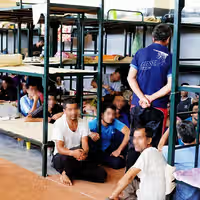
A court session against 11 political prisoners took place on Tuesday at the Revolutionary Court of Tehran in the latest mass trial of anti-regime voices.

A court session against 11 political prisoners took place on Tuesday at the Revolutionary Court of Tehran in the latest mass trial of anti-regime voices.
No evidence was provided regarding the charges brought against the group, all of whom were detained by security forces between August 1 and November 20.
Among the accused, Kazem Ali-Nezhad, Arsham Rezaei, Meysam Gholami, Vahid Ghadirzadeh, and Payam Bastani-Parizi have previously faced arrests and convictions due to their civil and political activities.
The accused individuals, namely Fatemeh Haqparast, Mohammad-Reza Kamrani-Nezhad, Vahid Sorkh Gol, Kazem Ali-Nezhad Baranlou, Arsham Rezaei, Meysam Gholami, Vahid Ghadirzadeh, Ali-Asghar Hassani-Rad, Saman Rezaei, Payam Bastani Parizi, and Hojatollah Rafei, faced allegations including "conspiracy and collusion to commit crimes against internal/external security, propaganda against the system.
Charges also included insulting Ali Khamenei, the Supreme Leader of the Islamic Republic, insulting the memory of Ruhollah Khomeini, the founder of the Islamic Republic, and encouraging people to commit crimes against internal/external security," according to reports from the US-based Human Rights Activists News Agency (HRANA).
The Islamic Republic has a history of detaining, torturing, and imprisoning government critics active in civil and political spheres since its establishment. The recent wave of suppressing civil, political activists, and protesters by the government has intensified since the nationwide protests of Iranians against the Islamic Republic began in September 2022, persisting to the present day.

Internet companies in Iran have petitioned the government to increase their broadband and mobile tariffs by 100%, according to Faraz Daily, a pro-reform website.
This request comes at a time when users are experiencing low-quality connections and are forced to pay for expensive Virtual Private Networks (VPNs) and anti-filtering software to avoid the censorship imposed by the government.
For more than two decades, the clerical government has blocked thousands of websites and in recent year, most social media platforms. It also offers very slow Internet connection and often cuts service during protests.
Iran's Information and Communications Technology Minister, Issa Zarepour, stated on Monday that the increase in internet service rates has not yet been decided. He also reiterated his usual response to the issue by insisting that the increase would only happen "if the providers improve the internet quality". But users have long suspected that slow traffic is related to government actions and draconian controls.
Also, the adamant stance he takes on "better quality" might not be entirely genuine. Shargh Daily reported last month that Zarepour publicly opposes increasing Internet rates but behind the scenes is following up on it, neglecting the quality altogether.

While President Ebrahim Raeisi promised free internet for the lowest income groups during his inauguration in 2021, the number of limitations on internet access and the price have gradually increased.
With these constraints in place, Iranian citizens are deprived of access to free information. Raisi's hardliner government has increased censorship. Numerous foreign and domestic websites, including reputable news outlets and social media platforms, have been added to the government blocking scheme.
The spiral of censorship measures has intensified since the beginning of the "Women, Life, Freedom" movement last year.
According to Freedom House, Iran was the Middle East's worst country for internet freedom in 2023 due mainly to severe and overzealous responses by authorities to nationwide protests.
However, the internet shutdowns and the filtering of popular messaging apps used by citizens continued even after protests subsided.
Legislators, such as Javad Nikbin, have alluded to a connection between those lobbying for internet censorship and those marketing tools that circumvent censorship, such as VPNs.
Lawmaker Jalal Rashidi Kouchi estimated that the financial turnover of VPN providers in Iran amounts to approximately 800 million to 1 billion dollars annually.
According to Kouchi, if the minimum monthly price of a VPN in Iran is $2, the country's citizens would be compelled to spend approximately $480 million annually to circumvent the regime's bans on such services as Instagram and WhatsApp.
But that is not the end of the story. Having a VPN active on your system will result in more data usage since some of that data is consumed by the VPN.
That amount according to the Farazdaily website means half of the traffic you buy from providers is consumed solely by using a VPN. And since the current administration has imposed more limitations, users are already paying more. Not just for more VPN but also more traffic.
With the providers asking for an increase in rates, consumers will be forced to pay yet another fee for "the most expensive low-quality service in Iran".

Gold jewelers in different Iranian cities have gone on strike in protest to a possible sales tax increase as the government has ordered registration of all gold transactions.
Over the weekend, the strike spread and transactions in Tehran and several other cities gold market were halted.
Last week, the Iranian National Tax Administration issued a notice, requiring a group of businesses, including gold dealers, to issue electronic invoices to their customers for each transaction beginning December 22.
Gold buyers and sellers were immediately concerned by the announcement, assuming the plan would result in a 25% tax on profits due to government efforts to fill its empty coffers.
Although the Tax Administration announced on Sunday that it has not imposed new taxes and rumors over a "25% tax were not true," the market was far from calm and strikes continued.
Nader Bazrafshan, secretary of the Tehran Jewelry Union, called the Tax Administration's notice "vague" and said that gold dealers are worried that recording the information of every transaction in the system will make them liable to more tax.
Bazrafhsan said that because of concerns over registering transactions, people abstain from buying gold, which has negatively affected the industry even more than it did under Covid.
Iran's President Ebrahim Raisi presented his proposed budget to the parliament in early December, which revealed that tax revenues were expected to be twice the government's oil revenues.
According to the Jahan-e-Sanat Daily, the Iranian government is also counting on an "inflation tax" to fund the budget for the next fiscal year which begins on March 21, 2024.

The Supreme Court of Iran has officially confirmed the death sentence for Mojahed Kourkour, a protester detained during the Women, Life, Freedom protests.
Mojahed (Abbas) Kourkour was taken into custody on December 20, 2022, following violent clashes between protesters and security forces near Izeh. Earlier this year, the judiciary issued a death sentence for Kourkour, designating him as the "main suspect" in the case involving the killing of 10-year-old Kian Pirfalak.
Pirfalak's family have explicitly blamed government forces for their son's death. On the evening of November 16 last year, the family's car, carrying Kian, his parents, and three-year-old brother Radin, was targeted by plainclothes individuals in Izeh. Kian’s father sustained severe injuries and was paralyzed during the shooting. Authorities claim the family car was attacked by "terrorists".
Contrary to official statements, Zeynab Molaei-Rad, Kian's mother, asserted that their car was shot by security forces and released a photo of herself with her hands in the hands of Kourkour's mother. Maysam Pirfalak, Kian's father, who was severely injured during the incident, also released a video rejecting the allegations against Kourkour following the judiciary's announcement.
Negar Kourkour, Mojahed's sister, said her brother's case had been transferred from the first branch of the revolutionary court in Ahvaz to a court in Izeh, southwest of Iran.

The employees of Iran's National Steel Industrial Group in Ahvaz continued their strike for a second day after 21 employees were banned from working.
Chanting slogans such as "Neither threats nor prisons are effective anymore", it was prompted by recent work bans as punishment for participation in protests and the failure to implement job classification plans, according to Ilna news agency.
Following the Saturday strike, the management blocked the entry cards of 17 other workers and on Sunday, there was a heavy security presence at the strike site, according to the Free Union of Iranian Workers Telegram channel.
Ilna quoted Ali Mohammadi, the CEO of the group, as saying the workers' ban was to “prevent the gatherings and halts in production lines from happening," indirectly threatening workers' salaries would not be paid if the protests continued.
"We have to pay the salaries of 3,000 personnel on the seventh or eighth day of this month, and the salaries cannot be paid with closed production lines," Mohammadi said.
In August, the Minister of Labor had stated that workers should negotiate salary increases with their employers directly, and denied that this had any relation to his ministry.
After failing to negotiate for the implementation of labor laws, many workers, including Ahvaz Steel, have also had problems with salary increases, leading not only to security clashes but also to threats of salary cuts in response to their protests.

Iran's Police closed down one of the country’s leading bookstores in Tehran on Friday for allowing women without “proper” Hijab to participate in a cultural event.
In a statement posted on its website, Shahr-e Ketab (Book City), a flagship chain bookstore, revealed that the police department in charge of overseeing retail shops, restaurants and similar businesses had sealed its central store in Tehran.
The police cited a “failure to abide by regulations of trade and interior ministry’s [directives]” as the reason for the closure of the popular bookstore in the heart of the capital.
Shahr-e Ketab, Iran’s largest chain of book and music stores, is a non-profit organization that operates dozens of modern bookstore-cafes across the country. In addition to selling books, it holds various cultural events.
“The Book City of Tehran was closed down over a few strands of hair!” Mohammad-Taghi Fazel-Meybodi, a prominent cleric who opposes coercion of women to wear the hijab, said in a tweet Friday. He questioned the religious and legal justification for suspending cultural centers and businesses over such minor issues and criticized the authorities for disgracing the country.

Fazel-Meybodi, like many others, also criticized the government for prioritizing the enforcement of hijab rules over addressing more pressing issues such as corruption and economic improvement. He suggested that the money spent on enforcing the compulsory hijab could have been better utilized to combat embezzlement and rising prices.
In recent months, authorities have increased pressure on businesses and retailers to enforce hijab rules and have warned or shut down thousands of businesses.
The closure of businesses for hijab-related issues, a tool used by authorities for four decades, is aimed at pressuring them to police women's hijab compliance, allowing the police and other authorities to avoid direct confrontation and potential clashes with citizens over hijab observance.
Many among Iranian women are increasingly refusing to wear the hijab even at the risk of being deprived from services in government offices, hospitals, and other public areas or their vehicles being impounded by the police for weeks.
On Friday an airport police official, Mohsen Aghili, said women who do not fully adhere to the “sharia-dictated hijab”, would no longer be served at airports.
After weeks of denial by various officials including the mayor of Tehran and the interior minister, the Secretary of the Supreme Cultural Revolution Council, Abdolhossein Khosropanah, on Friday confirmed that hijab enforcers are indeed organized by the council’s “Hijab and Chastity Taskforce” in coordination with the interior ministry.
Hijab enforcers, uniformed women in black veils, are sometimes accompanied by male plainclothes cameramen who record hijab breaches. They were initially stationed at metro stations in August but are now seen patrolling other public places, such as parks and busy streets, and admonishing women whose appearance does not conform to the dictated hijab rules.
Khosropanah also demanded gender segregation in universities and claimed that “the world has realized that gender segregation in different areas [of society] ensures better performance and security of both genders.”