Lawyer For Mahsa Amini's Family Receives Harsh Sentence

Saleh Nikbakht, Mahsa Amini's family attorney, has been handed a heavy sentence by an Iranian court for "engaging in propaganda against the Iranian regime."

Saleh Nikbakht, Mahsa Amini's family attorney, has been handed a heavy sentence by an Iranian court for "engaging in propaganda against the Iranian regime."
Ali Rezaei, Nikbakht's lawyer, revealed in an interview with Shargh Network that his client "has been sentenced to the highest punishment for the crime of propaganda against the system, which is one year of imprisonment and additional penalties." However, Nikbakht has expressed no intention to contest the verdict.
The news comes just days after Nikbakht received the prestigious 2023 Sakharov Prize for Freedom of Thought on behalf of Mahsa Amini on Tuesday. Amini died in a hospital from severe head injuries three days after being arrested by Iran's hijab police.
Legal proceedings were initiated against Nikbakht in August, focusing on allegations related to his media interviews. These interviews predominantly delved into discussions regarding the legal facets of Mahsa Amini's case. Nikbakht contested the forensic report that ascribed Amini's death to a "heart attack" and an "underlying disease," pushing for a comprehensive reinvestigation by an impartial committee of medical professionals.
Nikbakht received his first summons exactly six months after the death of Amini. The young woman, originally from Saqqez, had journeyed to Tehran with her family but was apprehended by the morality police on September 13, 2022 for a "violation of mandatory hijab." Within the initial two hours of her detention, she suffered severe head injuries, prompting her transfer to a hospital in Tehran. She died of her injuries on September 16, 2022.
Amini's death had profound implications, triggering widespread protests against the Islamic Republic. The demonstrations marked one of the most significant uprisings against clerical rule in Iran in over four decades.
An Iranian auto industry expert says the country’s state-owned carmakers are incurring daily losses of $3.7 million, totaling over one billion dollars annually.
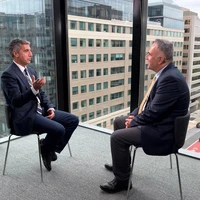
Farhad Ehteshamzad, the head of Iran Auto Importers Association, said in an interview Friday that the huge loss is the direct result of the government’s interventions in the auto industry.
Iran’s car industry is mired with a wide range of problems. The main manufacturers are owned by the state and enjoy huge incentives and support from the government. Despite the losses, Iran’s automotive industry is the third most active industry in the country, after oil and gas sectors, accounting for about 10% of Iran's GDP and 4% of the workforce (700,000 persons).It was valued in 2020 at $26.4 billion by India-based Modor Intelligence, which forecasts 10 percent sectoral annual growth to 2026. This would be possible without sanctions and with a new infusion of investments and foreign partnerships.
However, the carmakers are unable to satisfy domestic demand and they keep raising prices to levels several times higher than international prices of similar cars. This is partly the reason why imported cars are also expensive. For example, one Tehran showroom was selling an unused 2017 Mercedes-Benz E 200 class for about six times the price of the newest model in global markets. The government has long restricted car imports, turning the country into a vast parking lot of dilapidated cars. In recent years, it announced plans to import cars but the number of units hitting the market insignificant. A total of 241 vehicles were imported in the first quarter of the current Iranian year (March 21-June 21).
There are about a dozen state-and quasi-state-owned automakers in Iran, of which two -- Iran Khodro and Saipa -- accounted for 94% of the total domestic production, with nearly 1,500,000 units of light and heavy vehicles produced annually, mostly sub-standard and older foreign models. Criticizing Iranian automakers for low-quality vehicles responsible for a high rate of road accident casualties, Iran’s traffic police said last year that substandard and unsafe cars lead to at least 17,000 deaths and 300,000 injuries every year.

Ehteshamzad added that considering the huge loss of the state-run carmakers, decisions should be made whether to privatize these companies. He said, "For this industry, significant investments have been made, and a substantial amount of money has been spent to reach this point. If this industry collapses, we will lose a considerable amount of capital."
Highlighting the complexities and dangers of privatization, fraught with corruption in Iran, he said decisions about such fundamental steps need to be made at the highest levels of government. Criticizing the unrealistic figures in the administration's budget bill, he said that the government has set a revenue target of 320 trillion rials ($640 million) from high import taxes on cars.
For years critics and politicians have criticized the government-controlled auto industry and have referred to a “mafia” running the money-losing and inefficient sector. In 2019, it was revealed that these carmakers owed $9 billion, a considerable sum in Iran, due to corruption and mismanagement. "Widespread financial corruption has turned automakers in Iran into a powerful Mafia," a lawmaker said at the time. In 2019, the then CEO of Iran Khodro was arrested on charges of corruption and several managers from Saipa are also in jail.
Also on Friday, another car industry expert Hassan Karimi Sanjari criticized the high price of foreign cars assembled in Iran, saying that a Chinese car that costs around $10,000 is sold for about $30,000."In addition to huge profits, mismanagement in assembly companies has also affected prices, leading to increased costs for assembled cars, ultimately borne by the people. On the other hand, for assembled cars, a monopolistic market has been created, resulting from inflation, sanctions, and the insufficient import of cars to meet demand."
According to Ehteshamzad, the government is only providing lip service to Iran’s car industry, making the sector stuck in a quagmire of “speech-therapy” in a sense that officials only deliver speeches about the car industry instead of acting to deliver results.

On December 19, 2023, a Swedish appeal court delivers its verdict, a crucial step towards accountability for a dark chapter in recent Iranian history.
The case involves Hamid Nouri, a key figure implicated in the 1988 massacre of Iranian political prisoners, a massacre that left thousands dead and many more scarred for life. While the appeal court's verdict is still pending, it's worth reflecting on the trial's significance and what it represents for justice, human rights, and the pursuit of accountability.
The 1988 massacre of political prisoners in Iran is a tragedy that should never have happened. It is a stain on the pages of history, a moment when the world should have stood up and cried out against the unspeakable atrocities that took place. But justice was elusive for decades. Families of the victims longed for answers, and survivors carried the physical and emotional scars of that horrendous period.
Fast forward to November 2019, when the Swedish authorities arrested Hamid Nouri, a man alleged to have played a pivotal role in the 1988 massacre. Sweden's decision to act under the principle of universal jurisdiction was a beacon of hope for those who had waited for justice for 35 years. It was a reminder that justice knows no borders, that human rights are universal, and that those responsible for heinous crimes must be held accountable, no matter where they hide.
The subsequent trial in Sweden was not just a legal proceeding; it was a message to the world that the pursuit of justice and accountability remains steadfast even decades later. It demonstrated the power of international law to reach across time and distance to hold individuals accountable for crimes against humanity. The trial was a symbol of solidarity with the victims and survivors of the 1988 massacre, their pain acknowledged, and their voices heard.

As we await the verdict from the Swedish appeal court, we should take a moment to commend Sweden for its commitment to justice, human rights, and the rule of law. By conducting this trial, Sweden has exemplified the principles of international justice and demonstrated that no one is above the law. It has shown that nations can play a crucial role in holding perpetrators accountable for their actions, even when their crimes were committed in a different time and place.
We also thank the Swedish government for its dedication to upholding human rights. By pursuing this case, Sweden has sent a clear message to the international community that justice is not a mere concept but a tangible, achievable goal. It has provided a glimmer of hope to countless victims of human rights abuses worldwide, reminding them that they, too, can seek justice.
The road to justice can be long and arduous, but it is a journey worth embarking upon. As the appeal court's verdict approaches, let us remember that it represents not just a legal outcome but a triumph of humanity over cruelty. Regardless of the final judgment, Sweden's commitment to this trial is a testament to the enduring importance of accountability and justice. It is a beacon of hope for all those who have suffered and reminds us that the pursuit of justice is a cause worth fighting for.
In the end, whether the appeal court confirms the life sentence or not, one thing is certain: December 19, 2023, will be a day to remember, not just for Sweden but for all those who believe in the power of justice and accountability to heal wounds, restore dignity, and build a more just and humane world.
This opinion article was submitted by Laleh & Lawdan Bazargan, sisters of Bijan Bazargan one of the victims of the 1988 Massacre, and Plaintiffs in Hamid Nouri’s Case.
Opinion expressed by the authors are not necessarily the views of Iran International.

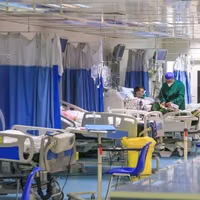
An imprisoned anti-government Iranian activist championing justice for victims of the Islamic Republic, faces ongoing challenges as he is being denied medical leave.
Manouchehr Bakhtiari, a political prisoner and the father of Pouya Bakhtiari, who was shot by a government sniper during the November 2019 protests, is confronting an unfavorable physical condition in Choubindar Prison in Qazvin. Bakhtiari became an outspoken opponent of the regime after his sone's death and was arrested by intelligence agencies.
Despite his pressing health concerns, Bakhtiari is unable to receive the necessary medical care due to opposition from relevant authorities, reported Human Rights Activists News Agency (HRANA).
Currently enduring over 500 days in solitary confinement, he is also not granted permission to meet with his family.
The loss of his 27-year-old son Pouya, who was shot and killed by security forces during the November 2019 protests, has fueled Bakhtiari's steadfast advocacy for accountability against the regime. His efforts include demanding justice not only for Pouya but also for numerous protestors allegedly killed by government agents and IRGC officers during political demonstrations.
In response to Bakhtiari's persistent campaign for justice, authorities have subjected him to harsh retaliatory measures. He was detained at his home in Tehran in 2021 and physically assaulted by members of the security forces. A subsequent sentence from the Revolutionary Court imposed two years and six months of internal exile, a two-year travel ban, and an initial three years and six months prison term. In November, Bakhtiari received an additional six-month prison sentence for "insulting the leader," as confirmed by the Qazvin Revolutionary Court.

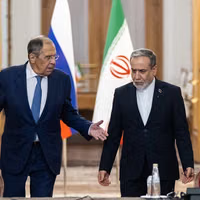
The deputy foreign ministers of Iran, Saudi Arabia, and China convened in Beijing to discuss Tehran-Riyadh relations after normalization and the ongoing Gaza war.
The sides evaluated the progress in reviving diplomatic ties between The Islamic Republic of Iran and Saudi Arabia that was launched in March with Chinese mediation.
According to the Saudi Arabian Press Agency, Ali Bagheri-Kani, the Political Deputy Foreign Minister of Iran, Waleed bin Abdulkarim Al-Khuraiji, the Deputy Minister of Foreign Affairs of Saudi Arabia, and Deng Li, the Vice Minister of Foreign Affairs of China, were present at the meeting.
In a statement the three sides also urged for the cessation of military operations in Gaza and the flow of "sustainable relief" to Palestinians. Iran has campaigned for an end to the Israeli military operation, which has weakened Tehran's ally Hamas.
While Iran has refrained from direct military involvement in supporting its ally Hamas and denies any role in the October 7 Hamas operation, but has faces accusations of supporting proxies like the Houthis, who have targeted US and Israeli interests, as well as international shipping.
Apart from addressing the Gaza situation, the discussions also centered on the process of reopening the embassies of both Iran and Saudi Arabia. The agenda underscored the importance of steps taken to implement the diplomatic thaw initiated in March. This agreement marked a pivotal moment after seven years of strained relations between the two nations.
While the Iranian Embassy in Saudi Arabia officially reopened in mid-June, symbolizing the restoration of diplomatic ties, the formal opening of the Saudi Embassy in Tehran has faced repeated delays, with no official explanation from Saudi authorities as yet.

Iran's state media on Saturday reported the execution of an individual allegedly tied to Israel's Mossad intelligence service.
The official IRNA news agency stated that the individual had been actively engaged in communication with foreign services, specifically Mossad, while clandestinely gathering classified information.
The accused, in collaboration with unidentified associates, was said to have supplied documents to foreign entities, notably Mossad. In line with Iran's customary approach to security and political cases, the identity of the executed individual was not disclosed, posing challenges for independent verification.
According to IRNA, the executed individual had provided classified information to a "Mossad officer" with the alleged intention of disseminating propaganda for groups and organizations opposed to the Islamic Republic. The specific location of the purported information transfer was not detailed, and the timing of the operative's arrest remained unclear.
The execution took place in a Zahedan jail in the southeastern Sistan-Baluchistan province and coincided with a recent attack by Sunni militants on a police station in the same region. The attack resulted in the death of 12 security personnel, with several others sustaining injuries. A state funeral for the victims unfolded in the town of Rask on Saturday, as reported by state television. Additionally, clashes following the attack led to the reported deaths of two militants affiliated with the Jaish al-Adl group.
Sistan-Baluchistan, a poverty-stricken province sharing borders with Afghanistan and Pakistan, has long been a focal point of confrontations between Iranian security forces and Sunni militants. The province's predominantly Sunni Muslim population stands in contrast to the Shiite majority in Iran, underscoring the complex dynamics at play in the region.