Amid Shortages, Iran Claims No Budget Problem To Import Medicine

The Central Bank of Iran announced that it has allocated nearly $3 billion since March to imports medicines, pharmaceutical raw materials, and medical equipment and supplies.

The Central Bank of Iran announced that it has allocated nearly $3 billion since March to imports medicines, pharmaceutical raw materials, and medical equipment and supplies.
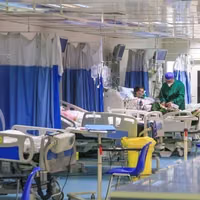
However, reports from Iran in recent weeks have indicated shortages of medicine and a sudden increase in the price of cancer drugs.
Mostafa Qamarivafa, the director of public relations in Iran’s Central Bank, said that $2.2 billion of the allocated amount has already been spent since the beginning of the Iranian year (starting March 21, 2023). In the government-controlled Iranian economy, the state subsidizes the imports of medicine by offering cheaper dollars for imports.
Also, a total of $156,000,000 of preferential currency subsidy has been allocated this year to import powdered milk, raw materials and health supplements, Qamarivafa added. However, there are reports of shortages of baby formula and a rationing at pharmacies.
These remarks run counter to the reports earlier in the day about the exorbitant prices and the severe shortages of cancer drugs in Iran.
Shargh newspaper in Tehran reported that the sudden increase in the price of cancer drugs has shocked patients. The reason of the unexpected hike seems to be the sudden removal of governmental currency subsidies, Shargh quoted some pharmacists as saying.
This is while the deputy chief of the Central Bank of Iran, Mohamamd Shirijian, said on October 17 that the country's foreign reserves are increasing due to the growth of oil and non-oil exports in spite of US sanctions.
The claims seem in contradiction to a report by reformist daily Ham-Mihan released on October 16 that forecasted a budget deficit twice as big as the figure in the previous year.


Two US military bases in Syria have been targeted in drone attacks, suggesting Iran's proxies are becoming ever more emboldened to expand Hamas' proxy war further.
Both Lebanon's Iran-aligned Al Mayadeen TV and the IRGC-affiliated Fars news agency, reported the news on Thursday though the US has not yet made official comment on the incidents.
According to Al Mayadeen, a drone strike occurred at the Al-Tanf base near Syria's borders with Iraq and Jordan, while a missile attack targeted the Conoco base in the northern Deir al-Zor region. However, no additional details have been provided.
The Al-Tanf base is notably significant for American forces in southeastern Syria and is situated in the triangular border area shared by Syria, Iraq, and Jordan.
Since Iran-backed Hamas declared war on Israel on October 7 after an invasion by air, land, and sea, there has been significant concern that the regime will activate its other proxies in the region on Israel's borders with Lebanon and Syria, and further afield including its Yemeni proxy, the Houthis.

Iran's foreign minister Hossein Amir-Abdollahian has sent direct warnings that there will be "a huge earthquake" should Israel continue its bombardment of Gaza which followed the Hamas invasion which saw the massacre of hundreds of civilians and capture of at least 200 more.
Hezbollah, Iran's biggest proxy, which sits on Israel's northern border in Lebanon, has engaged in an increasing number of skirmishes with Israel in recent days leading to 28 towns and villages in northern Israel to be evacuated.
Meanwhile, there are reports of minor injuries to coalition forces in Iraq following a series of drone attacks on US bases over the past 24 hours.
Two drones targeted the al Asad airbase in western Iraq, which is utilized by US forces, while another drone targeted a base in northern Iraq.
According to a US official who spoke with The Associated Press, all three drones were intercepted. Two of them were successfully neutralized, but the third drone was only partially damaged, resulting in minor injuries among coalition forces at the western base.
The US officials were not authorized to publicly discuss the attacks and spoke anonymously.
"In this moment of heightened alert, we are vigilantly monitoring the situation in Iraq and the region. US forces will defend US and coalition forces against any threat," stated Central Command in a Wednesday release.
Iran-backed Iraqi militia groups have issued threats against US facilities due to US support for Israel in recent days.
The Islamic Resistance in Iraq claimed responsibility for both attacks and said it intended to take further action against the "American occupation." Kataib Hezbollah militia leader Ahmed Abu Hussein al-Hamidawi warned that US bases could be attacked by rockets, drones and special forces.
The group issued a statement after a devastating explosion at a Gaza hospital on Tuesday night, blaming the United States and its support for Israel for the incident. They called for an end to the US presence in Iraq.
The statement concluded with a declaration: “These evil people must leave the country. Otherwise, they will taste the fire of hell in this world before the afterlife.”

This year's Sakharov Prize has been posthumously awarded to Mahsa Amini, who died last year in the custody of morality police, sparking the greatest ever challenge to the Iranian regime.
The prize is awarded by the European Parliament to individuals and groups for defending freedom of thought and human rights.
EU Parliament President Roberta Metsola said that 22-year-old Amini's death "marked a turning point," the Women, Life, Freedom uprising which followed, posing the gravest challenge to the regime since it came to power in 1979.
Arrested for not wearing her hijab properly, Amini was found to have been dealt severe blows to the head, though the regime never acknowledged responsibility nor brought the culprits to justice.
"It has triggered a women-led movement that is making history," Metsola said, adding that the movement stood for "dignity and freedom in Iran."
She said that the award was a tribute to the brave women, men and young people of Iran who are leading the push for change in a revolution which has seen the deaths of hundreds in the hands of brutal regime security forces and tens of thousands more arrested.
Amini hailed from the predominantly Kurdish city of Saqez in western Iran.
The Sakharov prize is named in honor of Soviet physicist, political dissident and 1975 Nobel Peace Prize laureate Andrei Sakharov.
Last year, the Sakharov Prize was awarded to the Ukrainian people for protecting democracy, freedom and rule of law following Russia's invasion which continues to today.

The results of a recent poll show that high rents and skyrocketing home prices are the main concern among the residents of the Iranian capital Tehran.
Donya-e-Eqtesad, an Iranian economic newspaper, reported that based on the responses of the participants in this poll, low incomes and very high inflation top the concerns of respondents after the high cost of housing.
According to the poll findings, half of the household income in Tehran is spent on rent, with every family paying 150,000,000 rials (approx. $300) on average for rent.
This is while more than 50 percent of the participants said that their income is less than 160,000,000 rials (approx. $320) per month.
Related figures also indicate that nationwide, 39 percent of household incomes is spent on housing on average, Donya-e-Eqtesad quoted Ali Farnam, an official in the research center of the Iranian parliament as saying.
According to international standards, the optimal housing cost is considered to be 30 percent of the household income at most.
Farnam added that high real estate prices relative to incomes is the main reason behind the rise of rents in Iran.
This obstacle can only be removed if real growth in household income is achieved via optimal and continuous economic growth, Farnam pointed out.
Wages in Iran have sharply declined in relative terms as the country has experienced above-40-percent inflation in the past three years. The Iranian currency has fallen 12-fold since 2018, when the United States withdrew from the JCPOA nuclear accord and imposed sanctions on Iran.

Mohammad Bagheri, the Chief of Staff of Iran's Armed Forces, has continued regime criticism of Israel's reprisal attacks in Gaza after its proxy Hamas declared war on the Jewish state on October 7.
In a phone call with Russian Defense Minister Sergey Shoigu, General Bagheri said, "We are profoundly concerned about the continuation of widespread and brutal crises against civilians. Such ruthless behavior is intolerable, and independent governments should react seriously to it."
Defense Minister Shoygu underscored Russia's stance on the need for a ceasefire and the protection of civilian lives in the region, IRNA state news agency reported.
Russian Foreign Minister Sergei Lavrov also expressed concerns about the Gaza conflict potentially spreading into a regional crisis, according to Interfax news agency. He also described attempts to blame fellow sanctioned nation and war ally Iran for the crisis as provocations.
The comments come as regime officials in the political and military domains continue to fan the flames of unrest, threatening to activate its proxies on Israel's borders.
Just days ago, the semi-official Fars news agency reported Iranian foreign minister Hossein Amir-Abdollahian warning, "If the Zionist aggressions do not stop, the hands of all parties in the region are on the trigger".
Iran provides financial support and weapons to groups such as Hamas, which is designated as a terrorist organization by both the United States and the European Union. Iran also supports Hezbollah, a Lebanese militia group known for its periodic confrontations with Israel, situated on its northern border.
Iran has claimed that any Israeli reprisal attacks, which have resulted in casualties in Gaza, will be met with a response from what Iran refers to as the "axis of resistance." The coalition includes anti-Israeli and anti-Western groups in Lebanon, Syria, Iraq, and Yemen.

Javad Owji, Iran's Minister of Petroleum, has publicly acknowledged that the country is grappling with a critical shortage of high-grade gasoline.
An investigation conducted by Iran International in August had revealed that the distribution of the premium gasoline in Iran plummeted by a staggering 90% in comparison to the same period last year.
High-grade gasoline, often referred to as Supercarburant in French, is a specialized type of fuel to which additives are introduced in order to enhance its octane rating, thereby improving its overall quality.
Owji, addressing the issue during a cabinet meeting on Wednesday morning, highlighted that high grade fuel like Euro 5 is being distributed during temperature inversions to mitigate air pollution.
In a conversation with Iran International, an anonymous source indicated that the inadequacy and delays in the annual maintenance of refineries are significant factors contributing to the decline in high-grade gasoline production.
Contrary to the claims made by the Minister of Petroleum, the distribution of Euro 4 and 5 standard gasoline has proven to have a limited impact on reducing air pollution, primarily due to its relatively small share in the daily gasoline consumption basket.
According to data obtained by Iran International, approximately 80% of the gasoline distributed does not meet the Euro 4 and 5 standards.
The findings indicate that gasoline production has dwindled to 100 million liters. However, the Ministry of Petroleum attempts to offset the deficit by increasing daily production to 115 million liters through the addition of non-standard and polluting substances.
Iran remains heavily dependent on revenues generated from crude oil exports, but due to international sanctions and systemic mismanagement, the country has struggled to modernize its energy sector.