Iran Commences Annual Air Force Drill Amid Heightened Tensions
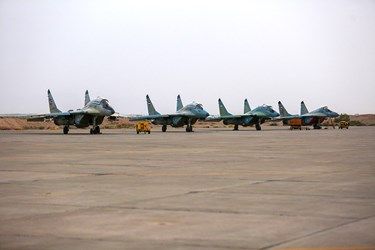
On Sunday, Iran initiated its annual air force drill, named Fadaeian Velyat-11, with 11 Iranian air force bases participating.

On Sunday, Iran initiated its annual air force drill, named Fadaeian Velyat-11, with 11 Iranian air force bases participating.
More than 90 fighter planes, bombers, and drones are set to take part in the drill, named Devotees of the Supreme Leader-11), according to local media.
Air Force Chief Hamid Vahedi claimed the drill’s message is “friendship, peace, and regional security”. He said: "Sustainable security, improving and fostering regional ties, peaceful coexistence, and defending air borders are on the agenda."
Iran, facing long-running sanctions and arms embargoes, relies primarily on missiles and drones, rather than having a viable modern air force.
In response to previous Iranian attempts to seize commercial ships in the Strait of Hormuz and Gulf of Oman, the US is reinforcing its presence in the area. The Pentagon announced earlier that the USS Thomas Hudner, a destroyer, along with a number of F-35 fighter jets, will be deployed to enhance security in the region.
Tensions have escalated due to recent incidents involving Iranian actions towards commercial vessels. Last month, Iran attempted to seize two oil tankers, the Marshall Islands-flagged TRF Moss, and the Bahamian-flagged Richmond Voyager, with one of the ships coming under fire.
The US Navy has accused Iran of seizing at least five commercial vessels over the past two years and harassing several others.
Iran denies these allegations, claiming that the seizures occurred after the vessels collided with local ships and polluted the waterway.


Dust storms and air pollution hit 14 Iranian provinces, forcing office and school closures in Markazi province.
The Meteorological Organization of Iran issued a warning for 14 provinces, cautioning about yellow weather conditions characterized by strong winds, rising dust, and declining air quality.
Sahar Tajbakhsh, the head of Iran's meteorological organization, expressed concern over the escalating sandstorms, attributing them to "the impact of climate change and powerful winds".
The situation has prompted authorities to advise respiratory patients, elderly individuals, children, and desert hikers in the affected provinces to avoid unnecessary travel.
In Markazi province, air pollution caused by dust has persisted for several days. The emergency working group of Qom province has also taken measures by reducing working hours due to worsening conditions.
While offices and schools in Tehran province remain open, environmental authorities have warned about the escalation of dust levels, reports state.
Desertification is considered a significant contributing factor to the problem. Approximately one million hectares of Iran's wetlands are transformed into fine dust centers each year, driven by the drying of wetlands.
Earlier, Iran's health ministry revealed that approximately half of the country’s population is currently facing hazardous dust storms, posing serious risks to people's health.

In a shocking revelation, an Australian-Iranian woman has exposed alarming harassment on Australian soil by a suspected regime agent.
The series of terrifying incidents took place in December, leaving the 28-year-old activist fearing for her safety and demanding recognition and protection from the Australian government.
The distressing ordeal began when Tina Kordrostami noticed a heavily tattooed man following her through Drummoyne on her way home to Dee Why. The situation escalated further when the man brazenly climbed into her car while she briefly stopped at a Sydney petrol station late at night.
Consequently, Kordrostami's father started receiving threats against her life, and she found herself under surveillance, with unidentified men taking photographs of her during rallies and public events.
In response to such alarming reports, several Australian-Iranians have broken their silence, highlighting how the Iranian regime monitors their activities in Australia. This has raised concerns among the community, who are now demanding protection from the Australian government.
Senator Chandler, who led a Senate inquiry into human rights abuses late last year, expressed her concern over the harassment of Australian citizens and the lack of action taken by relevant authorities.
“There are individuals in the community that are concerned they're being targeted. And they're reporting that to the relevant authorities, but they're worried those concerns aren't being taken seriously,” Senator Chandler stated.
The Iranian Islamic Revolutionary Guard Corps (IRGC) has conducted operations across a wide range of countries beyond the Middle East including the UK, where it targeted the Iran International staff and forced the offices to relocate to the US after British authorities failed to protect the team.

Secretary of State Antony Blinken reiterated Sunday that the US is pursuing de-escalation with Iran, but it remains unclear if Washington has made any offers to Tehran.
Speaking on CNN’s Fareed Zakaria GPS program, Blinken announced that “We’re now in a place where we’re not talking about a nuclear agreement. We are very clearly making it known to them that they need to take actions to de-escalate, not escalate, the tensions that exist in our relationship across a whole variety of fronts.”
Iranian officials and government media have yet to react to Blinken’s statement. Official and semi-official government media were silent on Monday but a ‘reformist’ website in Tehran, not directly controlled by the government, published the news about his remarks with a clear distortion.
Speaking about long negotiations in 2021 and 2022 that came to a deadlock last September, Blinken told CNN that “An agreement was on the table. Iran either couldn’t or wouldn’t say yes.” However, Etemad Online translated the sentence to, “Iran has not made a decision yet.”
Blinken did not explain what de-escalation means from the Biden administration viewpoint. Clearly, high levels of uranium enrichment and stockpiling fissile material for nuclear bombs is the most provocative policy Tehran currently pursues. But is the administration also telling the Islamic Republic they have to also de-escalate in their provocations in the region, such as attacks on US forces and open incitement of terror attacks on Israel?

There is also the issue of Iran supplying kamikaze drones to Russia that the administration has said is one of its pre-conditions for resumption of full nuclear talks. So far, Iran has shown no inclination to de-escalate in any of these areas.
Blinken also did not say what the United States is promising Iran in return for de-escalatory steps. Certainly, Tehran would demand the lifting of at least some sanctions. Already, the Biden administration has not been rigorously enforcing existing oil export sanctions that has allowed Iran to increase its exports to as high as 1.5 million barrels a day. Before former President Donald Trump withdrew from the 2015 JCPOA nuclear agreement, Iran was shipping around two million barrels. One can argue that Iran has almost overcome the oil sanctions, although US banking sanctions are still deterring most banks in other countries from doing business with Iran.
But if we assume that de-escalation applies only to less enrichment or a cap of 60-percent uranium purity in exchange for lifting some critical sanctions, then that was Iran’s plan all along. In December 2020, the Iranian parliament passed legislation to enrich at higher levels to force the US to lift sanctions. In fact, the bill was called the ‘Strategic Action to Eliminate Sanctions and Defend Iranian Nation's Interests.’
That negotiating tactic was initiated a month earlier in November by parliament, when Joe Biden won the presidential election and Tehran was certain that his administration was determined to reverse Trump’s decision and revive the JCPOA.
Now, the administration just hopes for de-escalation while it knows that Iran will use every means of pressure to project power.
“We are continuing to work out, to develop, to flesh out every possible option for dealing with the problem if it asserts itself,” Blinken said.
Earlier this month Iran tried to seize to commercial vessels in the Persian Gulf and the US Navy intervened to prevent it. Immediately plans were put in motion to reinforce the US naval presence in the region, dispatching more warplanes and warships.
Iran will not confront the United States where a clear deterrent signal has been issued. It most probably will hit back elsewhere or use new tactics.

One of the judges involved in the summary trial and execution of thousands of Iranian prisoners in the 1980s has been under treatment in a hospital in German city of Hanover.
According to German media outlet Presseportal, Hossein-Ali Nayeri was admitted to a private neurosurgical clinic -- the International Neuroscience Institute (INI) -- headed by Madjid Samii, a prominent Iranian-born neurosurgeon.
Nayeri, a cleric, judge and chief adviser to Iran’s judiciary, was one of the main figures in the "death committee" responsible for the mass execution of political prisoners in Iran in 1988. President Ebrahim Raisi was also a key member of this committee.
On July 7, Volker Beck, the president of the German-Israeli Society, notified Germany’s Federal Public Prosecutor, the Foreign Office, and the Federal Interior Ministry about Nayeri’s stay, urging them to initiate criminal prosecution measures against him.
While people are murdered and tortured to death in Iranian prisons, those responsible for the human rights violations travel to Germany with impunity, he said, stating, “This must come to an end.” He also referred to another Iranian judge -- Mahmoud Hashemi Shahroudi – who was treated in the same clinic in Hanover in 2018.
In July 2022, Nayeri defended the massacre in an interview with the Islamic Republic Documents Center, a government entity that collects the history of the 1979 revolution and more than four decades of rule by the Islamic Republic in Iran.
He tried to justify and explain away the killing of thousands of political prisoners, saying, “The country was in a critical state. If Khomeini [the Islamic Republic's first leader] did not stand firm... perhaps the regime would have not been able to survive.”

Amid tensions with Afghanistan over water, an Iranian lawmaker has suggested “non-diplomatic ways” to exert pressure on the Taliban, such as closing its Tehran embassy.
Fada-Hossein Maleki, a member of the Iranian Parliament's National Security and Foreign Policy Committee, said Sunday that a taskforce within the Supreme National Security Council is mulling over new measures to secure Iran’s share of water from Hirmand river, including closing the Taliban embassy and reducing political, commercial, and economic interactions through various means.
“We have many tools at our disposal that we can utilize for these purposes,” he noted.
Calling for stricter measures, Maleki said that considering the current position that the Taliban holds, Iran should not excessively appease them. “We have given them whatever they wanted, even compromising the relations between our Persian and Pashto speaking friends, who say demands by the Taliban are being accommodated one after another by Iran,” he said.
“We are witnessing a distressing situation in the Sistan and Baluchestan region, where villages are gradually becoming deserted,” he stressed, adding that the people of the province are facing imminent dangers and the first concrete step to address their grievances is to solve the water issue.
Flowing 700 miles, Hirmand -- which is called Helmand on the Afghan side -- enters Iran's Hamoun wetlands in the Sistan-Baluchestan province after originating in the Hindu Kush Mountains near Kabul. Lake Hamoun used to be one of the world's largest wetlands, straddling 4,000 square kilometers between Iran and Afghanistan.
The river, which both Afghanistan and Iran depend on for agriculture and drinking water, has been the biggest source of tension for years.
Iran has accused Afghanistan of restricting the flow of water from the river by building dams over it, a charge that Afghan authorities deny.
This comes as in the past few weeks, numerous reports have been published about water shortages in different regions of Iran, especially the Sistan and Baluchestan province.