Hijab Rebel Arrested In Iran, Forced To Confess

A young woman in Karaj, west of Tehran, has been arrested and subjected to forced confession after a video of her not wearing a hijab surfaced online.

A young woman in Karaj, west of Tehran, has been arrested and subjected to forced confession after a video of her not wearing a hijab surfaced online.
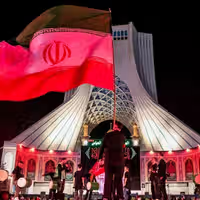
The incident came to light when a video of a man harassing the woman during a religious procession went viral on social media. In the video, the man accuses her of violating the procession's sanctity and insults her for not wearing the hijab. He further alleges that she insulted a security official and disturbed public opinion.
On Friday, the Judiciary released a short video of her forced confession, stating that she committed "blasphemy" during the religious procession in Alborz province. The circumstances surrounding the confession have raised concerns about potential coercion and violations of human rights.
Tweet unavailable
Political activist Mahboubeh Moradi shared the arrested woman's original statements on social media, where she firmly declares her commitment to her beliefs and refuses to be intimidated. "I am a woman; Don't scare me. I stand by my beliefs.... The time when we were afraid of you is over," the woman declared in the video.
In recent weeks, the morality police have returned to the streets, and the judiciary has issued unusual and controversial rulings, such as mandating the washing of dead bodies and sending women to psychiatric centers.
Despite these measures, women's civil disobedience against compulsory hijab continues to spread throughout Iran.


Iran's firebrand Prayer Imams avoided mentioning a sexual scandal by a local hijab enforcement official in Friday sermons or address worsening economic conditions.
Instead, they talked about seemingly unrelated and misplaced issues, while many of their rank and file complain that the social status of the Shiite clergy is declining among ordinary people.
The man who grabbed the public’s attention this week was a hardliner official in the northern Gilan Province, who is married but had sex with a young man. The news immediately went viral after damning videos were leaked on social media.
Homosexuality is a serious crime in the Islamic Republic, and more so in this case when the man was married and was supposed to be a gatekeeper for morality.
He was the director general for Cultural and Islamic Guidance and was removed from his post with unusual speed, unseen in Iran when officials are cut red-handed. The fiasco happened at the worst possible time during the Muharram public mourning ceremonies to mark the the martyrdom of Imam Hussain, the third Imam of the Shiite sect, 1,400 years ago.
Out of the blue, the Imam in Tehran, Ahmad Khatami, said some people believe the money spent on an Islamic festival in Tehran should have been used for taking care of an endangered species of Iranian cheetahs. This had very little to do with the pressing concerns of ordinary people, hit by a 70-percent annual inflation rate, and seemed a bad improvisation to fill the clerics sermon.

In another comment which made sense only in relation to the new round of violent crackdown on Iranian women defying the compulsory hijab, Khatami said those who come out of their houses without wearing headscarf are sick.
He further charged that women without hijab are backward and mentally retarded. In recent days, courts in Tehran have sentenced several movie starts who had appeared in public without headscarves to taking part in counselling sessions and presenting a certificate of mental health to the court.
In another part of his sermon, Khatami said that Muslim nations will make the government of Sweden repent for authorizing the burning of the Quran. Meanwhile, he thanked the government of Iraq, where the protesters had attacked the Swedish embassy, for deporting Sweden's ambassador.
In another development, the Imam in Mashhad, Ahmad Alamolhoda said without presenting any evidence that "the enemies" wish to suppress the clerics who rely on Supreme Leader Ali Khamenei. He further claimed that to do so, the enemies use all powers and means at their disposal.
Regime officials and loyalists use the term “enemies” to refer to the United States and its allies. Similar unfounded statements are made by other clerics and officials who think that Iran’s ruler Ali Khamenei likes to bash “the enemies.”
Alamolhoda, who was the main culprit in a recently disclosed corruption case covered by the Iranian media abroad, presumably made the comment to clear himself of the charges of corruption and to reassure Khamenei that he is the leader's obedient servant in the religious city. It should be noted that the cleric is the father-in-law of President Ebrahim Raisi.
Ironically, on the same date that the Friday Imams made those statements, conservative news website Tabnak called on the country's leaders to bar state officials and clerics from taking advantage of religious values and symbols. Alluding to the scandal in Gilan Province, Tabnak asked in an article on Friday: "How can we justify the behavior of a state official who introduces himself as a 'servant of Imam Hussain' and all of a sudden a leaked video on social media reveals his ethical corruption?" The website added, "Iran's government is a religious government. State officials pretend in public to be devoted to religious values, but some of them take advantage of this. But when these individuals are involved in a scandal the people find out what kind of a monster they were dealing with. As a result, the people are shocked and subsequently become indifferent toward sacred values."

In the wake of Quran desecration incidents in Sweden, Iran's Supreme Leader Saturday called for the severest punishment to be imposed on the perpetrator.
Ali Khamenei claimed in a statement that this stance is supported unanimously by all Muslim clerics.
In a message addressing the incident, he described it as "a bitter, conspiratorial, and perilous act," urging the Swedish government to hand over the culprit to the judicial authorities of Muslim countries. The man in question once burned the Quran in June and on Thursday he stomped and kicked the Muslim holy book.
"The consensus of all Muslim scholars is to impose the severest punishment on the perpetrator of this crime," alleged Khamenei. He also cautioned the Swedish government about “their support for the criminal” warning that such support takes a confrontational stance against the Muslim world, leading to enmity and resentment from Muslim nations and several governments.
Khamenei further addressed what he called “the conspirators behind the act”, asserting that “the sanctity of the Holy Quran will only grow stronger each day.”
Prior to Khamenei's response, Nasser Kanaani, the spokesperson for the Iranian Ministry of Foreign Affairs, summoned the Swedish ambassador to express "the strong protest of the Islamic Republic of Iran."
The incident involved Salwan Momika, an Iraqi immigrant, who burned the Quran in front of the central mosque in Stockholm on the first day of Eid al-Adha, after obtaining a permit from the Swedish government. He repeated the desecration, this time in front of the Iraqi embassy in Stockholm on July 20.

In a stark warning at the Aspen Security Forum, CIA Director William Burns expressed concern over the burgeoning defense partnership between Iran and Russia.
Burns also touched upon the partnership’s potential ramifications for US allies in the Middle East, specifically Iran's supply of weaponized drones to Russia, which have been used in the ongoing invasion of Ukraine.
“The Defense partnership between Russia and Iran right now is a useful two-way street…Russian technicians working on the space launch vehicle program in Iran and other aspects of their missile programs. We've seen discussion at least of the possibility of the Russians providing advanced combat aircraft to Iran which you know expands the threat from the innocent Ukrainian civilians,” added Burns, who cited the threats that poses across the Middle East, specifically referring to Iran receiving advanced combat aircraft from Russia.
However, Burns also revealed that the Iranian-Russian partnership has encountered obstacles within Tehran itself. "We have... seen signs where the Iranian leadership has hesitated about supplying ballistic missiles to the Russians, which was also on their wish list as well," Burns disclosed. He attributed Tehran's reluctance partly to apprehensions about not only the US response but also that of European nations.
Earlier this week, MI6 Chief Richard Moore corroborated the impact of the drone sales on Iran's internal dynamics, stating that the dealings had sparked "internal quarrels at the highest level of the regime in Tehran." While Burns acknowledged the report, he refrained from commenting further on the matter.

Reactions by Iranian officials have intensified following acts of Quran burning in Europe, more than three weeks after a man set fire to the Muslim holy book in Sweden.
While Iran lodged diplomatic protests to Sweden shortly after the incident in late June, street protests and repeated statements threatening reprisals did not occur until this week. The same can be said about other Muslim governments and countries.
Reportedly, one more incident of Quran desecration occurred July 20 in Sweden, and Iran's ruler Ali Khamenei reacted to all these incidents Saturday, by demanding harsh punishment for the perpetrators. He said that Sweden should hand over the individuals involved to a Muslim country. In case of some Muslim states, the punishment would be execution.
Iran’s foreign ministry spokesman Naser Kanaani issued yet another statement earlier Saturday, this time attacking Denmark for a Quran burning incident that happened in January. Tehran had already condemned it months ago, but for some unknown reason it decided to re-introduce the case.
“The Islamic Republic of Iran continuing its contacts and discussions with Muslim countries, will persist in its actions to confront this ignorance in the 21st century, which occurs under the protection of false Western freedom of speech…,” Kanaani was quoted as saying by IRGC’s Tasnim news website.
Sweden’s foreign minister Tobias Billström held a telephone conversation with his Iranian counterpart Hossein Amir-Abdollahian, the foreign ministry reported Friday. Billström said that the Swedish government condemns the Quran burning but could not refuse a permit to citizens for street protests.
Nevertheless, the Speaker of parliament Mohammad Bagher Ghalibaf also used his pulpit during a session Saturday to warn that disrespecting the Quran “will not be without cost.” Several hardliner lawmakers were quoted by the semi-official ISNA website also making similar statements.
Alireza Salimi, a hardline lawmaker said, “Sweden should expect a hard response,” as others dismissed the Swedish government’s argument that courts protect freedom of speech and it cannot stop people from burning books.
For hardliner Iranian politicians facing public anger over a 70-percent inflation rate and economic chaos, attacking Sweden at least would enhance their reputation as “revolutionary” figures within the regime. The people in general are not focused on such issues as they struggle in their daily lives with high prices and repressive government measures, such as a renewed crackdown on women ofr not wearing hijab.
Kanani, the spokesperson for the Iranian Ministry of Foreign Affairs, had personally summoned the Swedish ambassador July 20 for the second time and conveyed "the strong protest of the Islamic Republic of Iran."
"We strongly condemn the repeated desecration of the Holy Quran and Islamic holy things in Sweden, and we hold the Swedish government fully responsible for the consequences of inciting the feelings of Muslims around the world," said Kanani.
The incident involved Salwan Momika, an Iraqi immigrant, who burned the Quran in front of the central mosque in Stockholm on the first day of Eid al-Adha, after obtaining a permit from the Swedish government.
It seems that renewed protests by the Islamic Republic and other Muslim governments and groups intensified after the Shiite followers of Iraqi cleric Muqtada al-Sadr began protests in Baghdad this week and ransacked the Swedish embassy. Sadr is not an ally of Tehran, but the action of his group might have triggered a race to show who is tougher on Sweden and other European countries who would permit acts of Quran desecration.
The first street protest in Iran took place on Friday, and its ally the Lebanese Hezbollah also organized protests in Beirut, while rallies in countries such as Pakistan took place much earlier this month. Preachers and speakers, however, blamed the United Kingdom and the United States for Quran desecration in Sweden.

Four teachers from Iran’s northern city of Rasht have been accused of "damaging the image of the regime" due to participating in a protest.
The Rasht Prosecutor's Office issued the summons and accused the teachers of participating in activities under the banner of the "Teachers' Association", which has now been declared illegal according to the decree.
The Coordination Council of Iranian Teachers' Trade Associations expressed deep concern, fearing that the accused educators might face imprisonment and lashing, as reported in a picture of the order issued on Friday.
Additionally, the order explicitly states that any form of activity under the title of the “Teachers' Trade Association” is considered unlawful, further restricting the rights and freedom of educators in Iran.
This incident follows a series of mass trials held over the past two months in different cities, including Shiraz, Ahvaz, and Yazd, where a total of 24 teachers faced similar charges and trials.
On June 27, the association publicly protested the mass trials and issuance of what they deemed "unfair sentences" for educators. They called upon the authorities of the Islamic Republic to discontinue the practice immediately.
In a powerful show of solidarity, thousands of working and retired Iranian teachers signed a petition urging the regime to release their imprisoned colleagues and halt the harassment faced by educators.
The teachers launched the campaign last Friday, aiming to gather 100,000 signatures advocating for the release of detained educators and an end to the systematic harassment they face.