CIA Warns Of Growing Iranian-Russian Defense Partnership

In a stark warning at the Aspen Security Forum, CIA Director William Burns expressed concern over the burgeoning defense partnership between Iran and Russia.

In a stark warning at the Aspen Security Forum, CIA Director William Burns expressed concern over the burgeoning defense partnership between Iran and Russia.
“The Defense partnership between Russia and Iran right now is a useful two-way street…Russian technicians working on the space launch vehicle program in Iran and other aspects of their missile programs. We've seen discussion at least of the possibility of the Russians providing advanced combat aircraft to Iran which you know expands the threat from the innocent Ukrainian civilians,” added Burns, who cited the threats that poses across the Middle East, specifically referring to Iran receiving advanced combat aircraft from Russia.
However, Burns also revealed that the Iranian-Russian partnership has encountered obstacles within Tehran itself. "We have... seen signs where the Iranian leadership has hesitated about supplying ballistic missiles to the Russians, which was also on their wish list as well," Burns disclosed. He attributed Tehran's reluctance partly to apprehensions about not only the US response but also that of European nations.
Earlier this week, MI6 Chief Richard Moore corroborated the impact of the drone sales on Iran's internal dynamics, stating that the dealings had sparked "internal quarrels at the highest level of the regime in Tehran." While Burns acknowledged the report, he refrained from commenting further on the matter.


Reactions by Iranian officials have intensified following acts of Quran burning in Europe, more than three weeks after a man set fire to the Muslim holy book in Sweden.
While Iran lodged diplomatic protests to Sweden shortly after the incident in late June, street protests and repeated statements threatening reprisals did not occur until this week. The same can be said about other Muslim governments and countries.
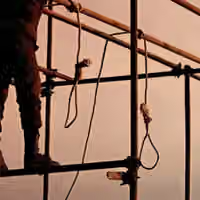
Reportedly, one more incident of Quran desecration occurred July 20 in Sweden, and Iran's ruler Ali Khamenei reacted to all these incidents Saturday, by demanding harsh punishment for the perpetrators. He said that Sweden should hand over the individuals involved to a Muslim country. In case of some Muslim states, the punishment would be execution.
Iran’s foreign ministry spokesman Naser Kanaani issued yet another statement earlier Saturday, this time attacking Denmark for a Quran burning incident that happened in January. Tehran had already condemned it months ago, but for some unknown reason it decided to re-introduce the case.
“The Islamic Republic of Iran continuing its contacts and discussions with Muslim countries, will persist in its actions to confront this ignorance in the 21st century, which occurs under the protection of false Western freedom of speech…,” Kanaani was quoted as saying by IRGC’s Tasnim news website.
Sweden’s foreign minister Tobias Billström held a telephone conversation with his Iranian counterpart Hossein Amir-Abdollahian, the foreign ministry reported Friday. Billström said that the Swedish government condemns the Quran burning but could not refuse a permit to citizens for street protests.
Nevertheless, the Speaker of parliament Mohammad Bagher Ghalibaf also used his pulpit during a session Saturday to warn that disrespecting the Quran “will not be without cost.” Several hardliner lawmakers were quoted by the semi-official ISNA website also making similar statements.
Alireza Salimi, a hardline lawmaker said, “Sweden should expect a hard response,” as others dismissed the Swedish government’s argument that courts protect freedom of speech and it cannot stop people from burning books.
For hardliner Iranian politicians facing public anger over a 70-percent inflation rate and economic chaos, attacking Sweden at least would enhance their reputation as “revolutionary” figures within the regime. The people in general are not focused on such issues as they struggle in their daily lives with high prices and repressive government measures, such as a renewed crackdown on women ofr not wearing hijab.
Kanani, the spokesperson for the Iranian Ministry of Foreign Affairs, had personally summoned the Swedish ambassador July 20 for the second time and conveyed "the strong protest of the Islamic Republic of Iran."
"We strongly condemn the repeated desecration of the Holy Quran and Islamic holy things in Sweden, and we hold the Swedish government fully responsible for the consequences of inciting the feelings of Muslims around the world," said Kanani.
The incident involved Salwan Momika, an Iraqi immigrant, who burned the Quran in front of the central mosque in Stockholm on the first day of Eid al-Adha, after obtaining a permit from the Swedish government.
It seems that renewed protests by the Islamic Republic and other Muslim governments and groups intensified after the Shiite followers of Iraqi cleric Muqtada al-Sadr began protests in Baghdad this week and ransacked the Swedish embassy. Sadr is not an ally of Tehran, but the action of his group might have triggered a race to show who is tougher on Sweden and other European countries who would permit acts of Quran desecration.
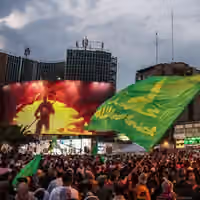
The first street protest in Iran took place on Friday, and its ally the Lebanese Hezbollah also organized protests in Beirut, while rallies in countries such as Pakistan took place much earlier this month. Preachers and speakers, however, blamed the United Kingdom and the United States for Quran desecration in Sweden.

US Secretary of State Antony Blinken has spoken of the US repairing ties with the E3, united in a joint commitment to restricting the regime's nuclear capabilities.
Speaking at the Aspen Security Conference, Anthony Blinken also expressed concern regarding Iran's actions abroad and said the regime had "gone global" by taking action against dissidents around the world, in countries including in the United States, in addition to stepping up assassination attempts on the likes of Jewish and Israeli targets.
Blinken said recent nuclear discussions have brought the US closer to its E3 allies, the UK, Germany and France, with whom he acknowledged there had until recently, been "real division". "We’re working very closely together to deal with some of the excesses committed by the regime," he said.
He admitted he feels "real concern" over Iran's nuclear progress and told the conference: “We have the concern that after having put its nuclear program in a box with the JCPOA, with that agreement no longer in force, Iran has speeded ahead with the production of fissile material for a nuclear weapon.
Blinken also acknowledged the courage of Iranian women and girls leading what he called "extraordinary protests" and expressed concern over the measures taken by the regime to suppress them.
He also voiced concern about Iran's actions in the region, particularly its support for groups involved in destabilizing activities. Blinken highlighted the dangerous exchange of technology between Iran and Russia, with drones provided to Russia having a devastating impact in Ukraine.
Many Iranian activists and some US lawmakers, however, criticize the administration for its continuing contacts with Tehran to reach agreements, that could free billions of dollars in frozen assets further enabling the regime.

Hardliners dominating Iran's parliament and others in the regime do not know what to expect from elections next March, with no signal so far from the Supreme Leader.
The fact that hardliners are Ali Khamenei’s preferred political force has been proven in the past, but others have to wait and see if the Supreme Leader will allow them to compete in the upcoming parliamentary vote.
Some are speculating that possible coalitions among relatively moderate groups could boost their chances success, but whether they will be approved by the Guardian Council controlled by Khamenei is entirely unclear.
If most political forces outside the hardliners are banned from running, the elections will turn into another low-turnout event, further eroding legitimacy.
Some are warning, however, that powerful groups of politicians do not want high voter turnout, so that conservatives and hardliners keep control of the legislature, despite deep public anger at multiple crises gripping the country.
While insiders wait to see in what direction the wind will blow, most ordinary Iranians have long given up on regime politicians and elections to shape a better future for them. One of the slogans in recurring nationwide protests has been, “No conservatives, no reformists.”
Moderate conservative Politician Mehrdad Lahooti told reporters in Tehran that politicians such as former parliament speaker Ali Larijani, who do not belong to the regime’s leading political factions, might form a coalition with moderate conservatives in a bid to increase their chance of being elected during the March 2024 parliamentary elections.

He called Larijani a national political figure whose influence goes beyond the boundaries defined by political factions. Lahooti added that both the moderate conservatives and the independents have already started their election campaigns. However, there is no indication in the media showing independent politicians starting electoral campaigns, while candidate registration for the March 2024 vote is still three months away.
In a recent interview with IRGC-linked Fars news agency, Mansour Haqiqatpoor a politician close to Larijani accused some conservative circles of trying to tarnish the former Speaker’s image by spreading the rumor that he has sougt political asylum in Scotland. Refuting the rumors, Haqiqatpoor said Larijani will certainly speak about the upcoming elections soon but reiterated that there is no indication yet that he is interested, although that can change in the coming months.
In fact, Larijani and other moderate, centrist, independent and proreform politicians are waiting to see a signal from Khamenei and his instruction to the Guardian Council.
Haqiqatpour said: "Larijani is the Supreme Leader's soldier. If he receives a signal that the leader does not want him to nominate himself as a candidate, he will certainly not put a step forward, but if he comes to the conclusion that the leader wants him to come forward, he will surely announce his candidacy."

Meanwhile, former presidential candidate and pragmatist politician Mostafa Hashemi Taba told reporters that "some powerful groups do not want the people to go to the polls" in March. By "powerful people" Hashemi was likely alluding to officials at Khamenei's office, the top echelon of the IRGC and its intelligence service and last but not least, the mighty ultraconservative Paydari Party, that wants to hold all the political power and not share it even with other conservatives.
Hashemi Taba further explained that groups with a radical approach want to continue the rule of the all-conservative government. He added: "I see no indication of any effort on the part of the country's officials to hold a high-turnout election, and I do not believe that this situation is going to change during the coming months.
In another development, Bijan Moghaddam, a political analyst close to Khamenei's office told Nameh News website in Tehran: "Usually conservative groups have two objectives in every election: To win the election, and to ensure a high turnout." He added that high turnout can be an outcome of either a coalition between all the conservative groups, or competition."
So far, it appears that the regime's choice between the two options is to forge a major coalition rather than holding a competitive election.

Iran's foreign ministry has once again rejected accusations of supplying kamikaze drones to Russia amid the latest EU sanctions, citing lack of evidence.
Iran's Foreign Ministry spokesman Nasser Kanani Friday said charges by Ukraine and Western countries are mere "accusations" lacking credible evidence, insisting that it has not supplied drones to Russia for any aggressive purpose.
However, hundreds of these drones have been shot down over Ukraine with multiple pieces collected by the Ukrainian military and in one case even a complete drone was put on display late last year.
The European Union's decision to impose additional restrictive sanctions against Iran comes after the Islamic Republic already faced three previous sanctions for drone exports to Russia. The latest measures target the export of components used in the construction and production of Unmanned Aerial Vehicles (UAVs) from EU member states to Iran.
Iran had consistently denied providing any drones to Russia to be used in the conflict with Ukraine until November 2022 when credible evidence forced foreign minister Hossein Amir-Abdollahian to admit that some were sent to Russia "before the war with Ukraine."
The United States and its main NATO allies have warned Tehran to cease military cooperation with Moscow and any weapons shipments.
In response to mounting criticism, Nasser Kanani asserted that any attempt to link the situation in Ukraine to Iran-Russia bilateral cooperation is a "purely political act."
Iran maintains that its relations with Russia are based on “shared interests and mutual agreements, unrelated to any military involvement in other regions”.

In a shocking move, morality police in Iran detained female athletes in the southern port city of Bandar Abbas on the Persian Gulf during their morning workout.
The news was brought to light by Mohammad Hossein Ajorlou, a reporter, and husband of Niloofar Hamedi, a journalist who is in prison for covering the death of Mahsa Amini in 2022 after her arrest for violating hijab rules.
According to Ajorlou, the incident took place Thursday, at approximately 5:30 in the morning. The morality police patrol intervened during the female athletes' routine workout session at the popular coastal boulevard.
Some local runners present at the scene have expressed their dismay over the incident. One of the runners described the scene: "In the mornings, when we go to the coastal boulevard to run, there are all kinds of crowds. Some have not collected their hookahs from the night before, some of them are still drunk and are speeding past us in their cars. A number of addicts are looking for a piece of bread in the garbage bins, but the police arrest athletes.”
The incident has sparked outrage among the community, as the female athletes were merely engaged in a peaceful morning workout.
The names and identities of the arrested female athletes have not been disclosed at this time, and it remains uncertain under what charges they were detained.
In the aftermath of the nationwide protests following the tragic death of Mahsa Amini, the Islamic Republic has intensified its efforts to enforce mandatory hijab.
However, a resilient wave of Iranian women and girls has chosen to defy these restrictive measures by appearing in public places without hijab.