European Official: EU States Likely To Keep Iran Missile Sanctions

A European official on Tuesday said he expected no difficulty persuading EU nations to maintain ballistic missile sanctions on Iran due to expire in October.

A European official on Tuesday said he expected no difficulty persuading EU nations to maintain ballistic missile sanctions on Iran due to expire in October.
The official also said he sees a window of opportunity by the end of 2023 to try to negotiate a de-escalatory nuclear deal with Iran.
"We may have a small window of opportunity to try to resume discussions with them on (a) return to the JCPOA or at least to an agreement of de-escalation … before the end of the year,” the official told reporters in Washington, speaking on condition of anonymity.
In June, sources told Reuters there were three reasons to keep the sanctions in place: Russia's use of Iranian drones against Ukraine; the possibility Iran might transfer ballistic missiles to Russia; and depriving Iran of the nuclear deal's benefits given Tehran has violated the accord, albeit only after the United States did so first.
The United States has denied any movement toward a full or a partial deal with Iran.
Keeping the sanctions would reflect Western efforts to prevent Iran from developing nuclear weapons and the means to deliver them despite the collapse of the 2015 deal, which then-US President Donald Trump abandoned in 2018.
The crux of that pact, which Iran made with Britain, China, France, Germany, Russia and the US, limited Tehran's nuclear program to make it harder for it to get fissile material for a bomb in return for relief from economic sanctions.
As a result of Trump's withdrawal from the deal and US President Joe Biden's failure to revive it, Iran could make the fissile material for one bomb in 12 days or so, according to US estimates, down from a year when the accord was in force.
Reporting by Reuters
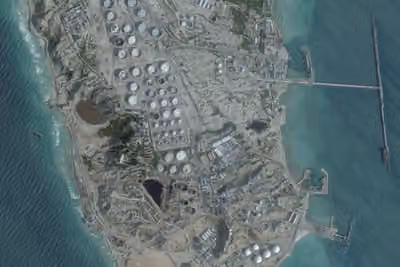

US federal prosecutors have faced challenges in auctioning off 800,000 barrels of seized Iranian oil aboard a Greek tanker off the coast of Texas.
According to the Wall Street Journal, the US companies are reluctant to unload the oil due to concerns about potential Iranian reprisals.
“Companies with any exposure whatsoever in the Persian Gulf are literally afraid to do it,” said a Houston-based energy executive involved in the matter, citing worries “that the Iranians would take retribution against them.”
This impasse sheds light on the difficulties the US government encounters in enforcing sanctions against Iran, especially as Iran has escalated its attacks against Western shipping interests as a deterrent to interdicting Iranian exports.
These tactics are seen as Tehran's strategy to prevent the West from interfering in its economic activities, added the report.
The issue comes at a time when US diplomats are quietly attempting to restart negotiations with Iran over a nuclear accord.
“That vessel’s emblematic of a much bigger drama that’s playing out about how we deal with Iranian threats,” a former US official told WSJ.
Tehran's military forces have hijacked several Western tankers in recent months, seen as retaliation for Western seizures of Iranian oil.
Meanwhile, the US Defense Department said Monday that it is deploying F-35 jet fighters and a Navy destroyer to the Middle East as a measure to deter Iran from attempting further seizures and to address Russian aggression in the region.

The Iranian president is focusing on securing drone sales in return for food during his latest trip to Africa.
According to Kayhan newspaper, affiliated with Supreme Leader Ali Khamenei's office, President Raisi is working on “extraterritorial cultivation, export of products such as drones and cars, petrochemical products, as well as technical exports".
The latest revelations will come as no shock, the barter deals of the heavily sanctioned regime the only way it can muddle through its current crisis, calling in favors from its dictatorial allies around the world from South America to Africa.
Iran has been providing drones to guerrilla groups across the Middle East for decades, and most recently, has supported Russia's invasion of Ukraine with hundreds of Shahed drones used in large scale missile attacks.
Only in March, Omar Hilal, Morocco’s ambassador to the United Nations, warned: “Iran, after undermining the stability of Syria, Yemen, Iraq and Lebanon, is in the process of destabilizing our region."
Concerns for Iran's involvement in Africa are also high. In October, the US State Department said Iran sent Ethiopia armed drones in the summer of 2021 in violation of a standing UN Security Council resolution.
The United States and its European allies have imposed a series of sanctions on Iranian individuals and companies involved with the drone program and shipments of the weapon to Russia.
Iran first denied it had supplied the drones but in early November foreign minister Hossein Amir-Abdollahian admitted the deliveries, while claiming they were sent before the Russian invasion.

Michael McCaul, chairman of the US House foreign affairs committee, has threatened a subpoena if the administration does not brief Congress on the circumstances of Iran envoy Rob Malley’s dismissal.
McCaul (R-TX) told the Washington Post in an interview on Monday that the State Department has been less than candid with a security clearance investigation of Malley.
Saying that he has no official information on the case besides media reports, McCaul said, “if he has leaked very sensitive or classified information to our foreign adversaries like Iran or Russia, that's a very serious act that would fall under treason.”
The Congressman said he has no evidence if any violation by Malley was small in nature or serious, but “We need to be briefed in the Congress. By law, they're required to do so, and we have asked for that classified briefing.”
Iran International first reported June 29 that Malley was absent for a considerable time, his security clearance was suspended and he is under investigation related to his handling of classified documents. The Involvement of the Federal Bureau of Investigation was also reported, although until now no official details have been released, except that Malley is on “unpaid leave.”
Congress had asked for briefings by Malley in past months, but the State Department said he was unavailable due to personal matters.
McCaul said that if the administration does not agree to a classified briefing, “then we're prepared to move forward with a subpoena and eventually another contempt proceeding, if necessary. They can't hide this from the Congress and the American people. There's too much at stake.”
Malley has been replaced by Abram Paley as acting Iran envoy, who has taken over the office’s Twitter handle and Malley’s name has been removed from the Department’s website.

US President Joe Biden has invited Israeli Prime Minister Benjamin Netanyhau to Washington for an official visit, the White House and the prime minister's office said Monday.
The move announced after a phone conversation between the two leaders marks a shift in US - Israeli relations as most Israeli prime ministers had already received an invitation to the White House this far into their terms.
The two leaders shared a "long and warm" conversation, the Israeli statement said, focused on curbing threats from Iran and its proxies and strengthening the alliance between the two countries.
US National Security Council spokesman John Kirby said, “The two consulted on our close coordination to counter Iran, including through regular and ongoing joint military exercises. They noted that U.S. that the US-Israel partnership remains a cornerstone in preventing Iran from ever acquiring a nuclear weapon."
Netanyahu told the US President he would try to form "broad public consensus" on controversial legislation in Israel that would see its highest court stripped of much of its powers.
President Biden and his administration have voiced concern over Netanyahu’s government plans to overhaul the judicial system taking away some of the powers of unelected judges. This has led to a serious split among the public, with months of large protests by those opposing the plan.
Kirby said, "We believe strongly in the democratic institutions and the ideals of democracy that the United States and Israel represent, not just in their particular parts of the world, but across the world. And we want to see Israel be as vibrant and as viable democracy as possible.”

The United States has officially confirmed earlier reports of sending more warplanes and additional warships to the Persian Gulf region to deter Iranian moves.
The Pentagon said Monday that it will send additional F-35 and F-16 fighter jets, along with a warship to the Middle East, in a bid to monitor key waterways in the region following Iran's seizure and harassment of commercial shipping vessels in recent months.
Meanwhile, in a telephone conversation on Monday US President Joe Biden and Israeli Prime Minister Benjamin Netanyahu discussed security challenges Iran poses in the region.
“The two consulted on our close coordination to counter Iran, including through regular and ongoing joint military exercises. They noted that U.S. that the US-Israel partnership remains a cornerstone in preventing Iran from ever acquiring a nuclear weapon," White House strategic coordinator John Kirby said.
In May, the White House had announced that the Biden administration would be making a series of moves in the region, but at the time did not say what it would include.
"The (Pentagon) is increasing our presence and ability to monitor the (Strait of Hormuz) and surrounding waters," Pentagon spokeswoman Sabrina Singh told reporters. It was not clear where exactly the additional jets would be placed and how long they would stay in the region.

A Pentagon official had said earlier that F-16 fighters will be placed in the region, but Monday’s announcement included more weapons systems.
Iran’s latest attempts to interfere with commercial shipping occurred earlier this month when it tried to seize two vessels. The US Navy announced July 5 that it prevented Iranian naval forces from diverting the vessels including the Richmond Voyager, a super tanker managed by Chevron in the Strait of Hormuz, the narrowest part of the Persian Gulf.
Since 2019, there have been a series of attacks on shipping in strategic Persian Gulf waters at times of tension between the United States and Iran. The Revolutionary Guard has seized or attacked 15 vessels since 2019, according to US NAVY. Over the years, Iranian speedboats also harassed US Navy ships, sometimes in dangerous maneuvers.
About a fifth of the world's crude oil and oil products passes through the Strait of Hormuz, a choke point between Iran and Oman.
With the 2015 Iran nuclear deal effectively dead, Iran's relations with the West have deteriorated over the last year, with Iran supplying hundreds of kamikaze drones to Russia that have been regularly used to attack civilian and infrastructure targets in Ukraine. The US and its allies have warned Tehran to seize its military cooperation with Moscow that can expand into supplying ballistic missile later this year when a UN restriction on Iran expires.
Due to former US President Donald Trump's withdrawal from the 2015 nuclear deal and President Joe Biden not being able to revive it, Iran has been accumulating more enriched uranium and could make the fissile material for one bomb in 12 days or so, according to US estimates, down from a year when the accord was in force.
Iran denies seeking nuclear weapons, which the West sees as a threat to Israel and Persian Gulf Arab oil exporters. But its enrichment of uranium to 60-percent purity has no civilian purpose and can only be for further enrichment to above 90-percent needed for building nuclear weapons.
Iran also probably wants to use escalatory tactics to force Washington to accept its terms in recently reported diplomatic contacts between the two sides aimed at some sort of a deal over Americans held hostage by Tehran.
Iran wants Washington to agree to around $20 billion of its frozen funds in third countries to be released, which would be significant for its beleaguered economy. Iraq holds around $10 billion of debts to Iran, while South Korean banks hold another $7 billion.