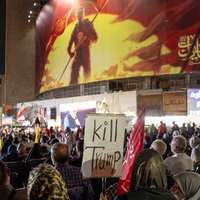
Khamenei Praises ‘Revolutionary Parliament’ For Tough Nuclear Bill

Iran’s Supreme Leader Ali Khamenei Wednesday praised the country’s “revolutionary parliament” for passing a bill in 2020 that complicated nuclear negotiations.
Iran’s Supreme Leader Ali Khamenei Wednesday praised the country’s “revolutionary parliament” for passing a bill in 2020 that complicated nuclear negotiations.
“From the beginning of this parliament [2020], based on information I had, I believed that it is a revolutionary parliament, and now after three years I reiterate that,” Khamenei told 290 members of the legislature.
The parliament, dominated by hardliners, passed a bill in December 2020 dubbed the ‘Strategic Action To Eliminate Sanctions and Defend Iranian Nation's Interests.’ The bill authorized higher-level uranium enrichment to force the United States to lift economic sanctions imposed in 2018, when former President Donald Trump withdrew from the JCPOA nuclear agreement.
The bill also mandated restrictions on nuclear monitoring by the United Nations watchdog, the International Atomic Energy Agency (IAEA). Since the passage of the law, Iran has further restricted international monitoring and inspections, adding to the complicated dynamics of renewing the JCPOA.
The current parliament was elected in February 2020 in a controversial vote when the Guardian Council, loyal to Khamenei, banned hundreds of relatively moderate candidates and allowed hardliners to gain a strong majority in the legislature. Few doubt that Khamenei was not aware or did not approve the engineering of the 2020 elections to pack the parliament with hardliners.
The timing of the bill in December 2020 was curious. The proposal emerged in parliament in early November just days after the US presidential election and Joe Biden’s victory. In September of that year, Biden had already announced thatif elected he would return to the JCPOA agreement to correct Trump’s “reckless” policy of dumping the nuclear deal that capped Iran’s uranium enrichment.
The Iranian regime knew that the incoming Biden administration wanted to restore the JCPOA, which would lift crippling sanctions, but nevertheless decided to pass the parliamentary law that made negotiations more difficult.
The bill’s stipulation about higher levels of uranium enrichment was not an empty negotiating tactic. Iran actually began enrichment at 20 percent in early 2021, breaking the JCPOA limit of 3.65 percent. Subsequently, enrichment was increased to 60 percent during the talks, and by all estimates, Tehran now has enough fissile material for at least two nuclear bombs. Tehran also gradually restricted IAEA monitoring access to its nuclear facilities, introducing another complicating factor into the JCPOA talks.
The government of President Hassan Rouhani initially opposed the legislation, saying it will complicate talks, but the hardliners went ahead anyway.
However, Khamenei Wednesday told lawmakers, “The Strategic Action law brought the country out of a wandering state in the nuclear issue. This law fully clarified what we needed to do.”
Negotiation to revive the JCPOA began in Vienna on April 7, 2021, between the members of the JCPOA, Iran, the United Kingdom, France, Germany, Russia and China, with the US on the side lines as Tehran rejected any direct talks with Washington.
After 11 months of talks, the Vienna process ended without success in March 2022 after the Russian invasion of Ukraine. Subsequent efforts by the European Union to bridge the gaps failed and the talks reached a deadlock in September 2020.
In the meantime, Iran’s economic crisis triggered by US sanctions got much worse, with annual inflation nearing 70 percent and the national currency losing much of its value. This and continued domestic repression led to nationwide protests in the fall of 2022, destabilizing the clerical regime, with no immediate prospect of ending sanctions.