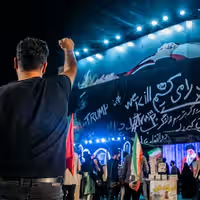
Several Iranian women remove their headscarves in front of Tehran’s iconic Azadi tower, formerly known as the Shahyad Tower.
In an open letter to Iran’s Supreme Leader Ali Khamenei, female Islamic scholar Sedigheh Vasmaghi has strongly challenged his recent edict over hijab.
In her letter which has been widely shared through social media, Vasmaghi has warned Khamenei that he will personally be responsible for all the “financial, physical, social, ethical, psychological and political” consequences of enforcing compulsory hijab rules as he has recently demanded.
“Discarding hijab is haram (sin) based on Sharia and also politically,” Khamenei emphatically declared at a meeting with state officials on April 4 while claiming that foreign intelligence services were encouraging Iranian women to disobey mandatory hijab.
Taking their cue from the speech, officials have been competing to re-establish control over women which has somehow waned following anti-regime protests, and they made a host threats,including expulsion from universities, against hijab-less women.
Vasmaghi has argued that the strict hijab rules have no foundation in the Quran which never specified that women have to cover their hair. According to Vasmaghi, there is also no evidence that women were harassed or punished for not covering their hair and body during the lifetime of the Prophet Muhammed.
Scholar Sedigheh Vasmaghi
“On what specific and unbreakable religious foundations and what logic the Islamic Republic’s prescribed dress code for women, which you also approve and stress, has been based?” she wrote and asked Khamenei to elucidate his religious and political arguments for demanding enforcement of his personal views over the society.
She also argued that Sharia scholars may insist that following the model prescribed by the Islamic Republic is religiously required but there is no absolute religious basis for coercing all women to obey such edicts by using government resources and force and at the cost of violating women’s dignity, and harm to the society.
Vasmaghi who taught Fiqh, the science of ascertaining the precise terms of the Sharia (Islamic law) at Tehran University before being banned from teaching due to her political view is famous for her poetry. She left Iran in 2011 and taught Islamic studies at University of Göttingen in Germany and University of Uppsala in Sweden as a guest professor until 2017 when she returned to Iran.
Vasmaghi who used to wear a black veil for years has relaxed her own hijab in recent years and no longer covers all her hair as she used to.
Only five months after the Islamic Revolution of 1979, then leader of Iran Ayatollah Ruhollah Khomeini banned women from appearing without a veil in government offices. The ban gradually spread to the entire society within the next two years.
All women eventually gave in to covering their hair, even if partially, with headscarves and shawls and wear tunics and trousers that could be tight-fitting and/or colorful. The hardline religious and political establishment considered this level of compliance faulty and called these women ‘bad-hijab’.
Most Iranian women, however, resisted wearing the long black veil, called chador, that the hardline religious and political establishment considered as ‘the ultimate hijab’ and tried to impose by making it mandatory in some government offices and universities. Many women would wear the chador to work or school, if they absolutely had to, but would remove it as soon as they were within a safe distance.
In the past few years, however, some women began to wear their headscarves on their shoulders rather than their heads, in their private vehicles and anywhere else they could not be harassed by the police and vigilantes.
Since the death of the 22-year-old Mahsa Amini in the custody of morality police and the protests that engulfed the country for months many women have discarded their headscarves altogether and vowed never to wear it again so instead of ‘bad-hijab’ women, the Islamic Republic is now facing the phenomenon of ‘hijablessness’ as a form of civil disobedience.