Prominent Iranian Sunni Leader Slams Government’s ‘False Accusations’

Mowlavi Abdolhamid, the most influential Sunni cleric in Iran, has slammed the "false and baseless allegations" against him by the government’s official paper.
Mowlavi Abdolhamid, the most influential Sunni cleric in Iran, has slammed the "false and baseless allegations" against him by the government’s official paper.
Iran Daily, the formal government newspaper, on Saturday lashed out at the Sunni religious leader of Zahedan, near the border with Pakistan, claiming that Mowlavi Abdolhamid is trying to lead “riots”.
Iran daily also noted that the Friday Imam of Zahedan in the largely Sunni southeastern Sistan-Baluchestan province continues to play his “destructive role against national security and unity”.
However, in its statement, the office of Mowlavi Abdolhamid said that after the September ‘Bloody Friday’ in Zahedan, “some inside and outside the country wanted to avenge the bloodshed, but the prominent leader has prevented that.”
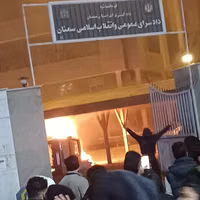
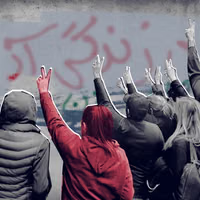
The Bloody Friday took place September 30, when security forces killed around 100 people, and injured hundreds more as part of their crackdown on nationwide protests following the death of Mahsa Amini in police custody in mid-September.
As people congregated for prayers on that day, many began protesting against the government as people in more than 100 other cities were doing. As some approached the headquarters of security forces in the city, Revolutionary Guard troops opened fire, killing nearly 100 civilians.
After the Bloody Friday of Zahedan, Mowlavi Abdolhamid held Supreme Leader Ali Khamenei responsible and demanded the cancellation of death sentences for protesters. He also continued calling for justice and respect for the people, gaining support from non-Sunni Iranians.
“The officials of Iran newspaper apparently do not know or have forgotten that on September 30, a bloody massacre and an unprecedented crime took place in Zahedan, in which nearly 100 people - including a woman and several children - were killed by the direct fire of security forces while more than 300 people were also injured,” reads the statement.
“In a situation when it was expected the crime would be condemned by the country's high-ranking officials and the perpetrators be held accountable, so far the government has neither censured the killings nor taken a step towards arresting the perpetrators.”
In another part of the statement, the office of the prominent Sunni leader stated, “Not only the people were not provoked by Mowlavi Abdolhamid and the Makki Mosque officials, but they controlled them to a great extent to maintain security.”
At the end the statement tells the editorial staff of the Iran newspaper to “increase their knowledge about the Sunnis in Iran, especially the people of Sistan and Baluchestan and urge the officials of the Islamic Republic to serve justice to those officers who shot directly at people.”
Earlier in November, the hacktivist group Black Reward targeted the data servers of Fars news agency, a media network affiliated with the Islamic Republic's Revolutionary Guard, releasing several documents to media indicating that Khamenei is dismayed by Mowlavi Abdolhamid’s remarks.
The documents also revealed that instead of arresting or harming him, Khamenei ordered underlings to tarnish Abdolhamid’s reputation so that his influence would decrease among the Sunni population of the country.