'We Are Close', UK Envoy To Iran Talks Says As Europeans Fly Home
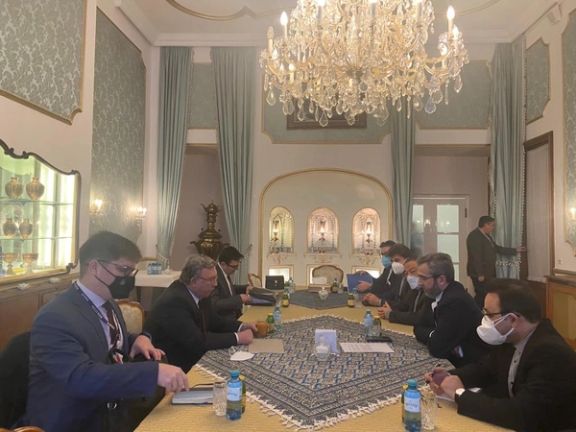
Nuclear talks with Iran are close to reaching a deal, the chief British envoy said on Friday as she and her French and German colleagues flew home to brief ministers.
Nuclear talks with Iran are close to reaching a deal, the chief British envoy said on Friday as she and her French and German colleagues flew home to brief ministers.
"We are close. E3 negotiators leaving Vienna briefly to update Ministers on state of play. Ready to return soon," Stephanie Al-Qaq said on Twitter, referring to the chief British, French and German diplomats involved in the talks.
Despite the British diplomat's teasing Twitter post, two sources with direct knowledge said there was still no deal and European and Iranian officials said that Iran's lead negotiator, nuclear negotiator, Ali Bagheri Kani was staying in Vienna.
Negotiators have worked for 11 months to try to revive the 2015 deal, known as JCPOA, under which Iran limited its nuclear program to make it harder to obtain fissile material for a bomb - an ambition Tehran denies - in return for relief from economic sanctions.
Then-US President Donald Trump reneged on the pact in 2018, restoring US sanctions that have slashed Iran's oil exports. Iran followed suit by increasing the level of its uranium enrichment violating the deal's nuclear limitations.
It is not clear what exactly the remaining issues are in the talks, but the head of the International Atomic Energy Agency is flying to Iran on Saturday to iron out past issues of suspected clandestine nuclear activities.
With reporting by Reuters





Despite participants tweeting guarded optimism over the looming renewal of the 2015 Iran nuclear deal, sticking-points remained Friday.
On Friday morning the lead British negotiator, Stephanie Al-Qaq, tweeted with the hashtag #EndgameViennaTalks that the ‘E3’ (France, Britain, and Germany) were meeting to take stock. In another tweet Al-Qaq wrote that a deal was "possible…but not guaranteed” and needed to be reached “before the diplomatic window closes.”
Fars news agency tweeted Friday a statement from Hossein Amir-Abdollahian, Iranian foreign minister, that the “haste of the western side cannot prevent the need to protect Iran’s red lines” even though Iran was “ready for a good agreement.” Amir-Abdollahian said that foreign ministers would not be able to gather in Vienna, for a signing ceremony, unless Iran was given “effective economic guarantees.”
Iran has sought in the talks guarantees both that the United States would not again leave the 2015 deal, as it did in 2018, and that parties to the deal would take other measures – including sanctions levied on other grounds, including ‘terrorism’ – ‘interfering’ with Iran’s ability to access overseas markets and attract inward investment.
Premature good news?
"Premature good news does not substitute good agreement,” Iran Foreign Ministry Spokesman Saeed Khatibzadeh tweeted Thursday evening.“Nobody can say the deal is done, until all the outstanding remaining issues are resolved. Extra efforts needed…Everybody is now focused on the final critical steps.”
"We are close to a possible deal," Jalina Porter, a US State Department's spokesperson, told a press briefing Thursday evening. "If Iran shows seriousness, we can and should reach an understanding on mutual return to full implementation of the JCPOA within days." Having left the 2015 nuclear deal, the JCPOA (Joint Comprehensive Plan of Action) and imposed ‘maximum pressure’ sanctions in 2018, prompting Iran to expand its nuclear program after 2019, the US takes part in Vienna indirectly.
‘Not there yet’
Enrique Mora, the European Union official chairing the talks tweeted Thursdaythat the talks, while in their "final stages", still faced challenges: "Some relevant issues are still open and success is never guaranteed in such a complex negotiation. Doing our best in the coordinator's team. But we are definitely not there yet."
Mikhail Ulyanov, the lead Russian negotiator in the talks, said Thursday evening said he had met with Iran's top negotiator Ali Bagheri Kani to discuss steps "to finalize" the talks.
Oil analysts say international markets are expecting more Iranian oil to flow into the market with an agreement in Vienna to restore the JCPOA and lift the sanctions. With the Ukraine crisis oil prices have soared to unprecedented heights of above $115 per barrel in a decade. While Russia's oil and gas exports have not been sanctioned, Iran has around 100 million barrels of oil in storage.
Under a restored JCPOA, Iran would severely cut back stocks of enriched uranium. The latest report from the International Atomic Energy Agency (IAEA) showed Iran had 33.2 kg (110 pounds) of uranium enriched to 60 percent. The Reuters news agency cited a “senior diplomat” that this was around three-quarters of the amount needed, assuming it was further enriched to 90 percent, for a nuclear bomb.
While negotiators in Vienna discuss the final details of a nuclear agreement, politicians and pundits in Tehran are still not sure whether there will be a deal.
An ultraconservative lawmaker even insisted on Thursday that Iranian negotiators should leave Vienna at once as he believes there is nothing to be gained in the talks.
International relations expert Ali Bigdeli told Didban Iran website in Tehran that if there is no agreement between Iran and world powers, the rate of exchange for the US dollar will rise to 400,000 rials as opposed to the current rate of around 260,000 rials in less than a week.
The analyst added that if negotiators fail to reach an agreement, Iran's case might be sent to the UN Security council, where more sanctions are likely to be imposed on Tehran even if Russia and China back the Islamic Republic.
Bigdeli said that concern over the implications of not reaching an agreement on Iran's already ailing economy could lead to growing concerns about the eruption of riots in Iran.
He sounded almost certain that the negotiations in Vienna are doomed to fail. He said Iran's support of Russia has affected the fate of the nuclear talks and it looks like the talks are ending in a deadlock as Iran's demands from the West are not rooted in reality.
Bigdeli went on to say that in the new Iranian year which starts in late March, prices will rise even further, and without an agreement, Iran's international isolation as a result of its support for Russia will lead to an unprecedented level of public dissatisfaction which will end in major riots.
Meanwhile, former lawmaker Mansour Haghighatpour told reporters in Tehran that those who are against a nuclear deal with the United States are no more than 20 lawmakers in the Iranian parliament and they cannot decide for the entire nation and impose their hardliner views.
He criticized hardliner lawmakers who say Iran should not make an agreement with the United States, adding that it is Supreme Leader Ali Khamenei who makes the final decision about steering the negotiations.
In another development, firebrand member of parliament Mahmoud Nabavian, a staunch opponent of any deal with the West, particularly with the United States, told reporters in Tehran that Iran's problems have nothing to do with the sanctions and insisted that Iranian negotiators should leave Vienna at once.
Nabavian, a member of the ultraconservative Paydari Party, boasted that in spite of sanctions Iran has had a lot of progress particularly in the area of developing military hardware. He added that creating relative welfare for the nation is feasible regardless of the economic pressures, only if the government has the right roadmap.
This has been a constant argument of hardliners, while many former officials and economists keep saying that the country would be doomed if sanctions continue.
He said the conditions set for Iran by the other side is unfair and will cause losses for Tehran. He said while 980 Iranians are sanctioned by the United States, Washington is prepared to lift the sanction on only 20 individuals.
Nonetheless, he claimed that sanctions affect only 20 percent of Iran's economy, and the other 80 percent should be attributed to poor management.
Iran has almost doubled its stockpile of uranium enriched up to 60 percent to 33.2kg, the UN nuclear watchdog reported Thursday, as talks in Vienna almost over.
A quarterly report to member states of the International Atomic Energy Agency (IAEA) seen by Reuters said Iran now had a total stockpile of 3.2 tons of enriched uranium.
The agency quoted a “senior diplomat” that the 33.2kg enriched to 60 percent was “around three-quarters of the amount needed, if enriched further, for one nuclear bomb according to a common definition.” Uranium enriched to 90 percent is generally deemed ‘weapons grade.’
Iranian officials have insisted that after two years of deep recession and despite inflation at 40 percent, Iran has effectively defeated the US ‘maximum pressure’ introduced by former president Donald Trump and continued by President Joe Biden. Biden came to office pledged to revive Iran’s 2015 nuclear deal with world powers, the JCPOA (Joint Comprehensive Plan of Action), which Trump left in 2018.
Iran responded to US ‘maximum pressure’ sanction sanctions by boosting its nuclear program beyond JCPOA limits, including raising the 3.67% cap on the purity to which it could purify uranium to 60% and the 202.8-kg limit on its enriched uranium stock.
Several sources have said that talks in Vienna to revive the JCPOA are at a final stage and that agreement may be close. Mikhail Ulyanov, the lead Russian negotiator in Vienna in tweeted Thursday that the "long and grueling marathon" was "almost over." Ulyanov told reporters Thursday afternoon that there was little likelihood of the talks failing, that relatively small matters remained unresolved, and that foreign ministers might meet “within a few days” to sign a document of agreement.
Less convinced, Laurence Norman, the Wall Street Journal correspondent in Europe, tweeted he had been told talks were progressing on outstanding issues: "And it's unlikely but not entirely excluded that the final issues could be nailed down today. Until they are, the risk of failure remains though shrinking.”
Golden circumstances
Reza Zandi, a senior oil and gas journalist in Tehran, tweeted Thursday he had received "definitive news" that agreement on reviving the JCPOA would be reached within 72 hours. "Iran's oil is returning to the market under golden circumstances," he noted, referring to the recent jump in prices towards $120 a barrel. Iran has around 100 million barrels in storage.
"If Vienna talks do not lead to a good deal, current US administration will feel defeated in near future due to lack of timely use of diplomatic opportunities," Ali Shamkani, Secretary of Iran's Supreme National Security Council (SNSC), tweeted Thursday.
Ebrahim Rezaei, a member of the Iranian Parliament's National Security and Foreign Policy Committee, said Thursday that a good arrangement for Iran would see the Revolutionary Guards removed from the US list of ‘terrorist’ groups. On Wednesday Gabriel Noronha, a US State Department official under Trump and JCPOA critic, tweeted attacks on Rob Malley, the White House special envoy for Iran, claiming unnamed US and EU officials had asked him to reveal that among concessions Malley had made in Vienna was offering to lift Trump’s designation of the IRGC.
Russia’s chief negotiator in the Vienna nuclear talks told reporters that an agreement will be signed in the next few days in the presence of Iranian and US foreign ministers.
Iran International correspondent in Vienna reported that Mikhail Ulyanov said a definite day has not been decided yet, but it could be Saturday, Sunday or Monday.
In a tweet which is being interpreted as a sign of an imminent deal, French chief negotiator Philippe Errera on behalf of E3 negotiators, thanked their teams for their efforts in past 11 months.
Earlier on Thursday, Iran's lead nuclear negotiator Ali Bagheri Kani, who flew to Tehran last week for consultations about the final draft of the deal, met with the European Union's Enrique Mora, who coordinates the talks in Vienna.
It has been weeks that pundits and diplomats are talking about the end of the negotiations, but all sides keep expressing uncertainties about the conclusion of the talks. This time however it seems different as reports about the endgame are pouring in from both opponents and proponents of the agreement.
Ali Akbar Salehi, a former foreign minister and head of the Atomic Energy Organization of Iran, told IRIB on Thursday that “It seems that the talks are reaching a conclusion, and I am very hopeful regarding it”.
The head of the UN nuclear watchdog Rafael Grossi will travel to Tehran on Saturday to discuss unresolved safeguards issues as nuclear talks reach an endgame.
The head of the UN nuclear watchdog Rafael Grossi will travel to Tehran on Saturday, to discuss unresolved safeguards issues as nuclear talks reach an endgame.
Nour news in Tehran said, which has in recent months several times broke news regarding the Vienna nuclear talks, said, Grossi was looking to help to restore the 2015 Iran nuclear with "a roadmap to resolve existing safeguard issues."
According to Nour News, which is close to Iran's Supreme National Security Council (SNSC), Grossi will meet with the head of Atomic Energy Organization of Iran and possibly other officials.
"Safeguards issues between Iran and the IAEA have turned into one of the main factors in slowing the Vienna talks," Nour News said. "Interactions between Iran and the IAEA are noticeably improving."
In recent days, the outstanding issue of Iranian nuclear work before 2003, a “safeguards issue” rather than one directly linked to the 2015 deal, has reportedly emerged as a sticking-point in Vienna, where Iran’s talks with world powers since last April are striving to revive the 2015 deal, the JCPOA (Joint Comprehensive Plan of Action). Iran has “safeguards” commitments as a signatory of the Nuclear Non-Proliferation treaty.
Backing off
The IAEA has sought explanations from Tehran over uranium traces found at four undeclared sites, with some analysts linking the issue to equipment supplied by Pakistani scientist AQ Khan previously used in the Pakistani nuclear program.
Nour News claimed that Grossi was backing off from pressing the issue, which Tehran has said is politically motivated. This was, Nour suggested, "one of the signs of improvement in the process of the said interactions.”
Grossi told reporters in Vienna Wednesday that the agency was "working very hard" on its next quarterly report. He visited Tehran immediately before the agency's last quarterly report in November. After his visit he said his talks had been inconclusive in resolving the pre-2003 issues.
Sources close to the negotiations told Iran International Wednesday that Tehran had demanded western powers ask the IAEA to drop the matter. Grossi said Wednesday the issue could be resolved "without politicizing" the matter or making it conditional on other issues.
Diplomatic opportunities
The lead negotiator of the United Kingdom – one of three western European powers in the Vienna talks – has portrayed the pre-2003 work as unrelated to reviving the JCPOA, saying the UK stance if supported by France and Germany. "With our partners, the E3 fully supports the independence of the IAEA and the professional efforts of DG [director-general] Grossi. Safeguards are a fundamental part of the non-proliferation system and are separate to the JCPOA," Stephanie Al-Qaq tweeted Tuesday.
Ali Shamkhani, secretary of the SNSC, tweeted Thursday that time was running out to revive the JCPOA. "Strategy of active resistance defeated Trump's policy of maximum pressure confessing by current US administration,” he wrote. “If Vienna Talks do not lead to a good deal, current US administration will feel defeated in near future due to lack of timely use of diplomatic opportunities.”
On Wednesday Gabriel Noronha, a US State Department official under former president Donald Trump, who withdrew the US from the JCPOA in 2018, launched a series of tweets attacking Rob Malley, US special envoy for Iran, for allegedly preparing to lift ‘terrorism’ sanctions on Iran. He said unnamed US and EU officials has asked him to reveal details about concession Malley made to Iran.
Iranian officials and media on Thursday remained silent about Noronha’s claim.