France, US Say Progress In Iran Nuclear Talks Too Slow

France has once again warned of slow progress in Iran nuclear talks, while the United States said the pace must be quickened if the JCPOA is to be salvaged.
France has once again warned of slow progress in Iran nuclear talks, while the United States said the pace must be quickened if the JCPOA is to be salvaged.
Iran and world powers negotiating in Vienna are still far from any agreement to revive their 2015 nuclear deal despite making some progress at the end of December, France's foreign minister said on Tuesday.
Iran and Russia have sounded a much more optimistic tone since late December, speaking of progress virtually on daily basis. Iran even said on Monday its negotiating team is moving "at the speed of light".
Indirect talks between Iran and the United States on salvaging the 2015 Iran nuclear deal resumed on January 3. The United Kingdom, France, Germany and EU officials act as mediators during the talk. Russia has also assumed the role of a mediator, with its chief envoy, Mikhail Ulyanov often meeting with US Special Representative for Iran Robert Malley.
Western diplomats have indicated they are hoping to have a breakthrough by the end of January or early February, but sharp differences remain with the toughest issues still unresolved. Iran has rejected any deadline imposed by Western powers.
"The discussions are ongoing. They are slow, too slow and that creates a gap that jeopardizes the chance of finding a solution that respects the interests of all sides," Jean-Yves le Drian told a parliamentary hearing.
"Bits of progress were made at the end of December, but we are still far from concluding this negotiation."
At a US State Department briefing, Victoria Nuland, the Under Secretary of State for Political Affairs, was asked about the Vienna talks, but she sidestepped the question. The department spokesman Ned Price acknowledged that the pace was much slower than needed to save the JCPOA.
He referred to earlier US statements that there was modest progress in the past two weeks, but added, “Of course, that progress needs to be more than modest if we are going to be in a position to salvage the JCPOA and to ensure that the nonproliferation benefits that the JCPOA conveys aren’t diminished, watered down, eliminated by the advancements that Iran has made in its nuclear program.”
Asked if the United States believes Iran has a nuclear program that could lead to the same situation that exists with North Korea, Price threw the ball to the UN nuclear watchdog, IAEA’s court, saying they are the ones who have inspections in Iran.
The IAEA inspections have not stopped Iran’s uranium enrichment at higher levels that have produced more than 200 kilograms of enriched fissile material. The IAEA also cannot know about any Iranian activities at hidden or military sites because its inspections are limited to a few designated installations, unless there is credible evidence from other sources pointing to illicit activities.
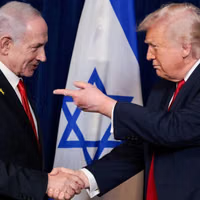
Price again insisted that the current crisis with Iran’s nuclear program is the result of former president Donald Trump pulling out of the JCPOA in 2018, in “an ill-considered or perhaps unconsidered decision...” He reiterated that Trump’s move and imposition of ‘maximum pressure’ sanctions did not produce the desired results, and “Quite the opposite is true. “
But the Biden Administration policy of trying to restore the JCPOA, that Trump and other critics deemed insufficient to stop Iran from becoming a nuclear power, has also not succeeded.
Iran began its higher-level uranium enrichment at 60 percent purity after President Joe Biden’s election, just weeks before the Vienna talks began last April.
With reporting by Reuters