Kuwait condemns Iranian drone attack, says it reserves right to self-defense
Kuwait on Thursday condemned an Iranian drone attack on its “vital sites” and said it reserved the right to take all necessary measures to defend its territory and protect key facilities.
The attack killed two Italian nationals, wounded a Kuwaiti citizen and a Pakistani national, and caused property damage, Kuwait’s foreign ministry said.
The ministry accused Iran of violating Kuwait’s sovereignty, the UN Charter and UN Security Council Resolution 2817. It warned that continued Iranian attacks threatened regional stability and undermined diplomatic efforts to ease tensions.
Kuwait cited its right to self-defense under Article 51 of the UN Charter. It also offered condolences to Italy’s government and people.
A medical worker attends to a patient at a hospital in Iran.
Weak oversight and financial strain in Iran's healthcare system have left patients facing demands for under-the-table payments, some running to billions of rials for essential treatment, the state news agency IRNA reported on Wednesday.
IRNA called the practice, known in Iran as zirmizi, or "under the table," a possible form of "modern-day extortion" that exploits patients' dependence on their doctors and their fear of losing treatment.
Patients have reported demands for hundreds of millions of rials for routine operations such as removing an appendix or tonsils, and several billion rials for specialized treatment such as bone marrow procedures, IRNA said. One hundred million rials is about $36, and 3 billion rials about $1,070, at a time when the monthly minimum wage is about 166 million rials, or $59.
The payments fall outside insurance and can bypass hospital accounts through cash, personal bank accounts, intermediaries and installments. Patients have told Iran International that some doctors demanded cash or gold coins before performing surgery.
Fear of delayed surgery, retaliation or losing follow-up care keeps many patients from reporting unauthorized charges, which weakens a system of oversight that depends on formal complaints.
Many cases referred to the Government Discretionary Penalties Organization end in acquittal for lack of evidence, such as missing receipts, Deputy Health Minister Sajjad Razavi told local media last month.
There are no reliable figures, said lawmaker Mohammad Jamalian, who heads a parliamentary committee investigating the payments, because so few violations lead to complaints.
In August, the head of the Medical Council, Mohammad Raeeszadeh, cited a survey of more than 60,000 people in which only 5.6 percent said they had paid above approved rates. IRNA questioned the survey's method and whether it counted payments that went unreported.
Patients pay
Iranian patients are paying 55 to 75 percent of their healthcare costs out of pocket this year, and some medicine prices have risen 400 to 500 percent, Hosseinali Shahriari, chairman of parliament's Health Committee, said in September.
Nearly half of those who answered a voluntary Iran International audience survey from October 30 to November 3 said they had postponed treatment or medication because of rising prices. Rising costs have also pushed patients from private hospitals into overstretched public ones.
Much of the strain comes from the state itself. Hospitals and doctors say official tariffs are too low to cover costs, and some state-run basic and supplementary insurers are seven to eight months behind on their payments, Raeeszadeh has said.
None of that justifies unlawful charges, IRNA said, adding that fixing medical pricing and health financing was the job of policymakers, not patients. It called for insurers to pay on time, for transparent hospital billing, for protection for patients who report violations, and for disciplinary cases to be made public.
Mohammad Javad Fazel Lankarani speaks at the “Jurisprudence of Revenge” seminar in Qom on November 25, 2026, where he described revenge for injustices against society as a binding religious obligation to be pursued by the state and citizens.
A senior cleric in the Iranian seminary city of Qom said on Wednesday that avenging attacks on Islam and the Islamic Republic, including the killing of Ali Khamenei, is a religious duty that cannot be forgiven, and that ordinary believers must act if the state does not.
Ayatollah Mohammad Javad Fazel Lankarani set out his case at a seminar titled "The Jurisprudence of Revenge," attended by clerics, university professors and students.
If officials fail to carry out the duty of revenge, he said, responsibility passes to individuals able to act, provided they do not disrupt the Islamic political order.
His argument gives religious grounds for individuals to take revenge into their own hands, at a time when Iran's commanders are vowing revenge for Khamenei, who was killed in US-Israeli strikes on February 28, and Iran-linked plots against people abroad are before courts in Britain, the United States and Europe.
Revenge, not retribution
Fazel Lankarani drew a line between revenge and qisas, the retribution in kind that Islamic law prescribes for murder and bodily harm. Qisas requires the punishment to match the crime. Revenge, he said, covers a much wider range of offenses and requires no such match.
He based the legitimacy of what he called "earthly revenge" on the Quran's depiction of God as an avenger, citing verses that name disbelief, persistent sin, crime and oppression as grounds for divine vengeance against societies.
Ruhollah Khomeini's grandson, Hassan Khomeini, stands next to Iran's slain former Supreme Leader Ali Khamenei.
A duty no one can forgive
Quranic verses that urge patience and forgiveness apply only to personal wrongs, Fazel Lankarani said. When an injustice is done to society, religion or the Islamic political system, the right to revenge belongs to the whole community.
He cited the killing of Khamenei, of military commanders, and children in the southern city of Minab as cases where revenge, not qisas, is a religious duty.
Drawing on Shiite tradition, he also suggested extending the role of vali-ye dam, the heir entitled to demand retribution for a killing, to the entire community of believers. Because religious leaders are spiritual fathers to the faithful, he said, avenging their deaths could become a right all believers share.
Once revenge is religiously required, he said, an Islamic state is bound to pursue it, and cannot waive it by forgiving the offender. That limits the room officials have to choose not to retaliate.
From fatwa to violence
Religious rulings have been used before to sanction violence by individuals far from Iran.
Ruhollah Khomeini, the founder of the Islamic Republic, issued a fatwa in 1989 calling for the killing of the novelist Salman Rushdie, who was stabbed and badly wounded on stage in New York in 2022.
A dynasty of clerics
Fazel Lankarani is the son of the late Grand Ayatollah Mohammad Fazel Lankarani, a marja-e taqlid, or senior religious authority whom Shiite Muslims follow on religious and legal matters. He now heads the jurisprudence research center his father founded in Qom in 1997.
He is part of a pattern of clerical families keeping religious institutions and political influence across generations. The most prominent example is Supreme Leader Mojtaba Khamenei, who succeeded his father this year.
Satellite imagery shows construction at Iran’s Behjatabad underground facility on November 24, 2026. (Vantor Technologies/Institute for Science and International Security)
Iran is rapidly constructing a fortified underground complex between two of its main nuclear sites that could house weapons systems or infrastructure linked to its nuclear program, a Washington-based research institute said on Wednesday.
“The function of the facility is not clear at this time. More information is needed to make an accurate assessment,” the Institute for Science and International Security said in a post on X.
The Behjatabad facility stands out among similar underground complexes built across Iran for its unusually rapid pace of construction, according to the institute, which published satellite imagery provided by Vantor Technologies.
The complex lies midway between the Isfahan nuclear site and Pickaxe Mountain near Natanz, approximately 62 kilometers from each. Its outer security perimeter is expected to encompass roughly 12,000 acres (5,000 hectares).
The site's security measures, the nature and pace of construction and Iran’s previous construction practices suggest the complex could serve several military purposes, including housing missile systems or other major weapons systems, the institute said.
“A nuclear purpose cannot be ruled out,” it added.
The facility was first identified by satellite imagery analyst Ben Tzion Macales, who said in a November 17 post on X that construction activity had accelerated following Operation Epic Fury, the US military campaign against Iran earlier this year.
The scale of construction activity was such that progress could be tracked even using relatively low-resolution Sentinel-2 satellite imagery, Macales added.
Satellite imagery reviewed by Vantor showed that initial construction activity began in December 2025 and expanded considerably throughout 2026.
The institute said it would publish additional satellite imagery and a more detailed assessment of the facility in a forthcoming report.
Rebuilding nuclear infrastructure
Construction of the Behjatabad complex comes as the Islamic Republic has sought to rebuild and reinforce some of its underground facilities following attacks on its nuclear and military infrastructure during the 12-day and 40-day wars.
An assessment published by the institute on November 21, 2025, five months after the 12-day war, found that the June attacks on Fordow, Natanz and Isfahan had inflicted extensive and, in some cases, catastrophic damage on Iran’s nuclear infrastructure.
Iran was unable at the time to enrich uranium on a significant scale or manufacture large numbers of centrifuges and had made little progress in restoring its damaged capabilities, according to the assessment.
Researchers warned, however, that the destruction of Iran’s main enrichment facilities did not mean all of its sensitive nuclear capabilities had been eliminated.
Satellite imagery at the time showed activity consistent with debris removal, equipment recovery and efforts to reinforce some facilities.
Remaining nuclear facilities
Among the facilities examined by the institute was Pickaxe Mountain, an underground complex near Natanz that was not targeted during the 12-day war in June 2025.
Iran announced in 2020 that it intended to establish a facility capable of assembling thousands of centrifuges annually at the complex.
Construction of the new facility was approaching completion by November 2025, according to the institute’s assessment.
Researchers identified Pickaxe Mountain as one of the potential sites where Iran could restore parts of its centrifuge manufacturing and assembly capabilities or potentially resume uranium enrichment.
The institute also examined reconstruction at Taleghan 2, a facility within the Parchin military complex that was targeted by Israel in October 2024.
Satellite imagery from 2025 showed extensive reconstruction at the site, including the installation of a cylindrical structure that researchers assessed could have applications in nuclear weapons-related research. Its intended function had not been independently confirmed.
Satellite imagery shows the tunnel complex under construction at Iran’s Behjatabad underground facility on November 24, 2026. (Vantor Technologies/Institute for Science and International Security)
At least three sites associated with possible weapons-related activities had undergone clearance work following attacks, the institute said in its November 2025 assessment.
Uncertainty over enriched uranium stocks
The whereabouts and condition of Iran’s stockpile of some 440 kilograms of uranium enriched to 60% remain among the major unresolved questions surrounding its nuclear program.
Restrictions on access to Iranian nuclear facilities had prevented the International Atomic Energy Agency from fully accounting for the stockpile, the institute said in its November 2025 assessment.
The agency assessed at the time that the material had probably not been removed from the main nuclear sites at Isfahan, Fordow and Natanz, although it could have been relocated within those complexes.
Satellite imagery alone cannot establish what activities are taking place inside Iran’s underground facilities, where its enriched uranium is stored or the condition of its nuclear equipment, according to the institute.
The rapid construction at Behjatabad adds to the growing importance of underground facilities in assessing the future of Iran’s nuclear and military programs.
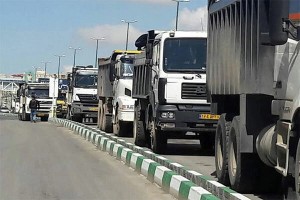
Trucks line in Isfahan, central Iran, during a strike on November 25, 2026.
Iranian truck drivers entered a fifth day of strikes on Thursday, with their union saying drivers in 18 cities were refusing to haul freight at rates that have stayed flat as the cost of keeping a truck on the road has climbed.
The Union of Truck Drivers and Trucking Associations Across Iran named Isfahan, Kermanshah in the west and Kazerun in the southern province of Fars among the cities in a message to drivers on Telegram. Truckers in Shiraz stopped work on Sunday, the day the strike began.
The union urged drivers to hold out for higher rates, saying that when one driver agreed to carry a load for next to nothing, others lost out too.
"Tires are priced in dollars, oil is priced in dollars, diesel is priced in dollars," the union said. "So freight rates have to reflect reality too." The rial fell past 2.8 million to the dollar on the open market this week, a record low.
Drivers also face higher insurance premiums, tolls and repair bills, according to the union. "Until we get what we're owed, we won't haul freight," it said.
Diesel shortages, limited supplies of engine oil and tires, and the rising cost of maintaining an aging fleet threatened freight transport across Iran, the union said in a separate statement.
Factories rely on the same trucks to move their goods as farmers do to get crops to market, it said. If those problems persist, production, distribution and prices would all be affected. Farmers had voiced support for the drivers on Wednesday, the union said.
Most of Iran's goods move by road, so truckers' strikes can quickly be felt in shops and markets. In 2018, a truckers' strike over pay and costs spread to hundreds of cities, and the judiciary threatened strikers with harsh punishment.
Syrian forces have seized weapons smuggled from Iran's Revolutionary Guards that were bound for Lebanon, US Central Command said on Wednesday, the latest in a string of seizures as Damascus and Beirut move to choke off the routes that once kept Hezbollah armed.
Syria's interior ministry announced two seizures of weapons bound for Lebanon in the countryside around Damascus, on November 20 and 22, and arrested one suspect.
On November 22, the Lebanese army said it had seized 264 kilograms of explosives, including about 203 kilograms of C4, smuggled from Syria, and arrested three people.
Syria's drug enforcement department also seized what CENTCOM called "enormous quantities" of Captagon pills at the border with Lebanon this month.
"Syrian Internal Security Forces confiscated weapons smuggled from Iran's Islamic Revolutionary Guard Corps that were bound for Lebanon," Admiral Brad Cooper, the CENTCOM commander, said in a statement.
"These efforts support a stable, unified, and peaceful Syria and reinforce regional security and stability."
A land bridge cut
For decades, Syria was Iran's main route to Hezbollah. Weapons moved from Iran through Iraq, crossing into Syria at Al-Bukamal on the Iraqi border, and on to Lebanon's Bekaa Valley through official and unofficial crossings, with the help of Bashar al-Assad's government and its security forces.
Revolutionary Guards forces and Iran-backed militias were based across the country.
The fall of Assad in December 2024 cut that route. Syria's new government, many of whose leaders fought against Assad, Hezbollah and the Guards during the civil war, has made a point of intercepting arms bound for the group and naming it in its announcements.
The smuggling has adapted rather than stopped. In July, Syrian authorities seized advanced weapons bound for Hezbollah hidden in a tanker traveling from Iraq.
Much of what is now intercepted on the way to Lebanon is believed to be weapons Hezbollah stockpiled in Syria during the Assad years.
Captagon
Under Assad, Syria became the world's largest producer of Captagon, an amphetamine-type pill smuggled across the Middle East, in a trade worth billions of dollars a year that Western governments said was run with the involvement of senior figures in his government.
The new authorities have made seizures a public priority, and Washington has rewarded the shift: the United States lifted most of its sanctions on Syria in 2025, and in August removed it from its list of state sponsors of terrorism.
Pressure in Lebanon
The seizures come as Lebanon's government tightens its own stance. It banned Hezbollah's military activities in March, after the group joined the war in support of Iran, and ordered the detention and deportation of people linked to the Revolutionary Guards.
"Do not ask Lebanon to accept what you would not accept for your own country," President Joseph Aoun said on Saturday, addressing Iran's leaders.