Iranian cleric says believers must avenge Khamenei if the state does not
Mohammad Javad Fazel Lankarani speaks at the “Jurisprudence of Revenge” seminar in Qom on November 25, 2026, where he described revenge for injustices against society as a binding religious obligation to be pursued by the state and citizens.
A senior cleric in the Iranian seminary city of Qom said on Wednesday that avenging attacks on Islam and the Islamic Republic, including the killing of Ali Khamenei, is a religious duty that cannot be forgiven, and that ordinary believers must act if the state does not.
Ayatollah Mohammad Javad Fazel Lankarani set out his case at a seminar titled "The Jurisprudence of Revenge," attended by clerics, university professors and students.
If officials fail to carry out the duty of revenge, he said, responsibility passes to individuals able to act, provided they do not disrupt the Islamic political order.
His argument gives religious grounds for individuals to take revenge into their own hands, at a time when Iran's commanders are vowing revenge for Khamenei, who was killed in US-Israeli strikes on February 28, and Iran-linked plots against people abroad are before courts in Britain, the United States and Europe.
Revenge, not retribution
Fazel Lankarani drew a line between revenge and qisas, the retribution in kind that Islamic law prescribes for murder and bodily harm. Qisas requires the punishment to match the crime. Revenge, he said, covers a much wider range of offenses and requires no such match.
He based the legitimacy of what he called "earthly revenge" on the Quran's depiction of God as an avenger, citing verses that name disbelief, persistent sin, crime and oppression as grounds for divine vengeance against societies.
Ruhollah Khomeini's grandson, Hassan Khomeini, stands next to Iran's slain former Supreme Leader Ali Khamenei.
A duty no one can forgive
Quranic verses that urge patience and forgiveness apply only to personal wrongs, Fazel Lankarani said. When an injustice is done to society, religion or the Islamic political system, the right to revenge belongs to the whole community.
He cited the killing of Khamenei, of military commanders, and children in the southern city of Minab as cases where revenge, not qisas, is a religious duty.
Drawing on Shiite tradition, he also suggested extending the role of vali-ye dam, the heir entitled to demand retribution for a killing, to the entire community of believers. Because religious leaders are spiritual fathers to the faithful, he said, avenging their deaths could become a right all believers share.
Once revenge is religiously required, he said, an Islamic state is bound to pursue it, and cannot waive it by forgiving the offender. That limits the room officials have to choose not to retaliate.
From fatwa to violence
Religious rulings have been used before to sanction violence by individuals far from Iran.
Ruhollah Khomeini, the founder of the Islamic Republic, issued a fatwa in 1989 calling for the killing of the novelist Salman Rushdie, who was stabbed and badly wounded on stage in New York in 2022.
A dynasty of clerics
Fazel Lankarani is the son of the late Grand Ayatollah Mohammad Fazel Lankarani, a marja-e taqlid, or senior religious authority whom Shiite Muslims follow on religious and legal matters. He now heads the jurisprudence research center his father founded in Qom in 1997.
He is part of a pattern of clerical families keeping religious institutions and political influence across generations. The most prominent example is Supreme Leader Mojtaba Khamenei, who succeeded his father this year.
Russian President Vladimir Putin, Chinese President Xi Jinping and U.S. President Donald Trump arrive for a trilateral meeting at Kylin Villa on November 19, 2026 in Shenzhen, China. The three leaders are meeting on the sidelines of the 33rd Asia-Pacific Economic Cooperation (APEC) Economic Leaders' Meeting hosted by China on November 18-19.
Iranian officials and commentators are divided over whether Donald Trump, Xi Jinping and Vladimir Putin struck a secret deal over Iran in Shenzhen, after a joint statement that never mentioned Tehran and a US claim that Xi and Putin had agreed with Washington on Iran.
Trump had said he would raise Iran with the Chinese and Russian leaders at their summit on November 19. But the final statement made no reference to Iran, the Strait of Hormuz or Tehran's nuclear program.
Two days later, US Treasury Secretary Scott Bessent said otherwise. "It was very interesting in Shenzhen, President Xi, President Putin both agreed they can never have a nuclear weapon and that the Strait of Hormuz should be open to free and open navigation," he said in a television interview.
Foreign Ministry spokesman Esmail Baghaei said on Monday that Tehran had been in contact with Moscow and Beijing, which he called friends of Iran, both before and after the summit. "Decisions about Iran are not made anywhere other than Tehran," he said.
'Didn't take the bait'
The state news agency IRNA argued that neither China nor Russia had reason to back Washington's campaign against Tehran, in an article titled "Trump Took the Iran File to Shenzhen, But Beijing and Moscow Didn't Take the Bait."
Beijing could not endorse US pressure on Iran in an official statement without hurting its own economic interests, IRNA said, while Russia had little reason to help weaken a strategic partner when doing so would strengthen the United States and Israel at Moscow's expense.
"The Shenzhen summit showed that Iran was both a subject of discussion and an issue over which the three powers failed to reach a consensus. This lack of consensus does not indicate that Tehran is unimportant; rather, it reflects the depth of disagreement between Washington, Beijing and Moscow over how to resolve the Iran issue," the article said.
Fears that Iran could be 'sold out'
Before the summit, some Iranian political figures had warned that Trump might win Chinese and Russian help in pressuring Tehran by offering them concessions on Taiwan and Ukraine.
"The three leaders meeting in Shenzhen have no plan to end the war and blockade against Iran. They want to divide the cake of the new world order among themselves ... I believe Iran is not the main issue but part of the deal," Heshmatollah Falahatpisheh, a former chairman of parliament's National Security and Foreign Policy Committee, wrote on X.
Ahmad Salehi, an analyst of Iran-China economic relations, rejected that view on Khat-e Energy, an online talk show run by a hardline outlet, on Sunday. Those who say China and Russia sold Iran out have offered no evidence, he said, and any deal involving Iran would have left some trace in the summit's outcome or in reports of the talks.
Mohammad Mehdi Mazaheri, a former adviser to the late president Akbar Hashemi Rafsanjani, made a similar case in an article for the Khabar Online news site on Sunday.
"It appears that at the Shenzhen summit, Washington did not offer Beijing and Moscow an enticing proposal or a sufficiently convincing strategic incentive to persuade them to sacrifice their regional leverage and put pressure on Iran," he wrote.
Thailand's Prime Minister Anutin Charnvirakul, Malaysia's Prime Minister Anwar Ibrahim, Canada's Prime Minister Mark Carney, Australia's Prime Minister Anthony Albanese, New Zealand's Prime Minister Christopher Luxon, Russia's President Vladimir Putin, China's President Xi Jinping, US President Donald Trump and South Korea's President Lee Jae-myung pose for a group photo during the Asia-Pacific Economic Cooperation (APEC) Summit in Shenzhen, in China's southern Guangdong Province on November 19, 2026.
A deal on the blockade?
Another theory, which spread through hardline media and social media last week, held that China and Russia had agreed with Trump to let Iranian tankers pass more freely through the US naval blockade. Online, it was tied to reports that 14 Iranian tankers had crossed the blockade, claims that Iranian officials later denied.
"Whether a behind-the-scenes deal was made is something we cannot judge because we simply do not know," Salehi said.
Iran should resolve the blockade itself rather than wait for a deal between foreign powers, he said.
Like several hardline figures, he proposed sending a fleet of tankers to their destinations, holding the United States responsible for any attack on them, and retaliating by striking targets Iran had already identified.
China’s President Xi Jinping (C), US President Donald Trump (R) and Russia’s President Vladimir Putin (L) hold a trilateral meeting on the sidelines of the Asia-Pacific Economic Cooperation (APEC) China Summit in Shenzhen, Guangdong province, China, 19 November 2026.
'Shenzhen that did not become Yalta'
Trump drew his own historical parallel. In a Truth Social post, he compared Shenzhen to the Tehran Conference of 1943 and the Yalta Conference of 1945, where Allied leaders shaped the world order after Nazi Germany's defeat, and shared a photo of himself with Xi and Putin that recalled the famous picture of Roosevelt, Churchill and Stalin in Tehran.
When those three met, Iran was under British and Soviet occupation. The Tehran Conference opened on November 28, 1943, so its anniversary falls this week.
"The world has changed; the current world order cannot be restored to the past with old photographs," Mohsen Rezaei, secretary of the Supreme National Security Council, wrote in response.
In an article titled "Shenzhen That Did Not Become Yalta," published on Saturday by the Ettelaat newspaper, Middle East analyst Mohammad-Ali Mohtadi argued that the summit's main lesson for Iran was not to let its future become a bargaining chip between major powers.
Tehran should keep its decisions in its own hands, strengthen its ties with China and Russia, and use their differences with Washington to its advantage, he wrote.
The debate reflects a broader worry in Tehran: whatever its ties to Beijing and Moscow, it cannot assume either will put Iran's interests ahead of its own when dealing with Washington
Members of Iran's Basij paramilitary force, a branch of the Islamic Revolutionary Guard Corps (IRGC), which has played a major role in suppressing anti-government protests across the country.
Iran's military chiefs marked Basij Week by hailing the militia as a global power the United States and Israel cannot neutralize, months after Mojtaba Khamenei set its new commander the goal of making "every Iranian a Basiji."
Iran's military chiefs marked Basij Week by hailing the militia as a global power the United States and Israel cannot neutralize, months after Mojtaba Khamenei set its new commander the goal of making "every Iranian a Basiji."
"None of the strategies of the American and Zionist enemies can predict or neutralize it," Brigadier General Abolfazl Shekarchi, the armed forces' senior spokesman, said in a message for the week, which peaks on Thursday, the 47th anniversary of the Basij's founding. He called it "the most invincible force in the world."
The chief of staff of the armed forces, Major General Ali Abdollahi, said on Wednesday that the Basij had become "more than an organization" and called for its role to be expanded in science and technology, society and defense, as part of Iran's push for "absolute deterrence."
The tributes come as the militia is being rebuilt and expanded. Its commander, Gholamreza Soleimani, was killed in US-Israeli strikes during the war. In August, Khamenei appointed Hossein Taeb, a cleric and former intelligence chief of the Revolutionary Guards, to replace him.
Taeb led the Basij once before, in 2008 and 2009, the year of the crackdown on protests over the disputed presidential election. His appointment decree set the expansion goal of "every Iranian a Basiji," and the Guards have since opened registration for 1,000 new "Janfada" (devotee) national resistance battalions.
Human rights groups know the Basij for something else: its role in crushing every major wave of protest in Iran for decades.
Basij forces take part in an urban military drill in Iran, with a billboard in the background depicting slain IRGC commander Qassem Soleimani saluting the late supreme leader Ali Khamenei.
A force in every neighborhood
Ruhollah Khomeini, the founder of the Islamic Republic, created the Basij, meaning "mobilization," in November 1979. It is formally a volunteer paramilitary force and one of the five branches of the Revolutionary Guards.
Its strength is its reach. The Basij runs "resistance bases," usually housed in mosques, in neighborhoods across the country, under a Guards' rule from 1982 that called for a cell in every neighborhood, working with local clerics and community figures. Student Basij units operate in schools, and Basij branches sit inside universities.
It also extends into the state itself. Government ministries, state companies and public bodies host their own Basij branches, and there are separate Basij organizations for civil servants, workers, merchants, doctors, engineers, lawyers, artists and tribes. Each draws office space, staff time and funding from the institution that hosts it, so much of the militia's real cost never appears under its own name.
That network does more than mobilize volunteers. Basij members have raided private parties where alcohol is served and detained women for breaking the mandatory dress code.
They also gather intelligence. An Iran International investigation in September found that a Basij-affiliated cultural group in the northeastern city of Fariman helped security forces identify people who took part in the January protests, leading to 23 arrests.
The same structure fills the streets for the state. Basij bases have long supplied the crowds for official rallies, from the anniversary of the revolution to Quds Day and the counter-protests staged after the 2009 unrest. Since the war began in February, the state has held nightly rallies that officials say have now passed 260 nights.
Perks and budgets
Membership brings material rewards, which have become a major reason people join: preferential university admission, an edge in government hiring, subsidized loans and shorter compulsory military service.
The state pays for it in many places at once. The Basij has its own line in the national budget, which rose by 45 percent in the budget bill for the year to March 2023, to 30.8 trillion rials.
A study of the following year's budget by Iran Open Data found at least 5.7 trillion tomans, then about $105 million, allocated to the Basij, its industrial arm and affiliated "jihadi" groups, spread across six separate clauses.
They included free bitumen from the oil ministry to pave Basij bases, free land from the roads ministry for Basij centers, and marriage and childbirth loans for members. Because the funding is scattered and its businesses undisclosed, the group said, the full figure could not be calculated.
The militia also has a business empire. In 2018, the US Treasury sanctioned a network of companies built around the Basij Cooperative Foundation, with stakes in banking, manufacturing and mining, saying it helped fund the force's recruitment of child soldiers.
A child soldier holds a rifle during the 1980–1988 Iran-Iraq War. Iran's then-supreme leader Ruhollah Khomeini once called child soldiers the country's “real leaders,” encouraging their participation in the war.
Every crackdown
Basij members, often in plain clothes and working alongside uniformed police, have been implicated in beatings, arbitrary arrests and killings of protesters.
In 2009, Human Rights Watch documented Basij members attacking peaceful demonstrators, raiding university dormitories and beating detainees.
The militia played a leading role in suppressing the November 2019 protests over fuel prices and the 2022 uprising after the death of Mahsa Amini in morality police custody. Amnesty International identified Basij battalions among the forces responsible for the mass killings of protesters in the January massacre.
Child recruits
The militia has a long history of recruiting children. In March 2026, the Revolutionary Guards launched a recruitment drive through mosque-based Basij centers that accepted children as young as 12.
Amnesty International later documented armed children at security checkpoints and said that recruiting children under 15 was a war crime.
The United States has sanctioned the Basij and several of its commanders over serious human rights abuses against Iranians.
Russian President Vladimir Putin, Chinese President Xi Jinping and U.S. President Donald Trump arrive for a trilateral meeting at Kylin Villa on November 19, 2026 in Shenzhen, China.
A sense of strategic disappointment has emerged across Iran’s political spectrum over the limits of Russian and Chinese support during the 2026 war and the US naval blockade that followed.
Rather than advocating a break with Moscow or Beijing, however, Iranian officials and commentators increasingly describe Russia and China as self-interested great powers, not reliable partners.
The prevailing view is that diplomatic backing in Vienna, home to the IAEA, and at the United Nations in New York cannot break the US blockade or ease Iran’s economic crisis.
The belief that a Russia-China-Iran alignment could offset American military and economic power in a direct confrontation, promoted by some Iranian officials and media until recently, has largely faded from Tehran’s political discourse.
In its place is a more sober assessment: Moscow and Beijing may provide diplomatic support and political cover, but Iran ultimately stands alone in confronting the United States in the Persian Gulf.
Doubts have deepened since the Trump-Xi-Putin summit in Shenzhen on November 19. The summit’s four-point declaration made no mention of Iran, prompting figures from reformists to hardliners to warn against mistaking Russian or Chinese rivalry with Washington for a commitment to defend Tehran’s interests.
Zarif and Javan
Most strikingly, the Revolutionary Guards-affiliated hardline daily Javan and former foreign minister Mohammad Javad Zarif, a leading figure of the reformist-pragmatist camp, reached remarkably similar conclusions from opposite ends of Iranian politics. Others have since echoed them.
“Neither in war nor in peace will anyone defend us; we must stand on our own feet,” Zarif said at a book signing in Tehran on Thursday. He had warned on October 2 that although Iran should keep strategic relations with Russia and China, those ties “must not lead to dependence on the East.”
Relying too heavily on either power, he said, weakens Iran’s leverage with both Washington and its neighbors.
Javan’s editor-in-chief, Gholamreza Sadeghian, put Russia and China in the same category as the United States, arguing that Moscow and Beijing benefit from what he called a “conscientious and cost-free” opposition to any change in Iran’s nuclear doctrine.
In his view, keeping Iran non-nuclear serves all three powers, while Iran alone bears the economic and military costs of confrontation.
The remarks stood out for three reasons. Zarif, who backed cooperation agreements with Russia and China as foreign minister under President Hassan Rouhani, now sounds more skeptical of relying on the East. Javan has traditionally portrayed China and Russia favorably. And Sadeghian’s reference to a possible “change in Iran’s nuclear doctrine” appeared to signal openness to revisiting one of the Islamic Republic’s longstanding taboos: building nuclear weapons.
Reformists, conservatives and clerics
On Monday, the reformist international relations professor Mohammad Javad Haghshenas argued that Moscow and Beijing negotiate around their own priorities, including Ukraine and Taiwan. A partnership has value, he said, only if it advances the security, development and welfare of Iranians, not if it serves as a bargaining chip for other powers.
Similar themes have come from conservative and religious circles. On Saturday, Massih Mohajeri, editor-in-chief of Jomhouri Eslami, argued that Washington’s failure to win anti-Iran commitments from Xi and Putin in Shenzhen was not in itself a diplomatic success for Tehran.
He urged policymakers to address Iran’s economic and social problems at home instead of counting on tensions among the major powers.
Official outlets such as IRNA continue to stress Russian and Chinese diplomatic support, including their joint statement at the IAEA on November 19 and their speeches at the UN Security Council condemning US-Israeli actions. But economic commentators and political analysts are increasingly asking what Russia’s and China’s interests actually are, and how closely they align with Iran’s.
Rhetoric and reality
Economic analysts point to a widening gap between words and deeds. China’s independent refiners, known as “teapots,” have reportedly stopped importing Iranian crude by sea since September, fearing US interdiction and secondary sanctions.
Iran has not had a single full month of crude exports since, despite Beijing’s repeated criticism of unilateral US sanctions.
The conservative Mehr news agency noted in a November 21 analysis that Russia “lacks the ideological, military and industrial capacity of the Soviet Union” and faces serious problems of its own.
Even conservative politicians have begun to emphasize Iran’s independence over the promise of a “Look East” policy.
On November 21, Abbas Moghtadaei, deputy chairman of parliament’s National Security Committee, said Iran makes its decisions solely on the basis of national interests and “seeks permission from no outside power, whether in Washington, Beijing or Moscow.”
Foreign Ministry spokesman Esmaeil Baghaei struck a similar note at his November 23 briefing. While still calling Russia and China “our friends,” he sought to reassure Iranians that “decisions regarding Iran are not made anywhere outside Tehran.”
All these remarks suggest a broader shift in Iranian political thinking. The debate is no longer about whether relations with Russia and China should continue, but about what they can realistically deliver. Across much of Iran’s political spectrum, expectations have dropped sharply, and the emphasis has moved from dependence to self-reliance.
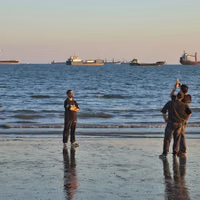
People on the waterfront in Bandar Abbas, Iran’s main port on the Strait of Hormuz, November 20, 2026.
Iranian state media and officials have denied that Iran was about to send tankers through the US naval blockade, after four days in which Guards-linked outlets, lawmakers and Friday prayer leaders spread the claim and AI-generated images showed ships breaking through.
The denials began on Sunday, the same day President Donald Trump said that if Iranian ships tested the blockade, “they’ll all be at the bottom of the sea like the rest of the navy.”
How the story grew
The reports began on Thursday, when the oil tracker TankerTrackers said Iran appeared to be preparing to ship out oil again. The Revolutionary Guards-affiliated Fars news agency had already published a commentary proposing a tanker convoy to break the blockade, and many readers took it as an operational plan.
The claims did not come only from commentators and social media. Friday prayer leaders in several cities called for the blockade to be broken, and some said tankers would soon sail from Kharg Island for China. Lawmakers repeated the claim over the weekend, and Foreign Minister Abbas Araghchi said on Friday that “the blockade must be broken.”
Hardliners welcomed the prospect of a confrontation. Propaganda images and videos, some built from real footage and others generated with artificial intelligence, claimed that an Iranian tanker named Khat Shekan, or “Line Breaker,” had crossed the blockade on Saturday. On Sunday, claims that 14 tankers had crossed spread widely online.
TankerTrackers said no tanker called Line Breaker existed. It also said an Iran-linked liquefied natural gas tanker named Tania Star that appeared in ship-tracking data on Sunday was a spoof, and that the vessel did not exist.
‘No basis in reality’
The Guards-affiliated Tasnim news agency said on Sunday that no operation had been planned for the weekend. The claims, it said, grew out of “a series of proposals by some individuals in the media or on social media,” and people had stitched together reports, some unrelated, to suggest an operation on Saturday or Sunday.
But Tasnim said Iran would not put up with the blockade forever. “Whether Iran will tolerate the naval blockade in the long term is not an issue of uncertainty; it will certainly break it, and this has been repeatedly stated by official military and civilian officials,” it said.
Iran was planning measures against the blockade and had prepared equipment and logistics, Tasnim said, but claims of an operation in the past day or two had “no basis in reality.” It accused people it called “capitulationists” of hoping to present a failed operation as proof that Iran had run out of options and should give in, and said the “enemy front” wanted to paint it as the failure of an Iranian military strategy.
Foreign Ministry spokesman Esmail Baghaei called the reports “media speculation” on Monday, blaming news sites, Telegram channels and other social media.
The state news agency IRNA, citing an account called the “War Message Center,” said no tanker convoy was moving toward the blockade as described or at the time claimed. The reports came from misreadings of ship-tracking data and speculation that hardened into claims of a confirmed operation through reposting, it said.
Iran’s response to the blockade was not limited to “a media scenario,” it said, and there were ways to get around or break the blockade whose details were not necessarily made public.
It is not clear who runs the War Message Center. It has not said it belongs to any state body, though accounts under that name have published war news and military statements since March.
‘Zero hour’
Nour News, which is close to the Supreme National Security Council, said on Sunday that the episode should not be judged only by whether an operation was confirmed or denied. The time for Iran to decide on breaking the blockade was “approaching rapidly,” it said, and everyone from Washington to regional governments and mediators should prepare for the coming “zero hour.”
Ending the blockade was becoming a public demand, it said, and the diplomatic window was not unlimited.
Mehdi Kharratian, a hardline commentator, told state TV’s Jahan Ara program on Sunday that he had not confirmed the tanker reports but that such news could influence decision-makers.
He urged officials to act, whether by halting all oil traffic through the Strait of Hormuz, confronting the UAE over what he called smuggling through the strait’s southern channel, or targeting ships heading for Arab ports.
“Ultimately, there are several solutions, and one of them has to be implemented,” he said.
Another hardline commentator, Ruhollah Jomei, wrote on X that the “project” had achieved its goals by stepping up regional diplomacy to lift the blockade. Regional capitals had been made to understand that “the Strait of Hormuz is either for everyone or for no one,” he wrote.
Fereydoun Majlesi, a former diplomat, told the Fararu news site that holding back a tanker operation, or denying it, showed “timely rationality.” The publicity and the threat of a US military response could have turned a maritime operation into a trap and a wider war, he said. “I believe we should not put the country in a position from which it would be difficult to exit, and which could cause damage that cannot be repaired.”
‘Lose-lose’
Some pro-government social media users asked why the reports had been allowed to run for days before being denied.
One, Abuzar Mashayekhi, suggested the reports had been a security operation to test reactions abroad, including in Arab countries, and public opinion at home, and that the late denial may have been deliberate.
Others said the confusion had damaged public trust. A user named Ario wrote on X that if the reports had only been meant to test the US response and measure support at home, the outcome was “lose-lose.” “Both the pragmatic credibility [of the approach] and social capital would be damaged,” the user wrote.
A screengrab from the March 2026 meeting of the Assembly of Experts where Mojtaba Khamenei was chosen as Iran's Supreme Leader.
Iranian state media left the location unnamed when they released footage of a March meeting where clerics chose Mojtaba Khamenei to succeed his father. However, a detail at the front of the room helped identify it.
The Assembly of Experts, the clerical body tasked under Article 107 of Iran’s constitution with choosing the supreme leader, met after Ali Khamenei was killed in US-Israeli strikes on February 28.
Two members date the meeting to March 8. The Assembly publicly named his son as his successor shortly after midnight the following day, Tehran time.
Iranian state media released the 53-second video on November 22, more than eight months after the succession. An unidentified man announces that Mojtaba Khamenei received more than two-thirds of the vote. Assembly members respond with chants of “Allah Akbar” (God is greatest).
Khamenei himself does not appear. No independently verified photograph, video or audio recording of Khamenei from his time in office has surfaced. His directives have reached the public through undated statements and officials who relay his words. His absence has raised questions about whether he is alive and how much authority he exercises relative to the Islamic Revolutionary Guard Corps (IRGC).
The footage offers a rare look at how the clerics received the announcement. In interviews intercut with the meeting, members describe their fear of assassination and the security arrangements for getting them to the hall.
Mohsen Qomi, a member of the Assembly’s presiding board, credited the Revolutionary Guards with making the meeting possible.
The video was circulated on Instagram with a caption describing it as the first footage of the announcement. A banner on screen makes the same claim. Neither identifies the venue or gives the day of the meeting.
Iran International had reported on March 5 that a session planned for that day would be held largely online and that at least eight members would stay away. The footage shows clerics gathered in person for the announcement.
How the hall was identified
At the front of the hall, a wall of decorative sandbags runs beneath a large screen. A wooden desk with three horizontal slots stands in front of it.
The same wall and desk appear in photographs of a provincial council meeting held in Qom six months later.
Figure 1. The dais. The sandbag wall in front of the LED screen (Red 1) and the wooden desk with three horizontal slits (Yellow 1) appear in both.
Defa Press published the photographs on September 22. Taken by Zeinab Zamani, they show Qom’s governor chairing the fifth session of the provincial administrative council the previous evening. The caption names the Isar Conference Hall at Qom’s Cultural Center and Museum of the Islamic Revolution and Holy Defense.
Figure 2. The seating. The five chairs on the right aisle (Green), the center block with distinct front-row seats (Yellow 2) and the portable table before the front row (Red 2) appear in both.
The seating provides a second match. Both sets of images show five chairs of the same type along the right aisle, a distinctive front row in the center block and a small table in front of it.
The annotations below mark the corresponding features.
How members dated the meeting
The screen behind the speakers reads “Special Meeting of the Assembly of Experts, Esfand 1404.” That month of the Iranian calendar ran from February 20 to March 20. The meeting took place after Ali Khamenei’s death on February 28 and before the Assembly announced his successor. Mehr News Agency carried the announcement at 3:17 a.m. on March 9 in Tehran, still March 8 GMT.
On March 9, Mehr quoted Assembly member Ahmad Khatami as saying the clerics had met in person in Qom the previous evening, the first of the Nights of Qadr, the holiest nights of Ramadan.
Qomi also dated the session to Sunday, March 8, in a statement carried by the state news agency IRNA. He said 59 of the Assembly’s 84 members attended and that the result was announced immediately. He estimated that Khamenei received about three-quarters of the vote.
A third member, Mostafa Hasanati, the Friday prayer leader of Najafabad, described an earlier attempt to vote individually. In a video published by Entekhab on November 23, he said members initially cast ballots one by one using sealed envelopes. Fearing the procedure would cast doubt on the result, they wrote that they wanted to meet in person “even if we are torn to pieces.”
Hasanati said it took three or four days to bring the clerics together on a Night of Qadr. Of the three possible evenings, only March 8 preceded the public announcement. The other two fell on March 10 and 12.
Like Qomi, Hasanati put attendance at 59. He said 49 voted for Khamenei, or 83% of those present. His tally and Qomi’s estimate both fit the description heard in the video, “more than two thirds.” The footage does not establish the exact count.
Hasanati said members had first tried to gather at the Fatima Masumeh Shrine in Qom, but called off the meeting when fighter jets flew overhead. Iran International reported on March 5 that the session planned for that day was to be run from a building next to the shrine.
Tasnim news agency reported that the Assembly’s seat in Tehran was struck on the night of March 2 and its secretariat in Qom the following day. Tasnim said the Qom building was empty at the time.
Qom’s deputy governor for political and security affairs later put the toll in the city’s Resalat Square at six killed and 30 wounded. The Assembly’s secretariat said three of its employees had been killed.
Neither account specified whether anyone was inside the secretariat when it was hit. Qomi referred to strikes on two Assembly buildings in Qom. The visual evidence places the succession meeting at the museum.
[@portabletext/react] Unknown block type "table", specify a component for it in the `components.types` prop
What the clerics recalled
The interviews give a sense of the precautions surrounding the vote and how little time the members spent together.
Reza Ramezani Gilani recalled being driven around for up to two hours. Mohammad Baqer Mohammadi Laeini said only Assembly members were present when they reached the venue.
Ali Abbasi put the time between arrival and departure at no more than 40 to 45 minutes. He did not say how much of that time the members spent deliberating.
Mohsen Mohammadi Araki said all members were targets for assassination. Hashem Hosseini Bushehri described the difficulty of making a decision during wartime.
The video also includes Rahim Tavakol saying, “We stand by our word.” The excerpt gives little context for the remark.
[@portabletext/react] Unknown block type "table", specify a component for it in the `components.types` prop
At the front of the hall, an unidentified man reads out the result.
“His Holiness Ayatollah Sayyed Mojtaba Khamenei with a majority of more than two thirds of the vote was introduced as the next Supreme Leader.”
The members respond with chants of “Allah Akbar.”
Figure 3. Google Maps satellite view of the Museum of Holy Defense on Avini North Boulevard, Qom (Plus Code: JV22+3XR), where the meeting was held.