EU, UK tell Iran to stop ‘hybrid attacks on European soil’ and Hormuz strikes
Britain's Prime Minister Andy Burnham, European Commission President Ursula von der Leyen and European Council President Antonio Costa attend a press conference, during the EU-UK summit, in Brussels, Belgium, November 20, 2026.
The European Union and Britain condemned Iran’s attacks on its neighbors and on shipping in the Strait of Hormuz on Friday, and demanded that Tehran stop its “hybrid attacks on European soil,” in a joint statement after a summit in Brussels.
“Iran must stop its destabilizing activities in the region and its hybrid attacks on European soil,” EU and British leaders said at the end of their second summit since Brexit. “Iran must never acquire a nuclear weapon and must cooperate fully with the IAEA.”
The leaders said they stood with their “regional partners” and backed diplomatic efforts to avoid further conflict, restore freedom of navigation through the strait and reach “a lasting diplomatic resolution” of both the Hormuz crisis and Iran’s nuclear program.
They also signed up to a “No Tolls/No Fees” pledge rejecting any measure that would hamper lawful navigation, a stand against Tehran’s attempts to charge ships for passage through Hormuz, and condemned attacks by Iran’s Houthi allies on Saudi Arabia and on shipping in the Red Sea.
Attacks across Europe
The statement follows a run of Iran-linked operations in Europe.
France blamed a Revolutionary Guards cyber unit for hacking refrigeration systems at about 700 supermarkets in October, and is investigating a similar attack on freezers at its national blood service.
In Britain, two men were convicted last week of spying on Iran International journalists for Iranian intelligence, and two men have been charged over an alleged plot against RAF Fairford, a base used by US bombers to strike Iran.
MI5 says Iran-linked operations have led to more than 50 arrests in Britain in the past year.
The leaders also agreed to cooperate more closely against hybrid and cyber threats, including by coordinating responses and imposing “costs on hostile actors.”
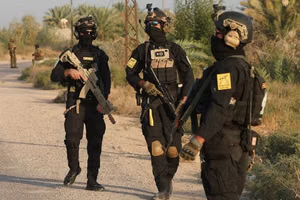
Members of the Iraqi police take part in a security deployment on the outskirts of Jurf al-Sakhar, Babil province, Iraq, November 20, 2026.
Iraqi forces began deploying on Friday in Jurf al-Sakhar, a town south of Baghdad held for more than a decade by Iran’s most powerful militia ally in Iraq, under a deal brokered by Shiite leaders days after the head of Iran’s Quds Force arrived in Baghdad.
A convoy flying Iraqi flags drove toward Jurf al-Sakhar on Friday, and hundreds of soldiers took up positions on the outskirts.
The yellow flags of Kataib Hezbollah were still flying farther inside the town, and none of the group’s fighters were visible. A security headquarters is due to open on Saturday to oversee the handover, with a unit assigned to protect energy facilities.
Under the deal, Kataib Hezbollah fighters are to withdraw to other parts of Iraq, Reuters reported, citing security officials. Al Arabiya, citing sources, said the withdrawal would be phased over a month. A joint command of the army, federal police, energy police and units of the Popular Mobilization Forces is taking over the town.
The standoff began on Monday, when Prime Minister Ali al-Zaidi ordered troops to prepare to enter Jurf al-Sakhar after an investigation accused Kataib Hezbollah of running a network that siphoned off hundreds of millions of dollars’ worth of state oil through tampered pipelines.
Nine senior security and oil officials were dismissed, and arrests linked to the case raised fears of an armed confrontation. The group denies the accusations and had warned it would resist any attempt to enter the town.
The same day, Esmail Qaani, commander of the Revolutionary Guards’ Quds Force, which runs Iran’s network of allied armed groups abroad, arrived in Baghdad to help defuse the crisis, Iraqi Shiite political sources told Reuters. Kataib Hezbollah said its leader, Abu Hussein al-Hamidawi, met Qaani and Hadi al-Amiri, head of the Iran-backed Badr Organization, in the talks that led to the deal.
A town nobody could enter
Jurf al-Sakhar, a Sunni farming town on the Euphrates about 50 kilometers south of Baghdad, was retaken from Islamic State in 2014 by the army and Shiite militias, Kataib Hezbollah among them. Its residents were never allowed back. More than 100,000 people from the town and surrounding villages remain displaced, Shafaq News reported, and even government officials have rarely been let in.
The town sits near the roads linking Baghdad with Karbala and Anbar province, and has served as a financial hub for evading sanctions on Iran, said Omar Mohammed, an Iraqi historian known for documenting life under Islamic State as Mosul Eye. He called the move “a theatrical show.”
“I think maybe the Iranian-backed militias will allow them some cosmetic gains, but there’s no way that Iran is going to allow its footprint in Iraq to disappear,” David Patrikarakos, a journalist and author of a book on Iran’s nuclear program, told Iran International earlier this week.
Iran’s strongest arm in Iraq
Kataib Hezbollah was founded after the 2003 US-led invasion of Iraq by Abu Mahdi al-Muhandis, who was killed alongside Quds Force commander Qassem Soleimani in a US drone strike at Baghdad airport in January 2020. Washington designated it a terrorist organization in 2009 and blamed it for a January 2024 drone attack that killed three US soldiers at a base in Jordan.
It is among the most influential members of the Islamic Resistance in Iraq, an umbrella of Iran-backed factions that has claimed more than 150 attacks on US forces since the Gaza war began in 2023, and more recently on US troops in the Persian Gulf states.
The militias report directly to Iran’s Revolutionary Guards. Their arsenals include anti-tank guided missiles, precision-guided rockets, armed drones and some short-range ballistic and cruise missiles, according to Iraqi security officials.
Kataib Hezbollah has thousands of fighters and no announced leadership structure. It forms several battalions of the Popular Mobilization Forces, an umbrella of mostly Shiite armed factions set up in 2014 to fight Islamic State and later made an official state force.
Its fighters draw state salaries, and some of its members designated as terrorists by the United States hold senior posts in the PMF. It also has a political party, Huquq, with five lawmakers, and business interests in construction, housing, trade and currency exchange, according to an Iraqi official report. The group denies these.
Since the United States and Israel went to war with Iran on February 28, Iraqi militias have struck US troops and facilities in Saudi Arabia and the United Arab Emirates. President Donald Trump has pressed Zaidi to disarm them, and the factions have refused to hand over their weapons.
Members of the Iraqi police take part in a security deployment on the outskirts of Jurf al-Sakhar, Babil province, Iraq, November 20, 2026.
A risky test for Baghdad
Moving against the militias carries a price. In November 2021, after then-Prime Minister Mustafa al-Kadhimi ordered a crackdown, his Baghdad home was hit by an armed drone in what officials called an assassination attempt.
In August, Iraqi special forces arrested the intelligence chief of another Iran-aligned faction, Harakat al-Nujaba, over drone attacks on US targets. He was released 48 hours later after threats of retaliation and the intervention of senior Shiite politicians.
Iraq is also tied to Iran in ways that a single town cannot change. It imports Iranian gas and electricity, and the militias’ access to dollars and to trade has made Iraq one of Iran’s main routes around sanctions. The US Treasury barred 14 Iraqi banks from dollar transactions in 2023 over suspected links to Iran, and in 2025 it sanctioned a businessman accused of smuggling Iranian oil disguised as Iraqi crude.
John Craig, a former US ambassador, called Baghdad’s move “about 10 years overdue.” Whether Zaidi can do more, he said, would show how serious he is.
Britain is carrying out offensive cyber operations against Iran, Russia, China and North Korea, the commander in charge of its military cyber force told Sky News, a rare public admission that comes as Iran-linked plots and hacks hit Britain and its allies.
Asked whether the National Cyber Force was conducting offensive operations, General Sir Rob Magowan said, “Absolutely, and we’ve been clear about that.” Russia, China, Iran and North Korea “are a threat to our way of life and they are conducting operations in the cyber domain,” he said.
“And they need to be really clear that there’s going to be a cost to them conducting operations in the cyber domain and that’s what our cyber force is about.”
British officials almost never discuss the force’s offensive missions in public. Set up in 2020, it brings together the signals intelligence agency GCHQ, the Ministry of Defense, the foreign intelligence service MI6 and the Defense Science and Technology Laboratory. King Charles opened its new headquarters in Samlesbury, in northwest England, on Monday.
‘Threat with threat’
Magowan, a Royal Marines officer who heads the military’s Cyber and Specialist Operations Command, said the force could map an adversary’s networks “and ensure that we can achieve effect inside that network.” Its operations were succeeding, he said, though he gave no details.
“I wouldn’t say we’re at war, but we’re not at peace either,” he said. “We’re in this hybrid zone, this grey zone, below the threshold of conflict.”
His message to adversaries was blunt. “If you’re going to try to operate in the cyber domain, then you’re going to meet us. You’re going to meet that threat with threat,” he said.
Britain’s National Cyber Security Centre, part of GCHQ, tracked 1,831 reported cyber attacks in the past year, 80 of them nationally significant.
From Fairford to Mildenhall
The admission comes after a run of Iran-linked threats against British soil, several of them aimed at the US military presence there.
In September, police arrested five men near RAF Fairford in western England, which US bombers had used to strike Iran. Washington pulled all 12 of its B-1B bombers from the base in early October, and two men were charged in October under the National Security Act, one accused of assisting Iranian intelligence. Prime Minister Andy Burnham said the plot was “almost certainly” directed by the Revolutionary Guards.
Earlier in November, a US indictment and an ITV News investigation tied the Fairford plot to a network run from Baghdad on behalf of Iranian intelligence, which Western officials blame for about 18 attacks across Europe, seven of them in Britain, many aimed at Jewish targets.
The same week, the US military moved tankers and aircraft out of RAF Mildenhall in eastern England over a threat from Iran, and raised the alert level there and at nearby RAF Lakenheath to the second-highest.
Iran’s top security official, Mohsen Rezaei, has since warned that Iran would strike US bases in Europe if attacked again. Last week, two men were convicted in London of spying on Iran International journalists for Iranian intelligence. Iran-linked operations have led to more than 50 arrests in Britain in the past year, according to MI5.
Iran’s hackers across Europe
Iranian hackers have also gone after civilian infrastructure.
In July, Iran-linked hackers took over the controls of a small gas power plant in Britain and forced it offline for about four days, the Telegraph and Guardian reported. British officials confirmed a cyber incident but have not publicly attributed it.
In October, hackers took control of refrigeration systems at about 700 supermarkets in France, letting fridges and freezers warm up. France blamed Shahid Kaveh, an offensive cyber unit of the Revolutionary Guards working behind front groups including one calling itself CyberAveng3rs.
On the night of November 1, supermarkets in at least nine European countries reported similar attacks, and hackers tampered with freezers storing blood for patients at France’s national blood service, which is now under judicial investigation.
The CyberAveng3rs name echoes a group that US authorities linked to the Guards after it hacked control systems at American water utilities in 2023. Iran-linked hackers were also blamed for attacks on US water systems in July.
Iran International is among the military targets of the Islamic Republic's armed forces, IRGC spokesman Hossein Mohebbi said Thursday, renewing an earlier threat against the London-based broadcaster amid a series of plots and attacks targeting its journalists.
Speaking at the University of Tehran, Mohebbi referred to an August 26 warning by senior armed forces spokesman Abolfazl Shekarchi, who threatened to designate Iran International, BBC Persian, Radio Farda and their employees as military targets.
“We have announced that some media outlets are our targets, such as Iran International,” Mohebbi said, referring to the earlier announcement by Iran's military leadership.
“They are our targets because they are acting with hostility. They are not impartial media outlets,” he added.
Shekarchi had accused the broadcasters of links to US and Israeli intelligence services without presenting evidence.
The renewed threat comes a week after two Iranian men were convicted in London of assisting a foreign intelligence service in a case involving surveillance of Iran International journalists and preparations for violence in Britain.
Mostafa Sepahvand, 41, and Farhad Javadi Manesh, 46, were convicted at Woolwich Crown Court on November 12. The court heard that the men had monitored journalists Mojtaba Pourmohsen and Kambiz Hosseini, as well as British lawyer Jonathan Turner, on behalf of Iranian intelligence.
Sepahvand was also convicted of preparing to commit serious violence against a person in Britain. Prosecutors said he had been promised up to £150,000, approximately $200,000, to carry out an attack.
Both men are due to be sentenced on December 17. A third defendant was acquitted.
British Prime Minister Andy Burnham warned Monday that Britain would respond to Iranian-sponsored attacks on journalists, Jewish communities and military airbases.
“We cannot allow Iran to have a nuclear weapon, nor to massacre their own people and threaten the region unchecked. Nor will we allow them to sponsor attacks on journalists, our Jewish communities here in Britain and airbases without response. Nor will we allow them to sponsor attacks on journalists, our Jewish communities here in Britain and airbases without response,” Burnham said at the Lord Mayor's Banquet in London.
Months of threats against Iran International
Mohebbi's remarks follow a series of threats against Iran International, its journalists and broadcasting infrastructure during the war.
In March, the government-aligned Tabnak website called for attacks on the broadcaster and people associated with it, including offices and homes of some employees and analysts in Israel.
Later that month, Iran's Khatam al-Anbiya Central Headquarters threatened facilities supporting Iran International's broadcasts, accusing the network of psychological warfare.
The Committee to Protect Journalists reported that Iranian authorities had warned Turkmenistan and Monaco over satellite services carrying the broadcaster's programming. Interference with its satellite signals was also reported.
In April, Iran International said Iranian state television had repeatedly aired calls for missile strikes against the broadcaster.
The network also reported financial and judicial measures affecting more than 100 people, including 63 of its journalists, as well as pressure on employees' families.
Three people were charged with arson with intent to endanger life following an April 15 incident in which an incendiary device was thrown towards a building near Iran International's London studios, landing in a car park.
Their trial was scheduled to begin on January 25, 2027, at London's Central Criminal Court. The Committee to Protect Journalists confirmed on November 13 that proceedings in the case remained ongoing.
US Treasury Secretary Scott Bessent speaks during the National Committee on US-China Relations 60th Anniversary Gala Dinner in New York City, US, November 10, 2026. REUTERS
US Treasury Secretary Scott Bessent's relocation to a military base was linked to Israeli intelligence about an alleged Iranian plot to use chemical agents against senior American officials, The New York Times reported Wednesday, citing a person briefed on the intelligence.
Bessent relocated from his Washington-area home to a military base earlier this month following threats attributed to Iran. In a Friday interview with CNBC, he said he had followed Secret Service instructions and would not be intimidated by the threats.
The Treasury secretary has spearheaded Washington's economic pressure campaign against Iran, including Operation Economic Outcast, launched in August to tighten sanctions and financial restrictions and pressure Tehran to reopen the Strait of Hormuz.
The reported threat comes amid broader US intelligence concerns about possible Iranian attacks against senior American officials.
CNN reported Monday, citing seven US officials, that intelligence indicated Iran was developing plans to potentially target senior Trump administration officials in Washington with a radioactive dirty bomb or chemical weapon.
US officials differed over whether Iran had the capability or intention to carry out such an attack.
President Donald Trump said Tuesday that Washington was examining the intelligence and warned Iran of severe consequences if it carried out an attack.
“Well, if there is, they will pay a price the likes of which no country has ever paid before,” Trump told reporters in Manila when asked whether an attack was imminent.
Secretary of State Marco Rubio said Wednesday that he did not believe Washington faced an imminent threat.
“I don't think there is any imminent threat,” Rubio told reporters, adding that US authorities remained alert to potential dangers.
Iran's Foreign Ministry rejected the allegations as baseless. The White House said it was monitoring potential threats but had identified no credible threat to the US homeland at that time.
Israeli officials have also warned that Iran could equip drones with chemical or biological weapons to attack Israel or neighboring countries, according to the Times.
US intelligence officials have identified indications of Iranian efforts to strengthen chemical and biological weapons capabilities, the newspaper reported. However, the Times said US intelligence officials largely assessed that Iran was developing those capabilities as a deterrent against major US or Israeli attacks, rather than for preemptive use.
US Director of National Intelligence Jay Clayton told a congressional hearing Wednesday that threats from Iran against Americans at home and abroad had increased substantially, although he declined to discuss specific intelligence about the reported Washington attack plot.
Lebanon’s Hezbollah, acting under the IRGC Quds Force’s direction, recruited six Thai clerics who had studied in Qom for a plot to attack the Israeli embassy in Bangkok, a Western intelligence source and a source close to the Quds Force told Iran International.
The sources identified the six men as recruits of Unit 910, the overseas operations unit of the Iran-backed Lebanese group. They said the plot was thwarted.
One member of the network said a Lebanese man he knew as Abu Hassan was his direct handler and supplied him with information for the planned attack.
The two sources identified Abu Hassan as Majed Abdullah, also known as Fadi Kassab, and said he began recruiting students at Al-Mustafa International University in Qom around 2020 with help from the Quds Force.
Kassab’s earlier mission in Bangkok
Kassab’s involvement in Thailand dated back to at least 2012, the sources said. That year, he entered the country under an assumed name to plan and oversee attacks on Israeli interests in Bangkok. The sources identified Hussein Atris, a Swedish-Lebanese national arrested at Bangkok airport that year, as one of his operatives.
Atris led Thai police to a warehouse outside the capital where bomb-making materials had been stored. A Thai court convicted him the following year of illegally possessing the materials.
The two sources said Kassab prepared recruits for Unit 910 and had also been linked to operations in Cyprus, Bulgaria, the United States and Canada. They described a division of responsibilities in Iran. A Lebanese national named Mohammad Hassan oversaw Hezbollah’s operations in the country and trained recruits, while Kassab planned attacks on Israeli interests.
From Qom’s seminaries to Bangkok
At the center of the Thai network, the sources said, was Mubarak Hosseini, a cleric who had spent more than three decades in Iran and later became head of Al-Mustafa’s alumni association.
His family’s ties to Iran went back to 1985, when his cousin Salman Hosseini, a Shia cleric, came to the country and was recruited by the Hojjatieh Association, the sources said. Salman subsequently made regular trips to Thailand to recruit others, including Mubarak.
In a 2023 interview with the Iranian publication Ofogh-e Howzeh, Mubarak said he arrived in Iran in 1991 and studied first at Qom’s seminary, then at the International Centre for Islamic Studies. He later pursued a doctorate in political science at Al-Mustafa, which was founded in 2008 on the orders of then-Supreme Leader Ali Khamenei.
The US Treasury sanctioned the university in 2020, saying the Quds Force used it to recruit for intelligence work and overseas operations.
Mubarak went on to head the Association of Thai Clerics and manage the Thai-language website of Khamenei’s office. In Bangkok, he established the Ahl al-Bayt religious center and founded an association called Supporters of Velayat-e Faqih, a reference to the doctrine of clerical rule underpinning the Islamic Republic.
Speaking to Iranian state television, Mubarak said he founded the association to “express affection for the Supreme Leader and the leader of Muslims” and to “prevent British and American Shiites from gaining influence in Thailand, in accordance with the Supreme Leader’s instructions.”
Family ties among the recruits
Mubarak and Salman helped Hezbollah recruit five other men from among Al-Mustafa’s students, the two sources said. Four of the five had family ties to Mubarak or to one of the other recruits.
The sources identified two of Mubarak’s sons-in-law, Mohammad Koim Akbar Syed and Seyyed Abbas Sadarsan, as members of the network. A third recruit, Ismail Pathan, was Mohammad Koim’s brother-in-law. Pathan graduated from Al-Mustafa and is active in the Ahl al-Bayt World Assembly, an Iranian religious organization that operates under the supreme leader’s supervision.
The fourth was Mubarak’s nephew, Ahmad Hossein Prathansakul, also an Al-Mustafa graduate, the sources said.
The sources identified Syedaree Sakkitticha as the only one of the six with no fa
mily connection to the others. They said he organized anti-Israel demonstrations in Bangkok. In 2023, Sakkitticha accompanied Meysam Motiei, an Iranian religious chanter associated with Khamenei’s office, during a visit to Thailand.
Quds Force source names three financial backers
The source close to the Quds Force identified three Iranian institutions affiliated with the supreme leader as financial backers of the network. They were Al-Mustafa International University, the Ahl al-Bayt World Assembly and Astan Quds Razavi, a wealthy Iranian religious foundation with extensive business holdings. The source said the World Assembly helped raise money for the network through seminars.
Motiei spoke publicly about financial support for Thai Shiites after his 2023 trip. He told Iranian state television that he and his companions had received no payment for the visit and had taken money with them for Thai Shiites he described as facing severe hardship. Motiei said Khamenei had encouraged him to spend as much as possible on the young people he met.
Mubarak also has business interests in Iran. He serves on the boards of Mobin Masir Mandegar Apadana and Pishtaz Sanat Mobin Pars, both of which trade in oil and petrochemical products.
After the closure of the Strait of Hormuz, Mubarak addressed rising oil prices in a Facebook post aimed at Thais. He told them Thailand’s Energy Ministry was not responsible, blamed the United States and Israel, and urged people to demonstrate outside their embassies in Bangkok.
On April 26, Mubarak was seen at a nighttime rally in Qom in support of Mojtaba Khamenei, who succeeded his father as supreme leader.