Saudi Arabia condemns Iranian attacks on Bahrain, calls for immediate halt
Saudi Arabia condemned continued Iranian air attacks on Bahrain on Sunday and urged Tehran to stop attacks on countries in the region immediately.
The Saudi Foreign Ministry said the attacks violated international law and the principles of good neighborliness.
It called for “the immediate cessation of the blatant Iranian attacks on the countries of the region” and urged serious steps to achieve security and stability for their people.
It affirmed Riyadh’s “full solidarity” with Bahrain and its measures to protect its security and stability.
A motorist refuels his car at a petrol station in Iran.
New restrictions on petrol sales have made fuel harder to access across Iran, prompting public complaints and warnings from transport operators that rising fuel costs could push up the prices of goods, officials and industry representatives said on Sunday.
Petrol stations' shared fuel cards, which allow motorists to buy fuel without using their own government-issued cards, have been withdrawn in 11 provinces. Unlike personal fuel cards, which provide access to subsidized petrol quotas, station cards allow drivers to refuel outside their individual allocations.
The restrictions have fueled public dissatisfaction, Abdolhossein Hemmati, secretary of parliament's energy committee, told ILNA news agency on November 15.
Under the allocation system, each vehicle receives 60 liters of petrol at 15,000 rials (about 0.6 US cents) per liter, 50 liters at 30,000 rials (1.1 cents) and another 50 liters at 100,000 rials (3.7 cents). Only the first allocation can be carried over to subsequent months, Hemmati said.
The restrictions come as Iran faces a deepening economic crisis, with inflation, declining purchasing power and rising living costs making basic necessities increasingly difficult to afford.
Messages received by Iran International indicate that some households have resorted to installment payments for groceries, including bread, meat, chicken and eggs.
Higher fuel costs raise concerns for motorists
Motorists traveling longer distances could face substantially higher fuel bills once their allocations run out, Hemmati warned.
Drivers who exhaust their 100,000-rial allocation during a journey may have to purchase premium petrol costing 1.03 million rials per liter, a price many households cannot afford, he said.
A proposal to allow unused 30,000-rial petrol allocations to accumulate and permit motorists to draw on future months' quotas is under consideration, Hemmati added.
Esmail Saghab Esfahani, a vice president and head of Iran's Energy Optimization and Strategic Management Organization, previously said only the first petrol allocation could be stored for up to three months.
Motorists should plan their journeys and save fuel in advance, Saghab Esfahani said, confirming that station fuel cards had been withdrawn in some provinces and that the process had begun in several border provinces.
Parliament Speaker Mohammad Bagher Ghalibaf attributed public concern to repeated comments about petrol policy, saying Sunday that any decision must be accompanied by efforts to secure public understanding.
The remarks followed criticism of Saghab Esfahani's comments by Iranian media.
News website Khabar Online accused him of unsettling the public, while the Khorasan newspaper, which is close to Ghalibaf, called his remarks personal and irrational.
Khorasan nevertheless supported removing station cards and identifying purchases made without personal fuel cards.
A motorist refuels a car at a petrol station in Iran.
First Vice President Mohammad Reza Aref said Saturday that announcements concerning petrol and petroleum products should come exclusively from the government spokesperson or the head of the National Iranian Oil Refining and Distribution Company.
Transport operators warn of higher prices
The restrictions could also increase the cost of transporting goods, placing further pressure on household budgets.
Fuel allocations for pickup trucks are insufficient, and higher petrol costs could raise freight charges and consumer prices, Davoud Mohammadi, head of Tehran's urban light freight and motorcycle courier association, told Tasnim news agency on Sunday.
Commercial pickup trucks have been assigned quotas similar to private cars despite being used by drivers to earn their livelihoods, Mohammadi said.
Some drivers could exhaust monthly allocations of 100 or 200 liters within a week, even with careful fuel management, he added.
Removing unrestricted station cards would further limit access to petrol, with additional costs gradually passed on to consumers, Mohammadi warned.
Insufficient fuel for motorcycle couriers and pickup drivers could disrupt deliveries and slow urban transport operations, he said.
Officials deny new policy as petrol queues grow
The government has made no new decision on petrol, Mohammad Sadegh Azimifar, deputy oil minister and head of the National Iranian Oil Refining and Distribution Company, said Saturday evening.
A system requiring identification before using station fuel cards remains experimental, with technical problems being addressed before any decision on wider implementation, Azimifar said.
Despite those assurances, videos sent to Iran International showed long queues at petrol stations, while motorists expressed concern about restrictions on unrestricted fuel purchases.
The Mehr news agency questioned why authorities were placing the burden of fuel shortages on consumers despite inefficient vehicles and inadequate public transport.
Access to petrol directly affects employment, commuting, medical treatment and the ability to live outside major urban centers, Mehr wrote Sunday.
Some citizens suspect the restrictions are intended to prepare the ground for higher petrol prices.
The government's ultimate objective is to gradually increase petrol prices, remove fuel subsidies and raise revenue, economic analyst Masoumeh Taherkhani told Iran International.
Economic and energy journalist Ata Hosseinian similarly described the restrictions as preparation for petrol prices reaching between 500,000 and 700,000 rials (about 19 to 26 US cents) per liter.
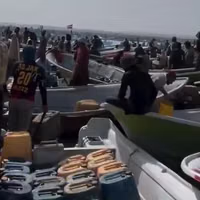
Screengrab from a viral video showing a large gathering of fuel smugglers aboard boats in Iran’s southeastern Sistan and Baluchestan province.
Long queues and empty pumps have brought Iran’s fuel shortages into sharper focus, raising a difficult question: how much would charging consumers more change where the country’s subsidized fuel ends up?
Esmail Saghab Esfahani, a vice president who heads the state energy efficiency agency, acknowledged this week that “we really have a supply problem.” He told Iranians they could no longer count on fuel stations to cover their needs and should save part of their monthly ration before traveling.
“All the gasoline the government has, it has given to the people,” he said. “Nothing has been held back to supply more.”
On Thursday night, residents of Bandar Abbas, the main port on the Persian Gulf, blocked a road near a fuel station in the city’s Rajaei district with their cars, protesting long lines and empty pumps. Drivers on the Minab–Bandar Abbas route had protested earlier over the lack of fuel.
The economic argument for higher prices is straightforward. Fuel is inexpensive domestically and costly abroad, making it profitable to move illegally. Narrowing that gap could reduce the incentive to smuggle.
But the price difference alone does not explain how large volumes leave a state-controlled distribution system, who obtains them or why enforcement so often focuses on those transporting the fuel. Nor should gasoline shortages and diesel diversion be treated as interchangeable problems.
Where fuel leaves the system
Journalist Yashar Soltani, in a recent interview, alleges that approximately 30 million liters of fuel are smuggled out of Iran daily with assistance from people within state institutions. That would represent roughly 11 billion liters annually. His estimates and allegations of official involvement have not been independently verified.
The allegations nevertheless raise a question that deserves investigation. Transporting millions of liters requires more than individual drivers willing to cross a border. It requires access to supplies, storage, vehicles, financing and buyers. The people carrying the fuel are visible; those deciding where it comes from and who receives the proceeds may be much harder to identify.
Soltani’s November 2024 investigation into a southern Iranian smuggling case described the alleged use of forged delivery documents, reused permits and payments to secure passage through checkpoints. If those mechanisms operate as described, the decisive breach occurs before the border, when fuel is released or diverted under false pretenses.
Higher prices could affect the profitability of that trade. They would not, by themselves, repair the controls that allowed the diversion.
The Razzaq scheme requires particular care. It is reportedly an authorized fuel allocation program intended to support border communities. Its existence does not establish that every shipment made through it is illegal. Equally, official authorization does not remove the need to examine who controls allocations, how transactions are recorded and how much income reaches households.
Conflating authorized trade with smuggling would make reform less credible. Authorities should distinguish legal exports, administrative discrepancies and proven diversion, then publish comparable figures. Otherwise, seizure statistics and alarming estimates can obscure the basic question of where public resources go.
Who would pay more?
The incentive created by price differences is substantial. In December 2025, Financial Tribune reported diesel selling domestically for around 300 tomans per liter while fetching nearly 50,000 tomans across the border. These were reported prices at that time, rather than current quotations, but they illustrate the potential margins.
The effect of a price increase depends on its size, currency movements, operating costs and how traders obtain supplies. Someone buying fuel lawfully faces a different calculation from an organizer acquiring it through a fraudulent allocation or an unrecorded transfer.
Small increases may leave lucrative margins intact. Larger increases could reduce them, but would also raise costs for legitimate freight operators and farmers, with consequences for household budgets. A subsequent fall in the rial could widen the international price gap again.
The distinction between fuels is equally important. Evidence of large-scale diesel diversion does not, on its own, establish that higher gasoline prices for motorists would address it. Officials should explain which fuel is disappearing, where losses occur and how each proposed adjustment would tackle that specific problem.
The distinction between participants matters, too. A household carrying fuel because other income is scarce does not exercise the same control as someone managing bulk supplies, financing and distribution. Enforcement should examine responsibility and financial benefit rather than assume that the easiest person to arrest is the most consequential.
Removing a driver’s livelihood may leave an organizer able to recruit somebody else. It can also deepen local dependence on whoever controls access to work. Alternative employment should therefore be part of enforcement policy, rather than postponed until restrictions have made families poorer.
Iran’s earlier subsidy reform provides a practical lesson. An IMF working paper on the 2010 reform describes compensatory payments deposited before higher prices took effect. That experience does not establish a lasting solution to smuggling, but it shows that household protection can be prepared before costs rise.
Following the fuel and the money
Soltani’s allegations of official involvement need independent investigation. Authorities should trace fuel from refineries and depots to its intended customers, comparing deliveries with quotas and transport records. When fuel goes missing, investigators should examine who approved its release, who received it and who benefited.
Tracking devices are useful only if someone acts on the evidence. They cannot prevent diversion on their own if records are altered or officials facilitate it. Any investigation must also be able to scrutinize politically connected operators.
Authorized border programs should make clear what households are entitled to receive, account for the money paid to them and provide a way to challenge unfair deductions. Families need realistic alternatives, including access to legal trade, support for local businesses and training that leads to paid work.
Higher prices can help narrow the margins that make smuggling profitable. But if the opaque allocations and protection arrangements described in these reports persist, households and legitimate businesses could face higher costs while those controlling diverted supplies continue to profit.
The test of reform is therefore more demanding than whether it raises revenue or produces more arrests. It is whether less fuel disappears, investigations reach those organizing its diversion, and vulnerable households receive support before their costs rise. Without those changes, consumers could end up paying more without knowing whether the next station will have fuel.
A government-organized Janfada mobilization gathering held in Iran in October 2026.
Iran’s Revolutionary Guards are expanding a campaign built around sacrifice for the homeland into a route for military training and Basij paramilitary recruitment, giving a force associated with decades of domestic repression a broader patriotic appeal.
The Janfada initiative — roughly meaning someone willing to sacrifice their life — presents participation as service to Iran. Its development raises a question: how far can the authorities use national loyalty to attract recruits who might otherwise hesitate to join the Islamic Republic’s security institutions?
On November 2, Hassan Hassanzadeh, commander of the Guards’ Tehran corps, said the first Janfada brigade had been organized, completed supplementary training and received equipment. Speaking at the opening of a training center in Tehran’s Tajrish Square, he said the unit was preparing for practical exercises and specialist shooting-range training.
The announcement marked a further step toward turning a public mobilization campaign into organized military units.
A new route into the Basij
Launched on March 28 by the Guards-linked Baqiyatallah cultural and social headquarters, Janfada initially invited volunteers to participate in defense, security and relief activities during the war with the United States and Israel.
By September, organizers were announcing plans for 1,000 national resistance battalions. Training programs subsequently included firearms handling, urban defense and rescue skills.
Ali Kowsari, the Basij’s deputy for training, has said participants who complete supplementary courses can join the organization’s combat structure. Esmail Faraji, its deputy for operations, has said the campaign attracted volunteers who had not previously belonged to the Basij, although the scale of that recruitment has not been independently established.
The distinction matters because the Basij, a paramilitary organization subordinate to the Revolutionary Guards, combines military mobilization with ideological organization and domestic security. Its network extends through neighborhoods, universities, schools and workplaces, and its members have participated in successive protest crackdowns.
A campaign emphasizing defense of the country could therefore provide a more accessible entry point than direct recruitment under the Basij name. Joining a course presented as preparation to protect Iran may carry different associations from joining an institution identified with policing dissent.
That remains an interpretation of the campaign’s appeal, rather than proof of its organizers’ intentions or success. Available evidence does not establish how many participants are new recruits, how many were already Basij members, or whether the patriotic message has broadened support beyond existing government loyalists.
National defense and domestic control
The campaign’s public presentation has combined national solidarity with explicit loyalty to the leadership.
At the September 18 Janfada parade in Tehran, participants included Basij members, uniformed volunteers and children. The event began with a declaration of allegiance to Khamenei, while President Masoud Pezeshkian described it as a display of national cohesion.
That combination illustrates how the campaign places defense of Iran alongside support for the political system.
Its activities also extend beyond preparation for an external attack. Campaign spokesman Sassan Zare said in September that Janfada provided training related to urban and public security, while responsibility for deploying volunteers at checkpoints rested with the relevant security bodies.
Those overlapping functions make the campaign relevant to domestic control, although they do not establish that every participant will undertake security duties or be deployed against protesters.
A Syrian parallel, with limits
Syria offers a comparison in how governments organize loyalist forces under the language of national defense.
During Bashar al-Assad’s rule, pro-government militias and neighborhood committees were incorporated into the National Defense Forces. Research by the Institute for the Study of War describes Iranian and Hezbollah assistance in formalizing the force along a model resembling the Basij, including training recruits.
The comparison has limits. Syria involved the consolidation of existing militias during a civil war. Janfada is presented as a recruitment and training campaign connected to institutions that remain in place. There is no evidence here that the Basij has been dissolved or formally renamed.
The more defensible argument is that Janfada offers the existing security structure an additional public identity and recruitment channel. Its language emphasizes sacrifice for the country; its training pathways lead toward institutions whose responsibilities also include preserving the Islamic Republic.
Whether that approach can repair the Basij’s reputation remains unproven. What commanders’ announcements demonstrate is a growing effort to turn patriotic participation into organized manpower.
Iranian protesters who lost one or both eyes to brutality by security forces.
Canadian lawmaker Ali Ehsassi has pledged to refer findings that Iranian security forces possessed paintball guns from a Canadian-owned brand during the 2022 protest crackdown, which left scores of demonstrators blinded, to federal authorities.
The report identified Tippmann guns, a brand owned by Montreal-based KORE Outdoor, in the possession of Iranian security personnel. Investigators could not establish whether the guns were responsible for any of the blinding injuries.
“We’ll take this report. I was not aware of it, and we’ll send it to the appropriate authorities,” Ehsassi told Iran International’s Eye for Iran.
Ehsassi, a Liberal who represents Willowdale, said he did not know whether Global Affairs Canada had reviewed the investigation, published in September 2025 by IranWire and the Iran Human Rights Documentation Center.
Asked what Canada could do about the equipment reaching Iranian security forces, he pointed to federal funding to strengthen sanctions enforcement.
Iran International contacted Global Affairs Canada and KORE Outdoor for comment. Neither responded by the deadline for this report.
How did Tippmann guns reach Iran?
Shahin Milani of the Iran Human Rights Documentation Center told Iran International that researchers found photographs showing Iranian security personnel with paintball guns bearing the Tippmann logo.
One photograph from 2018 shows a member of the Fatehin special unit holding a Tippmann marker. The report also includes a screenshot of the Iranian Paintball Association’s website offering a Tippmann marker for sale.
Some paintball guns seen in footage from the 2022 protests resembled Tippmann models, the researchers said, but image quality and distance made the brand difficult to confirm. Milani said investigators could not link a specific case of blinding to a Tippmann gun.
In October 2022, KORE Outdoor CEO Billy Ceranski condemned the use of the company’s paintball products to suppress protests in Iran. He said KORE complied with US import and export laws and had never sold goods directly or indirectly to countries on the US arms embargo list, including Iran.
Milani said Canadian authorities could start by asking KORE to identify its buyers and then ask those buyers where the equipment went next.
“You cannot just sell such devices and not care as to who actually ends up owning them,” Milani told Iran International.
The sales page for Tippmann Empire BT-4 Combat paintball marker in the official website of Paintball Association of the Islamic Republic of Iran. Source paintball.ir
Hundreds suffered eye injuries
A separate investigation by the Human Rights Center at the University of California, Berkeley found that about 120 people suffered partial or total blindness during the 2022–23 crackdown.
Researchers documented close-range shots to the face involving shotguns, paintball guns and tear gas canisters.
By November 2022, ophthalmologists at three Tehran hospitals had reported at least 500 serious eye injuries, while doctors in Kurdistan province reported at least 80 more.
In its investigation, IranWire and the Iran Human Rights Documentation Center documented 134 people injured by weapons described as less lethal across 47 cities in 24 provinces. At least 114 were injured by shotgun pellets and nine by paintball projectiles. Most of the injuries were to the head, face or eyes.
In one video from December 2022, a plainclothes agent fires a paintball gun at the face of a person being detained in Tehran’s Ekbatan neighborhood.
Blinding injuries documented again in January
Severe eye injuries were also reported during Iran’s January 2026 crackdown, although no link has been established between those cases and Tippmann guns.
Dr. Sarah Raza, a trauma and vascular interventional radiologist who advised wounded protesters remotely, told Iran International that patients feared their wounds would identify them as protesters if they sought medical care.
Raza cited reports of more than 400 gunshot-related eye injuries at a single Tehran hospital during the January 8 and 9 crackdown.
The report Ehsassi pledged to forward examined the 2022 crackdown. The weapons used in the January cases remain a separate question.
Newly elected democratic members of Congress, who have flipped Republican seats gather for photos at the US Capitol in Washington, DC, US, November 12, 2026.
US Democratic lawmakers are stepping up efforts to end the war with Iran after their sweeping midterm election victory, promising legislative action when they take control of Congress in January.
Democrats won control of both chambers of Congress in the November 3 elections, a defeat for Republicans that President Donald Trump and Vice President JD Vance acknowledged was driven in part by public dissatisfaction with the war.
“Last week, voters were loud and clear: Trump’s economy doesn’t work for Americans,” Senate Democrats said in a statement on X on Friday.
“When Senate Democrats are back in the majority next year, we will take immediate action to end Trump’s war in Iran, stop his reckless tariffs, and lower costs for everything from energy to groceries to housing.”
A Reuters/Ipsos poll released Tuesday found that 71 percent of Americans wanted Congress to pass legislation ending the conflict, including 93 percent of Democrats and 51 percent of Republicans.
The growing pressure has reached the current Republican-controlled Congress, where Representative Thomas Massie of Kentucky, a frequent critic of Trump, has pledged to force another vote on ending the war before his term expires.
Massie introduced a War Powers resolution on November 10 directing the president to remove US forces from hostilities with Iran.
In a post on X Saturday, Massie said he could force a vote by mid-December, provided House Speaker Mike Johnson does not cancel scheduled legislative days. He added that two other resolutions seeking to end the war could reach the House floor even sooner.
But Republican lawmakers, including some who have criticized the conflict, remain reluctant to use congressional powers to force its conclusion.
“A Republican Congress is not going to send bills to a Republican president that he's going to veto,” Representative Tom Cole of Oklahoma, chairman of the House Appropriations Committee, told reporters this week.
The disagreement is expected to become a central issue in negotiations over government funding, which expires on December 11, raising the possibility of another shutdown confrontation.
Several Republicans have previously joined Democrats in attempts to restrict Trump's military operations, although most of the party has remained aligned with the president.
A war that was supposed to last weeks
The pressure has intensified as the conflict approaches its ninth month, far exceeding the administration's initial expectations.
“We are now in week 37 of Trump’s ‘2 to 3 week’ war with Iran,” Democratic Representative Jason Crow of Colorado wrote on X.
Representative Jimmy Panetta, a California Democrat, also accused Defense Secretary Pete Hegseth of continuing the war in violation of the War Powers Resolution of 1973 and failing to provide transparency over deadly strikes on civilians, including an elementary school in Iran.
“Congress will exercise its constitutional authority to hold him accountable,” Panetta said.
Democrats will have several options when they take control of Congress on January 3, including legislation restricting military operations, limits on war funding and congressional investigations into the administration's conduct.
But their ability to compel an end to the conflict remains uncertain. Trump could veto legislation passed by Congress, requiring two-thirds majorities in both chambers to override him.