Two US Air Force F-16 fighter jets patrol over regional waters in the Middle East in a photo shared by US Central Command (CENTCOM) on Saturday, November 14, 2026.
More than 1.7 billion barrels of crude oil have been shipped through the Strait of Hormuz by regional partners under American military protection, US Central Command said.
In a post on X Saturday, CENTCOM showcased US Air Force F-16 fighter jets patrolling over regional waters in the Middle East, highlighting American military presence protecting oil shipments through the strategic waterway.
CENTCOM did not specify the period covered by the 1.7 billion-barrel figure or provide a breakdown of shipments by country.
Bundles of natural hair in different colors and textures are displayed for sale in Iran.
An eight-year-old girl sits with her back to the camera, her small frame almost hidden beneath a mass of long, shiny, curly hair. Her father has brought her to a hair buyer in Tehran. The family needs money, he says.
The video is among many circulating on Iranian social media showing women and girls selling their hair for cash.
The reasons for selling vary. Some women and girls say they need money for education, medical treatment or household expenses. Others hope to buy a mobile phone or wedding clothes.
Hair measuring 40 to 60 centimeters has been advertised for between five million and 30 million tomans. Exceptionally long or desirable hair has been listed for as much as 100 million tomans, although advertised prices do not necessarily reflect what sellers receive.
For some, selling hair is a relatively straightforward way to earn money from something that will eventually grow back. For others, it reflects more pressing financial difficulties.
Instagram is filled with videos advertising hair-buying services across Iran. Women and girls sit with their backs to the camera as buyers divide their hair into bundles, tie them tightly and cut them with scissors.
Growing market
Buyers seek long, healthy, untreated hair, while dyed or damaged hair commands lower prices. Young women and girls with naturally long hair are therefore particularly sought after.
Once cut, the hair enters a commercial market supplying wigs, extensions and, in some cases, the film industry.
Some sellers visit hair-buying businesses, while others negotiate remotely, sending photographs of their hair through WhatsApp for a price estimate before arranging a meeting or postal delivery.
Buyers range from established beauty salons to individuals operating under little more than a name and mobile phone number. Advertisements also appear on classified platforms such as Divar and Sheypoor.
A trade crossing borders
The market extends beyond individual buyers and sellers in Iran.
Last summer, Armenian customs officers discovered 26 kilograms of natural hair, divided into 143 bundles, concealed inside pillows in a truck arriving from Iran at the Agarak border crossing.
The shipment was seized, offering a glimpse into a cross-border trade that media reports have linked to markets in Turkey, the United Arab Emirates and Armenia.
Within Iran, social media advertising, remote negotiations and postal deliveries allow buyers to source hair from sellers hundreds of kilometers away.
For sellers, the arrangement offers a way to turn something they already possess into cash without leaving home. For buyers, it provides access to a wider supply of long, untreated hair.
Temporary relief
But for some of the women and girls appearing in these videos, the transaction is more than a commercial exchange. It means parting with something they have spent years growing, sometimes to meet an immediate financial need.
In some videos, girls appear reluctant to part with their hair, sometimes crying as buyers try to reassure them.
"Don't be sad. Your hair will grow back soon," one buyer tells a girl.
The presence of children raises more troubling questions. Some may have little say in the decision when their families urgently need money.
Even when the sale is voluntary, the proceeds may provide only temporary relief against rising living costs, particularly for those trying to cover recurring expenses.
The scenes recall Fantine in Victor Hugo's Les Misérables, who sells her beautiful hair to provide for her daughter Cosette before poverty drives her to sell her teeth and eventually turn to prostitution.
More than 160 years later, some Iranian women and girls are similarly turning to their hair to meet financial needs, though their circumstances vary.
An Iranian man fills his car at a gas station in Tehran on September 7, 2026.
Seven years after a fuel price rise set off one of the deadliest crackdowns in the Islamic Republic’s history, Iran is rationing gasoline more tightly, with lines at stations across the country, but it still dares not touch the subsidized price.
Esmail Sagheb Esfahani, a vice president who heads the state energy efficiency agency, admitted this week that “we really have a supply problem.” He told Iranians they could no longer count on fuel stations to cover what they need, and should save part of their monthly ration before traveling.
“All the gasoline the government has, it has given to the people,” he said. “Nothing has been held back to supply more.”
On Thursday night, residents of Bandar Abbas, the main port on the Persian Gulf, blocked a road near a fuel station in the city’s Rajaei district with their cars, protesting long lines and empty pumps. Drivers on the Minab–Bandar Abbas route had protested earlier over the lack of fuel.
Price of gasoline is displayed on a fuel dispenser.
Seven years after ‘Bloody November’
Sunday marks seven years since the government announced, shortly after midnight on November 15, 2019, that gasoline prices would rise by 50 to 200 percent. Drivers who had paid 10,000 rials a liter would now pay 15,000 for their first 60 liters a month and 30,000 after that.
Protests broke out within hours and spread to more than 100 cities. Demonstrators blocked highways with their cars, burned banks and tore down images of Supreme Leader Ali Khamenei. On the second day, Khamenei told senior officials, “Do whatever it takes to end it,” Reuters later reported, citing people close to his inner circle.
The state cut off the internet for about a week, and security forces shot protesters with live ammunition, including from rooftops, in Mahshahr in the southwest and in cities across the country. Hundreds of people were killed and more than 7,000 arrested. Iranians call it “Bloody November,” or “Bloody Aban,” after the month in the Iranian calendar.
Those two prices, 15,000 and 30,000 rials, are still the two cheapest tiers today. In 2019 the cheaper one was worth about 12 cents. After seven years of inflation and a collapsing rial, it is worth about half a US cent.
The state has not risked a general price rise since. Each time economic pain has boiled over, it has turned on the state: fuel stations in Tehran were set on fire when rationing began in June 2007, and the uprising over the economic collapse in December 2025 ended in the January massacre.
That memory hangs over every decision. Sagheb Esfahani said this week that the price of the third tier would be reviewed every season, but that “a range of security, military and law enforcement bodies” had to give their opinion first. Government spokeswoman Fatemeh Mohajerani said the two cheapest tiers would not change.
Gasoline for half a cent
Each private car gets a monthly ration on its fuel card: 60 liters at 15,000 rials a liter, half a US cent; 50 liters at 30,000 rials, about one cent; and, since September 8, 50 liters at 100,000 rials, under four cents. A full month’s ration of 160 liters costs about 7.4 million rials, or $2.70.
What the government is doing instead of increasing prices is cutting access.
Until now, drivers who ran out of their ration could fill up with the station’s own “emergency” card at the third-tier price. On September 7, those station cards supplied 41 percent of all gasoline sold, about 59 million liters a day, the national fuel distribution company said.
Since November 1, station cards have been withdrawn in 11 provinces, almost all of them along Iran’s borders with Pakistan, Afghanistan, Turkmenistan, Iraq, Turkey and the Caucasus, plus the Persian Gulf coast, where officials say subsidized fuel is smuggled out. The plan began in Kerman, the first to lose the cards, before spreading.
Tehran, which burns about 20 million liters a day, as much as 15 other provinces combined, has been spared for now. There, each fill-up with a station card is tied to the car owner’s national ID instead. Drivers anywhere who need more than their ration are told to buy premium gasoline at about 1 million rials, or 37 cents, a liter, more than 60 times the cheapest rate.
Executive Vice President Mohammad Jafar Ghaempanah said the cards would be collected province by province within weeks, blaming smuggling.
“Several thousand Nissan pickups do nothing but collect fuel from different provinces and take it across the border,” he said, putting smuggling at 30 million liters a day. A liter of gasoline sells for about 2.6 million rials, or 96 cents, in Pakistan.
Former lawmaker Nezam al-Din Mousavi said about 90 percent of smuggled fuel was diesel, not gasoline. “Stop making excuses and say you are after price rises,” he said.
‘Neither the capacity nor the money to import’
Behind the measures is a supply gap that the war has made impossible to close.
Iran consumed about 133 million liters of gasoline a day on average through October, peaking at 144 million in September, while refineries produce between 112 and 135 million, according to official figures cited by Rouydad24.
Hossein Taeb, head of the Basij militia, said on Thursday that Iran still imports about seven million liters a day. The US naval blockade of Iran’s ports, in place since April, has made those imports harder and costlier, and refineries and fuel depots were damaged in the war.
“Every effort of the government is to match gasoline consumption with domestic production,” Ata Hosseinian, an economic and energy journalist, told Iran International. “There is neither the capacity nor the money to import gasoline.”
The government, he said, is applying the method it used for electricity and gas bills: a fixed cheap ration, and a much higher price above it, while station supplies are released “drip by drip.”
“People have to go to five stations to maybe get the cheaper gasoline at one of them after standing for hours,” he said.
“The Islamic Republic is threatening people with death so they’ll settle for a fever,” he said, citing a Persian saying. Once the fate of Hormuz and the blockade is settled, he expects the third-tier price to rise step by step, each season, toward 500,000 to 700,000 rials a liter, 18 to 26 cents.
‘Please stop talking’
The rationing has also split the establishment.
Within a day of Sagheb Esfahani’s remarks, First Vice President Mohammad Reza Aref ordered officials to stop commenting on gasoline, saying decisions would be announced only by the government spokeswoman or the national refining and distribution company.
A former lawmaker, Ahmad Amirabadi Farahani, posted a message to Sagheb Esfahani: “Doctor, please stop talking, stop giving interviews, stop getting on people’s nerves.”
The hardline daily Kayhan accused “a current” in the government of pursuing higher prices “by other methods,” called the two vice presidents’ remarks “provocative” and said they had fed “hostile media.”
“Regulatory and security bodies must step in as a deterrent,” it wrote. It also warned that without station cards, Iranians could not flee cities if war resumed, as many did during the 12-day and 40-day wars.
The hardline Farhikhtegan called the policy “a media game with society’s psyche in the middle of a war.”
‘What can you do with 110 liters a month?’
Online, the measures drew anger and ridicule.
“With the fuel use of domestic cars, what can you do with 110 liters a month?” one user wrote,. Another asked what the plan was for millions who drive into Tehran every day “to earn 350 or 400 million rials a month,” about $130 to $150, “and survive on bread and eggs.”
“The government’s message is that the real price of gasoline is 1.1 million rials,” a third wrote. At that price, a month’s ration of 160 liters would cost more than the minimum wage of about 166 million rials, or $61
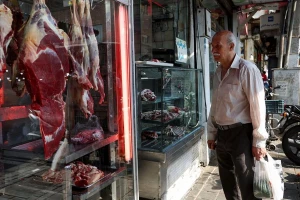
A man looks into a butcher’s shop window in Tehran, October 27, 2026.
Kayhan, the hardline daily overseen by the supreme leader’s representative, accused President Masoud Pezeshkian’s government on Saturday of frightening the public with talk of crisis, while official data show prices up nearly 89 percent in a year.
“The country’s situation is not critical,” the paper wrote in an editorial titled “Don’t weaken the nation’s morale.” A “current,” it said, was feeding the president distorted information to make things look worse than they are.
“If you look through government officials’ statements, you will find plenty of such cases, from the electricity shortfall to the gas shortfall, from gasoline rationing to the food coupon scheme,” it wrote.
“It is as if the cornerstone of the government’s actions and its media operations is scaring people.”
Kayhan is run by Hossein Shariatmadari, appointed by the supreme leader, and its editorials are widely read as the voice of the system’s hardline core.
The editorial, by Seyed Mohammad Emad Erabi, cited two of Pezeshkian’s warnings. In November 2025 the president said that if it did not rain, Tehran’s water might have to be rationed and the capital evacuated. Kayhan noted that neither happened and that Tehran’s reservoirs are now fuller than a year ago.
It also cited the government’s claim that Iran spent about $6 billion importing gasoline last year, a figure the state Court of Audit put at $1.8 billion through December, and Pezeshkian’s statement in October that Iran no longer needed to import gasoline at all, which two of his own deputies then contradicted.
Kayhan’s answer was to stop warning the public. It quoted the late supreme leader Ali Khamenei telling officials in December 2024 that anyone inside the country who spoke in a way that “empties people’s hearts” was committing “a crime.”
The editorial also urged Pezeshkian to stop tying an end to the country’s “neither war nor peace” limbo to a deal with the United States.
Kayhan’s own example undercut it. Hossein Taeb, head of the Basij militia, said on Thursday that Iran still imports about seven million liters of gasoline a day, with output at about 110 million liters against consumption of about 135 million.
What the official figures show
Point-to-point inflation reached 88.7 percent in the month to October 22, according to the Statistical Center of Iran, meaning a household pays on average nearly twice what it paid a year earlier for the same basket of goods and services.
The rial fell to about 2,720,000 to the dollar on Saturday.
Ali Babaei Karnami, who chairs parliament’s Social Committee, has said up to 50 million Iranians struggle to afford food and at least eight million face absolute poverty and malnutrition.
A family of four needs at least 1 billion rials (about $370) a month to live normally, he said. The base minimum wage is about 166 million rials (about $61), a sixth of that.
The International Monetary Fund expects Iran’s economy to shrink by at least 7.6 percent in 2026 because of the war and sanctions.
Messages sent to Iran International by people across the country describe essentials disappearing from their tables.
“I went to buy a lavash. I got one piece of bread the size of my palm for 400,000 rials,” one wrote. “I don’t know how we’re supposed to live.” Lavash, a thin flatbread, is the cheapest and most common bread in Iran. At about 15 cents, that one small piece cost roughly 7 percent of a day’s minimum wage.
A retiree wrote that his monthly pension does not last past the first ten days of the month, leaving nothing for food or medical bills.
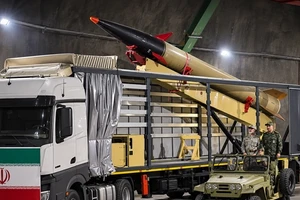
Others pointed to the state’s recent unveiling of underground “missile cities” and said the country’s money was going to military projects rather than fuel, water, electricity and people’s livelihoods.
Yoseph Haddad, an Arab-Israeli Christian journalist and activist from Nazareth, speaks in an interview with Iran International's Kambiz Tavana in Washington DC on November 13, 2026
The Iranian and Israeli people are natural allies against Iran's Revolutionary Guards (IRGC), and the fight against the force will be won in public opinion as much as on the battlefield, according to Arab-Israeli activist Yoseph Haddad.
“The Iranian people and the Israeli people, we love each other, we support each other,” Haddad said in Iran International’s Washington studio. “Every place I went for a demonstration, for a protest, I had Iranians at my back helping me.”
Haddad, a Christian from Nazareth and a volunteer Israeli army veteran, is one of Israel’s best-known advocates abroad. He ran second on Amcha Yisrael, a new right-wing list led by retired Brigadier General Ofer Winter, in Israel’s October 27 election. The list won 1.68 percent of the vote and no seats.
‘The same mission’
Haddad said he wanted to turn the ties between ordinary Israelis and Iranians into a common campaign.
“My plan is to take that relationship between the Israeli people and the Iranian people and strengthen it, and with the numbers, together we serve the same mission, which is one: destroying the IRGC and bringing security to Israel and the entire Middle East,” he said.
Israel has fought on what Haddad called seven fronts since the Hamas-led attack of October 7, 2023, including direct war with the Islamic Republic. In his view, Israel won militarily but stopped short of finishing the job, and the reason was the battle for public opinion.
“You know why we were stopped? Because of the public diplomacy and anti-Israel propaganda,” he said. “The way to fight the IRGC and to destroy the IRGC is through public diplomacy.”
He said Israel’s own government had fallen short. “We could have done more for Israeli public diplomacy. We could have done more for the Iranian people’s public diplomacy, and especially for the Iranian people against the IRGC,” he said.
He accused Qatar, which has hosted Hamas’s political office and funds Al Jazeera, of dominating that arena. “We completely gave that arena to Qatar, and they are shifting the narrative,” he said.
An Arab in the Israeli army
Haddad served in the Golani Brigade and was badly wounded by a Hezbollah anti-tank missile in the 2006 Lebanon war. “It was my Jewish brothers in arms who saved my life and who brought me back to Israel,” he said.
Arab citizens, about a fifth of Israel’s population, are exempt from compulsory service, and Haddad volunteered.
“I, as an Arab, was a commander over Jewish soldiers in the IDF,” he said, rejecting the charge that Israel is an apartheid state.
In 2024 he lit a torch at Israel’s official Independence Day ceremony. “This is something huge for an Israeli, yes, but for an Arab Israeli, it’s absolutely crazy,” he said.
Criticism of Arab-led parties
Arab-led parties won a record 19 seats in the October 27 election, and their backing helped opposition leader Gadi Eisenkot win the mandate to form a government. Haddad said the result showed Israel’s democracy works, but he accused the parties’ leaders of neglecting their own voters.
“When the election comes, all the leaders stop talking about Gaza, stop talking about Jenin and Ramallah, and finally they start talking again about Nazareth and Haifa,” he said. “They’re lying to us, time after time.”
He singled out Ahmad Tibi, the veteran head of Ta’al. “He tells you that Israel is an apartheid state. He tells you that he doesn’t want Israel as a Jewish state,”
He also said Tibi was protected by his parliamentary immunity. “He hit a cop, but because he’s a politician, he has immunity. No one can do anything to him,” Haddad said.
Haddad said he had once been kept out of a Knesset committee session chaired by Joint List lawmaker Aida Touma-Sliman on the claim that Israel is an apartheid state.
“I told her, ‘You guys are actually the apartheid, because you don’t want to listen to me, and I’m one of you, an Arab just like you,’” he said. “Pure apartheid toward me.”
He also cited Sami Abu Shehadeh, head of the Balad party, who withdrew from the election in October after the Central Elections Committee voted to bar him over remarks after the October 7 attack.
“They don’t want to set a precedent,” Haddad said of the Supreme Court, which recommended the withdrawal rather than ruling. “I’m all for freedom of speech, until you start to incite to terrorism.”
Teaching children to die
Haddad said the Guards’ proxies indoctrinate children from an early age, and that education can work in both directions. He praised the United Arab Emirates, which designated the Muslim Brotherhood a terrorist group in 2014 and later began teaching the Holocaust in schools.
Of children raised by Hamas in Gaza and Hezbollah in Lebanon, he said: “When you arrive at age 12, you’re already serving in their terrorist organization, completely brainwashed. When you arrive at age 16, you’re ready to die.”
Haddad said he hoped Israelis and Iranians would build a common front.
"Together, the people of Israel and the people of Iran, we can actually do it," he said.
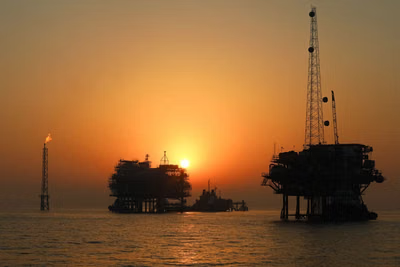
File photo: Iran's Reshadat oil rig in the Persian Gulf
Iran's oil production fell by nearly half from pre-war levels in October, dropping below the amount its refineries consumed before the war, according to new figures from the International Energy Agency (IEA) and Iranian Oil Ministry data reviewed by Iran International.
The IEA estimated in its latest monthly report that Iran produced 1.86 million barrels of crude oil per day in October, down 46% from pre-war levels.
An Iranian Oil Ministry report reviewed by Iran International showed that the country's refineries consumed more than 1.873 million barrels per day in 2024–25, before the war disrupted production and refining operations.
New processing units have since been added to Iranian refineries, potentially increasing their crude oil requirements. However, wartime damage and disruptions mean actual domestic demand may differ from pre-war levels.
The steep production decline comes amid a US naval blockade that has effectively halted Iranian crude exports and severely restricted shipments of petroleum products, leaving Tehran with limited options for maintaining production.
Kpler previously told Iran International that Iranian crude oil loadings had stopped in mid-August, leaving the country with virtually no option but to keep production close to domestic consumption levels.
One possible contributing factor is the damage to Iran's Lavan refinery during the war, although the facility has a relatively small crude oil processing capacity of 35,000 barrels per day.
Threat to refinery operations
Homayoun Falakshahi, a senior analyst at Kpler, told Iran International on November 13 that Iranian naphtha loadings had fallen by 100,000 barrels per day in recent months.
He warned that if Iran cannot export the product, it may be forced to partially shut down some refinery units.
"Iran's fuel oil (mazut) loadings have also fallen to 15% of their pre-war levels. However, some of the surplus refinery products, such as fuel oil, can be sold to countries like Afghanistan and Pakistan, or absorbed through increased domestic consumption. Naphtha is a more complicated issue," he said.
Naphtha is primarily used as a feedstock for petrochemical production, although modern refineries can also process it into higher-value products such as gasoline.
During the war, several units at the major petrochemical complexes in Assaluyeh and Mahshahr, which account for 70% of Iran's total petrochemical production, were also targeted.
The damage, combined with restrictions on exports, has complicated Iran's ability to absorb or sell surplus refinery products.
Kpler data show that while crude oil loadings have come to a complete halt, shipments of some petroleum products, particularly liquefied petroleum gas (LPG), have continued at reduced levels.
United Against Nuclear Iran (UANI) recently reported that Iran had managed to move 11 LPG cargoes past the US naval blockade since it began.
Reuters estimated Iran's LPG exports that evaded the blockade between mid-July and mid-October at 4.1 million barrels. An Iran International analysis based on Kpler data showed that this was less than 14% of Iran's LPG exports over the same period last year.
In its latest assessment, UANI said another 12 small Iranian tankers carrying LPG were anchored in the Gulf of Oman, apparently waiting for an opportunity to cross the blockade.
There have been no confirmed reports of Iranian naphtha cargoes passing through the US blockade.
Region recovers as Iran's output falls
While Iranian oil production has plunged, other major producers in the Persian Gulf have been recovering from disruptions caused by the war.
New OPEC figures show that its members, together with the UAE, which left the organization on May 1, produced a combined 27.16 million barrels per day in October, up 1.96 million barrels from September.
Excluding Iran, daily production by OPEC member countries in October was nearly 900,000 barrels above the 2025 level.
OPEC figures also show that Iran's daily output fell by 1.34 million barrels compared with 2025, while combined production by Iraq and the UAE increased by 1.3 million barrels.
Iraq produced 4.5 million barrels per day in October, although its oil minister recently said production had exceeded five million barrels per day in November.
Saudi Arabia has also reported raising its daily output to 10.5 million barrels, around 1.3 million barrels above its October level.
The IEA said in its latest report that global oil production exceeded worldwide demand in October for the first time since the outbreak of the Middle East war, driven by recovering output among Arab producers in the Persian Gulf.
The agency also reported that global oil stocks held at sea increased by 86 million barrels during the month, underscoring the broader recovery in supply even as Iran's production remained severely constrained.