Houthis say they targeted Riyadh airport, Aramco facilities
Iran-backed Houthis in Yemen said on Sunday they targeted King Khalid International Airport, Saudi Aramco oil storage tanks and a financial center in Riyadh.
Iran-backed Houthis in Yemen said on Sunday they targeted King Khalid International Airport, Saudi Aramco oil storage tanks and a financial center in Riyadh.










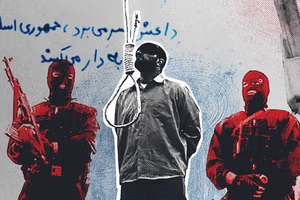
Iranians expressed anger and grief over the execution of three protesters and new death sentences against others, criticizing the United States and the international community for their response in messages sent to Iran International.
Iran's judiciary announced on November 8 that Hassan Divband, Hamid Kazemi and Reza Zanganeh, three people arrested during the January protests in Karaj, had been executed.
The executions came alongside reports of additional death sentences against protesters in the northeastern city of Mashhad.
Abolfazl Sedaghat, 20, Matin Farnian and Vahid Khedrikhah were sentenced to death on charges of moharebeh, or "waging war against God," in a joint case, according to the human rights organization HRANA.
Death sentences were also issued against Ali Zaghi and Ilya Akbari, bringing the number of protesters sentenced to death in the so-called Shandiz case to six, according to earlier reporting.
'We can no longer bear the news of executions'
"We woke up this morning to the news that three more innocent young men had been executed. I can no longer bear hearing about executions," a resident of Isfahan wrote to Iran International.
The executions prompted messages of grief and anger from people across Iran, many expressing concern about the future of younger generations.
"Every morning when we wake up, we are confronted with news of our beloved children being killed. You have taken life away from us," a Tehran resident wrote, addressing Iranian authorities.
Another from Dezful urged fellow Iranians to consider the future facing their children.
"Look at your beloved child. How can you bring yourself to leave the Islamic Republic as their inheritance? How can you bear to leave your child in line for execution and torture?" the citizen wrote.
Another, referring to discussion of possible US strikes on Iran's energy infrastructure, said the country's infrastructure was not their primary concern.
This citizen argued that the Islamic Republic's continued rule was destroying the country's infrastructure every day, from electricity and water supplies to the lives of its young people.
Questioning US response and call for continued solidarity
Several messages sent to Iran International criticized Washington's response to the executions, with some directly addressing US President Donald Trump.
"Do the human rights-defending Democrats in America not see all these crimes in Iran?" one asked, referring to the executions in Karaj.
Another described the executions as retaliation by the Islamic Republic against the Iranian people and questioned Trump's response.
"The oppressive system of the Islamic Republic cannot reach your soldiers, so it takes revenge on the Iranian people through executions. Isn't it time to fulfill your promise?" reads a message.
Other messages emphasized solidarity among Iranians and the importance of continuing efforts to seek justice for those executed.
A resident of Bandar Abbas expressed grief over the executions while thanking Iranians abroad for organizing demonstrations.
"One eye mourns the brave compatriots who lose their lives at the gallows every day, while the other sheds tears for the remarkable gatherings of compassionate Iranians who, despite all their difficulties, put their homeland first," the resident wrote.
A Tehran resident described the three executed protesters as "three stars whose names will live forever" and expressed determination to continue their cause.
"Victory is certain," the audience wrote.
Amnesty International warns over use of death penalty
Iranian authorities have intensified their crackdown in recent months through widespread summonses and arrests, lengthy prison sentences and a sharp increase in executions.
The growing use of capital punishment has also drawn criticism from international human rights organizations.
Iranian authorities are using the death penalty as a tool to suppress dissent, Diana Eltahawy, Amnesty International's deputy regional director, warned on October 13.
“The arbitrary executions of these five young men serves as another chilling reminder of how the Iranian authorities weaponize the death penalty to render the cost of dissent so high that it terrorizes the population into silence and deters further mass uprisings challenging their repressive decades-long rule,” she said.
The latest executions and death sentences have renewed expressions of grief and anger among Iranians, with messages to Iran International reflecting both frustration over the international response and determination to continue seeking justice for those killed.
More than 78,500 people have died in road accidents in Iran over four years, yet the government is seeking to delay new vehicle safety standards despite repeated warnings about the quality of domestically manufactured cars.
Road accidents killed 10,357 people in the first six months of the current Iranian calendar year, ILNA news agency reported on Sunday, November 8, citing figures released a day earlier by Iran's Forensic Medicine Organization.
The figure was down just 0.4 percent from 10,401 deaths during the same period last year.
Another 224,220 people injured in road accidents were referred to forensic medical centers during the six-month period, an increase of 10.8 percent from a year earlier.
Industry minister seeks delay in safety standards
Poor-quality vehicles, unsafe roads and ineffective public education are among the main causes of Iran's road safety crisis, according to critics who say authorities have failed to address the underlying problems.
Traffic police chief Teymour Hosseini has previously urged the Ministry of Industry and the National Standards Organization to improve vehicle safety, arguing that higher traffic fines alone cannot reduce fatalities without safer roads, better-equipped cars and stronger enforcement.
However, Industry Minister Mohammad Atabak asked First Vice President Mohammad Reza Aref in a letter dated November 6 to postpone the implementation of new vehicle safety standards by at least one year.
Atabak cited foreign currency shortages, the country's emergency conditions and automakers' inability to invest in developing and redesigning vehicle platforms as reasons for the request.
If approved, the postponement would allow manufacturers to continue production under existing regulations, delaying an increase in mandatory vehicle standards from 85 to 122 requirements, along with new fuel consumption rules.
The proposed delay comes despite repeated warnings about vehicle safety and the country's persistently high road death toll.
"People die in road accidents because of their poor driving, and it has nothing to do with the quality of domestically manufactured cars," Mostafa Mirsalim, a member of Iran's Expediency Council, said on November 8.
Mirsalim also described criticism linking domestic vehicle quality to road fatalities as unfair accusations against automakers.
Road accidents kill 78,510 in four years
Annual figures from Iran's Forensic Medicine Organization show that road deaths rose from 16,778 in the year ending March 2022 to 19,490 in the year ending March 2023.
Fatalities reached 20,045 in the year ending March 2024, the highest figure in the five-year period, before falling to 19,435 in the year ending March 2025 and rising again to 19,540 in the year ending March 2026.
Together, road accidents killed 78,510 people between March 2022 and March 2026, with annual deaths exceeding 19,000 throughout the four-year period.
Iran launched a national "No to Accidents" campaign in 2025 to reduce traffic fatalities, but ILNA questioned whether short-term initiatives could address the scale of the problem.
"It is unrealistic to expect that short-term campaigns and general recommendations can contain a crisis rooted in a combination of human, technical, infrastructural and managerial factors," ILNA wrote.
The news agency called for measurable targets and deadlines for the institutions responsible for road safety, including the Ministry of Roads, the Road Maintenance and Transportation Organization, municipalities and emergency medical services.
Young adults account for largest share of deaths
People aged 18 to 24 accounted for the largest share of road fatalities during the first six months of the current Iranian year, with 1,868 deaths, representing 18 percent of the total.
Another 1,555 victims were aged 30 to 39, while 1,514 were between 40 and 49 years old.
The fatalities also included 455 children aged 10 or younger.
Health Minister Mohammad Reza Zafarghandi described the roughly 20,000 annual road deaths as one of Iran's demographic challenges on June 16. Zafarghandi had previously said that 26 percent of road accident deaths were preventable.
The high number of young victims also raises questions about the government's population policies, which emphasize increasing birth rates and supporting infertility treatment.
"Population growth policies cannot be limited to encouraging childbirth and supporting infertility treatment. Preserving the lives of people already living in the country is equally important," ILNA wrote.
Iran has executed three men arrested during January protests in Karaj, west of Tehran, after the Supreme Court upheld their death sentences, the judiciary said early Sunday.
Hassan Divband, Hamid Kazemi and Reza Zanganeh had been sentenced to death and confiscation of their assets on charges of participating in operations for Israel, the United States and “hostile groups” against Iran’s national security and interests.
Judicial authorities alleged the men took part in attacks on public and government buildings, damaged public property and electricity infrastructure, and disrupted services during protests on January 8 and 9.
According to the judiciary, Divband was arrested on January 11 following a report by the Intelligence Ministry’s Alborz provincial office. Authorities accused him of setting fire to public property and encouraging others to carry out acts of destruction.
Ten other people were subsequently arrested on accusations of participating in the protests and collaborating with Divband.
The Karaj Revolutionary Court sentenced the three men to death and eight other defendants to prison terms ranging from five to 10 years.
The judiciary said proceedings to confiscate the executed men’s assets were continuing.
Human Rights Watch and the Abdorrahman Boroumand Center said in September that authorities were using rushed proceedings, torture-tainted confessions and public executions to instill fear and deter dissent. Their review found that 16 of 29 protest-related execution cases involved no allegation of killing.
An Iran International investigation in October showed Iran had executed nearly two people a week in political and security cases since the January protests, including over protest- and war-related accusations, while another 190 people faced death sentences.
At least 70 people were executed from January 7 to October 5. Human rights organizations and activists say the figures are minimum totals, covering only cases that have been reported and verified.
Of the 70 people executed, 35 were put to death in cases connected to the January protests, nine in cases linked to the 12-day and 40-day wars, and 26 in other political and security cases.
A group of hardline women wearing white burial shrouds rallied outside the Revolutionary Guards headquarters in Tehran, accusing the armed forces of defying Supreme Leader Mojtaba Khamenei amid demands for retaliation over threats against him.
The protest drew a sharp rebuke from Tabnak, a news website linked to Secretary of Iran’s Supreme National Security Council Mohsen Rezaei, which published commentary accusing the demonstrators of turning against state institutions and warning that action against their movement had begun.
Protesters carried placards warning of threats to Khamenei’s life. “The Imam’s life is in danger. Act now. Tomorrow will be too late,” read one handwritten sign.
A yellow banner addressed military commanders, saying Khamenei’s October 31 order for an “immediate, effective strike without geographical limits” in response to threats remained unfulfilled. “They have threatened the Imam again!” it declared. “Obey before it is too late.”
A speaker over a loudspeaker cited Khamenei’s statement before protesters chanted: “Beware, O armed forces, of defying the leader! Shame on us [if we stand by]!”
An IRGC representative came out to address the protesters, delivering what he said was a message from the Guards commander. He said conditions prevented commanders from meeting them in person and urged them to leave: “This area is not safe. The enemy could exploit the situation at any moment. Please clear the area.”
A woman leading the protest then issued an ultimatum: “If the threat against the Imam’s life is not avenged within 24 hours, we sisters will turn this place into Fatima’s House of Sorrows,” invoking a Shiite symbol of mourning associated with the Prophet Muhammad’s daughter.
The hardliners previously held a similar rally outside the headquarters of Iran’s Armed Forces General Staff, where they described their sit-in protest as an “affectionate reprimand.”
They said they were tired of “empty boasts.” Their statement also equated calls for sustainable development and lasting peace with disarmament, arguing that such ideas were preventing military retaliation against the enemy, according to Ensaf News.
Journalist Masoud Kazemi told Iran International the group, known as Toueh, viewed itself as representing Mojtaba Khamenei’s positions and demanded full implementation of statements attributed to him.
Its demands included dissolving the Supreme National Security Council, and returning its powers to the supreme leader, Kazemi said. The protesters opposed negotiations and regarded those conducting them as traitors, he added.
The rally held on November 5 follows months of pressure from hardliners demanding revenge for Ali Khamenei’s killing in a February 28 airstrike. His son and successor pledged in July that retaliation would be carried out, intensifying pressure on officials pursuing diplomacy with Washington.
Tabnak quoted Hossein Soleimani, editor-in-chief of the IRGC-affiliated Mashregh News, identifying the protesters as the same group that previously occupied Ravagh-e Keshvardoust, a Tehran mourning site near where the former leader was killed.
In June, the site closed after the shroud-wearing hardliners staged a three-day sit-in demanding vengeance. The protesters had also called for the execution of officials involved in negotiations with the United States.
Soleimani accused the group’s leaders of convincing followers that virtually the entire establishment had betrayed the leader, nation and country. Their confrontation, he wrote, targeted state institutions rather than Israel or the United States.
He said the group had been monitored and repeatedly warned but had mistaken the Islamic Republic’s tolerance for permission to continue. Describing the movement as a worsening “cancerous tumor” requiring “surgery,” he added: “That surgery has already begun.”
The conservative newspaper Khorasan also criticized the rally, suggesting the women had either come to believe repeated accusations of betrayal against officials or were being deliberately fed selective information by a political faction exploiting their emotions to pressure commanders.
The hardliners’ ability to rally outside military headquarters stands in stark contrast to the treatment of anti-government protesters. Security forces have repeatedly used lethal force to suppress demonstrations across Iran, including during January’s protests and earlier waves of unrest, while loyalist demonstrators have been able to gather outside some of the country’s most sensitive military sites.
Iran's Revolutionary Guards said Saturday that restrictions on the range of the country's ballistic missiles had been lifted, raising the prospect of strikes against targets farther afield if US or Israeli attacks resume.
Iran has long maintained that it voluntarily restricted the range of its ballistic missiles to 2,000 kilometres (about 1,200 miles), sufficient to reach Israel and US military installations across much of the Middle East.
Referring to a recent directive from Supreme Leader Mojtaba Khamenei to respond to threats with “no geographical limits,” IRGC spokesman Hossein Mohebbi said: “That restriction has been lifted for us.”
He did not say whether Iran had developed or deployed missiles capable of exceeding its previously declared range limit, saying only that the country's capabilities should be demonstrated in practice, not through public statements.
Ali Bilali, an adviser to the commander of the IRGC Aerospace Force, said Saturday that Iran's missiles had a range of about 2,000 kilometres and were capable of precision strikes.
The question of whether Iran possesses longer-range weapons gained prominence during the war in March, when US and British officials said two ballistic missiles had been launched towards Diego Garcia, a joint American-British military base in the Indian Ocean nearly 4,000 kilometres from Iranian territory.
British Defence Secretary John Healey said one fell short and the other was intercepted before reaching its target. Iran denied responsibility for the attempted strike.
Iran's ballistic missile programme has repeatedly featured in US demands for restrictions on Tehran's military capabilities, although it appears to have receded from more recent diplomatic proposals, which have focused primarily on the nuclear programme.
Missiles are central to Iran's military deterrence, especially after two rounds of war that severely degraded its air defences and other conventional capabilities.
Regional powers, including Saudi Arabia, Qatar and Turkey, press for a negotiated settlement between Tehran and Washington, seeking to avert another round of fighting that could threaten their security, disrupt energy supplies and inflict further economic damage across the region.
Speaking at a news conference marking the IRGC's Aerospace Week, Mohebbi said the late Supreme Leader Ali Khamenei had previously directed the military to halt increases in missile range at certain times and authorised extensions at others.
He also claimed that the Guards had moved missile and drone production underground during the wars with Israel and the United States, allowing manufacturing to continue despite bombardment.
“Any point from which we sense a serious threat against our country can become our target,” Mohebbi said, warning that further attacks on Iran would carry a heavy price for its adversaries.