Netanyahu's promise to "finish the job" in Iran has offered a ray of hope to some Iranians seeking the end of the Islamic Republic.
But Middle East analysts speaking to Iran International's Eye for Iran podcast challenged the idea that Netanyahu's return is essential to further military action against Tehran, arguing that Israel's political divisions do not necessarily extend to its assessment of the Iranian threat.
Instead, they pointed to President Donald Trump's remaining time in office as a potentially decisive factor in whether Israel and the United States launch another round of strikes against Iran.
Dan Feferman, a Middle East researcher and co-founder of Middle East 24, cautioned against interpreting Israel's political divisions through the traditional American left-right framework.
‘No soft approach on Iran’
He argued that an Israeli government led by former military chief Gadi Eisenkot, particularly one involving former prime minister Naftali Bennett and Avigdor Lieberman, would not necessarily approach the Iranian threat significantly differently from Netanyahu.
The divisions between Israel's political camps extend well beyond Iran, encompassing disputes over Netanyahu's handling of the October 7, 2023, security failures, the subsequent wars and military service exemptions for ultra-Orthodox Israelis.
Alex Winston, news editor of The Jerusalem Post, offered a similar assessment, arguing that Netanyahu's principal rivals would not necessarily pursue a softer approach toward the Islamic Republic.
But Winston drew an important distinction between confronting the Islamic Republic militarily and assuming responsibility for overthrowing it.
He argued that most Israelis would prefer to support Iranians seeking political change rather than have Israel itself be seen as the country that brought down the Islamic Republic.
That distinction raises a fundamental question about Netanyahu's repeated promise to "finish the job" in Iran: does it mean further weakening the Islamic Republic's military capabilities, or actively pursuing its removal from power?
Why Trump may matter more
Feferman pointed to the remaining two years of Trump's presidency as a potentially decisive window for further military action.
A future American president, particularly a Democrat, would be far less likely to support or participate in additional strikes against Iran, Feferman argued.
Netanyahu appeared to reinforce that argument in his first address following the October 27 election, in which his Likud party emerged as the largest but neither his bloc nor the opposition secured a clear parliamentary majority.
"Iran is weaker than ever, Israel is stronger than ever," he declared. "Israel stands before a historic, once-in-a-lifetime opportunity, with our partner President Trump, to remove the existential threat from Iran once and for all."
The remarks placed Iran at the centre of Netanyahu's plans for another term, even as his path to forming a government remained uncertain.
Israel has its own security interests and military capabilities, but US political backing remains central to its leaders' calculations.
‘We want Bibi’
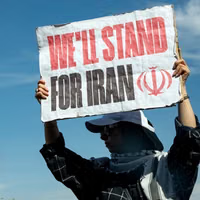
The Israeli election has nevertheless attracted considerable interest among Iranians hoping for the Islamic Republic's downfall.
Benjamin Basire, an Iranian-born Jewish political analyst living in the United States, said some had followed the vote as though it were their own, contacting him with messages expressing hope that Netanyahu would remain in power.
"We want Bibi. Bibi is our savior," he recalled them saying, adding that some feared Netanyahu's departure would extinguish their hopes of political change.
Netanyahu has already overseen two rounds of Israeli attacks on Iran, in 2025 and 2026, as well as operations that killed senior Iranian military commanders and severely weakened Hezbollah, Tehran's most powerful regional ally.
But with the prospect of another confrontation looming, the question is whether Israel will act again, and with what degree of American support.
Winston suggested that the prospect of renewed fighting was already shaping expectations in Israel, pointing to the approaching US midterm elections as a potential turning point.
"We're already preparing for war," he warned.
"We're ready. That's for sure."
Watch Eye for Iran on YouTube or listen on your favourite podcast platform.