Israeli PM hopeful rejects military pursuit of regime change in Iran
Former military chief and leader of the Yashar party Gadi Eisenkot delivers a statement to members of the press, near Kibbutz Mefalsim, southern Israel, on October 15, 2026.
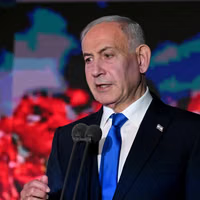
Toppling the Islamic Republic would be a service to humanity, but making it an objective of war would be wrong, Israeli prime ministerial contender Gadi Eisenkot said Monday.
Eisenkot, a former Israeli military chief who leads the centrist Yashar party, is one of Prime Minister Benjamin Netanyahu's leading challengers in Tuesday's parliamentary election.
In a television interview, Eisenkot said the proper military objectives were destroying Iran's nuclear and missile programs and its regional proxy forces.
Iranian Parliament Speaker Mohammad Bagher Ghalibaf stands with members of Iraq's Popular Mobilization Forces at the grave of Iraqi paramilitary commander Abu Mahdi al-Muhandis, who was killed alongside Iranian military commander Ghassem Soleimani in a US drone strike near Baghdad International Airport in January 2020, in Najaf, Iraq, August 21, 2026.
An Iraqi court ordered the arrest of a provincial leader on Monday after he threatened road blockades and even separation from Iraq over the closure of a border crossing with Iran, revealing tensions over Baghdad's efforts to curb Tehran’s influence on Iraqi security decisions.
Mustafa Duair, head of the provincial council in Maysan, a southeastern governorate bordering Iran, threatened civil disobedience unless the Al Sheeb crossing was reopened.
Baghdad has cited technical problems for the closure, while Tehran has pointed to US pressure.
The Iran-aligned Badr Organization defended Duair, turning the dispute over a border crossing into a broader challenge to the central government's authority from within Iraq's Shiite political establishment.
Risks of another battlefield
In September, Iraqi authorities seized a drone launcher allegedly used to attack Saudi Arabia's East-West oil pipeline. Saudi officials had traced the attack to the province, close to the Iranian border.
Asharq Al-Awsat reported Saturday that Iraqi officials suspected Israel had struck two depots storing Chinese-made portable air-defense systems allegedly supplied by Iran to allied Iraqi militias.
The reported shipments and Israeli involvement remain unconfirmed, but the allegations underscore the risks Baghdad faces when armed factions acquire weapons and pursue military agendas outside state control.
Ammar al-Hakim, a veteran leader with longstanding ties to Tehran, acknowledged sympathy for Iranians facing sanctions but warned in a September interview that Iraq must protect its own citizens from the same penalties.
“The feeling that the Islamic Republic has been treated unjustly under this siege of sanctions is valid and justified. But countries cannot be governed by wishes and emotions,” Hakim said.
On Monday, a spokesman for his Hikma Movement warned that breaking a militia de-escalation agreement could plunge Iraq into a “tunnel of sanctions.”
Baghdad pushes for greater control
Prime Minister Ali al-Zaidi has set June 2027 as the deadline for bringing armed factions under state authority, although some Iran-backed groups continue to resist.
He has also replaced several security chiefs since taking office in May. On Monday, Zaidi dismissed intelligence chief Hamid al-Shatri, who was appointed by his predecessor and had himself been considered for prime minister. No official explanation was given for his dismissal.
The push for greater state authority aligns with Washington's longstanding demands that Baghdad curb independent militias.
Zaidi has also sought closer economic and political ties with the United States, with more than $60 billion in commercial agreements and memorandums announced during his July visit to Washington.
But Zaidi still relies on a coalition that includes Iran-aligned parties. He insists Iraq will not become involved in the Iran war and wants Baghdad to act as a mediator, while acknowledging that disruption in the Strait of Hormuz has damaged Iraq's economy.
Iraq’s leaders are emphasizing national authority and economic interests over involvement in Tehran's confrontations, but the reaction to the Maysan border closure shows how difficult asserting that authority over Iran-aligned factions remains.
اسکات بسنت، وزیر خزانهداری ایالات متحده، در «تالار وجه نقد» ساختمان خزانهداری، ۴ آبان ۱۴۰۵
US Treasury Secretary Scott Bessent, in an interview with Iran International, warned Iranians to stock up on gasoline and heating fuel ahead of expected shortages, predicting the economy would shrink by more than a quarter in the year ending March 2027.
Bessent said Iran was running short of foreign currency, oil production was beginning to falter and the next eight weeks of Washington's Operation Economic Outcast would be “even more intense.”
“I would predict that from March of '26 until March of '27, the economy would contract more than 25 percent, which is more than the Soviet Union contracted after its collapse,” Bessent told Iran International’s Kambiz Tavana on Monday.
The Treasury secretary said the campaign was intended to pressure Iran's leadership rather than its population, while warning of severe fuel shortages this winter.
“My advice to the Iranian people would be: don't pay your taxes because you're not going to get anything back from the government,” Bessent said.
“You should start stocking up on heating fuel. There's going to be a big heating fuel shortage. In terms of gasoline, everyone should fill up their tanks now.”
Asked about the impact on ordinary Iranians, Bessent said humanitarian channels remained open for food and medicine, but the government was running out of dollars to pay for imports.
He also said authorities were printing money, failing to pay salaries and would continue cutting social benefits.
Bessent said economic pressure was exposing disagreements among Iranian politicians, the Revolutionary Guards and the supreme leader. He described some IRGC commanders as isolated from the public and unaware of the extent of the economic deterioration.
‘More intense’ pressure ahead
Iran's economy has come under mounting pressure from two rounds of war with the United States and Israel, a US naval blockade that has sharply curtailed its oil exports and an expanding sanctions campaign targeting its remaining sources of foreign currency.
“Iran, for the first time, probably since oil was discovered, has no oil on the water,” Bessent said. “There have been no loadings at Kharg Island. Production is starting to falter.”
“We've been going for eight weeks, and I can tell you the next eight weeks is going to get even more intense,” he said.
Bessent said Washington remained prepared to negotiate, but insisted Iran could not have a nuclear weapon and must stop financing regional armed groups.
Diplomatic efforts have intensified in recent days, with Qatari mediators in Tehran on Sunday followed on Monday by senior officials from Saudi Arabia, Pakistan and Turkey seeking to de-escalate tensions and revive negotiations.
US Treasury Secretary Scott Bessent (left) and Iran International's Kambiz Tavana during an interview in Washington DC on Oct. 26, 2026.
Tehran, however, has shown little sign of softening its core demands under mounting economic pressure. Iranian officials insist Washington must meet its conditions, including lifting the naval blockade.
Targeting Iran's middlemen
Bessent also appealed directly to people involved in moving Iranian government money overseas, saying some financial intermediaries were already refusing to return funds to Tehran.
Iranian officials commonly refer to such intermediaries as “trustees,” who handle oil revenues and other transactions outside the formal banking system to circumvent sanctions.
“We are seeing the regime go bankrupt,” Bessent said. “So many of the people who are holding money outside of Iran do not want to send it back in.”
He said Iranians inside the country, members of the diaspora and employees of embassies and consulates could provide information to Treasury under its whistleblower program, with rewards of up to 30% of recovered funds.
“We are happy to unsanction individuals who work with us,” he said, adding that cooperating intermediaries could potentially claim 30% of funds they were holding for Tehran.
Bessent said Treasury was also tracking Iran's attempts to move money through cryptocurrency and foreign banks.
“There are numerous banks… We shut the Dubai branches of an Egyptian bank. We closed a Turkish bank, the second-largest Russian bank, VTB. We discovered that their external branches outside of Russia were aiding the regime,” he said.
‘Nothing like this’
Bessent rejected suggestions that Iran could wait for the US midterm elections in the hope that Washington's approach would change.
“Nothing will change in terms of President Trump's calculus, in terms of how resolute we are here at Treasury, in terms of the blockade,” he said.
Asked whether the combination of sanctions and a naval blockade had any historical precedent, Bessent said the closest comparison was Washington's campaign against Venezuela, but argued that the measures imposed on Iran went substantially further.
“There's been nothing like this,” he said.
US Treasury Secretary Scott Bessent (left) and Iran International's Kambiz Tavana during an interview in Washington DC on Oct. 26, 2026.
Iran Air retirees gather in Tehran on August 8, 2026, to protest over healthcare coverage, pension payments and suspended welfare benefits.
Two retired employees of Iran's national airline died after being forced to abandon medical treatment they could not afford, the semi-official ILNA news agency reported on Monday, citing the head of the airline's retirees' association.
Jalal Hashemi, chairman of the Iran Air Retirees Association, said the deaths occurred over the past two to three weeks amid worsening financial and healthcare problems affecting around 13,000 retirees and pensioners of the airline, also known as Homa.
"The situation has become so catastrophic that in just the past two or three weeks, two of our retired colleagues were forced to abandon treatment because they could not afford hospital expenses, and unfortunately lost their lives," Hashemi told ILNA.
Iranian households face mounting economic hardship after years of inflation, sanctions and economic mismanagement, compounded by two rounds of war with the United States and Israel.
Iran Air retirees have staged repeated protests over pension payments, healthcare coverage and the management of their retirement fund.
In August, retirees gathered outside the airline's headquarters in Tehran to demand improvements to healthcare services and the reinstatement of suspended welfare payments.
Hashemi said Iran Air had paid only two of 12 installments owed to Iran Insurance Company under its insurance contract for the Iranian year ending in March 2026, prompting the insurer to suspend inpatient hospital coverage for retirees.
According to Hashemi, Iran Air retirees receive an average monthly pension of around 270 million rials (about $100), while approximately 5,600 receive minimum pensions of just over 180 million rials (about $66).
He estimated the shortfall in the airline's healthcare insurance fund at 4 trillion rials (about $1.5 million), saying no institution had accepted responsibility for covering the deficit.
Recent reductions in government-subsidized foreign currency for medicine imports, drug price increases and rising out-of-pocket healthcare costs have further strained the fund.
Hashemi also said Iran Air management had suspended a monthly welfare allowance of 60 million rials (about $22), citing financial losses from the war and reduced flights.
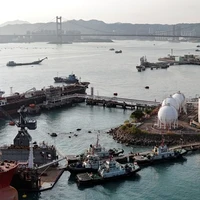
A drone view shows a Chinese-flagged oil tanker moored at an oil terminal at Tsing Yi port, with Tsing Ma bridge in the background, in Hong Kong, China March 19, 2026.
Hardliners in Tehran are hailing a surge in global oil prices as evidence that pressure on shipping is paying off, even as moderates warn that the same confrontation is inflicting mounting damage on Iran's economy and strengthening the case for a deal with Washington.
Crude prices rose above $116 a barrel on October 24 following reports of two attacks involving supertankers near Oman, prompting hardline newspaper Kayhan to portray the increase as vindication of the Islamic Revolutionary Guard Corps Navy's strategy of asymmetric pressure around the Strait of Hormuz.
Under the headline “Minefields near Musandam Prove Diplomacy Is Obsolete,” Kayhan argued that disruption to shipping and the resulting pressure on global energy markets had strengthened Iran's bargaining position rather than demonstrated the need for compromise.
The newspaper accused moderates and more pragmatic conservatives of “begging for an agreement,” singling out the centrist Sazandegi newspaper, which supports reaching a deal with the United States.
But the same confrontation is taking a growing toll on Iran's economy.
Moderate daily Shargh warned that higher crude prices offer little relief to private-sector manufacturers facing bankruptcy and argued that keeping negotiations with Washington alive is essential to Iran's economic survival.
The economic daily Donya-ye Eghtesad has also highlighted pressure on factories in industrial centers including Isfahan, Tabriz and Arak, reporting an unprecedented wave of corporate bankruptcies as the maritime blockade continues.
The competing assessments expose an increasingly important argument in Tehran: whether the economic disruption caused by the confrontation is leverage to be exploited or damage Iran can no longer afford.
Signs of diplomatic movement
The debate comes as signs of diplomatic movement feed cautious optimism among some Iranian political figures that an agreement with the United States may be becoming more likely than another round of war.
Former deputy parliamentary speaker Ali Motahari gave voice to that view on Monday, saying that for the first time in several weeks, the prospects of an agreement with Washington appeared greater than the likelihood of renewed conflict.
Speaking to reporters in Tehran, Motahari argued that war was becoming less likely because the United States was facing multiple problems and might therefore be prepared to accept some of Iran’s conditions.
Monday’s high-level talks with regional powers have added to that sense. Saudi Defense Minister Khalid bin Salman, Pakistani army chief Asim Munir and Turkish intelligence chief Ibrahim Kalin are in Tehran to meet national security chief Mohsen Rezaei and Foreign Minister Abbas Araghchi.
According to Iranian state outlets, Tehran has reiterated its proposal for reducing tensions in the Strait of Hormuz. Following technical discussions in Doha, it resubmitted a plan to restore shipping through the waterway in stages over seven days.
Foreign Ministry spokesman Esmaeil Baghaei said on Monday that Iranian technical negotiators were examining US counterproposals on procedures for lifting the naval blockade.
Tehran insists the seven-day window will not begin until $24 billion in foreign reserves becomes fully accessible and restrictions on container clearance at Bandar Abbas are lifted.
Iran has also insisted that its seven-point de-escalation plan, based on the Islamabad Memorandum of Understanding, remain separate from negotiations over uranium enrichment, International Atomic Energy Agency inspections and regional missile defense arrangements.
It remains unclear whether Washington accepts that separation. Tehran's position suggests it is seeking immediate economic relief while avoiding concessions on broader strategic issues.
The divide leaves Tehran confronting an awkward calculation. The disruption around Hormuz may be imposing higher costs on Iran's adversaries just as hardliners intended, but it is also increasing the economic pressure driving others in Tehran toward a deal.
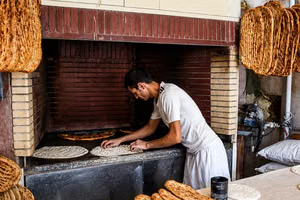
A baker prepares dough for bread at a bakery in Iran.
Flour shortages have forced bakeries to close in several Iranian cities and pushed up bread prices, with residents and bakers reporting disrupted supplies, falling purchasing power and growing uncertainty over their businesses.
Residents in Tabriz, Karaj, Kerman and Hamedan told Iran International that interruptions and delays in flour deliveries had disrupted independent bakeries and producers of various types of bread.
Several bakeries on a street in Tabriz have shut down, a resident said.
“I asked why, and they told me they weren't receiving flour. They keep promising that the flour quotas will be replenished today or tomorrow, but nothing happens.”
Previous reports have also documented flour shortages and bakery closures, with residents describing bread shortages and interruptions to production caused by electricity outages.
Flour supply disruptions shut bakeries and sandwich shops
Independent bakers have reported that difficulties obtaining flour have forced businesses to suspend operations.
A citizen of Hamedan in western Iran said flour shortages and rising prices had affected not only bakeries producing specialty bread but also sandwich shops.
Flour prices have risen, and suppliers are now saying there is no flour available at all, the resident said.
“Our bakery is closed because we have no flour, and nobody is taking responsibility,” a independent baker told Iran International.
The shortages have coincided with declining purchasing power, leaving bakeries struggling to secure supplies as customers struggle to afford bread.
“They don't have flour to give us, and I swear to God, people don't have money to buy bread either. Our economic situation has become critical,” another baker said.
Iran's flour distribution system distinguishes between subsidized bakeries and independent bakeries, which face different purchasing prices and supply arrangements.
Flour allocations to certain independent bakeries had been reduced, Bagher Khodadadi, head of supervision and inspection at the Khorasan Razavi provincial agriculture department, confirmed on October 21.
Khodadadi said the shortages in flour distribution had been addressed.
Bakeries reducing their operating hours because of flour shortages would be committing a violation and could face enforcement measures, he added.
Rising prices disrupt food retailers
The flour supply problems have also affected food retailers that depend on bakeries for their products, according to messages.
Two bakeries supplying bread to a supermarket in Kerman said they no longer had enough flour to continue production, the store's owner said.
“Two of the bakers who supply me called and said there was no flour left and they couldn't bake and deliver bread tomorrow. A famine has officially begun.”
A resident of Karaj also described a sharp increase in bread prices.
“I bought two baguettes and they cost 800,000 rials. The price of flour has also tripled.”
Iran International previously reported on October 8 that residents had described unannounced increases in bread prices and flour shortages in several areas.
Bread prices in Tehran province had risen by as much as 100% for certain varieties by June 23.
The increases have added to the financial pressure on households already struggling with declining purchasing power.
Uncertainty over flour quotas and pricing
The disruption has raised further questions about how flour quotas are allocated and priced for independent bakeries and producers of larger and semi-industrial bread varieties.
Flour allocations to these businesses were suspended about two weeks ago, according to another message received by Iran International.
The sender said suppliers had attributed the suspension to the government's failure to announce new flour prices, leaving bakeries uncertain about when deliveries would resume.
The resident also said certain flour mills were selling supplies on the black market without issuing invoices specifying prices.
Comments by provincial grain officials about flour allocations have added to questions over the distribution system and the availability of supplies.