Saudi-led coalition says it intercepted drone in Riyadh region
The Saudi-led coalition said on Thursday that it intercepted and destroyed a drone in the Riyadh region.
The Saudi-led coalition said on Thursday that it intercepted and destroyed a drone in the Riyadh region.







Germany’s financial regulator BaFin said on Thursday that Bank Saderat Iran’s Hamburg branch had lost its banking license and must be wound up. The branch, which operated in Hamburg and Frankfurt, is no longer allowed to conduct banking business.
BaFin revoked the license on November 5, 2025, citing persistent legal violations that the bank had failed to remedy. A 2023 special audit found serious shortcomings in its business organization, and the bank had been inactive for more than six months.
BaFin also cited sanctions against the institution, saying German banking law therefore presumes its managers to be unreliable, regardless of whether they personally engaged in misconduct.
BaFin orders branch wound up
BaFin ordered the wind-down on June 11, 2026. The liquidation order became final on July 15, according to the regulator. The bank later withdrew legal action against the measure on September 23, and a Hamburg court appointed Berlin-based FUW Treuhand Project Management GmbH as liquidator on September 30.
The withdrawal of the banking license had already become final on December 8, 2025.

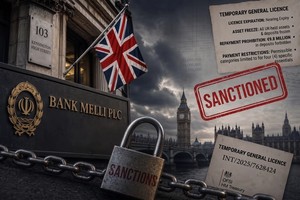

The bank mainly handled and financed Iran-related exports, including payment services, letters of credit, lending, guarantees and investments. It had 13 employees and assets of €62.4 million at the end of 2025. Customer deposits total about €200,000.
Deposits remain subject to sanctions restrictions
BaFin said there is currently no deposit compensation event, meaning Germany’s deposit guarantee system has not been triggered. Access to funds is restricted under EU sanctions, however, and the liquidator can make payments only with authorization from the Bundesbank’s Financial Sanctions Service Center.
BaFin said the existing deposits would instead be dealt with as part of the liquidation of the branch.
Iranian banks remain under scrutiny in Germany
The decision comes as Iranian banks operating in Germany face heightened scrutiny under renewed EU sanctions and increased US pressure on Tehran’s overseas financial network.
Bank Melli Iran’s Hamburg branch remains open despite being covered by EU sanctions, Germany’s Foreign Ministry told Iran International in August.
The ministry said at the time that the sanctions applied to Bank Melli and its German branch, but did not say whether Berlin was considering closing the operation.
The issue gained attention after US Treasury Secretary Scott Bessent launched “Operation Economic Outcast” and called for every Bank Melli branch abroad to be shut. Germany said it remained in contact with Washington and other partners over further measures against Iran but gave no indication that a decision had been made on Bank Melli’s Hamburg branch.
Bank Melli and Bank Saderat are separate institutions, and BaFin’s action against Bank Saderat was based on German banking-law requirements as well as the sanctions applying to the bank.
A man accused of plotting an attack on Iran International journalists told a London court Wednesday that he met an alleged Revolutionary Guards contact at the Iranian embassy while he was gathering information on the journalists.
Mostafa Sepahvand told Woolwich Crown Court that he visited the embassy on February 15, 2025, where he met a man he identified as Navid Emami.
Sepahvand said he told Emami that addresses provided for the journalists were incorrect but that he was still pursuing the matter. According to Sepahvand, Emami asked whether his co-defendant Farhad Javadi Manesh was working with him.
Later in his testimony, Sepahvand said Emami had supplied addresses to people he described as connected to the Revolutionary Guards. He also alleged that Emami had threatened him.
Sepahvand, 41, is on trial alongside Manesh, 46, and Shapoor Qalehali Khani Noori, 57. All three deny charges under Britain's National Security Act.
Prosecutors say the men gathered information for Iranian intelligence in preparation for serious violence against Iran International journalists Mojtaba Pourmohsen and Kambiz Hosseini.
Sepahvand accepts that he conducted surveillance but says he acted under duress and deliberately tried to undermine the operation.
The court was shown phone and vehicle location data placing Sepahvand near addresses linked to the alleged targets, as well as messages in which he passed Manesh information about Hosseini, including references to his dog and a blue Volkswagen Golf.
Sepahvand said he asked Manesh to make a video of the car. On one occasion, he said, he travelled to an address specifically so his phone's GPS would show his Iranian contacts that he had been there.
He said he was trying to convince the Revolutionary Guards that he was cooperating while actually frustrating the alleged operation.
“I played them,” Sepahvand told the court.
Sepahvand also testified that £30,000 had been sent to a money exchange in Finchley after an address linked to Pourmohsen was raised, but said he did not collect it because he did not want to carry out the task.
Asked who had sent the money and what it was for, Sepahvand named a man called Ruhollah and said it was to “go after the journalists.” Asked which journalists, he said that had not been specified.
Sepahvand said he had initially asked for £150,000. When he denied telling his Iranian contacts that he would attack a journalist if they paid him, his barrister, Tyrone Smith, pointed him to an earlier message in which he appeared to say he would carry out the attack if paid.
Sepahvand said he had no choice but to make such claims because he believed the Revolutionary Guards were monitoring his communications and waiting for him to say he would not carry out the attack.
He said he had been under duress from the beginning, citing the arrest of an associate and his younger brother, a raid on his mother's home and pressure over a criminal case against him in Iran.
“I didn't want anyone to be hurt,” Sepahvand said toward the end of his testimony. “I wanted to protect everyone.”
The trial continues.
Iranian leaders raised the conditions for negotiations with the United States and issued fresh warnings of a wider military response on Wednesday, even as signs persisted that Tehran was leaving room for diplomacy.
President Masoud Pezeshkian said threats and sanctions must be lifted in practice before conditions for negotiations could be established, while Revolutionary Guards spokesman Hossein Mohebbi said Iran would launch offensive operations against any country that attacked it as part of a shift toward asymmetric warfare.
An unnamed senior security official also told state-run Press TV that Iran was prepared for an all-out war and would respond “without restraint” to renewed attacks or assassinations.
The rhetoric coincided with high-level discussions in Tehran. Iranian media reported Wednesday that Parliament Speaker Mohammad Bagher Ghalibaf had met Supreme Leader Mojtaba Khamenei to discuss the latest military and economic developments in the confrontation with the United States and Israel.
The meeting also addressed strengthening Iran's national capabilities, maintaining social cohesion, tackling economic difficulties and “advancing relations with strategic partners,” according to the reports.
Yet diplomatic channels remain active. Russian President Vladimir Putin told US envoy Steve Witkoff on Wednesday that there was still room for diplomacy over Iran and that an agreement with Tehran was needed, according to the Kremlin.
The competing signals leave open whether Tehran is raising the price of a negotiated pause or preparing for another phase of confrontation.
Talk of a negotiated pause
The conservative daily Jomhouri Eslami reported, citing “informed sources,” that discussions mediated by Qatar and Pakistan could take place this week around a framework for halting military clashes and securing reciprocal concessions.
The report followed Pakistani Field Marshal Asim Munir's visit to Tehran on Tuesday and came amid a flurry of diplomatic activity involving Russia and other regional powers.
According to Jomhouri Eslami, the framework would seek to halt military clashes, address outstanding disputes and sequence concessions in a way that reduced the risk of fighting resuming.
The newspaper said it expected that “the region will not see an escalation of tensions under current conditions.”
The prominence given to the prospect of an agreement by a conservative establishment newspaper is notable at a time when Iranian officials publicly deny that substantive nuclear negotiations with Washington are under way.
Sobh-e No, a newspaper aligned with Parliament Speaker Ghalibaf, also linked renewed discussion of talks to diplomatic contacts involving Pakistan and Russian Foreign Minister Sergei Lavrov, who visited Tehran on Tuesday.
The newspaper reported on a Russian proposal for a joint Iranian-Russian-Chinese initiative concerning the Strait of Hormuz, although Tehran has continued to insist on maintaining its authority over the waterway.
The Pezeshkian administration's Iran newspaper argued that the country's security depended on exercising sovereignty over the strait rather than sharing responsibility with outside powers.
“To preserve our security, we have no option but to exercise sovereignty over the Strait of Hormuz,” it wrote.
That position points to one of the difficulties facing any potential agreement: Tehran wants the Strait of Hormuz and broader maritime security addressed alongside the conflict, while Washington has continued to prioritize Iran's nuclear program.
Pressure in the other direction
Hardline lawmaker Hassan Nataj called for Supreme Leader Khamenei to reconsider the religious prohibition on nuclear weapons in response to the conflict.
“We should ask the Supreme Leader to revise the fatwa prohibiting nuclear weapons in light of the current situation,” he told the Didban Iran website.
The comments come amid a wider debate among Iranian politicians and commentators over whether the country's nuclear posture still provides sufficient deterrence against further US or Israeli attacks.
The simultaneous emphasis on diplomacy and escalation does not establish which course Tehran ultimately intends to pursue.
But the pattern has become clearer: diplomatic channels remain open while Iranian officials publicly raise the conditions for negotiations and stress that renewed attacks could bring a broader military response.
Israel has barred a United Airlines pilot of Iranian descent from serving on flights to the country over unverified social media allegations that he supported Iran's government, the Revolutionary Guards and Hezbollah, Ynet reported Wednesday.
Israel's Diaspora Affairs and Combating Antisemitism Ministry alerted security and transportation officials on October 19 to allegations circulating on X about the pilot, Sina Amjadian, according to a ministry letter obtained by Ynet.
The letter included two posts from X. One alleged that Amjadian, who was said to have previously worked for flydubai, had shared content supporting Iran's government, including a video in which he purportedly kissed and saluted its emblem.
The other alleged that he had expressed support for the Islamic Revolutionary Guard Corps and Hezbollah and called on United Airlines to investigate his conduct.
Ynet said it could not independently verify the allegations and that the material submitted to Israeli authorities did not include original statements or social media posts by Amjadian.
The allegations nevertheless prompted a security review and a decision to prohibit Amjadian from serving as a crew member on flights to Israel, senior Transportation Ministry officials told Ynet.
The Diaspora Affairs Ministry said the warning followed an attempted attack aboard a flydubai flight bound for Israel in late September, during which a co-pilot attacked the captain and attempted to seize control of the aircraft.
The incident prompted Israel's National Command and Control Center for Combating Antisemitism to expand its monitoring to people who might pose a threat to aviation security, according to the ministry.
It said the allegations concerning Amjadian warranted security scrutiny because of the responsibilities of an international airline pilot and the potential risks to passengers and crew.
Transportation Ministry officials told Ynet that the ministry did not independently monitor social media or gather intelligence but coordinated with security agencies when information raised aviation safety concerns.
They said preventing a pilot from operating flights to Israel was separate from denying the individual entry to the country, which falls under the authority of border control officials.
Ynet said it remained unclear whether Amjadian had previously flown to Israel, had been scheduled to operate a flight to Ben Gurion Airport or was qualified to fly aircraft used by United Airlines on its Israel routes.
There was no indication that any flight had been canceled or prevented from reaching Israel because of the restriction.
Conflicting accounts emerged Wednesday over Iraq's plans for its border with Iran, as Baghdad attributed the closure of one major crossing to technical shortcomings while reports said more could be shut amid US pressure to restrict trade routes with Tehran.
Iraqi government spokesperson Haider al-Aboudi said the Sheeb crossing, known as Chazabeh in Iran, was closed because it lacked sufficient technical, technological and developmental readiness, according to the official Iraqi News Agency.
He said trade was proceeding normally through several other crossings with Iran.
But Al Jazeera cited an Iraqi government official on Tuesday as saying Prime Minister Ali al-Zaidi had ordered Sheeb closed indefinitely and several other crossings gradually shut in the coming days. No reason was given for the planned closures.
Separately, AFP reported Wednesday, citing two Iraqi political sources, that Washington was pressing Baghdad to close crossings with Iran as part of efforts to increase economic pressure on Tehran.
One source said the US Treasury Department raised the issue with Zaidi during his visit to New York for the UN General Assembly last month and that the proposed restrictions would leave only two crossings open, one in federal Iraq and another in the Kurdistan region.
The second source said Washington had asked other countries bordering Iran to take similar measures.
Reuters reported that Sheeb had been closed to passengers, vehicles and commercial trucks. An Iraqi border official told the agency the closure would allow security arrangements to be reviewed and detection equipment installed to prevent the smuggling of prohibited materials.
Tehran seeks reopening
Iranian officials said they had received no advance warning of the closure.
Valiollah Hayati, a security official in Iran's southwestern Khuzestan province, said consultations were under way with Iraqi authorities to reopen Sheeb and advised passengers and commercial trucks to use the nearby Shalamcheh crossing.
Iranian Interior Ministry spokesperson Ali Zeinivand said Iraq was required to notify Tehran of extended border closures but had not done so.
Foreign Minister Abbas Araghchi also criticized disruptions at Iran's borders on Wednesday, saying they had become places where traffic was held up rather than allowed to pass. He said the Foreign Ministry would seek to resolve obstacles originating in neighboring countries.
The uncertainty comes days after Pakistan suspended commercial activity at two major crossings with Iran, Taftan-Mirjaveh and Gabd-Rimdan, on October 17.
Iranian authorities said the border reopened on Tuesday, although the resumption of normal commercial traffic at both crossings has not been independently confirmed.
Iran and Iraq share a border of more than 1,400 kilometers (870 miles) and have extensive political, religious and economic ties.