• العربية
  • فارسی
BrandBrand
  • Iran Insight
  • Politics
  • Economy
  • Analysis
  • Special Report
  • Opinion
  • Podcast
  • Live TV
  • Iran Insight
  • Politics
  • Economy
  • Analysis
  • Special Report
  • Opinion
  • Podcast
  • Live TV
  • Theme
  • Language
    • العربية
    • فارسی
  • Iran Insight
  • Politics
  • Economy
  • Analysis
  • Special Report
  • Opinion
  • Podcast
  • Live TV
All rights reserved for Volant Media UK Limited
volant media logo

Video: Tehran stages jailed Trump in mock prison display

Oct 21, 2026, 11:42 GMT+1

Most Viewed

Iran threatens stronger response to new US attack as Lavrov visits Tehran
1

Iran threatens stronger response to new US attack as Lavrov visits Tehran

2

Toppling Iran’s regime is ‘primary objective,’ Netanyahu says after US talks

3

Russia vows continued Iran ties as Trump welcomes limits on support

4
ANALYSIS

Iran deal remains elusive amid risk of renewed strikes

5

Iran-Pakistan border trade halt leaves trucks and cargo stranded

Banner
Banner
Banner
Banner
Banner

Spotlight

  • Ghalibaf allies seek an end to war without giving up leverage over US

    Ghalibaf allies seek an end to war without giving up leverage over US

  • Iran in Israeli election: Netanyahu all-in on regime change, rivals want more
    INSIGHT

    Iran in Israeli election: Netanyahu all-in on regime change, rivals want more

  • Saudi Arabia should join US-led push for change in Iran, analyst says
    ONE-ON-ONE

    Saudi Arabia should join US-led push for change in Iran, analyst says

  • Ex-president's remarks expose divide over costs of Iran’s Palestine policy

    Ex-president's remarks expose divide over costs of Iran’s Palestine policy

  • Teenager killed by gunshot to eye after arrest in Iran, source says

    Teenager killed by gunshot to eye after arrest in Iran, source says

  • Soaring medical costs and staff shortages strain Iran’s hospitals
    VOICES FROM IRAN

    Soaring medical costs and staff shortages strain Iran’s hospitals

  • Architect of Guards' missiles becomes Iran's defense minister

    Architect of Guards' missiles becomes Iran's defense minister

•
•
•

More Stories

Ghalibaf allies seek an end to war without giving up leverage over US

Oct 21, 2026, 04:03 GMT+1
•
Behrouz Turani
100%
Iranian Parliament Speaker Mohammad Bagher Ghalibaf visits the grave of former Iraqi paramilitary commander Abu Mahdi al-Muhandis in Najaf, Iraq, on August 21, 2026 (Reuters)

A current within Iran’s conservative establishment associated with Parliament Speaker Mohammad Bagher Ghalibaf favors maintaining military and economic leverage while keeping open the possibility of a negotiated end to the war with the United States.

Ghalibaf has played a leading role in negotiations. The position reflected in the conservative newspapers Khorasan and Sobh-e No rejects both indefinite confrontation and a settlement on US terms, favoring preparations for renewed fighting, retaining Iran’s strategic leverage and keeping open the possibility of a negotiated settlement.

The divisions are also reflected in Iran’s media landscape, with outlets including Kayhan, Javan and Tasnim taking more confrontational positions, while Shargh and Sazandegi have generally favored diplomacy.

Commentaries and an interview published by Khorasan on October 18 illustrate the argument emerging from conservatives associated with Ghalibaf.

Hormuz as negotiating leverage

In “Ambiguity: The New Battlefield”, Khorasan argues that diplomatic contacts do not mean the military threat has disappeared. Uncertainty itself, the commentary suggests, can wear down Iran’s psychological and operational readiness, making continued vigilance necessary even while negotiations remain possible.

A second article, “The Puzzle of Iranian and American Resilience”, develops the economic case for resistance. It acknowledges Iran’s severe inflation and financial pressures but questions whether the United States can necessarily outlast Iran simply because its economy is larger. American debt, exposure in financial markets, borrowing costs and the economic consequences of disruption around the Strait of Hormuz are presented as potential weaknesses.

Taken together, the Khorasan articles present the Strait of Hormuz as a source of bargaining power that Iran should retain during negotiations. They do not address how long Iran could sustain disruption or whether the economic costs to its adversaries would outweigh those to Iran.

A negotiated exit

The articles leave room for diplomacy. “Ambiguity” refers to a seven-day proposal transmitted through Qatar under which maritime traffic could resume if specified conditions were met.

In a separate interview, political analyst Ehsan Salehi, an adviser to former President Ebrahim Raisi, argues that the diplomatic outcome associated with the Islamabad understanding should have been presented to the public as a potential achievement. Otherwise, negotiations risk becoming synonymous with betrayal.

Salehi also warns against labeling officials as traitors without evidence, arguing that disagreements over diplomacy should not divide the country.

The arguments point toward a conditional settlement addressing Iran’s security concerns and providing economic or political benefits that could be presented domestically as the result of resistance. The articles do not establish whether this faction would accept particular compromises on the nuclear program, sanctions or control of Hormuz. Those questions remain unresolved.

How the faction differs from its rivals

The clearest contrast is with the more confrontational conservative current associated with the Paydari (Steadfastness) Front. Paydari figures have generally resisted concessions to Washington and challenged negotiators when agreements fall short of maximalist demands.

The position associated with Ghalibaf is more transactional, treating military pressure as potential leverage for an agreement and diplomacy as a means of securing gains that military action alone may not deliver. The disagreement is less about whether Iran should resist American pressure than about how that resistance should end and what would constitute an acceptable outcome.

Reformist and pragmatic voices have placed greater emphasis on ending the conflict, reducing sanctions and easing economic pressure, contrasting with conservatives who argue that Iran should retain leverage while negotiating. Ghalibaf’s camp, by contrast, insists that distrust of Washington and the possibility of renewed attacks must shape any agreement.

Salehi’s interview adds a domestic dimension. His calls for broader political representation, stronger parties and a more inclusive state broadcaster suggest that national resilience requires political reform as well as military strength.

Parliamentary influence and its limits

Ghalibaf has considerable institutional weight. He was re-elected speaker in May 2026 with 235 votes, following his 198-vote victory in 2024. The results show that his parliamentary support extends beyond a narrow personal faction, although they do not establish that those lawmakers share his foreign-policy positions.

His former senior role in the Revolutionary Guards also gives him military credentials and connections that many civilian politicians lack. But these should not be confused with command over the armed forces. Parliament can influence political debate, scrutinize ministers and shape legislation, but it does not independently determine questions of war and peace.

The Supreme National Security Council brings together the presidency, parliament, the armed forces and other centers of power. Its decisions require the Supreme Leader’s approval. Ghalibaf can influence deliberations but cannot guarantee that the military establishment or the supreme leadership will accept his preferred compromise.

The political test

The faction’s broader influence across Iranian society is harder to establish. Salehi argues that wartime solidarity will not last if citizens who defended the country feel excluded from political life. This is a strategic argument, not evidence that Ghalibaf’s faction commands majority public support.

The immediate political question is whether conservatives advocating this approach can present a negotiated settlement to their rivals as the result of resistance rather than its abandonment.

The unresolved question is whether Iran can retain the Strait of Hormuz as negotiating leverage while pursuing an agreement that ends the conflict without deepening its own economic pressures.

Iran accused of stoking French unrest through influence operations

Oct 21, 2026, 02:00 GMT+1
100%
French riot police run amid clashes with protesters in Paris as part of nationwide protests against the cost of living and rising fuel prices called by the "Yellow Vests" movement, joined by French high school and university students, teachers and parents demanding better school conditions and government action, as well as labour unions, workers, farmers and retirees, France, October 17, 2026. REUTERS/Abdul Saboor

Iran is seeking to amplify unrest in France through online influence campaigns and alleged links to hard-left groups, The Times reported on Tuesday, citing researchers who accused Tehran and Moscow of exploiting student protests to weaken Western democracies.

The report also cited claims that President Emmanuel Macron blocked publication of a French government assessment of Iranian interference to avoid antagonizing Tehran.

The protests began last month over education funding and discrimination, before spreading and descending into violence in Paris and other cities. The Times said there was no evidence foreign powers initiated the movement.

French Foreign Minister Jean-Noël Barrot said last week that the demonstrations had been exploited by hostile narratives from Russia, China, Iran and the US MAGA movement, according to the newspaper.

France Culture separately cited police and intelligence sources alleging that foreign-backed bloggers and influencers had amplified the unrest. Officials or state-aligned media in the countries accused have rejected the allegations, The Times said.

Claims of infiltration and payments

David Colon, a historian at Sciences Po who studies disinformation, told The Times that Iran, Russia and Algeria were exacerbating tensions. He argued that Iran had been particularly effective because of its penetration of far-left groups.

Franco-Iranian journalist Emmanuel Razavi alleged that Iranian intelligence cultivated ties with those groups and encouraged them to promote the Palestinian cause. He linked the presence of Palestinian flags at protests to those efforts, although the flags themselves do not establish Iranian involvement.

Razavi also said Iranian agents were suspected of paying unemployed youths a few hundred euros to cause disorder in Paris. He said those allegedly paid represented only a small minority of participants in the October 17 unrest.

He further alleged that the Revolutionary Guards’ Quds Force operated troll farms and recruited influencers, including on Telegram. The report did not present documentary evidence substantiating his claims about payments or operational links.

Colon cited a Franco-Iranian influencer convicted of inciting terrorism who was now posting about French police violence, arguing that he understood how to maximize online visibility.

Report allegedly withheld

Citing French outlet La Lettre, The Times said Barrot received a government report describing Iranian disinformation campaigns and cyberattacks, including activity around the 2024 Paris Olympics and subsequent French protests.

Barrot wanted it published, but Macron refused while seeking to maintain diplomatic distance from both Tehran and Washington during the Iran war, according to the account.

La Lettre’s publicly accessible summary says the Élysée blocked disclosure of evidence compiled by French security bodies and ordered a restrained response to Tehran.

Previous influence campaigns

Iran International reported in October 2024 that Microsoft had identified an operation targeting Israel’s participation in the Paris Olympics by Cotton Sandstorm, a group Microsoft described as directed by the Revolutionary Guards.

Earlier that year, Iran International covered Microsoft’s findings that Iranian actors operated covert news websites targeting Americans across the political spectrum, including left-leaning Nio Thinker and conservative Savannah Time. Tehran denied interfering in US elections.

On October 9, Iran International reported OpenAI’s disclosure of an Iran-origin campaign using seven fictitious journalist identities to place nearly 100 articles in foreign outlets and generate hostile replies to Iran International posts.

OpenAI said the social media activity gained little traction and that it could not identify the organization behind the campaign. Those findings document separate influence efforts, rather than establish responsibility for the current French unrest.

Iran hardliners split over role of mediators in US tensions

Oct 20, 2026, 23:39 GMT+1
100%
Iranian President Masoud Pezeshkian meets with chief of Defence Forces of Pakistan, Field Marshal Asim Munir, in Tehran, Iran, August 24, 2026.

Renewed efforts to avert another war with the United States drew conflicting responses in Tehran, with hardliners questioning mediators’ motives while officials defended keeping diplomatic channels open.

The contrasting positions were reflected in Sedaye Iran (Voice of Iran), the internet daily of Iran’s supreme leader. Discussing Pakistani army chief Asim Munir's latest visit to Tehran, it praised Pakistan's relations with Iran and Oman's longstanding role in mediating with Washington.

Yet the publication said that although the mediators' efforts were appreciated, there were “serious and profound doubts” about their effectiveness because “the United States is not seeking an agreement.”

The daily accused Washington of combining negotiations with military threats and argued that intermediaries must persuade President Donald Trump to abandon what it called unrealistic demands.

100%
The front page of Sedaye Iran (Voice of Iran), an online publication of the office of Supreme Leader Mojtaba Khamenei, features an article titled “What's Holding Up Mediation?” about efforts to revive US-Iran negotiations, October 2026.

Hardliners question mediators' motives

Others were far less welcoming. Conservative commentator Ali Gholhaki portrayed visits to Tehran this week by Russian Foreign Minister Sergei Lavrov and Pakistan's General Munir as diplomatic failures. In posts on X Tuesday, he pointed to Tehran's public refusal to send any enriched uranium abroad, which he presented as evidence that Russia's proposed nuclear arrangement had failed.
Gholhaki said Tehran’s reiteration of the same position during Munir’s visit meant both men had “returned empty-handed.”

Ebrahim Rezaei, a member of parliament's National Security and Foreign Policy Committee, went even further, accusing an unnamed mediator of blaming Iran for the recent war, keeping Iranian assets frozen and participating in Washington's economic pressure campaign against Tehran.

Such a mediator was “part of the enemy's hybrid warfare machine,” he wrote on X as Munir visited Tehran. Rezaei did not explicitly identify the country or person he meant.

Suspicion also extended to the timing of the visits. The Revolutionary Guards-affiliated Fars news agency cited an unnamed source linking Munir's hastily arranged trip to a rise in oil prices to around $110 a barrel. It said past mediation announcements had helped lower prices without producing significant negotiating progress for Tehran.

In a separate report, the Iranian news agency IMNA questioned whether mediators were appearing whenever higher oil prices increased pressure on Washington, potentially weakening Tehran's economic leverage by raising hopes of negotiations.

Officials defend continued diplomacy

Iranian officials, however, defended continued diplomacy. Foreign Ministry spokesman Esmail Baghaei called Pakistan an important partner and said diplomatic efforts should continue wherever they could prevent escalation. Abandoning diplomacy, he said, would leave the ministry open to criticism for failing to pursue available options.

Munir met senior Iranian officials Tuesday, including Parliament Speaker Mohammad Bagher Ghalibaf and Supreme National Security Council Secretary Mohsen Rezaei. They repeated Tehran's conditions for new talks, including refusing to transfer enriched nuclear material abroad.

Sedaye Iran ended its editorial by again calling for mediation despite its doubts about the prospects for an agreement. The publication urged intermediaries to convince Washington to change course. Iran had already shown perhaps more flexibility than necessary, it said, before concluding about the negotiations: “It is not easy, but there is no other way.”

Iran in Israeli election: Netanyahu all-in on regime change, rivals want more

Oct 20, 2026, 22:24 GMT+1
•
Negar Mojtahedi
100%
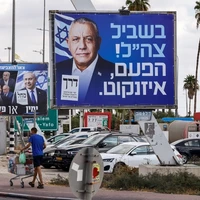
Billboards featuring Israeli Prime Minister Benjamin Netanyahu of the Likud party (left) and former Israeli military chief Gadi Eisenkot, leader of the Yashar party (right), at the entrance to Kiryat Malachi, Israel, October 20, 2026. The writing on Netanyahu's billboard reads "Right or Palestine". The writing on Eisenkot's billboard reads "for the IDF! This time, Eisenkot".

Israeli Prime Minister Benjamin Netanyahu is making regime change in Iran an explicit goal ahead of Israel’s election, while political rivals advocate tough measures against Tehran and criticize his failure to eliminate the Iranian threat.

The debate puts competing promises of security before voters whom analysts describe as exhausted by years of conflict, raising questions about what would constitute victory and how far Israel would go to achieve it.

“We must complete the elimination of the Iranian regime — that is the primary objective,” Netanyahu said Tuesday at Tel Hai University in Kiryat Shmona, near the Lebanese border.

Netanyahu has long welcomed the prospect of the Islamic Republic’s collapse. Now, with Israelis voting on October 27, he is placing the removal of Iran’s leadership at the forefront of his message.

Netanyahu argued that weakening Iran militarily would not guarantee Israel’s security. As long as the Islamic Republic remains in power, he said, it will attempt to rebuild its nuclear capabilities and regional network.

“Finishing the job means bringing down the terrorist regime in Iran,” Netanyahu said, describing Tehran as the head of a “poisonous octopus” whose removal, he argued, would also bring down Hezbollah in Lebanon.

The declaration followed discussions with US President Donald Trump and an unannounced visit by US Defense Secretary Pete Hegseth. Washington, however, has not publicly committed to regime change, emphasizing instead the prevention of a nuclear-armed Iran.

Why emphasize regime change now?

Netanyahu’s declaration comes as he seeks another term following three years of war and repeated military confrontations with Iran and its regional allies.

Itai Reuveni, director of communications and outreach at NGO Monitor, said the prime minister was articulating what many Israelis had already understood to be the broader ambition behind military operations against Tehran.

“I think he just summarized all the things that everyone meant,” Reuveni told Iran International.

Making regime change the declared objective raises questions about whether weakening Iran’s military and nuclear capabilities would be sufficient for Netanyahu to claim victory.

Yaakov Katz, former editor-in-chief of The Jerusalem Post and author of four books on Israel’s military, said repeated strikes alone cannot permanently eliminate the Iranian threat.

“You can bomb them, you can destroy facilities, you can set back nuclear programs, but they will rebuild,” Katz told Iran International.

Netanyahu is presenting regime change as the route to lasting Israeli security, a message delivered in Kiryat Shmona, a historically Likud-supporting community repeatedly targeted by Hezbollah.

Vivian Bercovici, Canada’s former ambassador to Israel and founder and editor-in-chief of State of Tel Aviv, said the location allowed Netanyahu to appeal directly to voters who have experienced the consequences of Iran’s regional influence.

But she questioned whether the declaration would persuade Israelis beyond his existing supporters.

“I really think that people have tuned him out,” she said.

A shared concern, a public tired of war

Those interviewed described opposition to the Islamic Republic as extending across much of Israel’s political spectrum, while drawing a distinction between agreement on the threat and enthusiasm for another military confrontation.

“It’s the one issue on which there’s no daylight in Israel,” Bercovici said.

Yet she described a public exhausted by years of fighting.

“I don’t think that Israel has any appetite for war,” she said. “We’ve had way too much war in the last three years.”

Reuveni described a similar tension. Many Israelis believe Iran’s immediate military threat has diminished following Israeli and American strikes, he said, complicating the case for further military action.

“People are tired from the war,” he said.

Katz said the election ultimately comes down to which leader Israelis trust to protect them, rather than any single declaration about Iran.

“What is important is the belief in which leader do Israelis think can keep them safe,” he said.

Does Netanyahu’s declaration set him apart?

Netanyahu’s explicit objective does not necessarily distinguish him from his political rivals, several of whom have advocated aggressive measures against Tehran and criticized his failure to eliminate the Iranian threat.

Former prime ministers Naftali Bennett and Yair Lapid are contesting the election together under the joint list Together (Beyachad).

Lapid has advocated striking Iran’s energy infrastructure, including Kharg Island, while Bennett has long promoted confronting Tehran directly rather than focusing on its regional proxies.

Gadi Eisenkot, the former military chief who leads the centrist Yashar party, has questioned whether regime change is achievable through military action, emphasizing the permanent dismantling of Iran’s nuclear capabilities.

Avigdor Lieberman, leader of Yisrael Beiteinu, has also advocated overthrowing the Islamic Republic and criticized previous Israeli efforts as insufficient.

Eric Mandel, founder and director of the Middle East Political and Information Network, said the broad agreement on Iran means a change of government in Israel would not necessarily produce a fundamental shift in policy.

“I think most Israelis know that it doesn’t matter who’s going to get elected, they’re going to have the same policy in Iran,” Mandel told Iran International.

But agreement on the threat is different from agreement on how to eliminate it.

Mandel said achieving regime change would require American involvement, underscoring the gap between Netanyahu’s declared ambition and Washington’s publicly stated objectives.

“Israel is a regional power, America is a superpower,” he said. “Israel could be very helpful, but Israel can’t do it on its own.”


Pakistani mediator leaves Tehran after Iran doubles down on demands

Oct 20, 2026, 20:30 GMT+1
100%
Pakistan's Chief of Army Staff Field Marshal Asim Munir is welcomed by Iran's Interior Minister Eskandar Momeni in Tehran.

Pakistan’s army chief Asim Munir left Tehran on Tuesday after Iranian leaders reiterated their conditions for negotiations with Washington and ruled out transferring enriched nuclear material abroad, as regional mediators continue efforts to ease the standoff.

Iranian state media reported that a Qatari delegation also visited Tehran after Munir’s departure, extending a flurry of regional visits that included Russian Foreign Minister Sergei Lavrov’s talks in Tehran and US War Secretary Pete Hegseth’s unannounced trip to Israel.

Qatar and Pakistan have played key roles in mediating Iran-US negotiations in recent months. Munir helped broker talks that led to a memorandum of understanding in June.

Iran reiterates conditions

President Masoud Pezeshkian told Munir that Washington must lift pressure, threats and sanctions before any negotiations, according to Iranian state media.

“Our nation does not trust America today and believes that if we negotiate, they will attack us again,” Pezeshkian said, referring to US attacks during earlier negotiations.

He thanked Pakistan for its diplomatic efforts while warning that another war would bring destruction and losses across the region.

Parliament Speaker Mohammad Bagher Ghalibaf separately told Munir that Iran had nothing new to tell Washington, which must fulfill Tehran’s seven conditions presented in New York to regain its trust.

Ghalibaf accused the Trump administration of violating the Islamabad memorandum and said military threats would not change Iran’s strategic decisions.

Supreme National Security Council Secretary Mohsen Rezaei also ruled out sending Iran’s enriched nuclear material abroad.

“Not even a particle of enriched nuclear material will leave Iran,” he told Munir, describing the stockpile as a national asset intended for domestic use.

Rezaei also said negotiations would not begin until Washington took steps to build trust, starting with fulfilling Iran’s conditions.

Mediation efforts continue

Al-Araby Al-Jadeed reported Tuesday that Qatar and Pakistan had proposed giving Iran interest on $6 billion in frozen assets held in Qatari banks in exchange for access to its nuclear facilities.

The outlet’s sources said Washington had approved the proposal and Iran had responded positively, with Munir conveying it during his visit.

Earlier Tuesday, a spokesman for Iran’s parliamentary national security committee had described Munir’s trip as solely focused on bilateral relations and border cooperation, denying it involved a new mediation initiative.

Regional visits amid military pressure

Munir’s visit followed Lavrov’s meetings with Pezeshkian and Foreign Minister Abbas Araghchi on Monday. Pezeshkian said Iran remained ready to resolve regional disputes through dialogue while rejecting attempts to impose terms by force.

Hegseth also met Israeli Prime Minister Benjamin Netanyahu on Monday at Uvda air base in southern Israel.

Netanyahu’s spokesman Doron Spielman told Reuters they discussed regional threats and US-Israeli cooperation in responding offensively and defensively. Hegseth later said he had visited US forces serving under Central Command.

Fox News reported Tuesday, citing two US officials, that a third US aircraft carrier and about 10,000 military personnel were heading to the Middle East, with arrival expected by the end of November.

The diplomatic contacts and military movements come amid mixed signals from President Donald Trump, who told a campaign rally in Kansas on Monday that the United States could already leave the war.

“Somebody said you could leave right now. It’s true. We could leave right now,” Trump said, adding that Iran would not obtain a nuclear weapon.