• العربية
  • فارسی
BrandBrand
  • Iran Insight
  • Politics
  • Economy
  • Analysis
  • Special Report
  • Opinion
  • Podcast
  • Live TV
  • Iran Insight
  • Politics
  • Economy
  • Analysis
  • Special Report
  • Opinion
  • Podcast
  • Live TV
  • Theme
  • Language
    • العربية
    • فارسی
  • Iran Insight
  • Politics
  • Economy
  • Analysis
  • Special Report
  • Opinion
  • Podcast
  • Live TV
All rights reserved for Volant Media UK Limited
volant media logo

IRGC says supertanker hit mine, threatens others in Hormuz

Oct 10, 2026, 18:11 GMT+1

Iran’s Revolutionary Guards said a supertanker carrying crude oil struck a naval mine while attempting to leave the Strait of Hormuz through what Tehran described as an unauthorized route, according to Iranian state media.

The IRGC Navy said the tanker had switched off its navigation and positioning systems before entering an area it had designated as dangerous.

The vessel suffered a powerful explosion after hitting the mine and was engulfed in a large fire, the Guards said, adding that the flames could be seen from the coast.

The IRGC did not immediately identify the tanker or provide details about its crew, cargo, ownership or exact location. Its account could not immediately be independently verified.

“A massive fire is the fate of any offending tanker that seeks to disregard the security and rules of the Strait of Hormuz,” the IRGC Navy said, explicitly warning other vessels against using routes not authorized by Tehran.

Most Viewed

Iran turns on Pakistan as Saudi defense pact takes effect
1

Iran turns on Pakistan as Saudi defense pact takes effect

2

Iranian security forces face wave of deadly attacks in restive southeast

3

'Three golden weeks': Trump’s no-strike pledge fuels calls in Iran to act first

4

Iraq creates PMF unit to take faction drones as arms plan advances - Erem News

5

Trump rules out Iran attack before midterms, Tehran says ready for prolonged war

Spotlight

  • Iran’s oil lifeline could run dry by mid-December, Kpler says
    PODCAST

    Iran’s oil lifeline could run dry by mid-December, Kpler says

  • 'Three golden weeks': Trump’s no-strike pledge fuels calls in Iran to act first

    'Three golden weeks': Trump’s no-strike pledge fuels calls in Iran to act first

  • J’Accuse! Tehran defends French students, silences Iranian youth
    OPINION

    J’Accuse! Tehran defends French students, silences Iranian youth

  • US pressure hits Iranians harder than rulers, 68% in poll say
    VOICES FROM IRAN

    US pressure hits Iranians harder than rulers, 68% in poll say

  • Saudi Aramco hires US firm to upgrade shared oil field as Iran lags behind

    Saudi Aramco hires US firm to upgrade shared oil field as Iran lags behind

  • Iran looks for escape routes as US sanctions close in
    INSIGHT

    Iran looks for escape routes as US sanctions close in

Banner
Banner
Banner
Banner
•
•
•

More Stories

Iran may be restoring activity at nuclear-linked site struck by Israel

Oct 10, 2026, 17:38 GMT+1
100%
Satellite image released by Institute for Science and International Security purporting to show "continued heightened vehicle activity and the cleanup work" at a site in northeast Tehran

New construction and repairs at an Iranian compound previously targeted by Israel suggest Tehran may be moving beyond clearing war damage toward restoring operations at a site linked to nuclear weapons research, according to a Washington-based research institute.

The Institute for Science and International Security (ISIS) said Saturday that satellite imagery showed repairs to what appeared to be a water tank and the addition of a small building nearby at the Minzadayi compound, northeast of Tehran.

The findings add to an assessment published Tuesday in which the institute identified unusually heavy vehicle traffic and earth-moving activity at the heavily secured site, which Israeli aircraft struck on March 3.

The latest observations suggest Iran is seeking “not just to clean up the site” but to resume regular activities there, the institute said in a post on X.

Iran has consistently denied seeking nuclear weapons, maintaining that its nuclear program is intended for peaceful purposes.

The International Atomic Energy Agency has said it has no credible indication of a coordinated Iranian nuclear weapons program, although it has repeatedly raised concerns about Tehran's uranium enrichment and unresolved questions over past nuclear activities.

The original ISIS report, based on high-resolution satellite images taken in September and October, documented passenger vehicles and trucks returning to the compound following extensive work to remove rubble and repair damage from the Israeli attack.

Researchers also identified continued excavation at a section of the compound where the March strikes had left several craters, apparently above underground structures.

The institute said the activity could indicate an attempt to restore capabilities associated with nuclear weapons development. But the images do not establish what work, if any, has resumed inside the compound.

Israel identified Minzadayi as a covert nuclear weapons development facility during the war, saying scientists there had been working on a component of a nuclear weapons system. The institute's assessment of the site's earlier purpose relies partly on those Israeli military claims, which have not been independently verified.

The US and Israel launched their military campaign against Iran on February 28, two days after indirect nuclear negotiations in Geneva that Omani mediators said had made progress. Further technical talks had been planned before the attacks began.

Washington and Tehran remain divided over the future of Iran's nuclear program. The Trump administration is demanding substantial reductions in Iran's enrichment capacity, while Tehran insists it will not surrender its right to enrich uranium.

On Saturday, the Kremlin said Russian President Vladimir Putin had conveyed Tehran's position on a possible settlement of the war to President Donald Trump during a phone call Friday, following consultations with Iranian President Masoud Pezeshkian.

Moscow disclosed neither the details of Iran's position nor Trump's response.

The institute's findings raise the possibility that Iran is rebuilding infrastructure damaged in the war, but leave unanswered the more consequential question of whether any nuclear weapons-related research has resumed.

Iran’s oil lifeline could run dry by mid-December, Kpler says

Oct 10, 2026, 15:33 GMT+1
•
Negar Mojtahedi
100%
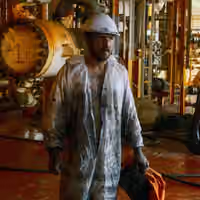
An oil worker at an Iranian oil facility.

For the first time in Iran’s history, revenue from crude oil and condensate exports could dry up entirely by mid-December if the US blockade remains in place, according to the head of crude oil analysis at Kpler.

“Revenues from crude and condensate will drop to zero for the first time ever,” Homayoun Falakshahi told Iran International's Eye for Iran, warning that Tehran could lose between $3 billion and $6 billion in monthly oil income.

That makes December the critical month as the last Iranian oil shipments already outside the blockade zone make their way to Chinese buyers.

According to Kpler, just eight million barrels of Iranian crude remain on the water outside the blockade, down from nearly 90 million barrels in mid-July. Falakshahi expects those remaining shipments to be discharged by around October 18.

With Chinese refiners typically taking another one to two months to settle payments, Tehran could receive its final proceeds from those shipments by mid-December.

The looming revenue shortfall follows a halt in Iranian oil shipments. Kpler data shows that Iran loaded no crude oil or condensate onto tankers throughout September, the first full month without loadings since the 1979 Islamic Revolution.

The last recorded loading took place around August 26 or 27.

Even during the 1979 revolution, the Iran-Iraq war and successive rounds of Western sanctions, Iranian crude continued reaching international buyers. During the COVID-19 pandemic, shipments fell as low as 300,000 barrels per day in some months, compared with typical volumes of around 1.7 million to 1.8 million, but never stopped entirely.

“This is a first in history,” Falakshahi said.

A financial lifeline under threat

Oil exports remain Iran’s largest source of foreign currency despite years of efforts to reduce the government’s dependence on petroleum income.

Falakshahi said much of Iran’s oil trade with China continues to be settled in dollars despite US sanctions, making the disappearance of those payments particularly consequential for an economy already struggling with currency depreciation.

He said expectations of dwindling oil income may have contributed to the rial’s recent decline. A prolonged loss of foreign exchange could put further pressure on the currency and government finances.

The squeeze could also affect Tehran’s ability to finance regional allies, although Falakshahi said the extent would depend on government priorities. Tehran could choose to preserve such support while cutting spending at home.

Sustained economic pressure could also affect Tehran’s negotiating calculus with Washington, he said, though he doubted the leadership was ready to make significant compromises over its nuclear program.

Why sanctions-evasion methods may not work

Iran has spent decades developing networks to circumvent Western sanctions and maintain oil exports, but Falakshahi said a physical blockade makes those methods far more difficult to replicate.

Unlike financial restrictions, which Tehran has historically navigated through intermediaries, disguised shipments and alternative trading arrangements, the current blockade prevents tankers from physically leaving Iranian waters.

One potential workaround has attracted attention as independent Chinese refiners increasingly turn to Iraqi crude to replace Iranian supplies: transporting Iranian oil through Iraq and disguising its origin before exporting it to China.

But moving even 50,000 to 70,000 barrels per day across the Iraqi border would require thousands of truck movements, Falakshahi said.

“You’d probably see videos of it on the internet,” he said.

He estimated that moving enough crude by truck to fill a single large tanker could take around 20 days, compared with roughly one large tanker Iran previously loaded each day.

Iraq continues to import Iranian natural gas, but payments owed to Tehran are held in a restricted account at Iraq’s central bank because of US sanctions. Falakshahi said Baghdad would be unlikely to facilitate large-scale Iranian oil shipments at the risk of further US sanctions.

Overland routes offer little relief

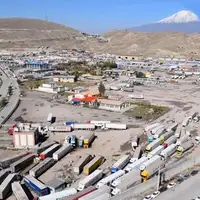
Rail offers limited alternatives. Falakshahi said the connection to China reaches Tehran, far from Iran’s main oil-producing regions, while the pipeline supplying the capital has capacity of only around 200,000 barrels per day.

Turkmenistan is also reportedly restricting rail transit through its territory over concerns about US sanctions.

Even if Tehran managed to move small quantities through neighboring countries, road and rail would be unlikely to replace the volumes previously exported by sea.

“Iran has a history of evading sanctions successfully to an extent,” Falakshahi said. “But this seems a lot more challenging.”

Pressure extends beyond oil

The blockade is also restricting Iran’s ability to import commodities as oil revenue approaches a potential halt.

Falakshahi said shipments of agricultural products, including corn and wheat, have declined sharply, while alternative supply routes through the Caspian Sea offer only a fraction of the capacity available through Persian Gulf ports.

For Tehran, the immediate question is whether the blockade will remain in place long enough to exhaust the final payments from oil already sold.

If it does, December could mark the first time in Iran’s modern oil-producing history that crude and condensate export revenue falls to zero, cutting off the Islamic Republic’s principal source of foreign exchange with no clear route to restoring exports while the blockade remains in place.

Iran detains football coach over child sexual abuse allegations

Oct 10, 2026, 10:34 GMT+1
100%

Iranian judicial authorities have detained a football coach in the western city of Divandarreh after five people filed complaints alleging sexual abuse connected to a youth football club.

Mohammad Jabbari, chief justice of Kordestan province, said the suspect was summoned to the judiciary in Divandarreh and remanded in custody after being formally accused of sexual abuse and producing obscene footage and other material, according to the judiciary-affiliated Mizan news agency.

Jabbari said the case had been referred to Kordestan province’s Criminal Court One and that further investigations were underway. Authorities have not publicly identified the suspect.

Divandarreh prosecutor Afshar Amir-Ahmadi said the judiciary ordered the arrest after reports emerged that a local teacher and football coach had sexually abused children. He said reports circulating on social media and concerns raised by families prompted authorities to investigate.

The local football association confirmed that the detained man was a football coach in Divandarreh. Police chief Hossein Montazeri said authorities had been aware of the allegations for several weeks and that the coach had been suspended from sporting activities.

Reports point to possible wider case

Earlier reporting by local news outlets in western Iran said around 50 children and teenagers at the Setaregan Divandarreh football club may have been sexually abused, although judicial authorities have so far confirmed only five complaints.

The outlets reported that one student initially filed a complaint with Iran’s cyber police, after which other students also came forward. It also said some students reported being sexually exploited after being promised opportunities to advance in football or join better teams.

Previous cases involving young athletes

The case follows other reports of sexual abuse allegations involving minors in Iranian sports.

In Tehran, a football coach accused by the families of eight teenage boys was initially sentenced to death, but the Supreme Court overturned the sentence. After a retrial, he was sentenced to 99 lashes, two years in internal exile and a two-year ban from coaching and other sporting activities. Forensic authorities had not established rape under the legal definition used in the case.

In Mashhad, parents of 15 young footballers raised sexual abuse allegations against a coach in 2023. Other cases involving coaches and minors have also been reported in Isfahan, Shiraz and Tehran, though the final judicial outcome of some cases has not been made public.

Iran turns to Turkey, Turkmenistan for power as war strains industry

Oct 10, 2026, 08:29 GMT+1
100%
Electricity grid near capital Tehran

Iran is seeking more electricity from Turkey and Turkmenistan as war damage and other outages leave thousands of megawatts of industrial and petrochemical power capacity offline, even as Washington presses neighboring countries to help restrict Tehran’s remaining economic routes.

Mohammad Allahdad, head of Iran’s electricity company Tavanir, told ILNA that about 4,700 megawatts of generation capacity belonging to industries and petrochemical companies had gone offline for various reasons.

He said the infrastructure was now in place for petrochemical plants to receive imported electricity from Turkey through Iran’s national grid. The companies have not yet signed contracts for the supply.

“If this does not happen, supplying electricity to these industries will face challenges,” Allahdad said.

War damage drives import push

Allahdad said serious damage during the war to utilities serving petrochemical complexes had sharply increased their dependence on the national grid. Iran supplied the sector with six times as much electricity this summer as in previous years, he said.

He added that Iran currently had no plans to export electricity and was instead focused on increasing imports, particularly during the winter.

Iran is also negotiating with Turkmenistan to extend an existing electricity import agreement and increase the volume of power exchanged between the two countries, according to a government statement.

Officials have also discussed additional cross-border power lines and the possible transit of electricity through Turkmenistan to third countries, though those proposals remain subject to technical and economic studies.

US seeks to close remaining economic routes

The push for additional electricity imports comes as the United States broadens its economic campaign against Iran beyond oil exports and financial sanctions.

US Treasury Secretary Scott Bessent said this week Washington was working with Turkey and Pakistan to restrict Iran’s overland commercial routes, while describing the United Arab Emirates and Oman as partners in the broader pressure campaign.

“We did have a maximum pressure campaign. Now we have an absolute isolation campaign and it’s working,” Bessent told Newsmax.

Bessent has also said Washington is targeting Iran-linked cryptocurrency and its remaining shipping network. Treasury on Thursday sanctioned 17 vessels and their owners, saying they were part of what remained of Iran’s shadow fleet, while Bessent said the US could seize about $1 billion in Iran-linked digital assets.

The overlap puts Turkey in an unusual position, with Tehran seeking greater electricity supplies from its western neighbor while Washington says Ankara is also cooperating in efforts to constrict Iran’s remaining overland economic links.

Bessent outlines US plan to cut off Iran’s remaining economic lifelines

Oct 10, 2026, 03:11 GMT+1
100%
US Treasury Secretary Scott Bessent speaks to the media after meeting China's Vice Premier He Lifeng, ahead of a summit between US President Donald Trump and Chinese President Xi Jinping, at JPMorgan Chase's global corporate headquarters in New York City, US, September 20, 2026. REUTERS/Vincent Alban

The United States is expanding its economic campaign against Iran beyond oil exports and financial sanctions, targeting Tehran’s overland trade routes, Iran-linked cryptocurrency and remaining shipping network, Treasury Secretary Scott Bessent said this week.

Bessent has pointed to Iran’s oil exports and the rial’s record lows as evidence the campaign is taking effect. On Monday, he said Iran had loaded no crude oil onto tankers in September.

A day later, he used the issue to question the appointment of Hamid Bovard as Iran’s acting oil minister, asking what he would oversee when, according to Bessent, Iran had not loaded crude onto a vessel since August 25.

The campaign has meanwhile expanded beyond seaborne oil exports. Speaking to Newsmax on Thursday, Bessent described the United Arab Emirates and Oman as partners in the effort and said Washington was working with Pakistan and Turkey to cut off Iran’s overland routes.

“We did have a maximum pressure campaign. Now we have an absolute isolation campaign and it’s working,” Bessent said.

That effort also extends to cryptocurrency. Bessent said the United States would “probably” seize about $1 billion in Iran-linked digital assets this week.

“We’re probably gonna seize a billion dollars of crypto this week,” he said. “We know where it is and we are isolating them.”
Closing Iran’s remaining economic routes

The widening campaign was reflected in a new round of Treasury sanctions Thursday targeting 17 vessels and their owners in what Washington describes as Iran’s remaining shadow fleet.

Treasury said the vessels had transported millions of barrels of Iranian crude oil, petroleum products and petrochemicals to markets in South and East Asia. It said the action effectively neutralized the vast majority of Iran’s remaining shadow fleet network.

The measures are the latest action under Operation Economic Outcast, launched on August 24 and dubbed Economic D-Day. The campaign initially increased sanctions exposure across Iran’s digital asset, technology, gold, aviation and shipping sectors before Washington widened it on October 1 to the automotive and rail industries.

Bessent has portrayed the effort as targeting not only Iran’s sources of revenue but also the ability of Iranian officials to access wealth and services abroad.

“They can’t go see their plastic surgeon in London, their girlfriend in Paris, and their money in Geneva,” he told Newsmax.

The campaign has coincided with a sharp decline in Iran’s currency, which traded near 2.7 million rials to the dollar this week despite efforts by the central bank to support it.

Bessent has said the ultimate objective is to force Tehran to choose between reintegration into the global economy and what he called “complete global isolation and a subsistence economy.”