‘$100k-a-month captains’: What it costs to move oil through Hormuz
A vessel sails through the Strait of Hormuz off the Iranian port city of Bandar Abbas, October 6, 2026
Oil tanker captains are being paid as much as $100,000 a month and offered $50,000 bonuses for individual trips through the Strait of Hormuz, the latest sign of the extraordinary costs now required to keep crude moving through the waterway since the Iran war began.
The payments, reported by the Financial Times on Wednesday, are several times normal salaries and are part of a wider surge in the cost of shipping through waters where Iranian missile and drone attacks have made transit perilous.
Regular crew members are also receiving multiples of their usual pay for making the crossing, according to the report.
The Wall Street Journal reported this week that some seafarers were being offered bonuses of as much as $25,000 for a single trip, with some shuttle voyages costing shippers as much as $40 million.
Middle Eastern crude exports rose above prewar levels on several days in late September, with the seven-day moving average reaching about 18.5 million barrels a day on Oct. 1, according to Kpler data reported by Reuters.
But the recovery in barrels has come at a remarkable price.
The price of passage
The cost of chartering a very large crude carrier from the Persian Gulf to China has climbed to the equivalent of about $24 a barrel, according to Kpler, with freight alone now accounting for roughly a quarter of the value of the crude being shipped.
Before the war, it accounted for about 5%.
The Baltic Exchange estimated daily earnings on its benchmark Persian Gulf-to-China route at more than $1.2 million last week.
The Financial Times reported that war-risk insurance for some tankers can reach $20 million, while ordinary sailors who make Hormuz crossings are receiving four to six times their normal wages.
Marine insurers had incurred about $2 billion in losses from the Hormuz crisis, the International Union of Marine Insurance estimated last month, even as premiums charged for individual voyages rose by multiples of their prewar levels.
‘Recovery, not normality’
The result is an unusual oil market: physical supply has recovered, but the cost of moving it has not.
Kpler says shipping has adapted through naval escorts, shuttle tankers, ship-to-ship transfers and alternative routes, allowing crude supply to recover without a political agreement between Washington and Tehran.
But it cautions that the recovery should not be mistaken for a return to normality.
“Buyers can regain access to Middle East barrels without regaining pre-conflict delivered costs,” the firm said in an analysis last week.
‘Hormuz closed’
Iran, meanwhile, rejects Washington's portrayal of the increased flows as evidence that the strait has effectively reopened.
Mohammadreza Naqdi, an adviser to the Revolutionary Guards commander, said Wednesday that Iran remained in control of Hormuz and would maintain its restrictions until Tehran's demands were met.
Tehran has said a formal reopening depends on the United States meeting seven conditions under a proposed arrangement being discussed through Qatari mediation.
At least seven attacks on tankers were reported in the first week of October, while shipping through the strait slowed sharply over the weekend.
Kpler recorded only five commodity vessels crossing on Saturday and none on Sunday, compared with 31 the previous weekend.
Tankers are crossing Hormuz, in some cases under US military protection. But shipowners, insurers and crews are demanding extraordinary compensation to take the risk — and that cost is traveling with the oil.
US Secretary of State Marco Rubio speaks during a dedication ceremony at the chancery of the US Embassy, in Athens, Greece October 7, 2026.
US Secretary of State Marco Rubio said on Wednesday that Iran had failed to take advantage of repeated opportunities to reach an agreement with Washington over its nuclear program, while also saying Tehran had “lost complete control” of the Strait of Hormuz.
Speaking during a visit to Athens, Rubio said oil flows through the strait had returned to nearly their prewar level.
“The Strait of Hormuz is open. There’s almost as much oil flowing out now as there was before this conflict began,” Rubio said. “So they’ve lost complete control of the Strait.”
He also described Iran’s economy as being in “total and complete freefall” under US sanctions.
Rubio said Washington’s position on Iran’s nuclear program remained unchanged.
“Iran cannot have a nuclear weapon, simple, period, end of story,” he said. “Anything they agree to that would be acceptable to the United States has to be something that ensures that Iran will never have a nuclear weapon.”
Tehran responds to Vance on enrichment
Later on Wednesday, a senior Iranian official told Reuters that Tehran would never give up what it regards as its right to enrich uranium, responding to nuclear demands set out by US Vice President JD Vance.
“There have been no negotiations between Iran and the US about Tehran’s nuclear program,” the official said, describing Vance’s comments as American “ideas and requests.”
The official said US recognition of Iran’s right to enrichment was a “red line” and that Tehran would “never give up its right to enrich,” although the level and other details of enrichment could be discussed later.
The official also said Washington must first meet Tehran’s conditions before the nuclear issue could be discussed and said US proposals on enrichment were inconsistent with Iran’s demands.
IRGC adviser says Hormuz remains closed
Also on Wednesday, Mohammad Reza Naghdi, a senior adviser to the commander-in-chief of Iran’s Revolutionary Guards, disputed Washington’s account of the Strait of Hormuz.
“The Strait of Hormuz is closed, and the armed forces have full control over it,” Naghdi said. “This situation will continue until Iran’s legitimate demands are met.”
He said Iranian forces would block what he described as unauthorized routes through the waterway.
Naghdi also said limits on the range of Iranian weapons were based on policy rather than technical constraints.
“Whenever the supreme leader gives authorization, we will increase the range of our weapons according to the needs of the battlefield,” he said.
Trump says decision coming ‘pretty soon’
The exchanges followed remarks by President Donald Trump on Tuesday night that the United States still had to decide how to “finish up” with Iran.
“We have to finish up, and it's only a question of which way we want to do it: the nice way or the not-so-nice way,” Trump said at an Anduril Industries event in Maryland. “You will find out pretty soon.”
Trump said the United States was doing “extremely well” against Iran and said Tehran’s military had been severely weakened.
“They have no military in sight. The whole place is shut,” he said.
“They were the bully of the Middle East. They're not so much the bully anymore.”
Vance calls for enrichment cuts
Vance had told Reuters in an interview that Iran would need to meaningfully reduce its uranium enrichment capacity to meet US demands and end the war.
“If you don't want a nuclear weapon, then why do you need 60% enriched fuel?” Vance said. “If you want to show commitment to not building a nuclear weapon, don't build highly enriched fuel.”
“I think if they want to show a commitment to not building a nuclear weapon, they would do something meaningful on their enrichment capacity,” he added.
Vance said Washington remained open to an agreement but wanted concrete action from Tehran.
“We're not going to trade words for actions,” he said.
He also said the US had been communicating with President Masoud Pezeshkian and Foreign Minister Abbas Araghchi but remained uncertain about how decisions were being made within Iran’s political system.
Iran’s central bank chief has rejected what he portrays as a US prediction of economic collapse, even as the rial trades near record lows and Iranian oil exports have fallen to zero.
Central Bank Governor Abdolnaser Hemmati said Tuesday that a US prediction of economic collapse was failing to materialize, pointing to what he described as the continued functioning of Iran’s economy despite months of war, sanctions and restrictions on its oil trade.
“There are only five days left of that two-week promise they made that the country’s economy was supposedly going to collapse,” Hemmati told state television. “We are sitting here now talking about the country’s economic achievements, and I tell them that this will not happen.”
Hemmati appeared to be referring to recent remarks by US Treasury Secretary Scott Bessent, who said on Sept. 27 that Iran had about 15 million barrels of oil left in transit and would make its final deliveries to China within roughly two weeks, after which it would have “nothing left to trade for anything.”
The remarks come as Washington intensifies economic pressure on Iran, targeting its oil revenues and access to the international financial system.
Hemmati played down the impact of reduced access to foreign currency, saying Iran had supplied about $24.9 billion since the beginning of the Iranian calendar year in March, compared with $28 billion during the same period a year earlier.
The central bank has also moved to provide up to $2 billion to the foreign exchange market in an effort to support the rial.
“The reason we provided $2 billion in foreign currency for the market was to make Trump and his Treasury secretary understand that we have no problem providing foreign currency,” Hemmati said.
The rial nevertheless continued to lose value, falling to about 2.688 million against the US dollar on the unofficial market on Saturday, a record low. The currency has lost more than half its value over the past year, while inflation has risen above 70%.
Pressure on Iran’s principal source of foreign revenue has also intensified. Iranian oil exports fell to zero in September amid the US naval blockade, even as Persian Gulf oil flows excluding Iran recovered to more than 81% of their pre-war levels.
Bessent said Tuesday that Iran had not loaded a single barrel of crude onto a vessel since Aug. 25.
Despite playing down the impact of the pressure on Iran’s economy, Hemmati acknowledged the difficulties facing ordinary Iranians.
“We truly understand the difficulties and pressures people are facing,” he said. “We are doing our best, and we are concerned as well. We are trying to minimize these problems.”
A portrait of Iran's slain Supreme Leader Ali Khamenei is displayed during a Janfada rally in Mashhad, October 6, 2026
Rhetoric is hardening on both sides of the Iran-US standoff, with even Iranian analysts traditionally optimistic about diplomacy warning that relations are slipping back to “square one” as military and economic pressure intensifies.
President Masoud Pezeshkian added to that sense of a narrowing diplomatic opening this week, declaring that “talks are meaningless” while Washington maintains what he described as a naval siege and fails to honor its existing commitments.
Pezeshkian said Tehran would not negotiate under military pressure or abandon its seven conditions for de-escalation, a position that leaves little obvious room for compromise as the US builds up forces in the region and tensions around the Strait of Hormuz continue.
Veteran foreign policy analyst Ali Bigdeli, who has traditionally taken a relatively optimistic view of diplomacy with Washington, told Fararu on Tuesday that Iran-US relations had effectively returned to “square one,” with deep mistrust and uncertainty prevailing in both capitals.
He also warned that the increased US military presence in the region, combined with mounting economic pressure on Iran, raised the risk of miscalculation.
Hardline newspaper Kayhan seized on Pezeshkian’s remarks, calling for an immediate and complete withdrawal from Qatar-mediated diplomatic channels.
The English-language Tehran Times portrayed his refusal to negotiate under naval pressure as “a principled rejection” of unilateral Western coercion.
On Monday night, international maritime security agencies issued four attack warnings within four hours following new projectile strikes on commercial oil tankers transiting the Strait of Hormuz.
Seven attacks on commercial vessels have been reported in the strait in the past week, according to maritime intelligence reports, which also describe direct radio warnings from the Revolutionary Guards Navy ordering some tankers to turn around.
IRGC-linked daily Javan highlighted the rapid succession of attack advisories and radio interdictions as evidence that CENTCOM’s naval presence has failed to guarantee freedom of navigation through the waterway.
But the same confrontation that hardliners portray as evidence of Iranian leverage is also generating warnings about its economic cost.
Economic daily Donya-ye Eghtesad argued that shadow fleets and off-radar transfers may allow crude oil to continue moving, but cannot reliably provide the raw materials needed by Iranian industry.
Once existing stocks of industrial inputs are exhausted, the newspaper warned, the combination of disrupted shipping and severed formal banking channels could push domestic industry into deeper decline.
Some Iranian outlets have increasingly focused on the possibility that a single security incident could upset the fragile balance altogether.
Moderate outlet Rouydad24 pointed to reports that American bombers were moved from RAF Fairford in Britain amid concerns about a possible Iranian or IRGC drone threat, as well as a US national security meeting last week with Iran and Yemen on the agenda.
The outlet warned that a single security incident could become a political trigger for escalation, sharply narrowing the distance between negotiation and confrontation.
Diplomatic channels have not disappeared, but harder positions in Tehran and Washington, an expanding US military presence, repeated incidents around Hormuz and growing economic pressure leave increasingly little room for error.
The emerging message from Iranian commentary is that a prolonged stalemate carries risks in either direction: deeper economic deterioration if it continues, and potentially rapid military escalation if it breaks.
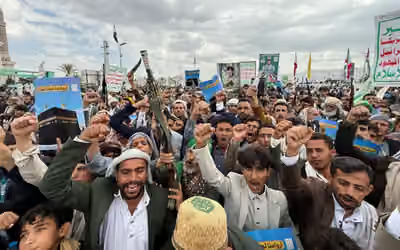
Houthi supporters rally to celebrate advances by Houthi forces along the Red Sea coastline in Sanaa, Yemen, Sept. 18, 2026. (Adel Al Khader/Reuters)
Saudi-backed Yemeni forces on Monday reversed weeks of Houthi gains around Bab al-Mandab, the strategic strait linking the Red Sea to the Gulf of Aden, exposing vulnerabilities in the Iran-backed group even as fighting elsewhere showed how far Yemen remains from a decisive shift.
As government-aligned forces advanced along Yemen’s southwestern coast, the Houthis stepped up pressure around Taiz, one of the country’s largest cities, leaving a battlefield moving in two directions at once.
The reversal came as Saudi Arabia, Turkey and Pakistan activated their Mecca Joint Defense Agreement following an emergency meeting in Riyadh, saying they would accelerate the deployment of agreed military forces and capabilities to Saudi Arabia.
Together, the developments point to a potentially consequential new phase of the Yemen war. But whether the counteroffensive can be sustained, and what any lasting reversal would mean for Iran’s position in Yemen, remains unclear.
“I think it’s too early to talk about sustainable gains against the Houthis at this point,” Thomas Juneau, a Yemen expert and non-resident fellow at the Sana’a Center for Strategic Studies, told Iran International.
“I think we need more time to see the dust settle.”
Iran watches a critical coastline
The importance Tehran attaches to Yemen’s western coast was apparent even as the latest Houthi gains were being reversed.
An IRGC-aligned Iranian newspaper led its coverage Monday with the headline “Ansarullah’s Upper Hand in Regional Equations,” arguing that Houthi positions around Bab al-Mandab translate into deterrence and regional leverage extending far beyond Yemen.
But the territory captured during the Houthis’ September advance was always going to be difficult to defend.
Juneau described southwestern Yemen as flat and exposed, with few natural defensive advantages and increasingly stretched Houthi supply lines.
“If it turns out that the losses are limited to the southwest corner of Yemen, that is not surprising in the sense that that was difficult for the Houthis to hold,” he said.
Even if pushed farther from Bab al-Mandab, the Houthis remain close enough to threaten Red Sea shipping with missiles and drones.
“So that would not be a strategic setback for them,” Juneau said.
Fatima Abo Alasrar, a Yemeni scholar, senior policy analyst and founder of Ideology Machine, said the Houthis’ September push had IRGC backing and caught Saudi-backed Yemeni forces poorly coordinated to respond.
Monday’s counteroffensive, however, demonstrated how quickly those gains could be reversed.
“The biggest takeaway is that this myth of Houthi invincibility is no longer there,” she said.
Hodeidah and Taiz complicate the picture
The more consequential test may now lie elsewhere.
The Houthis still control Hodeidah farther north on the Red Sea coast, preserving their ability to threaten maritime traffic even without holding territory immediately around Bab al-Mandab.
“Bab al-Mandab was just the icing on the cake,” Abo Alasrar said.
The possibility of attacks can itself increase shipping and insurance costs, meaning the Houthis do not need to physically control the strait to retain leverage over maritime traffic.
A loss of Hodeidah would represent a much more significant change to their strategic position. Late on Monday, the Saudi-led coalition said its naval forces struck Houthi military infrastructure in Yemen’s Hodeidah governorate, including weapons storage sites, facilities housing explosive-laden boats and stockpiles of sea mines.
At the same time, the Houthis are increasing pressure around Taiz, one of Yemen’s largest and most densely populated cities.
The geography presents a very different battlefield from the exposed southwestern coast and raises the prospect of a costly war of attrition.
“What I’m watching right now is the population centers,” Abo Alasrar said. “It’s in the cities, it’s in the population centers that the Houthis can inflict real damage.”
Iranian media has also shown growing interest in the fighting around Taiz, with Tasnim closely tracking Houthi advances there.
The simultaneous movement on the two fronts is one reason Juneau cautioned against drawing broad conclusions from the coastal counteroffensive.
“I don’t think we’re in a position to say yet that the Houthis are sustaining losses,” he said.
Two wars increasingly intertwined
The fighting is unfolding against the backdrop of the wider confrontation involving Iran, but Yemen cannot be understood solely through that lens.
“The war in Yemen is unlikely to end without a broader resolution to the war with Iran,” Mohammed al-Basha, a Yemeni-American analyst and founder of the Basha Report, told Iran International.
“But ending the confrontation in the Strait of Hormuz will not, by itself, end the war in Yemen.”
“The two conflicts are interconnected, but they are also distinct, with their own actors, grievances, battlefields, and political dynamics,” he added.
That distinction is important in assessing what the latest Houthi setbacks mean for Tehran.
Iran’s support has helped the Houthis develop into a powerful regional actor, but the group also operates within a distinctly Yemeni conflict shaped by domestic political, tribal and territorial dynamics.
A battlefield setback for the Houthis therefore does not translate automatically into an equivalent strategic loss for Iran.
Saudi Arabia signals it can absorb the risk
The activation of the Mecca Joint Defense Agreement adds another dimension to the confrontation.
Following an emergency meeting in Riyadh, Saudi Arabia, Turkey and Pakistan said they would move immediately to implement their joint-defense commitments and take measures to provide agreed military forces and capabilities and expedite their deployment in Saudi Arabia.
The three countries said the security of each member state was an integral part of their collective security and that implementing the agreement would strengthen deterrence.
“This is an important signal. It is a deterrent signal,” Abo Alasrar told Iran International following the announcement.
Saudi Arabia entered the counteroffensive knowing that supporting Yemeni government forces could expose the kingdom to retaliation from Houthi drones and ballistic missiles.
In Abo Alasrar’s assessment, the agreement signals that Riyadh is preparing to absorb that risk rather than allow the threat of retaliation to constrain the campaign.
It also sends a message about time.
The Houthis had hoped they could pressure Saudi Arabia and eventually emerge with concessions, she said. A Saudi signal that it is prepared for a prolonged confrontation potentially changes that calculation.
“This changes the rules of the game because Saudi Arabia is basically signaling that it’s going to play their game,” Abo Alasrar said. “It’s going to stay at this war as long as they want to, and that they’re ready to absorb the costs until they deal with this problem.”
Whether that deters the Houthis or leads to further escalation remains to be seen.
Limits to a broader government advance
Saudi-backed forces face another obstacle if they try to turn Monday’s counteroffensive into a broader campaign: divisions within the anti-Houthi camp.
Juneau said Iranian assistance explains only part of the Houthis’ resilience.
“Anti-Houthi forces remain fragmented and disunited,” he said.
The Houthis, by comparison, remain a considerably more coherent force, while rivalries among their opponents have repeatedly undermined efforts to establish a united front.
That is one reason Juneau remains skeptical of increasingly confident statements from Yemen’s government about eventually retaking Sana’a.
“When I hear the president of the Presidential Leadership Council, Rashad al-Alimi, talk about getting Sana’a back, as of now, I think that’s wishful thinking,” he said.
The contrast captures one of the central uncertainties surrounding the latest offensive: demonstrating that Houthi territorial gains can be reversed is one thing; translating that success into a sustained campaign against the group is another.
Tehran’s longer game
For Iran, the strategic calculation extends well beyond the movement of individual frontlines.
The Houthis have become an increasingly important part of Tehran’s regional network, particularly as other members of the so-called Axis of Resistance have come under intense pressure.
In Juneau’s formulation, small territorial losses along Yemen’s western coast are “the tree.” The durability of Houthi power is “the forest.”
“The forest, from Iran’s perspective, is the long game of seeing Houthi power in Yemen becoming institutionalized, becoming legitimated,” he said.
Juneau pointed to what appears to be an understanding under which the Houthis refrain from attacking US vessels in the Red Sea while Washington refrains from directly attacking the group.
The precise nature of any understanding remains unclear. But Washington dealing with the Houthis as an entrenched power is itself significant, he said.
“The US is making deals with the Houthis, you know, de facto a mutual non-aggression pact, which in practice legitimizes Houthi rule in large parts of Yemen, which is exactly Iran’s objective,” Juneau said.
Monday’s counteroffensive showed that recent Houthi territorial gains can be rapidly reversed. It has not yet shown that those reversals can be sustained or translated into a broader weakening of Houthi power.
Nor is the battle confined to Bab al-Mandab. The Houthis remain in control of Hodeidah, are applying pressure around Taiz and face opponents whose internal divisions have repeatedly worked to their advantage.
For Tehran, that leaves the picture similarly unsettled: one of its most important regional partners has shown itself vulnerable on the battlefield, but the foundations of the leverage Iran has built through the Houthis remain, for now, largely intact.
Vessels are seen off Sورو Beach in Bandar Abbas, near the Strait of Hormuz, at sunrise on Monday, Sept. 28, 2026. ISNA
Iranian President Masoud Pezeshkian said Monday that talks with the United States were meaningless, even as President Donald Trump remained open to direct negotiations, while a third tanker in two days was struck near the Strait of Hormuz.
The contrasting messages came as months of intermittent diplomacy remained stalled and tensions intensified around the strategic waterway, where Iran and the United States have imposed competing restrictions on shipping. Tehran has tied progress to conditions surrounding Hormuz, while Washington has pressed for broader concessions, including on Iran’s nuclear program.
“Our problem with the United States is that every time we come to the negotiating table, war is immediately imposed on us,” Pezeshkian told Armenian Foreign Minister Ararat Mirzoyan during a meeting in Tehran.
Pezeshkian said negotiations made no sense with an adversary that “every day engages in assassination, sanctions, pressure and threats” and breaks its commitments.
“We have been attacked three times so far following talks, and this shows that they are not seeking dialogue; rather, their goal is to overthrow the Islamic Republic,” he said.
Trump, however, said Monday that he remained open to direct talks with Tehran, keeping a diplomatic path available after saying over the weekend that Iran could resolve the confrontation “the easy way or the hard way.”
The two sides have continued exchanging messages indirectly despite the impasse. Tehran presented Washington through intermediaries with a seven-day proposal aimed at restoring security in the Strait of Hormuz, and Iranian officials said Sunday they were reviewing the US response. Foreign Minister Abbas Araghchi said Tehran remained serious about diplomacy but was also prepared to defend itself.
The diplomatic standoff coincided with another escalation at sea Monday, when a tanker was struck by an unidentified projectile in the Strait of Hormuz, sparking a fire in its engine room. UK Maritime Trade Operations said the crew was battling the blaze and no casualties or environmental impact had been reported.
The strike marked the third tanker hit in two days. UKMTO said Monday it had received delayed reports that two tankers — one carrying liquefied petroleum gas and another crude oil — were struck by unidentified projectiles Sunday.
UKMTO did not attribute those attacks to Iran. But in a separate incident Monday, it said an inbound tanker 11 nautical miles north of Khasab, Oman, turned back after Iran’s Islamic Revolutionary Guard Corps hailed the vessel and threatened to target it if it continued.
The IRGC-affiliated Fars news agency separately reported Monday that Iran had targeted 13 tankers it described as “violators” in the Strait of Hormuz over the previous seven days.
The incidents came as the United States intensified enforcement of its naval blockade against Iran. US Central Command said Monday its forces had redirected 130 commercial vessels since resuming the blockade on July 14, disabled three ships that refused to comply and destroyed 13 commercial vessels it said were violating the blockade or were part of the IRGC’s multibillion-dollar shadow network.
“The US military remains intensely focused on this mission,” CENTCOM commander Adm. Brad Cooper said. “We will swiftly act against any vessels trying to run the blockade.”
Washington has also stepped up economic pressure. Treasury Secretary Scott Bessent said Monday that the rial had fallen to record lows and Iran loaded no crude onto tankers last month, citing the figures as evidence that the US pressure campaign was working.
The military pressure has also continued alongside the diplomatic impasse. Senior members of Trump’s national security team met at Camp David on Friday to discuss the Iran war, with Trump considering renewed major combat operations as negotiations remain stalled, Axios reported.
Iranian officials warned Monday that renewed military action could widen the conflict. Mohsen Rezaei, secretary of Iran’s Supreme National Security Council, said another attack or “miscalculation” against Iran could open additional fronts.
“Every miscalculation by the enemy against Iran has brought it a heavy defeat,” Rezaei said. “The next mistake will bring new fronts and bigger surprises.”