Hegseth says US forces have ‘destroyed’ much of Iran’s military

US Defense Secretary Pete Hegseth said Wednesday that American forces had “destroyed” major parts of Iran’s military and crippled its nuclear ambitions, as he addressed military personnel at Marine Corps Base Quantico in Virginia.
“These Americans and their peers here have destroyed Iran’s navy, Iran’s air force, their defense system, their leadership and their military industrial capacity, their entire defense space,” Hegseth said.
“Iran’s conventional shield has been crippled, and their nuclear ambitions have been crippled and laid bare for the world,” he said. “You — this group — is ensuring Iran never gets a nuclear weapon.”
Hegseth also announced a series of changes to the US military, including the creation of a new autonomous warfare command and a planned 20% reduction in the number of generals and admirals.
He described the reductions as “accountability” rather than a “purge” and said the Pentagon’s priorities were “reviving the warrior ethos, rebuilding the military and reestablishing deterrence.”
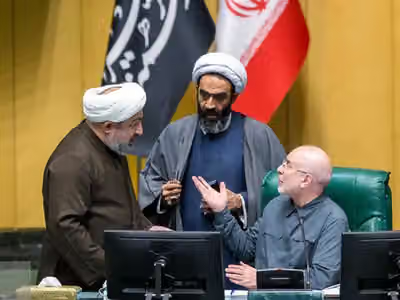


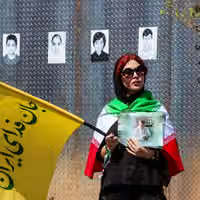

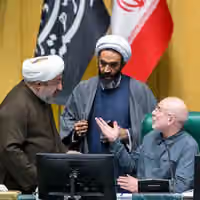

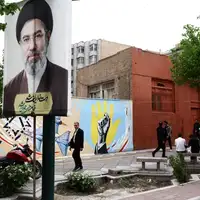



Continued contacts between Tehran and Washington, mediated by Qatar and Pakistan, have intensified debate inside Iran over whether diplomacy can still produce a deal despite President Donald Trump’s rejection of Tehran’s latest proposal and what should happen if it fails.
Foreign Minister Abbas Araghchi, speaking before leaving New York on Tuesday, rejected suggestions that Tehran had agreed to nuclear concessions, saying Iran’s immediate focus was the Strait of Hormuz.
Despite Trump’s rejection of the Iranian proposal, Araghchi said he had told Qatari mediators that Tehran would wait for an official US response through them.
The reformist newspaper Shargh said Araghchi’s remarks carried an important message: Tehran did not want its return to diplomacy to be interpreted in Washington as a retreat from its nuclear positions.
The dispute is increasingly about whether that diplomatic opening can produce an agreement before pressure gives way to another round of escalation.
An opening, but on whose terms?
President Masoud Pezeshkian reiterated on Wednesday that his government was seeking to bring the Islamabad understanding to fruition. He did not comment directly on Trump’s rejection of Iran’s proposal.
Parliament Speaker Mohammad-Bagher Ghalibaf, meanwhile, responded sharply to Trump’s recent statements, warning that Iran would retaliate against further military action.
“In a region where we do not sell oil, no one will sell oil, and if our security is not ensured, no infrastructure will be safe,” he said.
“The main issue in the coming days will not be whether Iran and the United States are talking to each other, but whether they can move from exchanging messages to an implementable formula,” Shargh wrote.
It said a US response meeting at least some of Tehran’s conditions could lead to more serious negotiations, while failure to find such a formula would return the dispute to “a logic of pressure and confrontation.”
Etemad, another reformist daily, raised a different concern: that the Strait of Hormuz could lose value as an Iranian bargaining tool the longer the confrontation continues.
It argued that if the blockade, restrictions on Iranian oil exports and pressure on Iran’s commercial networks become entrenched, Washington could increasingly rely on economic pressure rather than further large-scale military action.
Former Iranian diplomat Kourosh Ahmadi made a similar argument in Shargh, saying Iranian officials should recognize that “diplomacy is an arena of give-and-take” rather than expect progress while offering almost no concessions.
Trump’s rejection of Tehran’s proposal, he argued, showed that the dispute was increasingly about “who sets the negotiating ground and who will be forced to put more concessions on the table to get out of pressure.”
If diplomacy fails
Hardline voices have pushed in the opposite direction, warning officials against interpreting continued diplomacy as evidence that Iran should compromise.
Political analyst Mehdi Kharatian rejected arguments that the Strait of Hormuz was losing its effectiveness as leverage.
“Do not be deceived by those who these days are flooding you with false and biased reports about the ineffectiveness of oil and the Strait,” he wrote, accusing such voices of implicitly advocating surrender to the United States.
He also warned officials against sending what he described as excessive signals of willingness to negotiate, arguing that doing so could encourage Trump to resume military action.
The possibility of another confrontation was also raised by IRGC spokesman Hossein Mahdavi, who told state television that Iran was already at war. He said the United States was unlikely to launch attacks on the same scale or with the same capabilities as before.
But he added: “In the world of war, everything is possible.”
Mahdavi also claimed Iranian forces continued to target vessels attempting to transit the Strait of Hormuz and that the United States had recently refrained from responding.
The conservative Khorasan newspaper raised the possibility of Iran launching pre-emptive attacks if negotiations over the nuclear issue fail.
It argued that Iran could resort to a “Plan B” aimed at seizing the initiative before its adversaries complete their intelligence and logistical preparations, potentially triggering a period of intensified warfare before the US midterm elections.
The competing prescriptions emerging in Tehran reflect a debate that has moved beyond whether communication with Washington should continue. What the opposing camps increasingly share is a sense that the current diplomatic opening may not remain open indefinitely.
British Prime Minister Andy Burnham said on Wednesday there are “strong indications” Iran played a role in a suspected plot near RAF Fairford airbase used by US forces to carry out strikes on the Islamic Republic.
“But of course, it remains an ongoing, complex and serious police investigation,” he told BBC. “We are working closely with our colleagues in the United States of America.”
Five British men in their 20s were arrested on suspicion of terrorism and explosives offenses after three white vans were found near the base.
Police recovered petrol but found no viable explosives, and all five suspects were later released on bail as the investigation continued.
The base is home to the US Air Force’s 501st Combat Support Wing and also serves as a forward operating site for Air Force Global Strike Command.
Fairford has supported major US military operations, including the 1991 Persian Gulf War, the 2003 invasion of Iraq and this year’s US-Israeli strikes on Iran.
US Secretary of State Marco Rubio subsequently said a foreign state was involved, without naming it, while President Donald Trump said the men had planned "big damage."
Iran has denied involvement. Iran’s Revolutionary Guards (IRGC) said in July that bases used for attacks on Iranian territory could be considered legitimate targets.
Before Burnham’s remarks, British authorities had not publicly linked the incident to Iran, though counter-terrorism police said they were investigating possible foreign state involvement, including whether proxies may have been “knowingly or unknowingly working on behalf of a foreign state.”
Police said Tuesday that petrol, but no improvised explosive device, was found in the vans used by the men. They also defended releasing the suspects on bail after criticism, including from Trump.
The Times reported that one suspect called emergency services shortly before his arrest, with investigators considering whether the incident was surveillance, a “dry run” or an attempt to send a message to the British government.
Britain said in January that its services had tracked more than 20 potentially lethal Iran-backed plots over the previous year targeting dissidents, journalists and members of the Jewish community.
In June, 24 Western governments accused Iran’s IRGC intelligence apparatus, the Quds Force and Iran’s intelligence ministry of plotting attacks in Europe, North America and Australia, including against Iranian dissidents and Jewish and Israeli interests.
Prisoners in a security ward at Dastgerd Prison in Isfahan are beaten with cables and metal rods and held in overcrowded, windowless cells with poor ventilation, according to accounts provided to Iran International.
Informed sources described the section known as “Alef-Ta” as a place used for interrogations, holding prisoners before execution and, in some cases, applying additional pressure.
“Some prisoners put their faces close to the gap beneath the cell door so they can breathe,” one informed source said.
The ward holds some political prisoners alongside people accused of violent crimes and a number of clerics. Alireza Sepahi, a January protest detainee sentenced to death in the case known as the Alikhani case, has also been transferred there.
The Alikhani Square case stems from anti-government protests in Isfahan on January 8, during which authorities said four members of the security forces were killed.
Twelve protesters were sentenced to death, drawing concerns from rights groups and UN experts over due process and fair-trial standards. At least five had been executed by August, including Abolfazl Sepahi and Amirhossein Safari, who were publicly hanged in Alikhani Square on July 28.
Windowless cells
The section consists of rooms originally designed for solitary confinement, with each cell measuring about eight square meters.
The cells have no windows or adequate airflow and rely on a single ventilation fan that is sometimes switched off. Despite being designed for one person, several prisoners are sometimes held in the same cell, leaving insufficient room to sleep normally.
Prisoners receive two dirty blankets, while a shower and toilet without a separating door or wall occupy a significant portion of each cell. Using water further increases humidity inside the enclosed space.
Access to fresh air can be limited to about 15 minutes once a week. Prisoners are blindfolded and taken to the roof, where only the sky is visible.
Lights inside the cells remain on continuously. With no windows or clocks, prisoners can struggle to distinguish day from night. The central sewage system, which operates at around 6 a.m. and 6 p.m., can become one of the few indications of time.
Prisoners also have no access to phones, television, a prison shop or facilities for heating food. Sources said poor-quality food and the inability to reheat it have led to repeated cases of food poisoning.
'Cables and metal rods’
Prisoners can be removed from their cells for interrogation several times over a 24-hour period, sources said.
Sources described prisoners being beaten with cables and metal rods during interrogation and returning to their cells with injuries to their legs, mouths and teeth. Iran International also received accounts of interrogators pulling out prisoners’ fingernails.
Iran International reported on September 9, citing a judicial document, that 18 prisoners held at Dastgerd face charges connected to unrest and a fire in April that could carry the death penalty.
Iran’s receipt of Washington’s response to its seven-point proposal for ending the Strait of Hormuz crisis has sharpened divisions in Tehran over whether to pursue further compromise or intensify pressure on the United States.
The response was reportedly delivered through Qatar and has been described as US “feedback” rather than acceptance or rejection of the Iranian plan.
Hardline voices have portrayed Washington’s position as evidence that further diplomacy is futile, while more pragmatic commentators argue that the fact the US responded at all shows negotiations remain alive.
President Donald Trump had publicly dismissed Iran’s proposal as insufficient. Iranian diplomats said reopening the Strait and lifting the naval blockade were discussed in indirect talks mediated by Qatar.
The dispute in Tehran is increasingly about what it should do next.
Jame Jam, affiliated with state television, published an op-ed Wednesday by hardliner Abbas Salimi-Namin titled “America’s Fear of Admitting Defeat Against Iran.”
Salimi-Namin argued that Washington’s resistance to the seven-point plan, rooted in the earlier Islamabad talks, reflected the White House’s unwillingness to acknowledge that framework as a strategic setback.
US policymakers, he wrote, still cling to the prospect of delivering a “crippling blow” to Iran and fear the domestic political cost of acknowledging failure more than continued escalation.
Kayhan went considerably further.
Editor-in-chief Hossein Shariatmadari portrayed US demands for verifiable nuclear concessions as evidence that Washington never intended to negotiate in good faith.
He argued that linking freer navigation through the Strait to nuclear concessions was an attempt to strip Iran of its principal leverage while maintaining US economic and military pressure.
Kayhan criticized what it described as the Foreign Ministry’s excessive “patience” and called for non-attributable maritime interdictions, deployment of coastal anti-ship batteries and expanded targeting of Western-escorted vessels.
Global energy markets, it argued, must face an “unbearable cost” before Washington lifts its blockade.
The moderate daily Sharq offered an almost opposite prescription.
In a commentary, Ahmad Zeidabadi argued that despite the rigidity of the US response, Washington’s decision to send detailed feedback through Qatar showed that a diplomatic off-ramp remained open.
He urged the government to preserve the Qatari channel and proposed a two-stage approach under which Iran could offer targeted technical assurances, including temporary IAEA monitoring protocols, in return for an immediate, phased easing of restrictions on commercial transit under the Islamabad memorandum.
Zeidabadi rejected calls for military escalation, warning that abandoning shuttle diplomacy as restrictions on Iranian aviation and banking intensify would push the country towards deeper economic and civilian isolation.
The contrasting reactions show how Washington’s response has shifted the argument in Tehran from whether diplomacy should continue to what price Iran should be prepared to pay for it.
Jame Jam occupies a space somewhere between the positions represented by Kayhan and Sharq: deeply skeptical of Washington’s intentions, but portraying the impasse as a product of US reluctance to acknowledge Iran’s leverage rather than as grounds for immediately abandoning negotiations.
With an actual US response now before Tehran, those competing interpretations are no longer arguments about a hypothetical deal. They are becoming arguments over how Iran should answer.
An Iranian-American student who pressed Michigan Democratic US Senate nominee Abdul El-Sayed to state his position on Iran’s Revolutionary Guards says he and his family have faced threats and harassment after a video of the exchange went viral.
At a University of Michigan town hall, Iman Dashti said his cousin had been pursued through the streets over her hijab and his uncle sentenced to death and given 50 lashes under the Islamic Republic, before asking whether El-Sayed stood “unequivocally against the IRGC.”
El-Sayed responded that he would “always stand with movements for freedom and democracy” and later told Dashti, “I want freedom and democracy for the people of Iran, no question,” while stressing that political change should come from Iranians themselves rather than through US-led regime change.
He did not directly answer Dashti’s question about whether he stood unequivocally against the IRGC.
Dashti told Iran International he shares El-Sayed’s opposition to US-imposed regime change, but said that was never the question he was asking.
“I never asked about regime change. I never asked about his stance on the war,” Dashti said. “I asked him about the people.”
“I wanted to hear from him. I wanted to hear that he stood with us, I really did want to,” he said. “If Abdul were to win, at least we’d have an advocate for the Persian people, for the American people in the US Senate.”
El-Sayed’s campaign has defended his response.
“As he noted in his response, Abdul will always stand with movements for freedom and democracy and he condemns government anti-free speech violence,” campaign spokesperson Roxie Richner told Fox News.
The campaign also reiterated El-Sayed’s opposition to US-funded regime-change wars.
Iran International separately contacted El-Sayed’s campaign seeking an interview or written response about the exchange and his position on the IRGC but did not receive a response before publication.
Threats after the exchange
Dashti said the atmosphere inside the town hall became tense, with audience members applauding when El-Sayed rejected US-led regime change, a position Dashti said he agreed with.
“The tension was very high in that room,” he said. “You could cut it with a knife.”
Since the exchange spread online, Dashti says he has received threats and that his friends and family have been targeted.
“Since that day, people have threatened me, doxxed my friends, even harassed my family,” he said in a video posted after the town hall.
Dashti told Iran International the past several days had been anxious but said the hostile reaction had also been accompanied by considerable support.
“For every negative comment I’ve gotten, for every negative sort of threat, I’ve gotten a lot of beautiful positive messages,” he said.
Scrutiny of Dashti’s politics
The attention has also brought scrutiny of Dashti’s own politics. He describes himself as a “proud Christian conservative,” belongs to the College Republicans and has previously met Mike Rogers, the Republican nominee running against El-Sayed in November.
Dashti said he does not work for Rogers and was not sent to the town hall on behalf of his campaign.
“Am I a Zionist plant? Do I work for the Rogers campaign?” he said in his follow-up video, recounting accusations circulating online. “I don’t work for anyone. I’m just a Persian student and my family was hunted in the streets of Iran.”
The son of Iranian immigrants, Dashti said he sees speaking about repression in Iran as a way of advocating for people who cannot freely do so themselves.
“The least I can do is give a voice to the people who literally don’t have a voice,” he said. “I love my people, my heritage. It’s a beautiful, beautiful culture.”
Washington designated the IRGC a Foreign Terrorist Organization in 2019. The force is a central part of the Islamic Republic’s security apparatus and has been involved in suppressing anti-government protests.
Dashti said the criticism has not deterred him from continuing to raise the issue during the remaining weeks of the Senate campaign.
“I’m going to keep going, whether that means showing up at future events, mobilizing friends,” he said. “This is just the beginning.”