Tehran weighs what comes next if US diplomacy fails

Continued contacts between Tehran and Washington, mediated by Qatar and Pakistan, have intensified debate inside Iran over whether diplomacy can still produce a deal despite President Donald Trump’s rejection of Tehran’s latest proposal and what should happen if it fails.
Foreign Minister Abbas Araghchi, speaking before leaving New York on Tuesday, rejected suggestions that Tehran had agreed to nuclear concessions, saying Iran’s immediate focus was the Strait of Hormuz.








Continued contacts between Tehran and Washington, mediated by Qatar and Pakistan, have intensified debate inside Iran over whether diplomacy can still produce a deal despite President Donald Trump’s rejection of Tehran’s latest proposal and what should happen if it fails.
Foreign Minister Abbas Araghchi, speaking before leaving New York on Tuesday, rejected suggestions that Tehran had agreed to nuclear concessions, saying Iran’s immediate focus was the Strait of Hormuz.
Despite Trump’s rejection of the Iranian proposal, Araghchi said he had told Qatari mediators that Tehran would wait for an official US response through them.
The reformist newspaper Shargh said Araghchi’s remarks carried an important message: Tehran did not want its return to diplomacy to be interpreted in Washington as a retreat from its nuclear positions.
The dispute is increasingly about whether that diplomatic opening can produce an agreement before pressure gives way to another round of escalation.
An opening, but on whose terms?
President Masoud Pezeshkian reiterated on Wednesday that his government was seeking to bring the Islamabad understanding to fruition. He did not comment directly on Trump’s rejection of Iran’s proposal.
Parliament Speaker Mohammad-Bagher Ghalibaf, meanwhile, responded sharply to Trump’s recent statements, warning that Iran would retaliate against further military action.
“In a region where we do not sell oil, no one will sell oil, and if our security is not ensured, no infrastructure will be safe,” he said.
“The main issue in the coming days will not be whether Iran and the United States are talking to each other, but whether they can move from exchanging messages to an implementable formula,” Shargh wrote.
It said a US response meeting at least some of Tehran’s conditions could lead to more serious negotiations, while failure to find such a formula would return the dispute to “a logic of pressure and confrontation.”
Etemad, another reformist daily, raised a different concern: that the Strait of Hormuz could lose value as an Iranian bargaining tool the longer the confrontation continues.
It argued that if the blockade, restrictions on Iranian oil exports and pressure on Iran’s commercial networks become entrenched, Washington could increasingly rely on economic pressure rather than further large-scale military action.
Former Iranian diplomat Kourosh Ahmadi made a similar argument in Shargh, saying Iranian officials should recognize that “diplomacy is an arena of give-and-take” rather than expect progress while offering almost no concessions.
Trump’s rejection of Tehran’s proposal, he argued, showed that the dispute was increasingly about “who sets the negotiating ground and who will be forced to put more concessions on the table to get out of pressure.”
If diplomacy fails
Hardline voices have pushed in the opposite direction, warning officials against interpreting continued diplomacy as evidence that Iran should compromise.
Political analyst Mehdi Kharatian rejected arguments that the Strait of Hormuz was losing its effectiveness as leverage.
“Do not be deceived by those who these days are flooding you with false and biased reports about the ineffectiveness of oil and the Strait,” he wrote, accusing such voices of implicitly advocating surrender to the United States.
He also warned officials against sending what he described as excessive signals of willingness to negotiate, arguing that doing so could encourage Trump to resume military action.
The possibility of another confrontation was also raised by IRGC spokesman Hossein Mahdavi, who told state television that Iran was already at war. He said the United States was unlikely to launch attacks on the same scale or with the same capabilities as before.
But he added: “In the world of war, everything is possible.”
Mahdavi also claimed Iranian forces continued to target vessels attempting to transit the Strait of Hormuz and that the United States had recently refrained from responding.
The conservative Khorasan newspaper raised the possibility of Iran launching pre-emptive attacks if negotiations over the nuclear issue fail.
It argued that Iran could resort to a “Plan B” aimed at seizing the initiative before its adversaries complete their intelligence and logistical preparations, potentially triggering a period of intensified warfare before the US midterm elections.
The competing prescriptions emerging in Tehran reflect a debate that has moved beyond whether communication with Washington should continue. What the opposing camps increasingly share is a sense that the current diplomatic opening may not remain open indefinitely.
Iran’s receipt of Washington’s response to its seven-point proposal for ending the Strait of Hormuz crisis has sharpened divisions in Tehran over whether to pursue further compromise or intensify pressure on the United States.
The response was reportedly delivered through Qatar and has been described as US “feedback” rather than acceptance or rejection of the Iranian plan.
Hardline voices have portrayed Washington’s position as evidence that further diplomacy is futile, while more pragmatic commentators argue that the fact the US responded at all shows negotiations remain alive.
President Donald Trump had publicly dismissed Iran’s proposal as insufficient. Iranian diplomats said reopening the Strait and lifting the naval blockade were discussed in indirect talks mediated by Qatar.
The dispute in Tehran is increasingly about what it should do next.
Jame Jam, affiliated with state television, published an op-ed Wednesday by hardliner Abbas Salimi-Namin titled “America’s Fear of Admitting Defeat Against Iran.”
Salimi-Namin argued that Washington’s resistance to the seven-point plan, rooted in the earlier Islamabad talks, reflected the White House’s unwillingness to acknowledge that framework as a strategic setback.
US policymakers, he wrote, still cling to the prospect of delivering a “crippling blow” to Iran and fear the domestic political cost of acknowledging failure more than continued escalation.
Kayhan went considerably further.
Editor-in-chief Hossein Shariatmadari portrayed US demands for verifiable nuclear concessions as evidence that Washington never intended to negotiate in good faith.
He argued that linking freer navigation through the Strait to nuclear concessions was an attempt to strip Iran of its principal leverage while maintaining US economic and military pressure.
Kayhan criticized what it described as the Foreign Ministry’s excessive “patience” and called for non-attributable maritime interdictions, deployment of coastal anti-ship batteries and expanded targeting of Western-escorted vessels.
Global energy markets, it argued, must face an “unbearable cost” before Washington lifts its blockade.
The moderate daily Sharq offered an almost opposite prescription.
In a commentary, Ahmad Zeidabadi argued that despite the rigidity of the US response, Washington’s decision to send detailed feedback through Qatar showed that a diplomatic off-ramp remained open.
He urged the government to preserve the Qatari channel and proposed a two-stage approach under which Iran could offer targeted technical assurances, including temporary IAEA monitoring protocols, in return for an immediate, phased easing of restrictions on commercial transit under the Islamabad memorandum.
Zeidabadi rejected calls for military escalation, warning that abandoning shuttle diplomacy as restrictions on Iranian aviation and banking intensify would push the country towards deeper economic and civilian isolation.
The contrasting reactions show how Washington’s response has shifted the argument in Tehran from whether diplomacy should continue to what price Iran should be prepared to pay for it.
Jame Jam occupies a space somewhere between the positions represented by Kayhan and Sharq: deeply skeptical of Washington’s intentions, but portraying the impasse as a product of US reluctance to acknowledge Iran’s leverage rather than as grounds for immediately abandoning negotiations.
With an actual US response now before Tehran, those competing interpretations are no longer arguments about a hypothetical deal. They are becoming arguments over how Iran should answer.
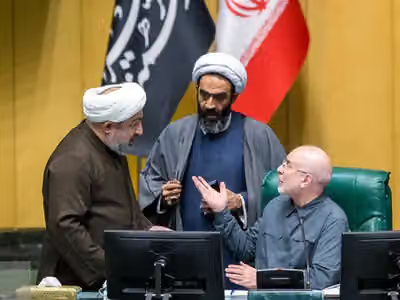
Attacks by hardliners on Parliament Speaker Mohammad-Bagher Ghalibaf and Chief Justice Gholam-Hossein Mohseni-Ejei following hardline lawmaker Hamid Rasaei’s imprisonment have intensified the rift among Iran’s conservatives.
Rasaei said during an online parliamentary session on Sunday that Ghalibaf, former president Hassan Rouhani, President Masoud Pezeshkian and the Secretariat of the Supreme National Security Council had filed complaints against several lawmakers.
He said one of those complaints had resulted in a 10-month prison sentence against him. Rasaei described the ruling as “non-legal” and “political,” but said he would report to prison to serve the sentence.
Rasaei was elected third in Tehran in the parliamentary election three years ago, when around 80 percent of eligible voters in the capital boycotted the election.
He is the first sitting lawmaker to be sent to prison during his term in office.
The complaint dates to before Rasaei was elected to parliament and concerns a case brought by Ghalibaf against the weekly 9 Dey, where Rasaei was managing director. The complaint followed an article published in January 2024 under the headline “Ghalibaf’s Manipulation of Parliamentary Documents.”
The judiciary announced on Monday that Rasaei had appeared at Tehran’s Special Clerical Court and was sent to the clerics’ section of Evin Prison the same day to begin serving his sentence. According to the judiciary’s statement, Rasaei had more than 18 months to resolve the case by apologizing to Ghalibaf.
Rasaei’s positions are closely aligned with those of the Paydari Party and former nuclear negotiator Saeed Jalili.
Hardliners react to the sentence
Rasaei’s supporters have accused Ghalibaf of “silencing the voices of critics” and criticized him for pursuing the complaint against Rasaei rather than focusing on the country’s economic and security problems.
Figures associated with these groups and their media outlets also attacked Mohseni-Ejei. The criticism has spilled over into some recent nightly pro-government gatherings.
Mohammad-Manan Raeisi, a Qom lawmaker who headed Saeed Jalili’s presidential campaign in the city two years ago, sharply criticized Ghalibaf and other officials and warned of a possible popular backlash against them.
“I doubt that, under these circumstances, people will allow you to appear in any mosque, gathering, public square or religious ceremony, and you may face a popular backlash,” he wrote.
Meysam Nili, managing director of the Raja News website and a figure associated with the Paydari Party, accused the judiciary of injustice and political bias, claiming that a “coup” was being organized against media and political figures belonging to the faction.
Hardline social media user Mohsen Maghsoudi, referring to arguments in favour of negotiations with the United States, wrote: “When it is possible to negotiate with the killer of the martyred Imam (Ali Khamenei) in the national interests and still talk about negotiations despite receiving insult, humiliation and aggression, why can’t we, in order to preserve unity, drop a three-year-old complaint over the headline of a weekly newspaper so that a revolutionary representative does not go to prison and hundreds of thousands of people’s votes do not become ineffective for 10 months?”
Other conservatives push back
Other conservative figures have sharply criticized the controversy generated by Rasaei’s supporters and the hardline groups.
The IRGC-affiliated Tasnim news agency published an article headlined “On Mr Rasaei’s Strange Fallacies!” and described his objections to the ruling as “slander against a judicial ruling.”
Tasnim said Rasaei had effectively challenged the validity of the ruling by describing it as “strange” and “contrary to procedure,” while accusing the judiciary of political conduct by calling the ruling “political and non-legal.” The agency characterized his statements as criminal.
The Tabnak website published a video showing hardliners chanting in support of Rasaei and against Ghalibaf at one of the nightly gatherings. It called them “infiltrators” and said a small number of people were using the gatherings to “advance factional objectives.”
The conservative Khorasan newspaper said Rasaei’s refusal to apologize had led the court to conclude that he was not only unrepentant about the allegations he had made against Ghalibaf, but was also refusing to resolve the case and defying a judicial order.
Mojtaba Zarei, a member of parliament’s National Security and Foreign Policy Committee, wrote that turning a judicial case into a political and media confrontation during wartime would only deepen divisions among political forces.
Deepening confrontation
Hardliners have stepped up attacks in recent days against political rivals who support resolving the dispute with the United States through negotiations and returning to the Islamabad understanding.
They have gathered outside the home of former President Hassan Rouhani, whom they accuse of being subservient to the West, and called for him and his former foreign minister, Mohammad-Javad Zarif, to be prosecuted.
They also chanted against President Masoud Pezeshkian and called him an “infiltrator” as he returned from New York, where he attended the UN General Assembly. Hardliners have also registered an impeachment motion against Foreign Minister Abbas Araghchi over his meeting with Steve Witkoff, US President Donald Trump’s special envoy for Iran, and launched an online campaign calling for Pezeshkian’s removal.
Iranian hardliners have intensified attacks on President Masoud Pezeshkian after he signalled nuclear flexibility and backed negotiations with Washington in a Fox News interview.
Conservative officials and media outlets had largely welcomed Pezeshkian’s speech to the UN General Assembly on Wednesday, but his comments to Fox News a day later provoked a sharp backlash from hardliners.
Pezeshkian said Iran was prepared to reduce its level of uranium enrichment, dilute its existing stockpile of uranium enriched to 60% and allow international verification as part of efforts to ease tensions over its nuclear program.
He also said Tehran wanted a possible agreement before the US midterm elections in November and denied that Iran had a plan to assassinate US President Donald Trump.
The contrasting reactions underscored a problem confronting Pezeshkian and Foreign Minister Abbas Araghchi: declarations of defiance can command broad support within Iran’s political establishment, but the concessions involved in actually reaching an agreement with Washington are proving considerably more contentious.
“Mr. Pezeshkian, don't spout nonsense about nuclear matters and uranium!” wrote hardline activist Mohammad-Hossein Chavoshi.
“We supported you when you spoke the truth, and we'll do it again; but if you step out of line, we'll deal with you accordingly. We will not give up the nuclear issue.”
But some defended Pezeshkian’s position.
“Did he say we should abandon the nuclear program?” one user wrote. “He is talking about 60% enrichment. Should we have constant war, remain under siege and have no money?
“Go to a large pharmacy and see what the shortage of medicine is like, not to mention the state of businesses and the market. Nobody is saying we should surrender. We can move forward thoughtfully.”
Araghchi’s plan
The backlash has not been confined to Pezeshkian. Foreign Minister Abbas Araghchi has faced sustained attacks from hardliners since presenting an Iranian proposal to the US through intermediaries on Tuesday.
The proposal sets out a phased, one-week process for implementing commitments, after which direct or indirect talks on a broader agreement could resume, according to Araghchi.
He said at a press conference on the sidelines of the UN General Assembly that Iran was ready to begin implementing the plan as soon as Washington agreed to it and that negotiations on the nuclear issue would resume after the Strait of Hormuz was reopened at the end of the seventh day.
According to Araghchi, one of the conditions is US agreement on a maritime passage arrangement through the Strait of Hormuz that has been agreed between Iran and Oman.
Although Mohsen Rezaei, secretary of Iran’s Supreme National Security Council, confirmed in a television interview on Saturday that Araghchi had been authorized to convey Iran’s conditions to the US through intermediaries in New York, criticism of the foreign minister has continued.
On Wednesday, hardline parliamentarian Amir-Hossein Sabeti said he had registered an impeachment motion against Araghchi through parliament’s system.
Warnings of wider conflict
At the same time, political and military figures have stepped up warnings of escalation if US pressure continues.
Ahmad Alamolhoda, the Friday prayer leader in Mashhad, said Friday that Iran had new weapons that would be used in the event of another US attack. He said Iran could expand the geographical range of attacks against US forces as far as the Indian Ocean.
IRGC spokesman Hossein Mohebbi similarly said Iran was prepared to enter new stages of confrontation with the US and could respond to another attack by “changing the geography of the conflict, using new equipment and weapons, and selecting different targets.”
The warnings have increasingly extended to neighboring countries as restrictions on Iranian aviation have tightened. Iranian flights to Najaf, Iraq, were cancelled Friday, further narrowing the country’s remaining international connections.
Rezaei warned regional countries earlier this week that if they barred Iranian flights in cooperation with Washington, flights from their own airports could also be stopped.
Mohammad Mokhber, an adviser and aide to Supreme Leader Mojtaba Khamenei, sharpened that warning Friday.
“Flights in the region are either free for everyone or for no one,” he wrote on X. “If Iran is unable to fly and receive airport services, no country in the region will have this possibility either.”
The competing messages highlight the difficulty facing Tehran as contacts with Washington resume: Pezeshkian and Araghchi are outlining the concessions and sequencing that a negotiated settlement could require, while hardline political and security figures emphasize Iran’s ability to widen the confrontation.
President Masoud Pezeshkian’s UN speech won unusual praise across Iran’s political establishment Thursday, but emerging details of negotiations with the United States could soon test the president’s careful balancing act.
Conservatives embraced Pezeshkian’s defiant rhetoric at the General Assembly, while reformists highlighted his willingness to negotiate, allowing both sides to find something to welcome in an address that rejected surrender while keeping the door open to diplomacy.
The harder test may now come at the negotiating table.
US and Iranian negotiators in New York are exploring a phased agreement that could reopen the Strait of Hormuz in exchange for Washington lifting its economic blockade of Iran, Reuters reported Thursday.
Neither side wants to surrender its main source of leverage before the other acts, and the talks remain far from an agreement.
Any substantive movement toward such an arrangement could sharpen the domestic divisions that Pezeshkian’s speech temporarily managed to straddle, particularly among hardliners who have opposed negotiations with Washington.
‘We will not surrender’
Pezeshkian’s speech Wednesday night drew praise from senior officials including Parliament Speaker Mohammad Baqer Qalibaf, judiciary chief Gholam-Hossein Mohseni Ejei, Expediency Council Chairman Sadegh Amoli-Larijani and Army Commander Major General Amir Hatami.
Revolutionary Guards commander Ahmad Vahidi said Pezeshkian’s remarks reflected the position of the Iranian people.
“We are not afraid of war. This is the voice of the Iranian people that was heard by the world through him,” Vahidi wrote.
Acting Defense Minister Majid Ibn al-Reza also praised the speech, saying Iran’s message represented a “change in Iran’s defense doctrine” and that the country would accelerate the development of its military capabilities accordingly.
Kayhan, one of the strongest opponents of negotiations with the United States, said Pezeshkian had turned New York into a “court for prosecuting the crimes of Washington and Tel Aviv” and delivered a decisive response to US President Donald Trump.
Javan, a newspaper affiliated with the IRGC, put Pezeshkian’s “We will not surrender” phrase on its front page.
‘Strategic mistake’
Reformist newspapers, however, emphasized another part of the same address: Pezeshkian’s stated readiness for negotiations and engagement with the world.
Their headlines included “We are not afraid of war, we do not shy away from negotiations for peace” and “Neither warmongering nor fear of negotiations,” illustrating the markedly different ways the speech was being presented to domestic audiences.
The balancing act did not satisfy everyone.
Hardline journalist Davoud Modarresian described parts of the speech as worthy of praise but criticized Pezeshkian for travelling to New York and continuing to advocate negotiations.
In the face of Trump’s threats against Iran, he argued, declaring readiness for talks amounted to a “strategic mistake.”
Other hardline commentators complained that Pezeshkian had failed to demand retribution for US and Israeli attacks.
A speech for home?
Reformist journalist Ahmad Zeidabadi, meanwhile, questioned the enthusiastic reception from some of Pezeshkian’s most determined opponents of negotiations with the United States.
He asked whether those praising the president also supported his references to negotiations, or were selectively highlighting his more confrontational remarks in an effort to push the president in a more radical direction.
Some reformists saw the combination differently. Journalist Mohammad Sohofi argued that Pezeshkian sometimes employed populist slogans precisely to reduce tensions and marginalize hardline opponents of his policies.
Former Tehran Chamber of Commerce chairman Hossein Selahvarzi said the speech appeared designed more for a domestic audience than for the international community.
“Pezeshkian’s speech seemed to have been written more to be heard inside the country than to convince the world,” he wrote, arguing that the president should have presented more concrete proposals and initiatives.