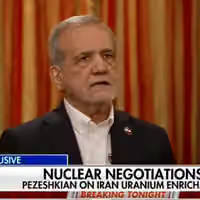
Pezeshkian accused protesters of being incited by the United States and Israel and receiving weapons to disrupt Iran’s security. He also defended system supporters who took to the streets during the unrest.
The sisters of Sina Kazemi, Emad Mavedatipour and Babak Sadeghi Mohseni responded on X, saying their brothers were unarmed when they were killed on January 8 or 9 and were not acting on behalf of any foreign government.
“I testify that my brother was unarmed when he was killed by the Islamic Republic of Iran’s forces on January 8, 2026,” Kazemi’s sister wrote. “He was not acting on behalf of any foreign government. I seek truth, justice, and accountability.”
Mavedatipour’s sister posted the same account of her brother, saying he was unarmed when he was killed on January 9 and denying that he acted for a foreign government.
Sadeghi Mohseni’s sister said her brother was unarmed when he was killed on January 8 and also called for “truth, justice, and accountability.”
The sister of Ahmad Khosravani, a 21-year-old professional basketball player, said her brother was completely unarmed when Iranian forces killed him on January 9.
“He was not acting on behalf of any foreign government,” she wrote. “They shot him directly in the heart.”
Fathers challenge Pezeshkian
Two other bereaved fathers challenged the government's account in separate video messages sent to Iran International.
The father of Erfan Abdipour, an architecture student who also worked at his brother’s restaurant, called on Pezeshkian to publish evidence if authorities had any showing that his son had received military training or carried a weapon.
“My request is that if you have evidence showing that he received military training, was instructed or had a weapon, or anything else that night, publish it,” Abdipour’s father said.
Abdipour had gone to protest on the night he was killed, his father said, questioning what his son could have been trying to seize in an area he described as having no military barracks or security facility.
The father of Pouria Bagheri separately rejected the government's explanation for the scale of the killings.
“I categorically reject the overall argument that such widespread killing was foreign actors work.”
Bagheri’s father questioned why authorities shut down the internet and electricity and said that security agents removed surveillance cameras from shops. He also asked why officials brought government supporters onto the streets two days later if foreign-backed armed groups posed the extensive threat described by authorities.
“Why did you bring your own supporters into the streets two days later? With what guarantee?” he said. “Was it not because you were in control?”
January crackdown
The protests began on December 28, 2025, following a sharp fall in the rial and rising prices before spreading across all 31 provinces and developing into a broader challenge to the Islamic Republic.
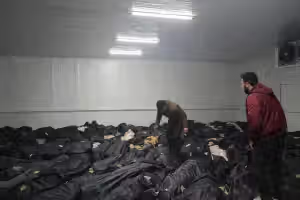
The deadliest violence came on January 8 and 9. Amnesty International said verified videos and eyewitness testimony showed security forces using rifles and shotguns against protesters, frequently firing at heads and torsos.
Iran International’s Editorial Board concluded in January that more than 36,500 people were killed by security forces on January 8 and 9 after reviewing classified government documents, field reports and accounts from medical workers, witnesses and victims’ families.
The UN Fact-Finding Mission on Iran later said security forces used lethal force against protesters and bystanders, including children, who posed no imminent threat of death or serious injury.
Iranian authorities initially put the death toll at 3,117. The government subsequently published 3,038 names, according to the UN mission, which said it believes the actual number may be significantly higher.
US President Donald Trump cited increasingly higher death tolls from Iran’s January protest crackdown in successive remarks, putting the number at 32,000 on February 20, 42,000 in later comments and subsequently 45,000.