IRGC adviser warns of heavier response to any new US, Israeli attack

Iran would respond more forcefully to any new attack by the United States or Israel, Ali Fadavi, head of the advisory group to the Revolutionary Guards commander, said on Thursday.
“If the enemy, as a result of a miscalculation, attacks Iran again, the Islamic Republic of Iran’s response will be much heavier than before,” Fadavi said, according to Tasnim.


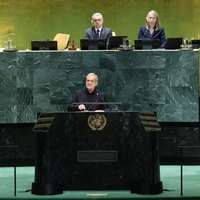
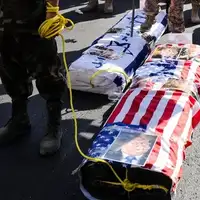



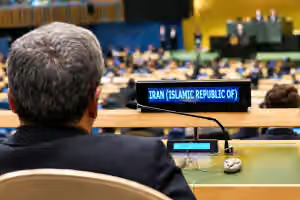
The one voice that could settle what Tehran wants from the diplomacy under way in New York has not been heard at all. Supreme Leader Mojtaba Khamenei has said nothing publicly about the contacts with Washington, the attacks on his foreign minister, or the speech itself.
He did not receive the president before the trip. And this is the first UN General Assembly in 37 years at which his father was not Iran's supreme leader.
What changed, and what did not
Before the speech, the hardline press was hostile to the trip itself. Kayhan warned that "New York is not a place for smiles and negotiations" and that the General Assembly should be turned into "a court for US crimes." Fars, affiliated with the Revolutionary Guards, wrote that Pezeshkian should not have gone at all.
Moderates pushed the other way: the daily Etemad recalled the meetings Iranian presidents failed to hold with Bill Clinton in 2000 and Barack Obama in 2013, and the reformist Mehdi Karroubi urged Pezeshkian to meet Donald Trump.
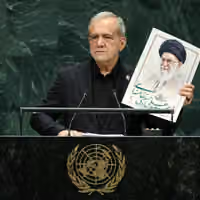
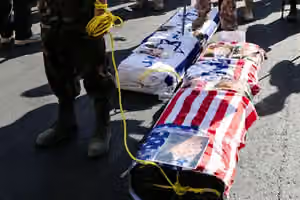
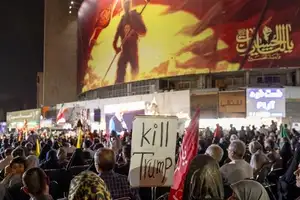
Pezeshkian did neither. After Trump used the UN podium to threaten to "annihilate" Iran, the president said he had rewritten his speech. He held up photographs of children killed in the strike on a school in Minab in the war's first hours alongside a portrait of the late Ali Khamenei, said Iran had defended itself "powerfully," said it remained open to negotiation, and said it would not accept "the language of coercion."
There was no offer in it, no gesture toward a meeting, nothing a hardliner could call weakness.
The praise followed within hours, and it praised the defiance.
Revolutionary Guards spokesman Hossein Mohebbi said the president had "at the heart of the system of arrogance, reproduced the message of power, pride, dignity and hope of a nation," in a statement carried by IRNA.
Iran would rely on unity "from the country's highest executive official to the brave fighters in the field and the people in the streets," he said.
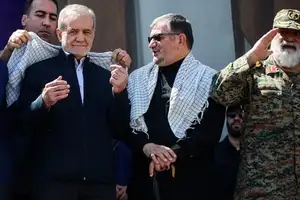
Mohammad Mokhber, an adviser to the supreme leader, called Pezeshkian "a worthy representative and the voice of all Iranians" who had been "decisive, reasoned and logical."
The message, he wrote on X, was clear: "we will not bow our heads before a bully, we will not forget our martyrs and we will make the aggressors regret their actions."
Ali Abdollahi, chief of staff of the armed forces and commander of the Khatam al-Anbiya Central Headquarters, Iran's wartime command, said the people "through Dr. Pezeshkian, slapped the criminal president of the United States before the eyes of the world," and that the armed forces stood "in harmony and in one voice with the people and the respected president."
Army commander Amir Hatami followed on Thursday. "Mr. President, well done. We sincerely thank you," he said, calling the address "a manifestation of the unity and coordination of all Iran against the bullying enemy."
Parliament speaker Mohammad Bagher Ghalibaf wrote that Pezeshkian "spoke not just for a government, but for a 3,000-year-old civilization."
Every one of those statements praised the speech for what it refused. None mentioned the talks.
The missing voice
In previous years, state media made a point of showing the president meeting the supreme leader before a major trip, including before the General Assembly. The meeting was the signal: the president traveled with the leader's mandate, and everyone in Tehran knew it. No such meeting was announced this year. Mojtaba Khamenei has not been seen or heard in public since he was named to succeed his father in March, and he has issued nothing on New York.
The closest anyone has come to speaking for him was Major General Yahya Rahim Safavi, one of his military advisers, on Wednesday. "If the Supreme Leader has deemed it expedient and left the government's hands open in the negotiations, that is an important act of prudence," Safavi said on state television. Even the adviser spoke in the conditional.
That leaves the generals' applause doing a job the leader's meeting used to do. Their statements told Tehran that the speech was approved. What they did not tell anyone is whether the contacts around it are.
The fight that did not stop
The argument over those contacts continued through the praise, and it is an argument about authorization, not about whether to talk.
Ebrahim Rezaei, of parliament's National Security and Foreign Policy Committee, challenged Foreign Minister Abbas Araghchi on Wednesday over his meeting in New York with US envoy Steve Witkoff. "
On the basis of which authorization and policy did the foreign minister meet the representative of the aggressor enemy?" he wrote on X. Iran's seven conditions had already been conveyed to Washington, he said, and "nothing comes from such an illegal meeting except a sign of weakness."
Tasnim, also affiliated with the Guards, called Araghchi's explanation "childish and vile" and, citing Mohsen Rezaei, the secretary of the Supreme National Security Council, said the approved plan had been to pass the conditions through mediators, not to meet Witkoff. It called the meeting "a major error." Fars argued the contact had eased pressure on Washington without securing anything.
On Thursday Ali Khezrian, another member of the Committee, said Araghchi had not been authorized to hold direct talks and that MPs had registered a motion to impeach him. "Araghchi must, after returning from his trip, answer in parliament on what basis this conversation with the American side took place," he said.
The foreign minister had defenders. MP Mojtaba Zarei said his own inquiries showed Araghchi had been authorized to meet Witkoff. "There was and is no negotiation," he wrote; the seven conditions had been delivered directly to Trump's envoy. Mohebbi, for the Guards, had already set the terms: "We don't reject diplomacy, but we impose our own conditions. Our defensive power will be proven in the field."
The man who stayed in his seat
A second row concerned Nasser Asadi, a member of Iran's UN mission who remained in the hall during Trump's address. Hossein Ali Haji-Deligani, deputy head of parliament's Article 90 Committee, which handles public complaints against state bodies, called it "a source of shame and regret" and said MPs would use "all supervisory tools, including the impeachment of Araghchi." Hardline accounts contrasted Asadi with delegations that walked out.
Foreign Ministry spokesman Esmail Baghaei defended him. "Iran's seat in a place such as the United Nations General Assembly is our trench," he said. "If we are supposed to leave this trench because of the harsh words, hostility and insults of others, then we certainly have not done our duty."
As President Masoud Pezeshkian and Foreign Minister Abbas Araghchi arrived for the UN General Assembly, the messages came in with a phrase that recurred until it became the story's own name: the "killers in suits." The demand attached to it was the same almost every time. Arrest them.
Voices from Iran draws on messages sent to Iran International by people inside the country. Names are withheld for their safety.
The demand
A writer from Fardis, on the western edge of Karaj, pointed to the latest human rights reports and asked why officials responsible for crushing 40,000 protesters in January were not being detained in New York.
Another wrote simply that now they were there, this was a good chance to arrest Pezeshkian and Araghchi.
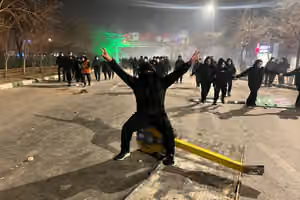
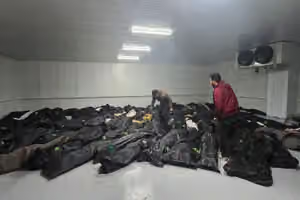
The UN fact-finding mission on Iran said in its new report that many of the violations committed in the crackdown on the January 2026 protests, including murder, imprisonment and severe deprivation of liberty, amounted to crimes against humanity. Its chair, Sara Hossain, said the true number of victims could be "significantly" higher than the government's own figure.
One writer suggested that while the officials were at the United Nations, footage and documents of the killings should be handed to the same body. Others addressed Donald Trump directly, asking him to act on the crackdown rather than host or negotiate with the delegation.
And several turned to Zohran Mamdani, who as a candidate for mayor of New York said he would have Benjamin Netanyahu arrested if the Israeli prime minister set foot in the city, citing the International Criminal Court warrant against him.
"The mayor of New York who wanted to arrest Netanyahu," one wrote, "does he by any chance not intend to arrest the criminals in suits who sit on the Supreme National Security Council and whose signatures are on the massacre of January 8 and 9?"
The visas
A second thread was anger at what writers called the West's double standard: condemning the repression while receiving the men accused of it.
"My question is this," one wrote. "Didn't Mr. Trump always talk about the January massacre? So why has he given visas to the ringleaders of the killers of Iran's children?"
The State Department has said that admitting the core members of the Iranian delegation was an obligation Washington carries as host of the United Nations, and that the delegation's movements were restricted. The US government also agreed to Araghchi's request for a security detail during his stay.
"Bodies attached to the United Nations say the leaders of the Islamic Republic have committed crimes against humanity," another writer addressed the president. "Why are they now freely, and even under your escort, in America and at the UN?"
Not everyone expected an arrest. One writer said it was probably beyond the West to detain the officials, and proposed instead that Iranians abroad gather outside UN headquarters.
'A puppet'
The other constant in the messages was that Pezeshkian does not decide anything, and that his presence at the UN is a performance of the system that does.
Writers called him a marionette, a wind-up doll, and the tea boy of the power mafia, and called the trip a circus staged for legitimacy.
Some pointed to how little it achieved. One wrote that for years the Islamic Republic's only gain from attending the UN had been shopping in New York, and that Trump had taken even that away.
Last September the State Department restricted the Iranian delegation's access to wholesale and luxury stores during its stay.
Beneath the mockery ran a fear. Several writers worried that a deal might be struck, and that the file on the killings would be pushed aside for it.
Iranian customs records showed one delivery arriving on June 17, when Washington and Tehran signed a 60-day truce and China promoted its peacemaking role. More than a dozen shipments followed two days later, carrying over $6 million in parts usable in drones.
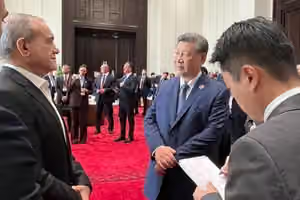
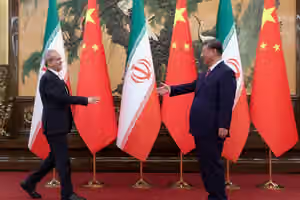
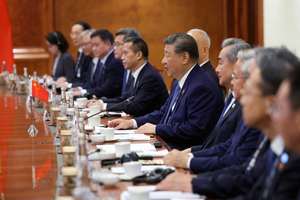
The findings put Chinese support for Tehran at the center of Xi Jinping’s Washington visit this week, alongside trade, artificial-intelligence safety and Taiwan. Trump told aides that preserving relations with Xi was a priority, the Journal reported.
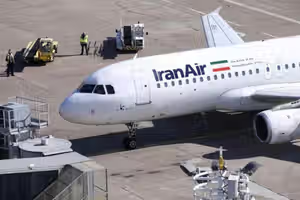
Records supplied by ImportGenius, covering January 2025 through June 2026, listed thousands of shipments to Iranian companies and the defense ministry, including GPS devices, motors and aircraft engine parts. Many cited Article 119, which exempts defense imports from tariffs.
Days before war began on February 28, China delivered 300 tons of chemical compounds to the ministry. Trade initially collapsed, and April’s US naval blockade restricted supplies further. Iran responded by expanding air connections.
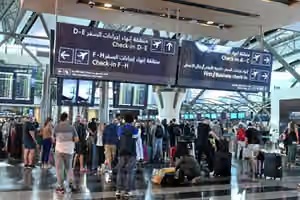
US-sanctioned Mahan Air increased flights from Beijing, Shanghai and Guangzhou to Tehran from four weekly in early March to about 27 by late April, FlightRadar24 data showed. It operated 39 China–Iran flights in September’s first week, twice its prewar level. Several were unavailable for passenger bookings. China services continued despite announced suspensions to Oman and Turkey.
CSIS researcher Kate Koren identified Chinese companies advertising sensitive electronics used in Shahed drones. Suppliers cultivated Iranian customers through trade fairs and Persian-language marketing.
Chinese chemical supplies also helped replenish missile production damaged by Israeli attacks in 2024. After reports of those exports in 2025, US forces raided a ship carrying dual-use components from China to Iran.
In a December letter, sanctioned Chinese company Haokun Energy said it had coordinated confidential export licensing for sodium perchlorate, used in missile propellant, and created a Beijing shell company for the transaction. The Journal verified the company’s registration but could not establish whether the deal proceeded.
Washington also targeted networks seeking newer Chinese shoulder-fired missile systems for Iran, which manufactures versions based on older Chinese designs. One unsuccessful effort sought delivery through Belarus to conceal Iran’s Center for Innovation and Technology Cooperation as the recipient. Tasnim separately published footage of IRGC personnel training with portable launchers.
Iran's biggest buyer
China became Iran’s dominant oil buyer after Trump’s 2018 “maximum pressure” campaign; the countries signed a 25-year pact in 2021. US lawmakers put China’s share above 80% of Iranian crude exports. Banks and shell companies have facilitated payments, including in yuan, US officials and other sources told the Journal.
One arrangement involved Iranian petrochemical sales to Egypt through Banque Misr’s UAE branch. After US objections to dollar payments, proposed transactions shifted to yuan through China’s Cross-Border Interbank Payment System. Washington intervened, stopping the plan, and later moved to restrict the branch’s dollar access.
Egypt and the bank said they were engaging US authorities; the bank affirmed regulatory compliance. Beijing suspected Egyptian officials had shared information with Washington, and Xi raised the matter in Cairo on September 1, the Journal reported.
US officials also linked Chinese satellite imagery obtained before and after a July 17 Iranian strike to the attack, which killed three American troops in Jordan. Washington had sanctioned three Chinese imagery companies in May.
Despite hundreds of sanctions, disagreements persisted inside Trump’s administration. Hegseth said China and Russia enabled Iran; Trump cited Xi’s assurances against weapons deliveries, saying: “I trust them.” Rubio said Chinese assistance had not changed the war’s trajectory.
July measures targeted Mahan-linked entities, including a Chinese sales agent. Late-August Operation Economic Outcast targeted a Chinese-owned tanker and procurement networks, but no major Chinese companies. Kpler recorded roughly four million barrels reaching China the following week.
Lawmakers from both parties urged tougher action; Senator Elissa Slotkin called for Iran to become central to the summit. Rubio promised frank talks, while Treasury and the White House defended their enforcement efforts.
China rejected accusations of improper support, citing export controls and opposition to unilateral sanctions. Hong Kong said it implements UN sanctions only.