The one voice that could settle what Tehran wants from the diplomacy under way in New York has not been heard at all. Supreme Leader Mojtaba Khamenei has said nothing publicly about the contacts with Washington, the attacks on his foreign minister, or the speech itself.
He did not receive the president before the trip. And this is the first UN General Assembly in 37 years at which his father was not Iran's supreme leader.
What changed, and what did not
Before the speech, the hardline press was hostile to the trip itself. Kayhan warned that "New York is not a place for smiles and negotiations" and that the General Assembly should be turned into "a court for US crimes." Fars, affiliated with the Revolutionary Guards, wrote that Pezeshkian should not have gone at all.
Moderates pushed the other way: the daily Etemad recalled the meetings Iranian presidents failed to hold with Bill Clinton in 2000 and Barack Obama in 2013, and the reformist Mehdi Karroubi urged Pezeshkian to meet Donald Trump.
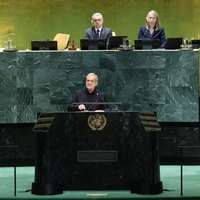
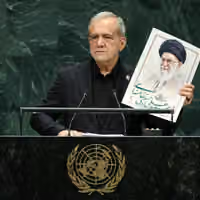
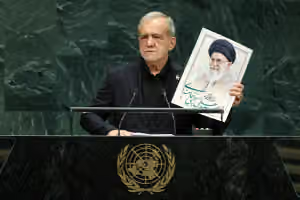
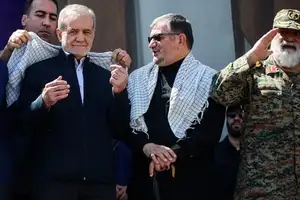
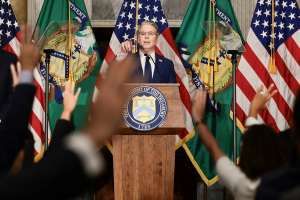
Pezeshkian did neither. After Trump used the UN podium to threaten to "annihilate" Iran, the president said he had rewritten his speech. He held up photographs of children killed in the strike on a school in Minab in the war's first hours alongside a portrait of the late Ali Khamenei, said Iran had defended itself "powerfully," said it remained open to negotiation, and said it would not accept "the language of coercion."
There was no offer in it, no gesture toward a meeting, nothing a hardliner could call weakness.
The praise followed within hours, and it praised the defiance.
Revolutionary Guards spokesman Hossein Mohebbi said the president had "at the heart of the system of arrogance, reproduced the message of power, pride, dignity and hope of a nation," in a statement carried by IRNA.
Iran would rely on unity "from the country's highest executive official to the brave fighters in the field and the people in the streets," he said.
Mohammad Mokhber, an adviser to the supreme leader, called Pezeshkian "a worthy representative and the voice of all Iranians" who had been "decisive, reasoned and logical."
The message, he wrote on X, was clear: "we will not bow our heads before a bully, we will not forget our martyrs and we will make the aggressors regret their actions."
Ali Abdollahi, chief of staff of the armed forces and commander of the Khatam al-Anbiya Central Headquarters, Iran's wartime command, said the people "through Dr. Pezeshkian, slapped the criminal president of the United States before the eyes of the world," and that the armed forces stood "in harmony and in one voice with the people and the respected president."
Army commander Amir Hatami followed on Thursday. "Mr. President, well done. We sincerely thank you," he said, calling the address "a manifestation of the unity and coordination of all Iran against the bullying enemy."
Parliament speaker Mohammad Bagher Ghalibaf wrote that Pezeshkian "spoke not just for a government, but for a 3,000-year-old civilization."
Every one of those statements praised the speech for what it refused. None mentioned the talks.
The missing voice
In previous years, state media made a point of showing the president meeting the supreme leader before a major trip, including before the General Assembly. The meeting was the signal: the president traveled with the leader's mandate, and everyone in Tehran knew it. No such meeting was announced this year. Mojtaba Khamenei has not been seen or heard in public since he was named to succeed his father in March, and he has issued nothing on New York.
The closest anyone has come to speaking for him was Major General Yahya Rahim Safavi, one of his military advisers, on Wednesday. "If the Supreme Leader has deemed it expedient and left the government's hands open in the negotiations, that is an important act of prudence," Safavi said on state television. Even the adviser spoke in the conditional.
That leaves the generals' applause doing a job the leader's meeting used to do. Their statements told Tehran that the speech was approved. What they did not tell anyone is whether the contacts around it are.
The fight that did not stop
The argument over those contacts continued through the praise, and it is an argument about authorization, not about whether to talk.
Ebrahim Rezaei, of parliament's National Security and Foreign Policy Committee, challenged Foreign Minister Abbas Araghchi on Wednesday over his meeting in New York with US envoy Steve Witkoff. "
On the basis of which authorization and policy did the foreign minister meet the representative of the aggressor enemy?" he wrote on X. Iran's seven conditions had already been conveyed to Washington, he said, and "nothing comes from such an illegal meeting except a sign of weakness."
Tasnim, also affiliated with the Guards, called Araghchi's explanation "childish and vile" and, citing Mohsen Rezaei, the secretary of the Supreme National Security Council, said the approved plan had been to pass the conditions through mediators, not to meet Witkoff. It called the meeting "a major error." Fars argued the contact had eased pressure on Washington without securing anything.
On Thursday Ali Khezrian, another member of the Committee, said Araghchi had not been authorized to hold direct talks and that MPs had registered a motion to impeach him. "Araghchi must, after returning from his trip, answer in parliament on what basis this conversation with the American side took place," he said.
The foreign minister had defenders. MP Mojtaba Zarei said his own inquiries showed Araghchi had been authorized to meet Witkoff. "There was and is no negotiation," he wrote; the seven conditions had been delivered directly to Trump's envoy. Mohebbi, for the Guards, had already set the terms: "We don't reject diplomacy, but we impose our own conditions. Our defensive power will be proven in the field."
The man who stayed in his seat
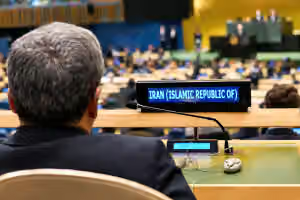
A second row concerned Nasser Asadi, a member of Iran's UN mission who remained in the hall during Trump's address. Hossein Ali Haji-Deligani, deputy head of parliament's Article 90 Committee, which handles public complaints against state bodies, called it "a source of shame and regret" and said MPs would use "all supervisory tools, including the impeachment of Araghchi." Hardline accounts contrasted Asadi with delegations that walked out.
Foreign Ministry spokesman Esmail Baghaei defended him. "Iran's seat in a place such as the United Nations General Assembly is our trench," he said. "If we are supposed to leave this trench because of the harsh words, hostility and insults of others, then we certainly have not done our duty."