• العربية
  • فارسی
Brand
  • Iran Insight
  • Politics
  • Economy
  • Analysis
  • Special Report
  • Opinion
  • Podcast
  • Live TV
  • Iran Insight
  • Politics
  • Economy
  • Analysis
  • Special Report
  • Opinion
  • Podcast
  • Live TV
  • Theme
  • Language
    • العربية
    • فارسی
  • Iran Insight
  • Politics
  • Economy
  • Analysis
  • Special Report
  • Opinion
  • Podcast
  • Live TV
All rights reserved for Volant Media UK Limited
volant media logo

Professor-turned-swimmer becomes first Iranian woman to complete Triple Crown

Sep 22, 2026, 18:13 GMT+1

Iranian dissident open-water swimmer and university professor Raha Akhavan became the first Iranian woman to complete the sport’s Triple Crown after swimming the English Channel on Tuesday, spending nearly 20 hours in the water.

The Triple Crown requires completing the English Channel, California’s Catalina Channel and the 20 Bridges swim around Manhattan.

Akhavan crossed Catalina in 2021 and completed the 48.5-kilometer Manhattan swim in 2023. Among Iranians, only two men had previously achieved the distinction.

Akhavan, who grew up in Iran and studied industrial engineering at Tehran’s Sharif University before earning graduate degrees in the United States, is now a professor of operations management and business analytics at Sabanci University in Istanbul.

She has repeatedly used her swimming to support Iranian protesters and criticize restrictions imposed by the Islamic Republic. Her Manhattan swim was dedicated to Mahsa “Jina” Amini, Iranian women and protesters blinded during the 2022 crackdown.

Akhavan said she wanted to “raise the voice” of women demanding freedom, equal rights and control over what they wear, and helped raise support for protesters with eye injuries.

She has said she was detained several times at the same Tehran detention center where Amini was held. More recently, she described Iran’s government as the “Islamic Regime” and accused it of using an internet blackout to suppress protests.

She dedicated her latest Channel swim to the “brave and freedom-seeking women and men of Iran.”

Banner

Most Viewed

Turkish Airlines says all Iran flights suspended until March 2027
1

Turkish Airlines says all Iran flights suspended until March 2027

2

Iran diplomacy intensifies at UN as Hormuz crisis keeps pressure on region

3

Flying to or from Iran? What to know as US pressure squeezes air links

4

Economic crisis puts Iran’s coal miners at greater risk

5

Iran threatens wider war as tanker attacks test mediation efforts

Banner
Banner

Spotlight

  • Flying to or from Iran? What to know as US pressure squeezes air links

    Flying to or from Iran? What to know as US pressure squeezes air links

  • Iran factories face deepening raw material shortages
    ANALYSIS

    Iran factories face deepening raw material shortages

  • Will shutdowns forced by US blockade damage Iran’s oil wells?
    ANALYSIS

    Will shutdowns forced by US blockade damage Iran’s oil wells?

  • Tehran sees ‌Beijing as potential bridge to Washington
    ANALYSIS

    Tehran sees ‌Beijing as potential bridge to Washington

  • Tehran ‘ashamed’ as Iranians struggle to make ends meet

    Tehran ‘ashamed’ as Iranians struggle to make ends meet

  • Iran faces postwar winter with major gas capacity still offline
    ANALYSIS

    Iran faces postwar winter with major gas capacity still offline

Banner
•
•
•

More Stories

Iranian test-takers head abroad as exam access shrinks

Sep 22, 2026, 12:11 GMT+1
100%
A language test center in Iran.

Iranian applicants are turning to costly overseas trips and alternative exams after access to international tests narrowed, compounding difficulties caused by internet disruption, payment restrictions and the falling value of the rial.

Students and language teachers described cancelled exams, disrupted preparation and growing reliance on overseas testing in interviews with Iranian newspaper Etemad.

TOEFL and GRE testing inside Iran stopped after the US Treasury Department suspended an authorization covering certain educational services involving Iran on August 24. Applicants have also faced restrictions affecting PTE and Duolingo, although the rules differ between providers.

“The morning she arrived at the center, they told her the test would not be held because of sanctions,” Homa, a language teacher identified only by her first name, said of a student who travelled from Gilan province in northern Iran. “That Saturday, all I could hear was students crying, some of whom had only a few weeks until their test date.”

  • Iranians tell of shrinking paths to study abroad

    Iranians tell of shrinking paths to study abroad

Some candidates had already paid for transportation and accommodation before learning their exams would not take place. Others were approaching university deadlines with little time to find alternatives.

Exam trips become a new expense

Applicants are increasingly looking to Armenia, Turkey and other nearby countries, feeding an informal business offering what Homa described as “exam tours.”

Intermediaries arrange appointments, foreign-currency payments, transportation and accommodation, sometimes allowing applicants to leave Iran, sit an exam and return within 24 or 48 hours.

Applicants travelling overland and sharing accommodation can spend around 300 million rials, about $130 at an open-market rate of roughly 2.3 million rials to the dollar. More expensive trips can reach 1 billion to 1.5 billion rials, or about $435 to $650, Homa estimated.

Those sums compare with a government-set minimum base wage of about 166 million rials, or $72, a month. With standard allowances, the minimum monthly package for a single worker is around 218 million rials, or $95.

Telegram groups have become information hubs for testing centers, accommodation and foreign payments. Homa said some operators also offer to manipulate internet or computer settings to make applicants inside Iran appear to be abroad, potentially exposing them to cancelled scores or blocked accounts.

Few alternatives without travel

Switching exams can mean losing months of specialized preparation and does not necessarily eliminate the need to travel.

IELTS is in a different position because it is jointly owned by the British Council, Australia's IDP and Cambridge University Press & Assessment rather than a US testing organization. The suspension of General License G therefore does not directly apply to it.

IELTS testing inside Iran, however, had already ended on January 31, 2026, after IDP cited separate “financial and regulatory factors” outside its control. Iranian applicants seeking the test must therefore also travel abroad.

Tabassom, identified only by her first name, had spent nine months preparing for PTE as part of plans to obtain an Australian work visa. She now expects to switch to IELTS.

100%
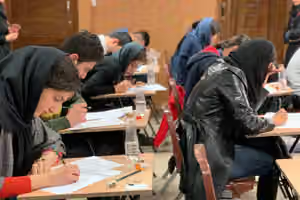
Students take an exam at a testing center in Iran.

“I spent an average of 150 million rials ($65) a month on language training,” Tabassom said. “Over nine months, I spent nearly one billion rials ($435) just on classes and training. I had reached the point where I was going to take the exam in another month and a half, but now I have to switch to IELTS and start preparing again.”

Domestic problems compound the disruption

The testing restrictions have landed on applicants already dealing with economic and infrastructure problems inside Iran.

Tabassom said internet outages had already disrupted contact with her immigration lawyer before the problems surrounding PTE forced her to change plans.

  • Iran sanctions reach education: Duolingo blocked, TOEFL and GRE in doubt

    Iran sanctions reach education: Duolingo blocked, TOEFL and GRE in doubt

Applicants with sufficient resources can respond by travelling abroad or paying for additional preparation. Others may have to borrow money or delay their plans. Homa said some students had sold gold or household belongings or taken loans to continue pursuing testing and migration.

For Iranians seeking to study or work abroad, the challenge is no longer only achieving the required score, but finding an affordable way to reach the examination room.

Frozen embryos advertised for sale online in Iran

Sep 21, 2026, 10:53 GMT+1
100%
An illustrative image of a fetus in an amniotic sac.

An informal market for frozen embryos appears to be emerging on Iranian social media and online marketplaces, where sellers are advertising them for cash outside the country’s donation system, local media reported on Monday.

One advertisement offered eight frozen embryos for one billion rials (about $4400), although it was unclear whether the price applied to each embryo or the entire group, Jahan-e Sanat newspaper reported on Monday.

Another seller advertised 18 frozen embryos and asked prospective buyers to suggest a price. Similar advertisements for embryos, eggs, sperm and surrogacy services have appeared on Instagram and Telegram.

The advertisements directed prospective buyers away from the original platform to continue discussions elsewhere, with little information about the people offering the embryos or how any transfer would take place.

Iranian law provides for donation, not direct sales

Iranian legislation passed in 2003 permits embryo donation to infertile married couples under specified conditions, with implementing regulations adopted the following year also covering frozen embryos.

  • Iran ‘youth population’ law linked to rise in Down syndrome births - daily

    Iran ‘youth population’ law linked to rise in Down syndrome births - daily

Under those regulations, embryo donation is defined as the voluntary and free transfer of one or more embryos to authorized infertility treatment centers. Written consent from the couple providing the embryo is required, and transfers must take place through authorized specialist centers.

100%
A newborn baby rests in a hospital neonatal care unit in Iran.

Prospective recipients must apply jointly as a married couple to a court and meet requirements covering infertility, legal capacity, health, drug use and Iranian citizenship.

The regulations therefore provide a formal route for donating frozen embryos but do not define them as commodities that can be sold directly between individuals.

Sociologist points to poverty and intermediaries

The online advertisements could reflect a combination of financial hardship among potential sellers and the desperation of couples struggling with infertility, sociologist Alireza Sharifi-Yazdi told Jahan-e Sanat.

“Behind this are a number of digital intermediaries who operate on Instagram, Telegram, and similar platforms and exploit the poverty and financial vulnerability of families, particularly women, as well as the desperation and confusion of infertile couples,” Sharifi-Yazdi said.

He distinguished regulated infertility treatment from an informal market in which intermediaries seek to profit from reproductive services.

Some infertile couples may turn to such channels after unsuccessful treatments including intrauterine insemination, or IUI, and in vitro fertilization, or IVF, he said.

Lengthy adoption procedures and the cost and waiting times associated with infertility treatment can also make unofficial alternatives appear easier, Sharifi-Yazdi added.

The financial circumstances of people offering embryos, he said, are another part of the picture, with worsening poverty potentially making them more susceptible to intermediaries seeking to profit from their situation.

Questions over oversight and identity

Sharifi-Yazdi also raised concerns about the possible consequences for children born following informal embryo transactions, including questions about their genetic parentage and legal status.

  • Missing embryos case at Tehran fertility clinic triggers legal probe

    Missing embryos case at Tehran fertility clinic triggers legal probe

Modern DNA testing could allow children conceived through such arrangements to discover that the people raising them are not their genetic parents, potentially creating psychological and legal complications later in life, he argued.

Iran also lacks a transparent centralized national system through which people seeking to donate embryos without payment can readily register and navigate the legal process.

Economic crisis puts Iran’s coal miners at greater risk

Sep 21, 2026, 10:29 GMT+1
100%
A coal miner works at a mine in Iran.

Iran’s economic crisis and rising currency costs are making essential safety equipment harder for coal mines to obtain, increasing risks for workers already operating in dangerous conditions, labor news agency ILNA reported on Monday.

Rising foreign exchange rates, sanctions and difficulties obtaining specialized equipment have become major challenges for the industry, where many mines still rely on traditional or semi-mechanized methods, said the report.

“There is an inverse relationship between the exchange rate and the provision of equipment; the more expensive foreign currency becomes, the less financial capacity employers have to provide safety,” Ebrahim Rahimian, executive secretary of the Tabas Workers’ House, told ILNA.

Many components used in mine monitoring and safety systems are imported and have no domestically produced alternatives, Rahimian said.

  • Iran oil workers protest pay conditions at offshore platforms, Assaluyeh

    Iran oil workers protest pay conditions at offshore platforms, Assaluyeh

Employers, he added, still have options to obtain equipment if they prioritize worker safety, including raising the necessary funds to purchase imported products at market exchange rates.

Deadly record in Iran’s mines

Workplace accidents, according to ILNA, remain a persistent problem in Iran, with coal mines among the most dangerous workplaces because of the conditions involved in underground extraction.

A collapse at the Parvadeh Tabas Coal Company mine killed a worker on April 29 in one of the latest fatal accidents.

A methane explosion at a coal mine in Tabas killed 53 workers in September 2024, drawing renewed attention to safety standards in Iran’s mining industry.

The economic pressures affecting mine operators have intensified as the rial has lost value, making imported machinery and specialized equipment more expensive.

100%

Sharp currency fluctuations have also complicated financial planning for businesses as Iran contends with sanctions and persistent inflation.

Underground mines need advanced monitoring

Coal miners working underground require more than personal protective equipment such as boots and gloves, Rahimian said.

Advanced systems, he added, are needed to continuously monitor gas concentrations and pressure in layers above underground workings, providing information directly connected to workers’ safety.

  • Iranian workers report  layoffs, months of unpaid wages

    Iranian workers report layoffs, months of unpaid wages

Workers at mining companies in Tabas, Kerman, Zarand and Jiroft continue to operate using traditional or semi-mechanized methods, with only one company providing an exception, according to Rahimian.

Training is another essential part of reducing the dangers workers face underground, particularly in preparing them to respond to emergencies, he said.

“Continuous training and retraining is the minimum right of the workforce and must not be stopped at any cost.”

The combination of aging mining practices, costly imported safety technology and mounting economic pressure has left workers exposed to hazards that previous deadly accidents have already demonstrated can carry severe consequences.

Iran mobilisation drive extends to children under 15

Sep 20, 2026, 02:56 GMT+1
100%
Children carrying rifles take part in a Janfada mobilisation rally in Iran, September 18, 2026

The spokesman for Iran’s mass mobilisation campaign said children under 15 could be introduced to military concepts, while denying that minors were receiving formal weapons training as authorities expand a civilian defence drive launched during the war.

Sasan Zare, spokesman for the Janfada campaign, said the main organisation of volunteers would be based around adults aged 18 and over, but acknowledged that younger people were also being brought into the initiative.

“The stronger their value system is formed from childhood, and the more familiar they become with concepts such as patriotism and self-sacrifice, the more significant the impact can be on their future,” Zare told the Iranian news agency ILNA.

Those registered with the campaign were over 15, he said, while women taking part in its training courses were over 18. For children below that age, Zare said the emphasis should be on patriotism, responsibility, first aid, safety and what he called a “culture of self-sacrifice and resistance.”

The Islamic Republic has stepped up a broad campaign to mobilise civilians since the US-Israeli war began in February.

The Janfada initiative was launched in late March, and authorities have since promoted registration through mosques, Basij bases and public events, alongside plans for military and emergency-response training.

The campaign has drawn scrutiny over the involvement of minors, with rights groups accusing Iranian authorities of recruiting children into the Basij and using them at checkpoints.

Amnesty International said in April that Iranian law allows children under 15 to join as ordinary Basij members, while those aged 15 and over can become active Basij members and collaborate with the Revolutionary Guards on assigned missions.

The rights group said it had verified evidence of children as young as 12 deployed at checkpoints and patrols, including some carrying rifles.

Iran International has separately received accounts from several provinces describing children and teenagers taking part in checkpoint operations and handling weapons at state-sponsored gatherings.

Asked specifically about teenagers being used at checkpoints, Zare said he did not know how such deployments were being carried out because checkpoints fell under the authority of local police and security bodies.

His campaign, he said, provided training related to urban and public security, while the units deploying volunteers would decide whether they were used at checkpoints.

Woman, Life, Freedom and the Iran that cannot go back

Sep 17, 2026, 16:10 GMT+1
•
Lawdan Bazargan
100%
People walk and shop in a local market in Tehran, Iran, summer of 2026

Four years after Mahsa Amini’s death, the deepest legacy of Woman, Life, Freedom may be that Iran cannot simply be returned to the society it was before September 2022.

Four years have passed since Zhina Mahsa Amini, a 22-year-old woman who had travelled to Tehran to visit family, died after being detained by the morality police.

She could never have imagined how her name would appear on walls, streets and university campuses, or on the lips of millions of Iranians, or how three simple words, “Woman, Life, Freedom,” would become one of the most enduring slogans in Iran’s modern history.

The story of 2022 is not only the story of a slogan. It is the story of the price thousands paid to break through the wall of fear.

Zhina’s death on September 16, 2022, sparked protests across Iran. Human rights organizations documented live ammunition and pellet fire, mass arrests, torture, sexual violence and the killing of protesters. HRANA later recorded protests in all 31 provinces, 160 cities and 143 universities, and reported at least 530 people killed, including 68 children and teenagers.

Nika Shakarami and Sarina Esmailzadeh were both sixteen. Kian Pirfalak was nine, remembered for “In the name of the God of the rainbow” and the small boat he built with his own hands. Khodanour Lojei, a 27-year-old Baluch man, lives on in videos of him dancing, alongside the haunting image of him with his hands tied to a pole and water placed before him while in detention.

Their stories were different, but each became part of the collective memory of Woman, Life, Freedom.

Then came the gallows. Mohammad Mehdi Karami, a 22-year-old karate champion, was executed after being sentenced in connection with the fortieth-day commemoration for Hadis Najafi. Seyed Mohammad Hosseini, who worked at a poultry farm and taught martial arts to disadvantaged children for free, was executed the same day; human rights reports say his confessions were obtained under torture. Majidreza Rahnavard, executed only 23 days after his arrest, asked before his death that people not cry at his grave but celebrate and play happy music.

These names are reminders that behind every statistic was a family.

The repression did not end with the street protests. Students, schoolchildren, journalists, artists, athletes and activists were arrested. Families sometimes went weeks or months without news. Some detainees appeared in televised “confessions” that human rights organizations said were tainted by torture. Families seeking the truth about those killed also faced pressure. Others eventually left Iran after imprisonment, threats and persecution, carrying the cost of the uprising into exile, lost careers, interrupted education and separation from family.

And yet one of the movement’s deepest legacies is visible in an ordinary scene: a woman walking down an Iranian street without compulsory hijab.

The state responded with fines, vehicle seizures, arrests, flogging, business closures, cameras and surveillance. But women’s defiance continued. Four years after Zhina’s death, a woman without compulsory hijab is no longer the exceptional image it was in September 2022; it has become part of Iran’s social reality.

That is also where the connection to Dey 1404 (December 2025 and January 2026) becomes important.

The new protests began amid the collapse of the currency, inflation and protests by Tehran bazaar merchants, but quickly moved beyond economic demands. According to HRANA data cited in a UK government report, by January 27 at least 656 gatherings had been recorded in 201 cities across all 31 provinces, compared with 160 cities during the 1401 protests.

There are no reliable data to compare total participation, but the later uprising was documented across more cities and had a far higher reported toll. By March 2026, HRANA had recorded information on more than 7,000 people killed and more than 53,000 arrested in connection with the Dey and Bahman protests, far above the Iranian government’s figures.

HRANA described the confirmed cases as the minimum it could verify, with thousands more still awaiting review. Internet shutdowns, pressure on families and the lack of independent access inside Iran made the full scale harder to establish.

But the difference was not only scale. The society that entered January 2026 was not the same society that had existed before September 2022.

Iranians had lived through a national experience of disobedience, broken taboos, solidarity, bullets, prison, executions, migration and grief.

Abolfazl Hajizadegan’s research on “The Lives of Dey,” based on the social-media traces of 957 of those killed, found people from widely different professions and backgrounds, from baristas, repair workers and sports coaches to lawyers, professors, filmmakers and musicians.

The uprising also entered families in ways that made the breadth of the upheaval painfully visible.

Mehdi Shafiei, 44, and his 18-year-old son Mani were killed in Eslamshahr less than two hours apart. In Bushehr, 37-year-old nurse Mansoureh Heydari and her husband, Behrouz Mansouri, were both killed, leaving behind two children. Elsewhere, fathers and daughters were arrested together.

This does not mean that the 1401 and 1404 uprisings were identical, or that all protesters shared one ideology, leader or vision of Iran’s future. Their immediate triggers were different. But something had changed in society’s relationship with fear.

Repression continued, but the memory of disobedience could not simply be erased. Hajizadegan’s research suggests that those who came into the streets in 1404 did not acquire their anger overnight. Their earlier posts showed dissatisfaction and protest stretching back through previous protest waves, including the November 2019 protests and the 2022 uprising.

Dey 1404 was therefore not simply the explosion of an economic crisis. It was part of a longer accumulation of experience. Perhaps this is one of the most important legacies Woman, Life, Freedom left behind: not a single organization or leadership, but a social experience of the possibility of saying “no.”

The government’s response in Dey 1404 was severe. From January 8, the internet was almost completely shut down. Amnesty International reported widespread killings, mass arrests, enforced disappearances, torture and systematic pressure on victims’ families.

Yet behind every new number was another life: Hamid Mahdavi, Mohammad Jabbari, Mehdi and Mani, Mansoureh and Behrouz, just as Nika, Sarina, Kian and Khodanour had been lives, not statistics, four years earlier.

From September 2022 to January 2026, the names and faces changed and the sparks were different, but each chapter left something for the next: memory, wounds, language, courage and sometimes hope.

Zhina is not only the name of a young woman, and Woman, Life, Freedom is not merely the name of a few months of protest. It became part of the social and political language of a generation that paid an extraordinarily heavy price and emerged with a different understanding of choice, dignity and the possibility of standing firm.

Zhina and thousands of others killed in Iran’s protest movements are no longer with us. But something of them remains: in the hair of a woman who chooses not to cover it; in a mother who refuses to let her child’s name be erased; in a father who rejects the official account of his son’s death; in a family that dances at a loved one’s grave despite threats; and in a generation that has not abandoned its questions about freedom, dignity and the future.

Repression can empty the streets for a time, but it cannot erase what a generation has lived through.