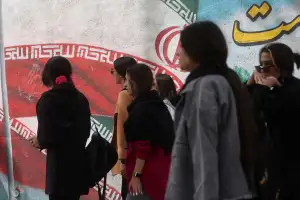
A girl who was just entering adolescence when the Woman, Life, Freedom protests began is now approaching adulthood. The past four years have been part of the period in which her understanding of society, government and freedom has taken shape.
Women burning their headscarves, nighttime chants from apartment windows, protests in schools and universities, young people knocking turbans off clerics’ heads and protesters standing up to security forces all became part of the memories that accompanied that generation into adulthood.
One of the most enduring changes is visible on the streets.
Many women now appear without mandatory hijab in streets, universities, cafes, shopping centers and on public transport. Some ride bicycles and motorcycles without covering their hair.
The Islamic Republic has responded to this defiance with arrests and summonses, warning text messages, vehicle seizures, restrictions on bank accounts and SIM cards, surveillance cameras and the closure of businesses.
Human rights organizations say tens of thousands of women have faced security or judicial action over their clothing during the past four years.
Abandoning mandatory hijab has become one of the clearest forms of collective disobedience to emerge from 2022, continuing in parts of society despite the security and legal costs.
As the fourth anniversary of Amini’s death approached, a coalition of Iranian Kurdish political groups called for a general strike on September 16, urging people to close shops and markets and stay away from work.
From Mahsa Amini’s death to prison and executions
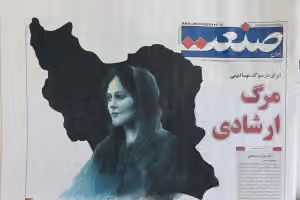
Mahsa “Jina” Amini, a 22-year-old woman from Saqqez in Iran’s Kordestan province was detained by the morality police in Tehran on September 13, 2022. She was taken to hospital and died three days later.
Her gravestone bears the words: “Dear Jina, you will not die. Your name will become a symbol.”
Her father, Amjad Amini, wrote on September 14, ahead of the fourth anniversary of her death, that her name had “gone beyond our small home.”
The family, he said, was still waiting for the truth to emerge.
“The sealed secret that you and all the loved ones resting in this earth carry with you will not remain hidden forever,” he wrote.
Amini’s name quickly became a rallying cry for protests that began in Saqqez and Kordestan, spread to Tehran and then swept across Iran. The Kurdish slogan “Jin, Jiyan, Azadi” and its Persian equivalent, “Woman, Life, Freedom,” became the uprising’s defining chant.
“Death to the dictator,” “This is the final message, the target is the entire system,” “Poverty, corruption, high prices — we will go on until overthrow,” and “Don’t call it a protest, it’s called a revolution” were also heard on the streets, reflecting the political direction the protests had taken.
Supreme Leader Ali Khamenei and the Islamic Republic itself became the direct targets of many of the slogans.
The uprising also quickly became a global cause. Artists, athletes, academics, human rights activists and political figures around the world voiced support, carrying Amini’s name and the slogan Woman, Life, Freedom far beyond Iran’s borders.
The authorities answered the protests with lethal force, widespread injuries and mass arrests.
Human rights organizations have put the number of people killed in the uprising at more than 550. Many more were wounded, while shotgun pellets blinded dozens of protesters in one or both eyes.
Judiciary chief Gholam-Hossein Mohseni-Ejei said in May 2025 that more than 90,000 cases had been opened in connection with the 2022 protests, including cases involving schoolchildren, university students and teachers.
The crackdown continued in the courts after large street gatherings subsided.
Execution, imprisonment, flogging, internal exile, fines, travel bans and restrictions on social rights were among the punishments handed down to protesters and activists linked to the uprising.
Mohsen Shekari, Majidreza Rahnavard, Mohammad Mehdi Karami, Mohammad Hosseini, Saleh Mirhashemi, Saeed Yaghoubi, Majid Kazemi, Milad Zohrevand, Mohammad Ghobadlou, Reza Rasaei, Mojahed Korkor, Mehran Bahramian, Mehrab Abdollazadeh, Abdoljalil Shahbakhsh and Aref Khoshkar were among those executed in cases connected to the 2022 protests.
Others remain at risk of execution.
Among them is Ali Zarei Dozdarehsi, who suffered an eye injury from shotgun pellets during the uprising. After spending time in Germany, he returned to Iran, was arrested and was later sentenced to death by a Revolutionary Court.
Dozens of other protesters have also received death sentences or still have cases under review.
Golrokh Iraee, Nasim Simiyari, Hamid Ghareh-Hassanlou, Farzaneh Ghareh-Hassanlou and Hossein Mohammadi are among hundreds of political prisoners connected to the Woman, Life, Freedom uprising who have faced restrictions in prison, including being denied phone calls, family visits or furlough.
For some, much of the past four years has been spent behind bars, even as Iranian society outside prison has moved through new protests and new changes.
A generation that says ‘We are not going back’
The children and teenagers of 2022 have grown older. Some are now at university, some have entered the workforce and others have left Iran.
What many share is the experience of growing up in a society that lived through one of the most widespread uprisings in the history of the Islamic Republic.
Schools themselves became protest sites in 2022. Students chanted slogans, pulled down images of Islamic Republic officials from classroom walls and girls removed their headscarves.
Universities saw weeks of demonstrations, sit-ins and confrontations with security forces.
For a generation that witnessed those scenes during formative years, politics became tied to the street, the school, the university and everyday life.
German-American political thinker Hannah Arendt linked freedom to the human capacity to begin something new. In her thought, political action emerges among others in the public sphere, and revolutions are among the moments when the possibility of a “new beginning” becomes visible.
For the teenagers of 2022, an experience of that kind unfolded on a mass scale before their eyes: people who often did not know one another chanted the same slogans, supported each other and joined collective action in schools, universities, neighborhoods and streets.
Four years later, this generation lives in a society where repression continues. But the experience of 2022 has not been erased from its political memory.
What Woman, Life, Freedom gave the protests that followed
The 2022 uprising did not topple the Islamic Republic, but it changed the language and horizons of protest.
Woman, Life, Freedom entered Iran’s political vocabulary alongside slogans calling for the overthrow and end of the Islamic Republic.
Women stood at the center of a nationwide uprising. School students emerged as a visible force in protest, and acts of disobedience moved from demonstrations into everyday life.
Some of the behaviors that took shape during those months continued in the years that followed.
Rosa Luxemburg, the Marxist revolutionary and theorist, viewed the defeats of revolutionary movements as links in a historical chain that could help prepare the ground for future victories.
After the failed January 1919 uprising in Berlin, she treated the experience and political understanding gained through defeat as part of a revolutionary movement’s accumulated strength.
The protests that followed 2022 began from a point that Woman, Life, Freedom had already reached. Opposition to the Islamic Republic as a whole, and demands for its overthrow, remained present in later protest slogans.
January 2026 offered one of the clearest examples.
Protests that began over economic grievances rapidly spread across the country, with political slogans against the Islamic Republic becoming a major feature.
Estimates of those killed ranged from the government’s official figure of 3,117 to more than 36,500 in Iran International’s reporting. Tens of thousands were wounded, while around 100,000 people were arrested, summoned or interrogated.
For the generation that had experienced 2022, January 2026 became a second encounter with a nationwide uprising and a bloody crackdown within only a few years.
A generation carrying the memory of several generations
Iran’s teenagers and young adults now stand at the end of a much longer history of protest and repression: women’s protests against compulsory hijab in March 1979, the executions of the 1980s, the July 1999 university dormitory crackdown, the 2009 Green Movement, the protests of January 2018 and the bloody November 2019 crackdown.
Many learned about those events through their families, photographs, books and news reports.
Woman, Life, Freedom and the January 2026 protests, however, belong to their own lived experience.
That distinction has helped shape this generation’s political memory.
Images of protesting women, schoolgirls, young people in the streets, families demanding justice and political prisoners now sit alongside images of those killed, wounded and executed.
A girl who was just entering adolescence in September 2022 is now approaching adulthood carrying memories of Amini, protest, repression and disobedience — memories now layered alongside the stories earlier generations carried from March 1979, the 1980s, July 1999, the Green Movement and November 2019.
Four years after Amini’s death, Woman, Life, Freedom remains part of this generation’s memory: in the school and the street, in experiences of repression and defiance, and in the picture of freedom and Iran’s future that it carries into adulthood.
Above all, this generation has seen that the path to political change in Iran runs through the street, collective action and effective organization.