• العربية
  • فارسی
Brand
  • Iran Insight
  • Politics
  • Economy
  • Analysis
  • Special Report
  • Opinion
  • Podcast
  • Live TV
  • Iran Insight
  • Politics
  • Economy
  • Analysis
  • Special Report
  • Opinion
  • Podcast
  • Live TV
  • Theme
  • Language
    • العربية
    • فارسی
  • Iran Insight
  • Politics
  • Economy
  • Analysis
  • Special Report
  • Opinion
  • Podcast
  • Live TV
All rights reserved for Volant Media UK Limited
volant media logo

Iran’s strait authority lists 77 vessels accused of violations

Sep 14, 2026, 10:15 GMT+1

Iran’s Persian Gulf Strait Authority published an updated list of 77 vessels it accused of violating Iranian protocols for the Strait of Hormuz.

The authority had warned that the listed vessels could face restrictions on future passage, including fines, detention or confiscation.

It also said vessels cooperating with those on the list would be added to it and warned maritime service providers against assisting them.

Most Viewed

Blogger sentenced to death in Iran on security-related charges
1

Blogger sentenced to death in Iran on security-related charges

2

Mideast oil flows recover while Iran exports vanish, tracker says

3

Iraqi groups deny Saudi pipeline strike, say ‘would be proud if we did it’

4

Iranians buy bread on credit, queue for chicken scraps

5

Trump says Iran likely behind Saudi pipeline attack

Banner
Banner
Banner

Spotlight

  • Rushed trials, public hangings: Iran courts race to crush dissent
    INSIGHT

    Rushed trials, public hangings: Iran courts race to crush dissent

  • Israeli envoy says no victory until Islamic Republic falls

    Israeli envoy says no victory until Islamic Republic falls

  • Russia may fill Iran gap if support for Yemen Houthis falters
    ANALYSIS

    Russia may fill Iran gap if support for Yemen Houthis falters

  • Bid to oust Pezeshkian exposes rift among Iran conservatives
    INSIGHT

    Bid to oust Pezeshkian exposes rift among Iran conservatives

  • Iran’s hardliners bet on escalation as options narrow
    ANALYSIS

    Iran’s hardliners bet on escalation as options narrow

•
•
•

More Stories

Iranians say basic food slipping beyond reach as bread prices soar

Sep 14, 2026, 10:06 GMT+1
100%
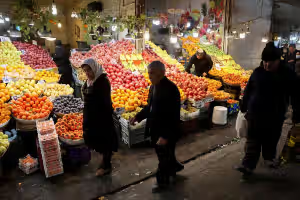
Shoppers walk through a crowded bazaar in Iran.

Iranians are struggling to afford basic food as bread prices rise sharply and citizens describe soaring costs for vegetables, snacks and other everyday purchases, according to an local media report and messages sent to Iran International on Monday.

Bread prices in the Iranian capital have risen sharply without official authorization, putting even bread and cheese beyond the means of some workers, labor-focused ILNA news agency reported.

“Things are very bad with bread, and the unofficial increase in bread prices has become staggering. There was a time when a worker could at least count on bread and cheese, but today they can no longer afford even that,” Ali Torkashvand, executive secretary of the Workers’ House, told ILNA.

The pressure comes as Iran’s official minimum wage stands at about 166.3 million rials per month, equivalent to roughly $72 at the open-market exchange rate.

  • Iran is living through America’s 2022 inflation shock almost every month

    Iran is living through America’s 2022 inflation shock almost every month

Messages sent separately to Iran International describe sharp increases across basic food and household purchases. One citizen said several kilograms of vegetables had cost 25 million rials, equivalent to about 15% of the monthly minimum wage.

“Damn the Islamic Republic for making people suffer this much. We really can’t afford to buy anything anymore,” the citizen said.

A packet of meat-flavored instant noodles cost 900,000 rials, another citizen said.

“I bought a few food and hygiene products and it came to 20 million rials,” another citizen told Iran International, a sum equivalent to about 12% of the monthly minimum wage.

Bread moves beyond reach

ILNA linked the rising cost of essentials to repeated currency depreciation and increases in energy prices, saying shocks to fuel and foreign-exchange costs feed through to food, medicine, housing and other necessities.

Wages and pension payments had failed to keep pace with rising prices, leaving workers struggling to meet basic household expenses, Torkashvand said.

The latest pressure follows the government’s decision to double Iran’s third-tier gasoline price to 100,000 rials per liter from September 8.

Higher gasoline prices could drive up the cost of other goods and services through increased transportation and production expenses, Torkashvand said.

Iran’s economy has come under mounting pressure from international sanctions and restrictions on trade and finance, the economic fallout from war and US efforts to block Iranian oil exports and other revenue streams, alongside declining investment and domestic economic mismanagement.

Workers were struggling with rising prices even before the latest gasoline increase, Ali Zamiri, a labor activist, told ILNA.

“Under the present circumstances, there is no longer any clear order or pattern to prices, while workers’ incomes have not changed in line with these rising costs,” Zamiri said.

Food prices outpace wages

Prices for some staples have risen far faster than overall inflation, with rice increasing by more than 200% and cooking oil by more than 300%, Majid Rahmati, a member of Tehran province’s Islamic Labor Councils board, told ILNA.

Rahmati called for increased food subsidies and higher wages and benefits during the second half of the Iranian year to offset some of the loss in purchasing power.

  • Iranians buy bread on credit, queue for chicken scraps

    Iranians buy bread on credit, queue for chicken scraps

The strain has also forced some families to seek credit for basic food. ILNA reported on Sunday that people in poorer areas of Tehran were asking neighborhood stores to let them buy groceries, meat, prepared meals and even bread on credit.

Shopkeepers themselves were finding it increasingly difficult to continue extending credit as their own costs rose, according to ILNA.

Hormuz diplomacy stalls as attacks deepen pressure on Persian Gulf oil routes

Sep 14, 2026, 00:40 GMT+1
100%
Vessels transit the Strait of Hormuz in an image published by ISNA on September 9, 2026.

Hormuz diplomacy hit a fresh setback Sunday as Oman postponed talks between Iran and Persian Gulf states, while attacks on shipping and Saudi energy infrastructure raised pressure on key regional oil routes.

The postponement came as Washington and Tehran hardened their positions over what any future negotiations should cover. The Trump administration wants talks with Iran focused on Tehran’s nuclear program rather than reopening the Strait of Hormuz, CNN reported, citing three sources familiar with the matter.

Iran, meanwhile, has signaled that it would consider nuclear negotiations only after the dispute over the strait is resolved, including the lifting of the US naval blockade.

Omani Foreign Minister Badr Albusaidi said the meeting planned for Monday in Salalah had been postponed “in the interests of consensus.” Iran’s IRGC-affiliated Fars News later reported that Tehran and Muscat had jointly agreed to the delay at the request of some regional countries.

Saudi Arabia had submitted amendments to the Omani-Iranian proposal over concerns that its wording could establish a new status quo in the strait unacceptable to Riyadh and other GCC states, Axios reported Sunday, citing a senior regional official.

The disagreements have emerged despite a flurry of regional diplomacy. Qatar’s prime minister and Oman’s foreign minister discussed efforts toward a solution guaranteeing freedom of maritime navigation, while the foreign ministers of Kuwait and Saudi Arabia also discussed ensuring the safety and freedom of shipping through Hormuz.

US blockade remains in force

The United States has continued to tighten its maritime pressure on Iran even as regional states search for a diplomatic arrangement.

US Central Command said Sunday that American forces had redirected 101 commercial vessels to ensure compliance with the blockade against Iran, up from 100 a day earlier.

US officials told CNN they believe American forces currently have the military upper hand in the strait, but questions remain over how long Washington can sustain the large-scale escort and naval operation.

Iranian Foreign Minister Abbas Araghchi has said an agreement with Oman on shipping arrangements would not itself reopen the strait, insisting that reopening depends on Washington meeting Tehran’s demands.

President Donald Trump, meanwhile, said Sunday that Iran “wants to make a deal so badly” and suggested the war could end before or shortly after the US midterm elections.

Vessel strike adds to Hormuz risks

Security risks around the strait also intensified on Sunday after an Iranian commercial container ship was struck by an unidentified projectile near Hengam Island, off Qeshm.

Iranian authorities said one crew member was killed and four others wounded. UK Maritime Trade Operations separately reported a vessel struck by an unknown projectile in the Strait of Hormuz, followed by a fire and crew evacuation, though it was not officially confirmed that the two reports concerned the same vessel.

Several explosions of unknown origin were also reported later Sunday in Sirik, in southern Hormozgan province, according to Iranian state media.

Saudi oil route under pressure

The pressure on Hormuz has become more acute for Saudi Arabia after drone attacks forced it to shut its East-West oil pipeline, a critical route carrying crude from the kingdom’s eastern oilfields to the Red Sea.

The pipeline had been transporting around 4 million barrels per day and allowed Riyadh to bypass the disruption in Hormuz. Reuters reported that stocks at the Red Sea port of Yanbu may be sufficient to sustain exports for only five to seven days if the pipeline remains shut, after which as much as 4% of global oil supply could be at risk.

Oil prices rose sharply as markets reopened, with Brent climbing above $108 a barrel after fresh attacks on Saudi Arabia and shipping in the Persian Gulf.

The Iraqi government has meanwhile stepped up security measures after Saudi Arabia said drones used in the pipeline attack were launched from Iraqi territory. Baghdad has begun reopening several border crossings with Iran after temporary closures and security reviews, with commercial traffic through Shalamcheh expected to resume Monday.

Houthis tighten pressure at Bab el-Mandeb

Saudi Arabia is also facing growing pressure on its western flank as Yemen’s Iran-aligned Houthis expand their position around Bab el-Mandeb, the narrow waterway linking the Red Sea to the Gulf of Aden.

The Houthi advance along Yemen’s Red Sea coast has raised fears that Saudi oil exports diverted away from Hormuz could face disruption at a second chokepoint. The US Navy has remained on high alert as the Houthis move closer to Bab el-Mandeb.

The Houthis said Sunday that four commanders of Saudi-backed Yemeni forces were killed and five others wounded in operations near Bab al-Mandab, according to the group-run Saba news agency.

The combination of pressure at Hormuz, attacks on Saudi infrastructure and Houthi gains near Bab el-Mandeb is narrowing the region’s alternatives at a time when diplomatic efforts remain divided over the terms of any maritime settlement.

With the Oman meeting now postponed and Washington and Tehran publicly at odds over the agenda for negotiations, there is no clear timetable for a diplomatic breakthrough even as the economic and military costs of the conflict continue to rise.

Foreign investment in Iran hits zero after war

Sep 13, 2026, 20:55 GMT+1
•
Dalga Khatinoglu
100%
A view from Bushehr port in southern Iran

Foreign investment in Iran has effectively come to a halt following the war with Israel and the United States, with no new foreign investment recorded so far this Iranian year, a senior industry ministry figure said.

No foreign investment has been made so far in the current Iranian calendar year, which began on March 21, Tahmoures Lahouti, Deputy Industry Minister and head of Iran’s Small Industries and Industrial Parks Organization, told the Iranian Labor News Agency (ILNA).

“Given the sanctions and restrictions in place, foreign investment is not taking place,” Lahouti said.

Domestic investment in industrial development has also declined compared with last year, with exchange-rate volatility, inflation and weakening household purchasing power weighing on businesses, Lahouti added.

The Iranian year began about three weeks after Israel and the United States launched military operations against the Islamic Republic on February 28.

Lahouti did not provide figures for the decline in domestic investment or specify whether his assessment of foreign investment covered all sectors of the Iranian economy.

The rial has lost roughly 60% of its value against the US dollar since the beginning of the Iranian year, increasing the cost of imported equipment and other inputs for businesses. High inflation and uncertainty over future prices have further complicated long-term investment decisions.

Industrial employment declines

The deterioration in investment has coincided with significant job losses in industry.

About 630,000 industrial jobs were lost in the first quarter of the current Iranian year compared with the same period a year earlier, according to figures from Iran’s Statistical Center.

Separate labor-market data have also shown a sharp decline in the number of workers making social-security contributions.

The contraction adds to longer-running problems facing Iranian manufacturers, including sanctions, restrictions on international banking, inflation, currency depreciation and recurring energy shortages.

Foreign investment falls as capital outflows surge

Data from the United Nations Conference on Trade and Development (UNCTAD)shows that Iran was already struggling to attract foreign direct investment well before the war.

  • 100 days after carnage: Iran economy reels from war, inflation, unemployment

    100 days after carnage: Iran economy reels from war, inflation, unemployment

In 2016 and 2017, following the implementation of the nuclear deal and the temporary easing of international restrictions, Iran attracted an average of about $4.2 billion in foreign direct investment (FDI) annually. After the United States withdrew from the nuclear deal and reimposed sanctions in 2018, the trend reversed, with annual FDI subsequently falling to around $1.5 billion.

At the same time, Central Bank data point to a sharp increase in capital outflows. Iran’s capital-account deficit widened from $6.77 billion in 2017 to $19.62 billion in 2025, nearly tripling over the period.

Overall, Iran attracted about $12.7 billion in foreign direct investment between 2018 and the end of 2025, while cumulative capital-account deficits approached $120 billion over the same period.

The gap illustrates that Iran’s problem extends beyond its difficulty attracting foreign capital. The country is also recording substantial capital outflows.

Iran falls further behind regional rivals

UNCTAD data for 2025 show the scale of the investment gap between Iran and some of its regional competitors.

Saudi Arabia attracted $32.6 billion in foreign direct investment last year, while the United Arab Emirates received about $48.2 billion.

The figures underscore Iran’s difficulty competing for foreign capital after years of sanctions and restrictions on international banking and trade.

Lahouti’s comments show that those constraints have now choked off an already limited flow of foreign investment. At the same time, depreciation of the rial, inflation, economic uncertainty and persistent capital outflows have made it more difficult for domestic investors to fill the gap.

  • Iran’s economy is a powder keg. Tehran is preparing for the spark

    Iran’s economy is a powder keg. Tehran is preparing for the spark

Foreign investment falling to zero this year is therefore part of a longer trend. Iran was struggling to attract foreign capital well before the latest war, while substantial capital outflows added to the pressure on investment at home.

Eight women face execution in Iran, rights group warns

Sep 13, 2026, 18:18 GMT+1
100%
(L-R) Pakhshan Azizi, Arghavan Fallahi, Sevda (Marzieh) Ebrahimi Shamsabadi, Taraneh Rahimi, Leila Abolhasani, and Zahra Shahbaz Tabari.

At least eight women are facing death sentences in prisons across Iran, including four in cases linked to the nationwide January protests, the US-based Human Rights Activists News Agency (HRANA) rights group reported on Sunday.

HRANA said the women had been sentenced in separate political, security and protest-related cases on charges including “armed rebellion,” “enmity against God” and “corruption on earth,” offenses that can carry the death penalty under Iran’s Islamic penal code.

The cases were heard by branches of the Revolutionary Courts in Tehran, Isfahan, Rasht and Bandar Abbas, the group said.

The death sentences of Pakhshan Azizi and Arghavan Fallahi have been upheld by Iran’s Supreme Court, according to HRANA.

Azizi, who is being held in Tehran’s Evin Prison, was arrested in August 2023 and sentenced to death the following year on a charge of “armed rebellion through membership in groups opposed to the country,” HRANA said. Her requests for a retrial have since been rejected.

Fallahi, also held in Evin, was arrested in Tehran in February 2025 and later sentenced to death on a charge of “armed rebellion through membership in groups opposed to the government and armed action.” Her sentence was upheld by the Supreme Court in August, HRANA said.

A third woman, 68-year-old Zahra Shahbaz Tabari, was sentenced to death for a second time after the Supreme Court overturned an earlier death sentence and ordered a retrial. She was convicted of “armed rebellion through membership and activity in an opposition group” and is being held in Lakan Prison in the northern city of Rasht, according to HRANA.

Four other women — Maryam Hadavand, Mahnaz Chardouli, Leila Abolhasani and Taraneh Rahimi — were sentenced to death in cases connected to the nationwide protests that erupted in January, the rights group said.

Hadavand, 45 and a mother of two, was arrested in connection with events in Pakdasht, southeast of Tehran, on Jan. 8 and sentenced to death on charges including allegedly participating in the killing of two Basij members, deliberately setting fire to a religious site, damaging public property and assembly and collusion against national security, according to HRANA.

Chardouli, held in Qarchak Prison, was tried on charges including “attacking a mosque with a Molotov cocktail,” “participating in gatherings” and “assembly and collusion,” HRANA said.

A Revolutionary Court in Isfahan sentenced Abolhasani, a mother of two teenage daughters, to death on a charge of “enmity against God” after her arrest during protests in Shahin Shahr on Jan. 8. HRANA said a source close to her family had previously said the case stemmed from her presence at and filming of a fire at a shop, while judicial authorities accused her of involvement in the blaze.

Taraneh Rahimi was among 10 defendants sentenced to death and 11 years in prison in a case involving 16 people arrested over the January protests in Isfahan, known as the “Isfahan Shohada Square” case. The defendants were each sentenced to death and 11 years in prison on charges including “enmity against God through carrying a bladed weapon,” destruction of public property and assembly and collusion, the group said.

The eighth woman, 32-year-old Sevda, also known as Marzieh Ebrahimi Shamsabadi, was sentenced to death in Bandar Abbas on a charge of “corruption on earth” in a case HRANA said was linked to security developments during the war.

She also faced accusations including insulting Iran’s Supreme Leader, conducting media activity deemed contrary to national security, carrying out intelligence activity for hostile governments and photographing a military site and sending images to Persian-language media abroad.

HRANA said five of the eight cases were still at the initial trial or appeal stages.

The group also highlighted the case of Bita Hemmati, who had been sentenced to death in connection with the January protests before the Supreme Court overturned the sentence in June and ordered a retrial. HRANA said the outcome of the new proceedings remained unclear.

Separately, Varisheh Moradi, who had been sentenced to death on a charge of “baghi,” or armed rebellion, over alleged membership in an opposition group, had her sentence overturned by the Supreme Court in December 2025 and was granted a retrial. Her case remains unresolved.

Iran court sentences January protest detainee to death, rights group says

Sep 13, 2026, 16:31 GMT+1
100%
Crowds gather during protests in Mashhad, northeastern Iran, Jan. 8, 2026.

An Iranian court has handed down a death sentence to a man detained in connection with the January 2026 protests in the northeastern city of Shandiz, the US-based Human Rights Activists News Agency (HRANA) reported on Sunday.

Hossein Rasouli-Nasab was sentenced by the Mashhad Revolutionary Court on charges including “moharebeh,” or waging war against God, HRANA said.

The rights group said authorities had alleged that he committed moharebeh through participation in the destruction of public property and setting fire to religious centers. He was also accused of assembly and collusion against national security.

A source close to his family told HRANA that a mosque and a Quranic center caught fire during protests in Shandiz on January 8 and 9, and that Rasouli-Nasab’s case was opened in connection with those events.

Rasouli-Nasab was arrested during the January protests along with several other people, HRANA said. He was later transferred to Vakilabad Prison in Mashhad, where he remains held.

His case comes amid mounting concern from rights groups over the use of the death penalty against people detained in connection with the nationwide protests.

Human Rights Watch and the Abdorrahman Boroumand Center said in a joint report published on September 10 that Iranian authorities announced the executions of 29 people arrested in connection with the December 2025-January 2026 protests between March 18 and the end of August. Several were 18 or 19 years old, and five were executed in public.

The groups said that in 16 of those cases authorities did not allege that the defendants had killed anyone. Instead, some were executed over allegations including blocking streets, damaging public property and other acts that rights groups said did not meet the threshold for capital punishment under international law.

Human Rights Watch said the proceedings were often extremely fast, in some protest-related cases taking just over five weeks from arrest to execution, and said convictions were based in some cases on torture-tainted confessions and vague national security charges.

Amnesty International has separately accused Iranian authorities of “weaponizing the death penalty to repress dissent.”

Last week, Iran International reported that 18 prisoners held at Dastgerd prison in the central Iranian city of Isfahan were facing possible death sentences over unrest and a fire at the facility.

Last month, UN human rights chief Volker Türk said executions and death sentences in Iran had risen since March, with more than 100 other people facing similar charges and the death penalty.