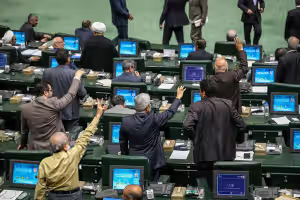
UN Security Council holds briefing on Iran sanctions

The UN Security Council on Thursday held a briefing on the committee overseeing UN sanctions on Iran’s nuclear and ballistic missile programs, which France, Germany and the United Kingdom moved to restore in August 2025 by triggering the nuclear deal’s snapback mechanism.
No formal committee report was presented at the meeting because China and Russia opposed its adoption and reject the legal validity of the snapback mechanism.
The committee was established under Resolution 1737 in 2006 and was required to report to the council every 90 days. Its work became defunct after the 2015 nuclear deal suspended earlier UN sanctions resolutions on Iran.
Russia’s representative, Anna Evstigneeva, said there were “no grounds” for the committee to resume its work and argued that Resolution 2231 expired on October 18, 2025.
“The Russian Federation is against this briefing,” she said, requesting a procedural vote on adopting the agenda.
China’s representative also said there was no basis for resuming the committee’s activities, while Britain said six Security Council resolutions on Iran, including Resolution 1737, had been back in force for nearly a year.
The US representative said Resolution 1737 and subsequent resolutions required quarterly reports from the committee, but that obstruction by China and Russia prevented one from being presented.
Bahrain’s representative condemned Iran’s attacks on Arab countries and ships and expressed support for diplomatic efforts to resolve Iran’s nuclear file, reduce tensions and strengthen regional security.



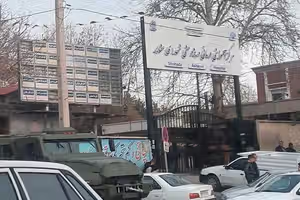
Mohammad-Sadegh Motamedian did not identify which institutions were using the schools or disclose how many educational facilities had yet to be returned to the Education Ministry.
“These educational spaces must be handed over to the Education Ministry before the start of the school year, and where there are challenges, the relevant institution should inform the province so alternative space can be provided and the issue resolved,” Motamedian said.
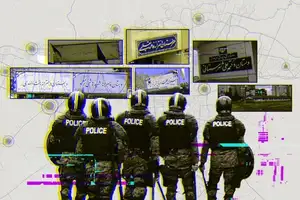
The Revolutionary Guards, Basij paramilitary force and police used schools to station personnel during and after the war.
Dozens of schools used during war
An Iran International investigation published in March found that security and military forces moved personnel, weapons and equipment into at least 70 civilian sites across 17 provinces during the US-Israeli strikes from March 2 to 14.
Nearly half of the locations – 34 – were primary or secondary schools. Other sites included hospitals, stadiums, universities, mosques, parks and government offices.
Footage from several cities showed security vehicles, personnel or military equipment on school grounds.
‘Schools offered greater security’
Journalist Ali Hossein Ghazizadeh said schools offered forces large courtyards, numerous rooms and locations among residential buildings at a time when military bases were being targeted.
“Being in schools provides greater security for them,” Ghazizadeh told.
Schools were particularly useful for relocating personnel after bases and other facilities were struck, and their location among civilian buildings provided additional protection, Ghazizadeh said.
The use of educational facilities did not necessarily end with the fighting, Ghazizadeh said, adding that Iran International had received information indicating that some institutions sought to retain schools for longer-term use.
Civilian protection concerns
Schools are generally protected as civilian objects under international humanitarian law but can lose that protection if their use makes them military objectives. Attacking forces remain bound by rules including distinction, proportionality and precautions to limit civilian harm.
Iranian officials have denied using civilians as shields and accused Israel of targeting civilian infrastructure during the conflict.
The Israeli military confirmed to Iran International in March that it had identified Iranian forces deploying personnel and weapons at civilian sites, including schools, mosques and stadiums.
The Houthi advance, the prospect of a protracted US-Iran conflict and renewed international pressure over Tehran’s nuclear program emerged as the three most consequential developments of the day, pointing to a war expanding geographically, placing sustained pressure on US military resources and further threatening global energy supplies.
Three Yemeni government sources told Reuters that the Houthis had taken control of Mocha, a strategically located city on Yemen’s Red Sea coast near the Bab al-Mandab strait, one of the world’s most important shipping routes.
The capture marked a significant territorial advance by the group, which already controls Yemen’s capital, Sanaa, and some of the country’s populous north. It followed a new series of Houthi missile and drone attacks against Saudi Arabia, bringing another major US ally more directly into the conflict.
The Saudi-led coalition said the Houthis attacked Khamis Mushait, Abha and Jazan on Wednesday using ballistic missiles and drones. Saudi authorities issued an early warning in Khamis Mushait on Thursday morning before later announcing that the danger had passed.
Major General Turki al-Maliki, the coalition’s spokesperson, said the Houthis were continuing their attacks on Saudi “national assets and infrastructure.” He said the coalition would respond “responsibly” in defense of Saudi sovereignty, civilians and national resources.
The attacks have also tested the Mecca agreement signed last month by Saudi Arabia, Pakistan and Turkey. Pakistan’s Foreign Ministry described the accord on Thursday as a “defensive alliance” but said there were no plans to expand it.
“There is no such thing under discussion right now,” ministry spokesperson Sajjad Haider Khan said when asked how Islamabad would meet its obligations following the Houthi attacks. “When the time comes, we will act under the agreement.”
Tehran rejected US Secretary of State Marco Rubio’s assertion that Iran was behind the attacks. Iranian Foreign Ministry spokesperson Esmaeil Baghaei said the Houthis, formally known as Ansarallah, made their own decisions.
“Ansarallah is an independent Yemeni actor that makes its own decisions; it takes orders from no one and acts as nobody’s proxy,” Baghaei said.
Rubio had said that the Houthis were “in many ways agents and proxies of the Iranians” and that “behind some of this is clearly the Iranian hand.”
The developments in Yemen unfolded as top US officials privately considered the possibility that the war with Iran could last considerably longer than Trump has suggested publicly.
Vice President JD Vance, Rubio and other senior advisers have discussed with Trump the possibility that Tehran could continue resisting the US naval blockade, sanctions and military pressure through the end of his presidential term and potentially beyond January 2029, the Wall Street Journal reported, citing US officials.
Those assessments contrast sharply with Trump’s public insistence that Iran cannot withstand US pressure much longer. Trump said Wednesday that the war would end “immediately” after November’s congressional elections because Iran “can’t hold out any longer.”
At a Republican event in Dallas, Trump said Iran was “falling apart” and was no longer the dominant power it once was in the Middle East.
“They’ve been the bully of the Middle East for 51 years, and they’re not the bully anymore,” Trump said.
The Journal reported that a prolonged war would strain American military resources and extend disruption to global oil markets. Defense Secretary Pete Hegseth has already extended some US deployments in the Middle East into 2027, while some air-defense units are expected to remain in the region without a firm departure date, according to the report.
The military risks were underlined by reported damage to US aircraft at Muwaffaq Salti Air Base in Jordan following Iranian strikes overnight.
One A-10 Thunderbolt aircraft was left missing a wing and around eight F-15 fighter jets sustained light damage, CBS reported. The F-15s were subsequently returned to service. US forces defending the base launched more than 30 Patriot interceptor missiles during the Iranian attack, according to the report.
Iran said it attacked the base in Jordan as well as US vessels after the United States targeted Iranian oil tankers. US Central Command denied that any American warship had been struck, saying all attempted IRGC attacks against US naval vessels had failed.
The intensifying attacks on military installations, tankers and shipping routes have heightened fears of a prolonged disruption to energy markets.
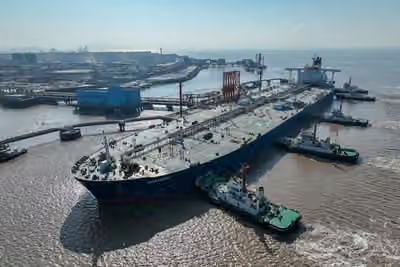
Only seven vessels passed through the Strait of Hormuz on Wednesday, down from 12 the previous day and half the recent daily average of 14, Reuters reported, citing preliminary ship-tracking data. Some vessels may have crossed with their transponders turned off and would not have appeared in the figures.
Meanwhile, Goldman Sachs warned that escalating attacks in the Persian Gulf and Red Sea could drive Brent crude above $120 a barrel, CBS reported.
Trump said oil prices would decline once the United States defeated Iran.
“Oil will be going down as soon as we win the war with Iran, which is taking place right now,” he said.
The third major source of pressure on Tehran came from the International Atomic Energy Agency’s Board of Governors, which reported Iran to the UN Security Council over breaches of its nuclear non-proliferation obligations -the first such action against the country since 2006.
Iranian officials signaled that Tehran could respond by reducing its already limited cooperation with the UN nuclear watchdog.
Iran had the right to adopt “special measures” in response to the resolution and reserved the option of taking any action it deemed necessary, lawmaker Somayeh Rafiei said.
“It is natural for Iran to seek a review and reassessment of any further cooperation with the International Atomic Energy Agency or any other institution in the nuclear field,” said Rafiei, a member of parliament’s presiding board.
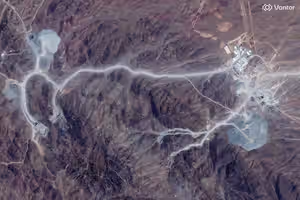
The confrontation over inspections comes amid renewed scrutiny of construction at Pickaxe Mountain, a deeply buried complex near Iran’s Natanz uranium-enrichment facility.
A satellite-imagery analysis by the Center for Strategic and International Studies found a sharp increase in activity at the site during 2026. The work included hardening tunnel entrances, paving internal roads, reinforcing access points and removing soil excavated from inside the mountain.
CSIS said the site appeared to have moved from large-scale excavation toward probable internal construction and further external reinforcement. Its analysts said open-source imagery could neither confirm nor disprove assessments that Iran had transferred centrifuges to the facility.
As diplomatic and military pressure grew, Iran sought to project resilience and signal that it was replenishing its defensive capabilities.
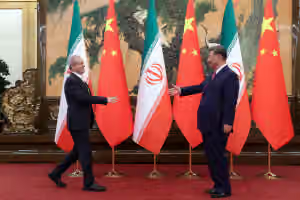
Reuters reported that Tehran routed an estimated $2 billion to $2.5 billion through a China-based trade mechanism during the past year, using proceeds from oil sales to pay for Chinese goods without transferring money through the international banking system.
The barter-like arrangement was used to acquire medicine, vehicles and communications equipment and was also connected to contracts worth millions of dollars for Chinese air-defense equipment, Reuters reported, citing two senior Iranian sources and three other people familiar with the system.
Iran’s Defense Ministry said on Thursday that the country’s military industry remained operational and was “stronger, smarter and more advanced than before.”
“You will soon see a glimpse of the tip of this iceberg,” the ministry said, without identifying the capabilities.
Iranian lawmakers and commanders issued similar warnings. Alireza Salimi, a member of parliament’s presiding board, said Iran possessed “many military surprises” known to the United States.
“If they continue their actions, we will make them regret it,” Salimi said.
The combination of expanding Houthi operations, preparations in Washington for a potentially multiyear conflict and mounting confrontation over Iran’s nuclear program suggested little immediate prospect of de-escalation.
With fighting spreading across the Red Sea, and the Persian Gulf, the risks increasingly extend beyond the direct confrontation between Washington and Tehran.
The published notice did not explain what the committee report contained or specify which parts of it the government opposed.
The cabinet took the decision at an August 23 meeting and it was formally communicated on September 8 by Iran's first vice president, IRNA said, citing the country's national database of laws and regulations.
The cabinet named the president's legal affairs office and the presidential office for science, technology and the knowledge-based economy as government representatives in the matter, IRNA said.
Bill has drawn criticism over broad reach
Parliament approved the general principles of legislation on combating foreign infiltration in August by 183 votes to four, but lawmakers have yet to complete consideration of its individual provisions.
A publicly circulated draft would impose new restrictions on contacts with foreign media, universities, embassies and international organizations and give the Intelligence Ministry and the Revolutionary Guards' Intelligence Organization roles in identifying prohibited foreign links.
Some provisions would restrict sharing information with foreign institutions and certain forms of academic, cultural and civil-society cooperation.
Critics in Iran have warned that the broad wording could expose journalists, academics, researchers and other citizens to prosecution.
The notice did not say whether the cabinet opposed the legislation as a whole or only aspects of the parliamentary committee's report.
Pezeshkian government had raised rights concerns
The decision follows earlier public opposition from President Masoud Pezeshkian's administration. Vice President for Legal Affairs Majid Ansari said in August that the proposal conflicted with constitutional protections for citizens' rights and individual freedoms and would sharply restrict academic contacts with institutions abroad.
"If every type of contact and communication faces restrictions and is criminalized by law, naturally they will prefer to migrate and carry out their scientific and research activities in a free environment," Ansari said, warning that the measure could drive more Iranian researchers, doctors and academics to leave the country.
“Despite all these surgeries, I am still confined to my home,” the protester, whose identity and place of residence are being withheld for security reasons, told Iran International. “I am married, and during this time we have faced many problems paying for my treatment.”
His family eventually sold their car to help cover his medical bills, the protester said. Doctors have told him that regaining the ability to walk could take at least another year.
The account reflects the prolonged physical and financial consequences facing some people wounded during the protests, with Iran International receiving multiple accounts of injured demonstrators struggling to obtain treatment and pay medical expenses months later.
23 operations and more treatment ahead
The gunshot caused extensive damage to the protester’s leg, requiring doctors to perform muscle and skin grafts during a series of operations.
“About a month has passed since the skin graft, and the Ilizarov device that was fitted to my leg at the beginning of treatment is due to be put back on for about three months,” the protester said.
An Ilizarov apparatus is an external bone-fixation system using metal rings, rods and wires to gradually reposition sections of bone. It can be used to treat severe damage or the loss of part of a bone.
Doctors also attached a vacuum-assisted device to the wound for several months to promote new tissue growth, the protester said.
Infection, nerve damage and numbness later forced doctors to remove some of the repaired tissue and perform a muscle graft about six months after the shooting, according to the protester.
“I asked people who were able to help, but in the end, with great difficulty and even by selling our car, we tried to cover the costs,” he said.
Security fears complicate hospital treatment
Fear of arrest or identification at hospitals has complicated treatment for some protesters wounded during demonstrations, prompting some to seek medical care covertly or at home.
“After one of the surgeries, because there were many security officers in the emergency department, the doctor helped me leave the hospital,” the protester said.
Hospital staff recorded the cause of his injuries as a traffic accident, and his doctor later helped take him to Tehran to continue undergoing surgery, the protester said.
“I really do not know how to thank the medical staff,” he added. “They cooperated extensively and tried to make sure nothing else happened to me.”
Protester recounts January 8 shooting
Security forces initially fired pellets toward demonstrators before a live round struck his leg at close range on the evening of January 8, the protester said.
“My whole body is covered with pellet marks. The bullet hit my leg from close range,” he said. “When I was shot, they dragged me along the ground while I was in a very bad condition. I will never forget that night.”
Security personnel insulted him and tried to remove his clothing after he was wounded, according to his account.
“I held tightly onto my trousers, and they struck my hands with their boots,” he said. “My entire body was bruised, and I even thought my ribs were broken.”
The officers then put him on a motorcycle, the protester said.
“One of them said, ‘Don’t hit him here, take him farther up,’” he said. “I thought they meant they were going to finish me off. I passed out from fear.”
The protester said he regained consciousness alone in a dark alley, where an elderly couple found him and helped him reach a hospital.
“At first, I thought I was dead,” he said. “Then an elderly woman and man found me. They were like angels to me and helped me get to the hospital.”
The protester said he had joined the demonstrations knowing that doing so could put his life at risk.
“That night, I went out like many others, and I knew I might lose my life, but for me it was about Iran,” he said.
Six months after the shooting, the protester remains unable to walk, with further procedures ahead and no certainty over when he will regain mobility.