• العربية
  • فارسی
Brand
  • Iran Insight
  • Politics
  • Economy
  • Analysis
  • Special Report
  • Opinion
  • Podcast
  • Live TV
  • Iran Insight
  • Politics
  • Economy
  • Analysis
  • Special Report
  • Opinion
  • Podcast
  • Live TV
  • Theme
  • Language
    • العربية
    • فارسی
  • Iran Insight
  • Politics
  • Economy
  • Analysis
  • Special Report
  • Opinion
  • Podcast
  • Live TV
All rights reserved for Volant Media UK Limited
volant media logo

Bessent welcomes EU joining US-led Operation Economic Outcast

Sep 4, 2026, 01:04 GMT+1

Treasury Secretary Scott Bessent welcomed the European Union’s decision to join the US-led Operation Economic Outcast against Iran on Thursday, praising its “strong and early stance.”

“The European Union has officially joined Operation Economic Outcast,” Bessent wrote in a post on X.

Bessent also shared an EU statement issued in the context of the G20 finance ministers and central bank governors meetings, in which the bloc welcomed additional economic pressure on Iran, including through the US-led operation.

Most Viewed

Iranians to Trump: This time you fight, help is on its way
1
VOICES FROM IRAN

Iranians to Trump: This time you fight, help is on its way

2
EXCLUSIVE

US crackdown leaves much of Iran’s shadow banking untouched

3
ANALYSIS

Iran’s economy is a powder keg. Tehran is preparing for the spark

4

Canada awarded contracts to Iran ex-VP’s son despite security probe - Global News

5

Iran drug shortages hit 800 medicines as costs could triple

Banner
Banner
Banner

Spotlight

  • US strikes deepen Tehran debate over compromise or confrontation
    INSIGHT

    US strikes deepen Tehran debate over compromise or confrontation

  • Xi snub reignites Iran’s doubts about China
    INSIGHT

    Xi snub reignites Iran’s doubts about China

  • Trump’s call for an Iranian uprising runs into a trust problem
    ANALYSIS

    Trump’s call for an Iranian uprising runs into a trust problem

  • Five years ago, Iran’s planners put today’s crisis on paper
    INSIGHT

    Five years ago, Iran’s planners put today’s crisis on paper

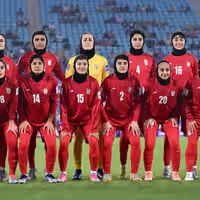
  • Women footballers came home under pressure. Now Iran wants them on camera
    ANALYSIS

    Women footballers came home under pressure. Now Iran wants them on camera

  • Iran’s economy is a powder keg. Tehran is preparing for the spark
    ANALYSIS

    Iran’s economy is a powder keg. Tehran is preparing for the spark

  • US military ‘never targets civilians, unlike the IRGC,’ CENTCOM says

    US military ‘never targets civilians, unlike the IRGC,’ CENTCOM says

•
•
•

More Stories

Five years ago, Iran’s planners put today’s crisis on paper

Sep 4, 2026, 00:43 GMT+1
•
Behrouz Turani
100%
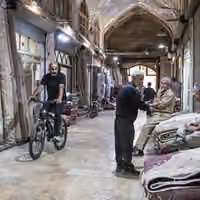
Shopkeepers chat in the carpet section of the Bazaar in Iran's northern city of Qazvin, August, 31, 2026

An economic forecast produced by Iran’s own government planners more than five years ago projected where continued sanctions would leave inflation and the national currency by 2026—and the numbers have proved strikingly accurate.

The model projected inflation of 66% and the dollar at 178,000 tomans in the current Iranian year under a scenario in which sanctions remained in place.

The forecast has resurfaced after Iranian economic journalist Marzieh Mahmoudi highlighted it in a widely shared YouTube video, arguing that successive governments disregarded warnings their own planners had put on paper.

The model was produced by economist Mohammad Hossein Rahmati, then head of the Macroeconomics Office at Iran’s Planning and Budget Organization (PBO).

It projected government revenues and spending, economic growth, inflation, exchange rates and other fiscal indicators through the Iranian year 1406, ending in March 2028.

Best case, worst case

Crucially, it offered policymakers two possible futures: one in which sanctions were lifted and another in which they continued.

Under the continued-sanctions scenario, the model projected the dollar reaching 284,000 tomans in 2027. It now stands at 220,000, having exceeded Rahmati’s 178,000.

Under the alternative scenario, in which sanctions were lifted, Rahmati projected a dramatically stronger rial, with the dollar at around 50,000 to 60,000 tomans by the end of the period.

Several of the projections now bear a striking resemblance to Iran’s economic trajectory, although comparisons are complicated by the multiple exchange rates operating in Iran and the extraordinary volatility of the rial during the war.

In a recent episode of the YouTube-based daily news program Hasht-e Shab (8 PM), Mahmoudi displayed the table and argued that what now looks prescient was politically inconvenient when it first appeared.

The numbers were alarming even in 2021. But rather than treating the projections as a constraint around which policy needed to be built, Mahmoudi said, officials largely sought to distance themselves from them.

‘The dollar sage’

The controversy extended to the Planning and Budget Organization itself. After the table was published and debated in the Iranian press in 2021, the PBO issued a formal denial disputing the forecast attributed to it, despite the model having emerged from its own economic planning apparatus.

The table remains available in the archives of the Iranian Parliament’s Research Center and was also published at the time by Iranian news outlets including Tabnak and Khabar Online.

Rahmati subsequently left his position following disagreements over budget formulation. He became known in Iranian media as “the man of the dollar forecast,” while Mahmoudi argues that his warnings about the fiscal and inflationary consequences of continued sanctions were marginalized rather than acted upon.

The significance of the model goes beyond whether Rahmati correctly guessed the future price of the dollar.

Its two scenarios attempted to show how sanctions would shape Iran’s broader fiscal trajectory. Continued sanctions meant weaker revenues and growth alongside mounting inflationary and exchange-rate pressure, while their removal produced a substantially less damaging outlook.

Five years later, Iran has moved much closer to the former scenario.

Everybody knew

The period covered by Rahmati’s projections has spanned three presidencies—those of Hassan Rouhani, Ebrahim Raisi and Masoud Pezeshkian—and the rial has weakened substantially under each.

The market rate stood at roughly 30,000 tomans to the dollar when Rouhani left office in 2021. It weakened to around 60,000 during Raisi’s presidency before depreciating much more sharply under Pezeshkian amid war, sanctions and mounting fiscal pressure.

The official exchange rate, meanwhile, remained politically managed and increasingly detached from the price at which ordinary Iranians and businesses could obtain dollars.

The result is a trajectory remarkably similar in direction to the one Rahmati’s model warned about more than five years ago, even if individual figures cannot be compared precisely with today’s volatile exchange rates.

Mahmoudi’s central argument is therefore less that one economist successfully predicted the price of the dollar than that Iran’s own economic planners had already modeled the consequences of allowing existing pressures to continue.

Have Iran’s hijab enforcers returned to Tehran streets?

Sep 3, 2026, 20:05 GMT+1
100%
A screengrab from a video of hijab enforcers in Tehran's Grand Bazaar released by Khabar Online

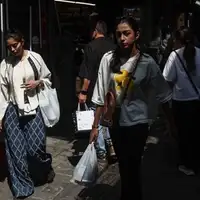
Signs of renewed street-level hijab enforcement have emerged in Tehran and other parts of Iran, including footage of women warning passersby over their clothing, though it remains unclear whether it represents an organized return of hijab patrols.

A video circulating on social media appears to show two women confronting people over hijab in Tehran’s Grand Bazaar. The exact date of the footage has not been established, although the Iranian outlet Khabar Online said it was believed to have been recorded recently.

The women’s faces are not clearly visible. One is wearing a medical mask, while another can be seen carrying a radio communication device that is generally unavailable to ordinary citizens in Iran.

Khabar Online said it was not possible to determine from the footage whether she was wearing police insignia, although parts of her clothing resembled police uniform.

[@portabletext/react] Unknown block type "facebook", specify a component for it in the `components.types` prop

Iran’s police have not publicly commented on the incident.

Tehran City Council chairman Mehdi Chamran said any organized activity of this kind in the capital would normally need to be coordinated with municipal authorities, while adding that he had no information about the specific incident at the Bazaar.

Khabar Online also reported that women involved in enforcing Islamic dress rules had appeared in recent days on the sidelines of a nighttime gathering in at least one neighborhood in northeastern Tehran.

The reports come amid broader signs of renewed campaigning over compulsory hijab.

Khabar Online said online activity on the issue has increased in recent weeks, particularly on the Iranian messaging platform Eitaa and on X. Gatherings have also been held in Qom and in the Miankaleh area of Mazandaran demanding action against women who do not observe compulsory hijab.

During a recent visit by Culture Minister Abbas Salehi to Yazd, some participants also chanted in favor of implementing the Islamic Republic’s stalled Hijab and Chastity Law.

At Tehran’s Iran University of Science and Technology, the Student Basij recently protested the presence of unveiled female students at a meeting attended by the head of Iran’s Student Affairs Organization and an adviser to the science minister.

Taken individually, the incidents do not establish that the Islamic Republic has decided to restore the type of morality-police enforcement that became synonymous with compulsory hijab before the 2022 Woman, Life, Freedom protests.

Together, however, they point to renewed pressure over an issue the authorities have struggled to manage since the death of Mahsa Amini in morality police custody in September 2022.

Women appearing in public without headscarves have since become commonplace in major Iranian cities, making defiance of compulsory hijab one of the most visible social changes to emerge from the protests.

While compulsory hijab remains legally in force, authorities have stopped short of fully restoring the extensive street patrols that existed before 2022.

Frustrated hardliners

That restraint has increasingly frustrated parts of the Islamic Republic’s ideological base, for whom enforcing Islamic dress is not simply a social policy but one of the defining obligations of a state that presents itself as Islamic.

Pressure has also returned to parliament.

After Mohsen Rezaei was appointed secretary of the Supreme National Security Council in August, hardline lawmaker Mohammad-Taghi Naghd-Ali publicly questioned whether the council would continue blocking implementation of the Hijab and Chastity Law.

The tougher legislation had been due to take effect in December 2024 before its rollout was halted amid concerns that enforcement could provoke renewed unrest.

UN human rights experts said at the time that the law represented “an intensification of state control over women’s bodies in Iran” and a further assault on women’s rights and freedoms.

The dispute leaves the Islamic Republic facing competing political risks.

A return to aggressive street enforcement could create another source of public anger at a time of severe economic pressure and continued political repression. But allowing widespread non-compliance to continue carries its own cost with the loyalist constituency on which the system relies during elections, official rallies and periods of political crisis.

For the Islamic Republic’s most committed supporters, the disappearance of compulsory hijab from much of everyday public life can be interpreted less as tactical restraint than as ideological retreat.

That helps explain why the state has neither fully restored the pre-2022 enforcement system nor abandoned compulsory hijab.

Instead, enforcement has remained fragmented. Authorities have continued to use pressure on businesses, universities and individuals while avoiding, at least so far, an unambiguous nationwide return of the old morality-police model.

The latest incidents therefore leave a question that Iranian authorities have yet to answer: whether they represent scattered pressure from hardline activists and individual institutions, or the first signs of a broader return to street-level hijab enforcement.

Iran rights group seeks German probe into crimes against humanity

Sep 3, 2026, 15:28 GMT+1
100%
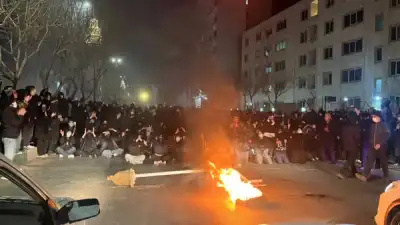
Merchants protest in Tehran in December 2025 as security forces stand nearby.

A rights group has asked German prosecutors to investigate crimes against humanity by Iranian authorities, presenting evidence of thousands of killings and mass detentions during nationwide protests that began in late 2025 and early 2026.

Human Rights Activists in Iran (HRA), supported by legal group UpRights, submitted the request to Germany’s Federal Prosecutor General on August 31, according to an executive summary released Thursday.

The nearly 100-page submission draws on more than 60 interviews with victims, witnesses and relatives, alongside documentary and digital evidence. It identifies 48 suspected perpetrators and examines their positions and links to specific cases and command structures.

HRA said its evidence provided sufficient indications that Iranian state authorities committed acts potentially amounting to crimes against humanity under Germany’s Code of Crimes against International Law.

Thousands killed, rights group says

The protests began on December 28, 2025, with shopkeepers and merchants closing businesses before spreading to at least 203 cities across all 31 provinces, according to HRA.

100%
People gather around burning debris on a street in Iran in during January 2026 protests.

Thousands were killed and arrested or detained during the crackdown, HRA said. Its documented cases include unlawful killings, torture, enforced disappearances, sexual violence, arbitrary detention and forced confessions.

The submission also describes the involvement of the Revolutionary Guards, Basij, Law Enforcement Command, intelligence agencies and the judiciary.

HRA documented what it described as recurring patterns across different parts of Iran, including the use of live ammunition and pellet-firing weapons against protesters and bystanders. It also linked a nationwide communications blackout and the shutdown of street lighting to an escalation in the use of force.

Why Germany

HRA argued Germany is well placed to open a structural investigation because victims and witnesses are already present in Europe and suspected perpetrators could eventually enter or transit German territory.

Iran is not a party to the Rome Statute, leaving the International Criminal Court without jurisdiction over crimes committed inside the country unless jurisdiction is otherwise established, including through a UN Security Council referral.

HRA said a German investigation could therefore provide an avenue for preserving evidence and pursuing accountability over the alleged crimes when jurisdictional opportunities arise.

UN mission urges Iran to drop bill criminalizing foreign contacts

Sep 3, 2026, 13:04 GMT+1
100%
Pedestrians walk along a street in Iran in this undated file photo.

The UN’s fact-finding mission on Iran called for the immediate withdrawal of legislation that could expose Iranians to up to 30 years in prison for contact with foreign individuals and organizations, according to a statement released Thursday.

“We are appalled at the steps by the Government of Iran to subject everyday Iranians to blanket criminalisation for any contact with the outside world when people are already suffering from isolation due to long-standing international sanctions, the Government’s repression of recent protests, the longest ever Internet shutdown, and the US-Israeli airstrikes,” Sara Hossain, chair of the Independent International Fact-Finding Mission on Iran, said.

The draft “Countering Foreign Infiltration” bill would allow cooperation or interaction with designated foreign states, media organizations, academic institutions, human rights defenders and civil society groups to be prosecuted as major security offenses, the mission said.

Broad activities require approval

The legislation would require Iranians to declare and register activities involving foreign agents or nationals and obtain authorization through an online system that prioritizes security considerations from the Ministry of Intelligence and the Intelligence Organization of the Revolutionary Guards.

Publishing books or articles, sharing data and analysis, academic cooperation, interacting with foreign or designated “hostile” media, and operating newspapers or websites could require prior approval.

The requirements would also cover workshops, scientific conferences, artistic festivals and some film, music and visual-arts activities, as well as certain commercial and financial transactions.

“If implemented, this bill would subject all interactions with the outside world to Government control and sanction, the law also would further curtail the rights of citizens, with consequences for commerce, education, freedom of expression and the pursuit of justice among other areas,” mission member Viviana Krsticevic said.

UN contacts could face punishment

The mission warned that the bill could also criminalize communication with its investigators and said punishment for such cooperation would constitute a reprisal.

100%
Students attend a lecture at a university in Iran in this undated file photo.

“Punishing any interaction by Iranians or persons living in Iran with the Mission under this bill constitutes a reprisal and the threat of criminalising such activity is a form of intimidation and oppression,” mission member Max du Plessis said.

The UN Human Rights Council established the mission in 2022 following protests sparked by Mahsa Amini’s death. Its mandate was extended for another two years in January 2026 to investigate allegations of recent and continuing serious human rights violations in Iran.

Iran drug shortages hit 800 medicines as costs could triple

Sep 3, 2026, 11:39 GMT+1
100%
Pharmacy workers arrange medicines at a pharmacy in Iran.

Iran faces shortages of about 800 medicines, including dozens considered vital, as currency constraints and import disruptions threaten to drive some drug costs as much as threefold, Iranian local media reported on Thursday.

Shortages of foreign currency and raw materials, unpaid insurance debts, difficulties transferring money, disrupted imports and rising production costs have increased concerns about the pharmaceutical supply chain, the Iranian news outlet Rouydad24 reported.

“The alternative routes for supplying raw materials and imports are time-consuming and can increase drug costs by up to three times,” Hadi Ahmadi, spokesman for the Iranian Pharmacists Association, told the outlet.

Shortages of raw materials, Ahmadi said, were hindering domestic pharmaceutical production at the same time that imports were facing disruption.

  • Iran’s healthcare crunch forces patients to cut treatment

    Iran’s healthcare crunch forces patients to cut treatment

Rouydad24 described the problem as extending across the pharmaceutical supply chain rather than being confined to individual medicines or pharmacies, leaving patients to absorb higher costs.

Iranian citizens have also told Iran International in recent months that medicine shortages and rising prices have disrupted treatment for many patients. Some said difficulties obtaining conventional medicines had prompted people to turn to traditional medicine.

Domestic production depends on imports

About 99% of medicines by volume are produced domestically, but imports account for roughly 13.86% of the market by value, according to figures cited by the website.

The disparity reflects the pharmaceutical industry's dependence on imported raw materials, equipment and specialized products even when finished medicines are manufactured inside Iran.

Disruptions to foreign-currency transfers or shipments of raw materials can therefore affect factories before shortages become visible in pharmacies weeks or months later.

Iran's Food and Drug Administration has said raw materials and medicines are being moved through alternative routes because wartime conditions have disrupted transportation.

Those routes take longer and cost more, Ahmadi said.

  • Drug prices jump up to 400% as shortages strain Iranian pharmacies

    Drug prices jump up to 400% as shortages strain Iranian pharmacies

Economic pressures have also changed how some Iranians pay for healthcare. Eghtesad News reported in July that installment payments had increasingly spread through the health sector, including for dental treatment and medicines.

Not enough currency

Iran's pharmaceutical sector requires about $2.2 billion in foreign currency for medicines and raw materials this year, but only around half of that amount has been supplied, Ahmadi said.

Changes to Iran's subsidized foreign-exchange system have added another source of pressure on medicine prices.

100%
A pharmacist sorts medicines at a pharmacy in Iran.

The Food and Drug Administration has said a complete removal of subsidized currency for medicines is not planned this year, although the allocation has been reduced for some products, including insulin.

The agency said the changes did not amount to ending subsidized currency for all medicines or necessarily signal a new wave of price increases.

Ahmadi offered a different assessment of the impact on medicines affected by the changes, saying the removal of subsidized currency for some pharmaceutical groups had pushed the cost of their raw materials up more than fivefold within several months.

Iran International reported in July that patients' out-of-pocket costs for insulin had risen more than 24-fold over about 50 days.

Higher prices fuel informal drug market

Shortages are only part of the pressure facing patients because medicines that remain available may become financially inaccessible as prices rise, Rouydad24 reported.

  • Iranians borrow for medicine while state shields Arbaeen healthcare

    Iranians borrow for medicine while state shields Arbaeen healthcare

“If medicine is available on the market but its price increases several times over, for a patient who needs medication every month and permanently, the price increase can effectively be just as problematic as a shortage,” Rouydad24 wrote.

“If insurance cannot increase its contribution in line with price rises, part of the cost will be paid out of the patient’s pocket.”

The combination of shortages, rising prices and inadequate insurance coverage places particular pressure on people with chronic illnesses, older patients and those who depend on expensive or imported medicines, the outlet added.