• العربية
  • فارسی
Brand
  • Iran Insight
  • Politics
  • Economy
  • Analysis
  • Special Report
  • Opinion
  • Podcast
  • Live TV
  • Iran Insight
  • Politics
  • Economy
  • Analysis
  • Special Report
  • Opinion
  • Podcast
  • Live TV
  • Theme
  • Language
    • العربية
    • فارسی
  • Iran Insight
  • Politics
  • Economy
  • Analysis
  • Special Report
  • Opinion
  • Podcast
  • Live TV
All rights reserved for Volant Media UK Limited
volant media logo

US set to broaden scope of Iran secondary sanctions - Reuters

Aug 24, 2026, 13:39 GMT+1Updated: 16:42 GMT+1

The US Treasury is expected to expand secondary sanctions on countries and entities maintaining business ties with Iran as the Trump administration intensifies economic pressure on Tehran, Reuters reported on Monday, citing a source familiar with the plans.

The move is intended as a final warning for countries to sever business ties with Iran and help force an end to the nearly six-month conflict, which has disrupted shipping through the Strait of Hormuz and energy exports from the Persian Gulf, the source said.

Treasury Secretary Scott Bessent is expected to announce details at a 1 p.m. EDT (1700 GMT) news conference and outline the wider pressure campaign that he and President Donald Trump have called an “economic D-Day.”

Bessent is expected to warn countries that they must side with Washington or risk having key companies and entities cut off from the dollar-based financial system, the report said.

Most Viewed

Iran state TV airs threat against Trump’s son Barron
1

Iran state TV airs threat against Trump’s son Barron

2
VOICES FROM IRAN

Iranians voice economic despair as dollar hits 2 million rials

3

Iran security chief hints at nuclear doctrine shift after US attacks

4
PODCAST

Will Iran bend or escalate as US launches economic war?

5

Iran executes another January protest detainee

Banner
Banner
Banner

Spotlight

  • Will Iran bend or escalate as US launches economic war?
    PODCAST

    Will Iran bend or escalate as US launches economic war?

  • Iran leader’s absence gives war camp room to shape policy
    ANALYSIS

    Iran leader’s absence gives war camp room to shape policy

  • Iran's central bank says it is not hyperinflation. Economists are not convinced
    INSIGHT

    Iran's central bank says it is not hyperinflation. Economists are not convinced

  • Ghalibaf's hunger warning sparks hardline backlash over showing weakness
    INSIGHT

    Ghalibaf's hunger warning sparks hardline backlash over showing weakness

  • Iran crude loadings plunge to one-seventh of pre-war level as blockade bites
    ANALYSIS

    Iran crude loadings plunge to one-seventh of pre-war level as blockade bites

•
•
•

More Stories

Nine out of ten shun marriage, parenthood in Iran International poll

Aug 24, 2026, 11:40 GMT+1
100%
An Iranian couple, with the woman wearing a wedding dress, walk along a street in Tehran.

Nine in 10 respondents to an Iran International Instagram poll said they did not want to marry or have children under Iran’s economic, social and political conditions, according to results gathered from about 100,000 participants.

More than 12,000 people also commented on the poll, with financial pressure, job insecurity, housing costs and concerns about children’s futures emerging repeatedly among the reasons given for putting off marriage or parenthood.

Some respondents said they wanted to marry or have children but lacked the financial or social conditions to do so. Others pointed to divorce and unsuccessful marriages as reasons for avoiding marriage.

Men accounted for 68% of respondents and women for 32%. The largest age group was 25 to 34, representing 40.3% of participants, followed by people aged 35 to 44 at 29.2%.

  • Continued decline in Iran's marriage rates despite Supreme Leader's growth push

    Continued decline in Iran's marriage rates despite Supreme Leader's growth push

Respondents aged 18 to 24 made up 13.3%, while those aged 45 to 54 accounted for 9.8%.

Economic pressures weigh on family plans

Many respondents linked their reluctance to start families to the cost of everyday life, according to an examination of comments submitted with the poll.

Some wrote that meeting their own expenses had become difficult enough and that supporting a spouse or child was beyond their financial means. Others said they remained interested in marriage or parenthood but could not afford either.

Iran has faced years of high inflation and a steep decline in the value of its currency, eroding household purchasing power and making housing and other basic costs harder to meet.

The economic strain has been compounded by international sanctions and government policies at home and abroad, with their contribution to Iran’s economic problems a subject of continuing political debate.

Personal experiences of divorce and unsuccessful marriages also appeared repeatedly in the responses. Some participants described marriage under present conditions as a “high-risk decision.”

100%
A man and a woman sit on a bench in Tehran.

Others who were already married said they had decided against having children because of economic and social conditions. Respondents also cited mistrust and difficulty finding a suitable partner.

A smaller number expressed support for marriage or having children.

Parents question children's prospects

Concerns about the conditions in which children would grow up formed another major strand of the responses.

Some said they wanted children but were unwilling to bring them into a society where they feared they could face poverty, inflation, electricity shortages, insecurity and an uncertain future.

A number used much stronger language, describing having children under present circumstances as a “crime” or a “betrayal” of the child because parents could not guarantee an adequate quality of life or future.

Iran faces severe environmental challenges including air pollution, groundwater depletion, forest fires and wider ecosystem degradation. Experts have linked such problems to a combination of poor policymaking, weak environmental protections, corruption and insufficient resources.

Political outlook feeds pessimism

Some respondents connected their decisions directly to Iran’s political and social conditions and their expectations for the country’s future.

Years of economic hardship have coincided with repeated waves of anti-government protests and deadly crackdowns, alongside restrictions on political and social freedoms.

  • Sex work blessed by religion: Inside Iran’s temporary marriage network

    Sex work blessed by religion: Inside Iran’s temporary marriage network

For some participants, those pressures appeared to have turned decisions about marriage and parenthood into a broader judgment about what kind of future is possible in Iran.

The scale and substance of the responses point to a question facing many of them: not simply whether they can afford to build families, but whether they see a future in which they want to do so.

He spent a decade helping vulnerable children. Iran handed him 31 years

Aug 24, 2026, 05:03 GMT+1
•
Negar Mojtahedi
100%

A 46-year-old Baha’í who devoted more than a decade to helping some of Iran’s most vulnerable children has been handed prison sentences totaling 31 years after a trial in which his family says he was denied a lawyer.

Afshin Heyratian’s days often began at 6 a.m. He would leave his home in Tehran and spend the day volunteering with an organization helping working children, Afghan children without birth certificates and others whose legal status could prevent them from accessing education.

Sometimes his work meant teaching. Sometimes it meant painting rooms or repairing tables and chairs. Often, it was simply spending time with the children and trying to make them happy.

“That was his passion,” his older brother, Ramin Heyratian, told Iran International’s Eye for Iran. “If one virtue was supposed to define a person, it is his kindness.”

A playwright and screenwriter, Afshin also helped friends write productions without receiving credit because of restrictions imposed on him, according to Ramin, who said this was his brother’s third imprisonment

A life interrupted

His latest ordeal began after he was questioned at the school where he volunteered. Security forces came to the family home on November 11, 2025, and arrested him.

Agents confiscated phones, tablets, computers, Baha’í books and even Baha’í pictures hanging on the walls, according to his brother.

Afshin then spent 34 days in solitary confinement. For the first days after his arrest, his family did not even know where he was.

Eventually, he was permitted to call his mother and tell her to prepare the deed to the family home, raising hopes that it could be used as collateral for his release.

The release never came.

Ramin said Afshin remained imprisoned for more than 260 days before being charged, while his mother was repeatedly sent between courts trying to find out what was happening.

“They were sending her back and forth almost every day,” he said.

Afshin had an opportunity to build a life outside Iran in the early 2000s and spent time in the United States, but ultimately chose to return.

“He truly loves Iran and Iranians,” Ramin said.

The case has drawn international condemnation. Nobel Peace Prize laureate Shirin Ebadi has called for his release, while the Canadian government described his treatment as an example of Iran’s “continued disregard for human rights.”.

‘No lawyer, no warning’

The ordeal has been particularly devastating for Afshin’s mother, an 80-year-old cancer survivor.

She can now visit her youngest son approximately once every two or three weeks, Ramin said. Afshin is also allowed to telephone her each day.

Ramin said the family had been told Afshin would receive legal representation and that they would be notified before his court date.

Neither happened.

Instead, one of Afshin’s fellow prisoners alerted his own family that Afshin had been taken to court. Afshin’s mother learned what was happening while she was on her way to an oncology appointment.

She rushed to the courthouse.

Ramin said she waited in the hallways, trying to determine where her son was, until she suddenly heard Afshin behind her as he emerged from court.

By then, the hearing was over.

Afshin pleaded not guilty but had no lawyer representing him, Ramin said.

“He was basically his own lawyer,” he said.

When his mother asked how he was doing, Afshin reassured her.

“I’m okay. Don’t worry about it. We’ll be fine,” Ramin recalled him saying.

‘Life sentence’

Branch 26 of the Tehran Revolutionary Court sentenced Heyratian to prison terms totaling 31 years, according to the Hengaw Organization for Human Rights.

The sentences included 12 years for “forming an illegal group,” 11 years for “propaganda activities contrary to the sacred law of Islam,” six years for “assembly and collusion,” and two years over allegations of “obtaining illegitimate property.” Financial penalties were also imposed.

Under Article 134 of Iran’s Islamic Penal Code, only the most severe sentence, 12 years, is expected to be enforceable.

Ramin rejects the allegations against his brother.

“The things that they have attached to those charges … are, first of all, completely untrue,” he said, adding that the organization where Afshin volunteered had been permitted to operate in Iran.

Iran’s Baha’í community has faced decades of state persecution and restrictions on education, employment and other aspects of public life. The Islamic Republic does not recognize the Baha’í faith as one of the country’s protected religious minorities.

Ramin said the length of his brother’s punishment was extraordinary even by the standards of that persecution.

“At Afshin’s age, this can be a life sentence,” he said, adding that the family had not abandoned hope.

“We believe that the future of Iran is absolutely brilliant,” Ramin said. “We are hoping for that to happen soon.”


Iran state TV airs threat against Trump’s son Barron

Aug 24, 2026, 03:30 GMT+1
100%
A screen grab from an Iranian state television segment depicting a hooded figure monitoring images of Barron Trump as part of a report on purported efforts to reach the US president’s son

Iranian state television has broadcast a segment describing efforts to reach President Donald Trump’s son Barron and referring to a $10 million reward, an unusually explicit threat against a member of the US president’s immediate family.

The roughly three-minute report focuses on Barron Trump and portrays attempts to identify ways of reaching him, using stylized graphics depicting surveillance, online activity and people in his surroundings.

The segment displays locations and online platforms purportedly associated with the effort and depicts attempts to map social connections around the president’s son and penetrate layers of Secret Service protection.

Iran International could not independently verify the operational claims made in the broadcast, which relies heavily on dramatized graphics and provides no evidence that any attempt to reach Barron Trump has succeeded.

But the decision to air such material on Iranian state television is significant in itself. Threats against Trump and other current and former US officials have featured for years in Iranian political rhetoric, state-linked media and rallies, alongside alleged assassination plots that US authorities have attributed to Tehran.

Similar videos have been broadcast before targeting Trump and his wife, Melania.

US prosecutors have previously accused members or associates of Iran’s Revolutionary Guards of plotting to kill former senior American officials, including former national security adviser John Bolton, in retaliation for the 2020 US killing of Quds Force commander Qasem Soleimani.

Trump himself has also been the subject of alleged Iranian assassination plots. US prosecutors said in 2024 that Tehran had tasked an operative with developing a plan to kill him, while Iranian threats have contributed to heightened security around the president.

Such rhetoric has intensified dramatically since the war began on February 28, when US-Israeli strikes killed Supreme Leader Ali Khamenei and other senior Iranian military and political figures.

Calls for revenge have since become a prominent feature of hardline messaging. Hundreds of thousands attending Khamenei’s funeral chanted against the United States and Israel, while some hardliners openly called for Trump’s assassination.

The latest broadcast marks a potentially significant escalation in that rhetoric by shifting the focus from Trump and US officials directly involved in policy toward Iran to the president’s family.

Toward the end of the segment, the narrator asserts “many would be willing” to take the $10 million reward connected to efforts targeting Barron Trump.

Will Iran bend or escalate as US launches economic war?

Aug 24, 2026, 01:16 GMT+1
•
Negar Mojtahedi
100%
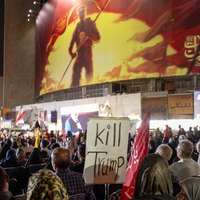
A participant holds a sign reading “Kill Trump” at a state-backed event in central Tehran, as a giant billboard depicting an avenging warrior looms over the crowd, August 21, 2026

Iran’s leadership may see an end to the war as necessary under mounting US economic pressure, but that does not mean Tehran will heed Washington’s demands, experts say, warning that the pressure could instead drive it toward further escalation.

President Masoud Pezeshkian said Friday that it would be better to end the war now, while Iran remains in what he called a position of “power and dignity.” Parliament Speaker Mohammad Baqer Ghalibaf was more blunt about the stakes of a deteriorating economy.

“No matter how much military power we have, we won't survive if people are hungry and we don't have financial turnover, economic growth and national production,” Ghalibaf said, according to Iran’s official news agency IRNA.

Raz Zimmt, director of the Iran and Shiite Axis Research Program at Israel’s Institute for National Security Studies, believes the statements reflect growing recognition in Tehran that the current situation is unsustainable.

But he says there is a potentially dangerous gap between recognizing that reality and deciding to compromise.

“If they have to make a choice between taking the risk for a new round of war with the United States or making concessions which they consider to be full capitulation to the United States... I think it’s very clear that they are not going to give up,” Zimmt told Iran International’s Eye for Iran podcast.

The dilemma comes as Washington prepares to intensify the pressure. US Treasury Secretary Scott Bessent has promised the “toughest sanctions in history,” alongside a naval blockade already squeezing Iranian trade.

Iran entered the war with high inflation and a weakened currency. By July, annual inflation had reached 66 percent and food prices were 128 percent higher than a year earlier, according to official data.

‘Reasons to resist’

Zimmt says Iran’s ability to use Hormuz as leverage could also erode as the United States makes military gains in opening a corridor through the strait. But he sees no evidence yet of a consensus in Tehran for a change of course.

Iran’s calculation, he argues, is shaped by what happens after any agreement as much as by what happens now. Its leaders do not appear convinced that concessions would guarantee a permanent end to the war.

Instead, they may fear reopening Hormuz and surrendering leverage in exchange for a ceasefire that Washington could abandon after the US midterm elections in November.

Washington’s own messaging may be reinforcing that distrust.

Bessent said Thursday that the combination of the blockade and new sanctions could “collapse this regime,” even as he argued that successful economic pressure could reduce the likelihood of another large-scale military campaign.

From Tehran’s perspective, Zimmt argues, such statements can strengthen those who ask why Iran should make concessions to an administration that is simultaneously talking about its collapse.

The war itself may have given Tehran another reason to resist concessions.

“The conclusion in Iran is that the United States and Israel don’t have the capability to force Iran into major concessions,” Zimmt said.

‘Escalation before negotiations’

Hormuz provides Tehran with another source of leverage. After decades of threatening to close the strategic waterway, Iran has demonstrated its ability to severely disrupt it. Only seven commodity vessels passed through on Thursday, compared with more than 130 a day before the war, according to Kpler data.

Zimmt believes Iran’s leadership may therefore calculate that it can inflict enough economic pain on its Persian Gulf neighbors and the global economy to improve its position before negotiating.

He points to Iran’s behavior after Trump withdrew from the nuclear deal during his first presidency. Tehran initially responded to maximum pressure with what it called “strategic patience” but escalated as the economic damage mounted, including through attacks on Persian Gulf shipping and the downing of a US drone.

He sees the possibility of the same logic asserting itself again.

“If the Iranians reach the conclusion that they can’t resist or they can’t handle the growing economic pressure,” Zimmt said, “their decision would actually be to escalate things even further before returning to negotiations.”

The pressure may be working. The unanswered question is what Tehran chooses to do because of it.

You can watch Eye for Iran on YouTube or listen on any podcast platform.

Persian Murakami editions race ahead of English release with AI help

Aug 23, 2026, 22:41 GMT+1
100%
Covers of five Persian editions of Haruki Murakami’s The Tale of KAHO.

Haruki Murakami’s latest novel has yet to receive an official English translation, but at least six Persian versions have already been published or are in preparation in Iran, with some translators relying on unofficial English texts and AI tools.

Haruki Murakami’s latest novel has yet to receive an official English translation, but at least six Persian versions have already been published or are in preparation in Iran—with some translators relying on an unofficial English text and artificial intelligence.

The Tale of KAHO was published in Japan on July 3. Within weeks, three Persian translations had reached the Iranian market and at least three more were on the way.

Iran is not a party to the Berne Convention on international copyright, allowing publishers to release competing translations of foreign books without securing exclusive Persian-language rights.

But the latest race to translate Murakami has added a new element to Iran’s already unruly publishing market: AI.

Some translators have worked from an unofficial English version of the novel whose provenance is unclear and which, according to Barseghian, showed signs of having been generated using AI.

That raises the prospect of Persian editions based not directly on Murakami’s Japanese original or an authorized translation, but on an AI-generated intermediary text of uncertain origin.

‘Transparency and responsibilty'

The published versions are by Ali Mojtahedzadeh for Vazn-e Donya, Araz Barseghian for Milkan and Yasmin Davoudi for Chitra. Sahar Bastam is preparing a translation for Didavar, Kazem Kamrava for Sandoghcheh and Amir Behrouz Ghasemi for Kheyzaran.

Mojtahedzadeh told Iranian economic newspaper Donyaye Eqtesad that he obtained an unofficial English translation from a website specializing in such material and completed his Persian version in less than two weeks.

Barseghian said he bought the official Japanese Kindle edition and used an unofficial English version that appeared to have been generated with AI, comparing the texts with AI tools and checking issues including meaning, pronouns, point of view and paragraphing.

“The main issue for me is not whether artificial intelligence is used, but transparency and the translator’s responsibility,” Barseghian told Donyaye Eqtesad.

He said AI served as a tool for comparison and comprehension rather than as the final translator, with questionable passages checked against the Japanese original.

‘It’s only the beginning’

The speed and methods behind the competing editions have drawn criticism on Persian-language social media, particularly over copyright and the use of unauthorized source material.

“The translator proudly says I downloaded the book file from an illegal website and translated it. He doesn’t even seem to think there is anything wrong or ugly about it,” an X user named Milad wrote.

Others argued that AI was accelerating a problem that long predates the technology.

“The main problem is that none of them sees any need to buy the translation and publication rights from the original publisher,” X user Tiro Whakatika wrote. “Otherwise, the rights would normally go to one publisher and we wouldn’t see six simultaneous translations of one book.”

“Artificial intelligence has now reduced the cost and time of translation and turned this unregulated market into a race to publish bestselling books immediately,” the user added. “This is only the beginning, and it will probably get much worse.”