Iran weighs gasoline rationing as fuel deficit widens
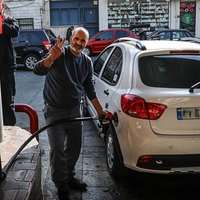
Iran’s government is considering three proposals to curb gasoline consumption as war damage, import difficulties and a widening gap between domestic production and demand put growing pressure on fuel supplies.
The options include imposing a daily cap on supplies to filling stations, tightening vehicle quotas and allowing additional gasoline to be sold at market rates, or transferring fuel allocations from vehicles to individuals and permitting citizens to trade them.
No proposal has been approved, and the government has not announced any immediate change to subsidized gasoline prices.
Esmail Saghab-Esfahani, a vice president of the Energy Optimization Organization, outlined the three scenarios on state television and said the public would be informed before any decision was implemented.
Iran’s government is considering three proposals to curb gasoline consumption as war damage, import difficulties and a widening gap between domestic production and demand put growing pressure on fuel supplies.
The options include imposing a daily cap on supplies to filling stations, tightening vehicle quotas and allowing additional gasoline to be sold at market rates, or transferring fuel allocations from vehicles to individuals and permitting citizens to trade them.
No proposal has been approved, and the government has not announced any immediate change to subsidized gasoline prices.
Esmail Saghab-Esfahani, a vice president and head of Iran's Strategic Energy Policy and Management Organization, outlined the three scenarios on state television and said the public would be informed before any decision was implemented.
Daily supplies could be capped
Under the first proposal, existing prices would remain unchanged, but filling stations nationwide would receive a combined 121 million liters of gasoline per day.
Saghab-Esfahani said pumps would stop operating once that amount had been sold, effectively imposing a nationwide daily supply ceiling without formally increasing prices.
The second proposal would divide the same 121 million liters among registered vehicles through a stricter quota system. Motorists exceeding their allocation would have to purchase additional gasoline at an unsubsidized market rate.
The third option would transfer gasoline quotas from vehicles to individuals. Every citizen would receive about 30 liters per month, whether or not they owned a vehicle, and could use or sell the allocation.
Around 30 million liters per day would separately be reserved for public transportation, conventional taxis and ride-hailing services under that proposal, in an effort to prevent fare increases.
Saghab-Esfahani said the third plan would be accompanied by a three-year program to electrify 400,000 motorcycles, convert 130,000 pickup trucks to natural gas and add 7,300 buses. He did not explain how the program would be financed or provide a detailed implementation schedule.
Conflicting production figures
In his latest remarks, Saghab-Esfahani put daily gasoline production at about 121 million liters and consumption at around 135 million, implying a shortfall of approximately 14 million liters per day.
Tehran-based news website Rouydad24 cited earlier remarks by the official that put production at about 112 million liters. The reason for the nine-million-liter discrepancy was not explained and may reflect different reporting periods or production conditions.
President Masoud Pezeshkian has said Iran spent about $6 billion importing gasoline during the Iranian year that ended March 20, 2026. Officials say falling revenue, limited access to foreign currency and obstacles affecting import routes have made that approach increasingly difficult.
Kerman plan halted before launch
The debate intensified after authorities abruptly announced and then suspended a plan to sell gasoline consumed beyond existing quotas at a sharply higher rate in southern Kerman province.
The plan was halted hours before it was due to begin following talks between Kerman’s governor and national officials. Provincial authorities said the existing system would remain in place while the proposal underwent further review.
Neither the Oil Ministry nor the government disclosed the legal basis for the plan or how the new price had been calculated. Officials also did not clarify whether Kerman had been selected for a local anti-smuggling initiative or as a test for wider changes.
Legacy of the 2019 protests
Gasoline pricing remains among the most politically sensitive issues in Iran.
An overnight nationwide price increase in November 2019 triggered protests in more than 100 cities. Rights groups documented hundreds of deaths in the ensuing crackdown, during which authorities imposed a near-total internet shutdown.
Pezeshkian promised during his 2024 presidential campaign that gasoline prices would not be increased without public consent and that more fuel-efficient vehicles would be made available before any increase.
Government officials have said no immediate price rise is planned, but all three proposals now under consideration would restrict consumption or redistribute subsidies.
The proposals leave the government seeking to address a growing supply deficit without an abrupt policy change that could further strain household finances and renew public anger over gasoline prices.
Jafar Pourkabgani, a lawmaker representing the southern Iranian province of Bushehr and a former longtime member of the IRGC and Basij, personally fired at protesters during nationwide demonstrations in January, witnesses told Iran International.
Armed forces opened fire on protesters on January 8 and 9 from the rooftops of the Quran Mosque, a nearby Basij facility and surrounding buildings on Ashouri Street in the city of Bushehr, witnesses said.
Several people who said they were present identified Pourkabgani as one of the armed men in the area. Some said he carried a handgun, while others described him as holding a Kalashnikov-style rifle.
One witness said Pourkabgani shouted “Labbaik ya Khamenei,” an expression of allegiance to then-Supreme Leader Ali Khamenei, as he fired.
Other accounts described the lawmaker as a leading figure among the armed personnel deployed in the area.
Gunfire against at least 19 people attributed to Pourkabgani
Accounts collected by Iran International attributed the shooting of at least 19 people to Pourkabgani. Witnesses said at least two of those struck by his gunfire have died.
It was not immediately possible to independently establish the identities of all those shot, the weapons used or the precise circumstances of the deaths.
Some residents of Bushehr refer to Pourkabgani by the nickname “Jafar the Axe,” according to local accounts.
Pourkabgani has longstanding ties to the Quran Mosque, one of the locations from which witnesses said gunfire was directed at protesters. Public accounts identified him as head of the mosque’s board of trustees for at least part of the period between 2014 and 2022.
Pressure on bereaved families
One local source with knowledge of the matter said that Pourkabgani visited the homes of some bereaved families after protesters were killed and sought to persuade them to say their children had been killed by “terrorists,” which the families rejected.
Pourkabgani has not publicly addressed the allegations that he personally fired at protesters or pressured bereaved families.
Decades in security and local government roles
Pourkabgani joined the IRGC in the early 1980s and subsequently held security, executive and political positions in Bushehr.
In 2004-05, while holding the rank of IRGC colonel, he headed the local Basij unit responsible for enforcing the Islamic Republic’s doctrine of “enjoining good and forbidding wrong.” Accounts of the unit’s activities included searches of homes, confiscation of equipment and arrests.
He served as governor of Bushehr from about 2005 to 2013 and headed the county’s election headquarters during the disputed 2009 presidential election.
Pourkabgani later served on the Bushehr City Council, including as its chairman, before entering parliament as the representative for Bushehr, Ganaveh and Deylam.
Residents have also said that he was involved in the authorities’ response to the November 2019 protests and the 2022 Woman, Life, Freedom protests.
During the 2022 protests, Pourkabgani was injured in a knife attack in Bushehr’s Kouti neighborhood while serving on the City Council.
Calls for harsh punishment
After the January 2026 protests, Pourkabgani publicly described demonstrators as “rioters” and the demonstrations as a “terrorist operation.”
He called on the judiciary to identify protesters and create official files on them, further demanding that they face the “harshest punishment.”
Viewers who contacted Iran International pointed to what they described as a stark contradiction between Pourkabgani’s position as a representative of the public and the allegations that he fired at the people he was elected to represent.
More than 36,500 Iranians were killed by security forces during the January 8-9 crackdown on nationwide protests, making it the deadliest two-day protest massacre in history, according to documents reviewed by Iran International's Editorial Board.
Iran International's Editorial Board confirmed the death toll on January 25 after reviewing classified documents, field reports, and accounts from medical staff, witnesses, and victims’ families.
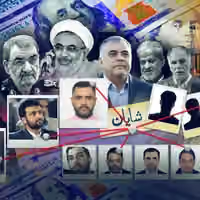
Relatives of some of Iran’s most powerful security figures, including Mohsen Rezaei’s son, were among nine people tied to an oil-sales network that sources say failed to return about $11 billion in proceeds, an Iran International investigation found.
The major corruption network involved in the sale of Iranian oil has been operating within the Islamic Republic’s Intelligence Ministry, according to multiple sources familiar with the matter.
The network was built around trusted intermediaries, known in Iran as “trustees,” who were given oil to sell as part of efforts to circumvent sanctions and were expected to return the proceeds to the state.
Iran International’s investigation found that the nine included the relatives of senior current and former officials, including a son of Supreme National Security Council Secretary Mohsen Rezaei and the sons-in-law of two former intelligence ministers.
On August 9, the Iranian Labour News Agency (ILNA), quoting Hossein Samsami, a member of parliament’s Economic Committee, named one of the trustees who he said had failed to return Iran’s oil revenue: Hossein Aghayari.
A day later, ILNA provided further details, saying Aghayari was born in 1982 and operated in Tehran using Iranian and Afghan passports. It said he had purchased 40 Iranian oil tankers, taken delivery of 90 million barrels of oil, sold it on the market and failed to return the proceeds.
Aghayari has been based in the United Arab Emirates since before the start of the 40-day war. Two oil-industry sources told Iran International that five months ago, he stayed for several days at the Ritz hotel in London using a Dominican passport.
According to the sources, Aghayari’s name and details of his activities were deliberately provided to Iran’s domestic media as part of a security operation intended to conceal the identities of the principal figures in a much larger network of Intelligence Ministry trustees.
The sources identify the leader of the network as a senior Intelligence Ministry official known as Shayan, the ministry’s director-general for fuel and energy. He was dismissed 10 days ago and, according to three sources, is expected to be arrested.
The sources say the group, known as the Shayan Network, was responsible for about $11 billion in oil-sale proceeds not being returned to the state.
How the network operated
Since the administration of former President Ebrahim Raisi took office, Iran’s budget laws have allowed executive agencies and state, military and Social Security pension funds, in coordination with the Oil Ministry, to receive Iranian crude oil and gas condensate for sale as part of efforts to circumvent sanctions and return the proceeds to Iran.
The individuals and companies entrusted with selling the oil and transferring the revenue are commonly known in Iran’s political and economic terminology as “trustees.”
The administration of President Masoud Pezeshkian has continued to use similar mechanisms for oil sales.
According to Iran International’s sources, several large patronage networks emerged around the system, including one operating within the Intelligence Ministry through the cooperation of three figures.
One was Oil Minister Mohsen Paknejad, who previously headed the Oil Ministry’s Fuel Supply Oversight Headquarters.
The other two, according to the sources, were the principal organizers of the alleged network. One was Shayan, the Intelligence Ministry’s director-general for fuel, who had previously served as a senior ministry interrogator in major oil cases.
Sources say that Shayan used his influence over cases ranging from the missing oil rigs scandal to the Crescent case to accumulate considerable wealth.
The third figure was Meysam Darzinejad Rami, director-general of the Intelligence Ministry Pension Fund, through whom the sources say legal cover was provided for the oil sales. He previously headed security at the Execution of Imam Khomeini’s Order (EIKO), the vast economic conglomerate controlled by the office of Iran’s supreme leader.
According to Iran International’s sources, Shayan and Darzinejad built an extensive oil-sales operation around nine influential trustees, one of whom was Aghayari.
Mohsen Fallahian, son of an ex-intelligence minister
One of the best-known members of the alleged network is Mohsen Fallahian, the son of Ali Fallahian, who served as intelligence minister under President Akbar Hashemi Rafsanjani.
Ali Fallahian has been widely accused of being one of the architects of the Islamic Republic’s campaign of assassinations against opponents abroad, including during the period when Shapour Bakhtiar, the last prime minister under Mohammad Reza Shah Pahlavi, was killed in Paris.
Mohsen Fallahian runs a company in Iran called Sepehr Sanat Negin, whose stated business activities were changed to include oil and gas operations in October last year.
Iran International’s sources say Fallahian obtained authorization to establish an oil-storage facility at Shahid Rajaei Port in Bandar Abbas through his father’s influence and subsequently joined the Shayan Network’s oil-selling operation.
According to the sources, Mohsen Fallahian lives in the UAE and trades oil under another identity, “Mohsen A.,” using a Turkish passport. In one instance alone, the sources say, he converted 200 million dirhams in Iranian oil revenue into cryptocurrency and transferred it to a European country.
Ali Rezaei, son of Mohsen Rezaei
Ali Rezaei, son of Iran’s newly appointed security chief Mohsen Rezaei, is also identified by the sources as one of the Shayan Network’s trustees.
Rezaei is married to the daughter of Leili Boroujerdi, a granddaughter of Ruhollah Khomeini. For years, he served as deputy for communications at the Secretariat of the Expediency Discernment Council, effectively serving as his father’s deputy.
Iran International’s sources say Rezaei has for some time been living at the Address Mall hotel in Dubai, where he works as an oil trader. They allege that he is among the Shayan Network trustees who have failed to return hundreds of millions of dollars in oil-sale proceeds.
Ali Bayandorian, a trustee for several networks
Another member of the alleged network identified by Iran International’s sources is Ali Bayandorian, 52, who was born in Tehran and lives on Morvarid Street in Tehran’s Saadat Abad neighborhood, although he spends much of the year in the UAE.
The United States sanctioned Bayandorian in January 2020 over his links to Triliance Petrochemical, a Hong Kong-based broker that the US Treasury said facilitated sales of Iranian petroleum and petrochemical products on behalf of the National Iranian Oil Company.
Iran International’s sources say Bayandorian sells oil and petrochemical products through a network of companies registered in Iran and Southeast Asia. They also allege that he handles financial transactions related to sanctioned oil sales and pays kickbacks to Shayan through an account in the UAE belonging to one of his wife’s relatives, a woman named Neda.
Before joining the Shayan Network, according to the sources, Bayandorian was a trusted intermediary for a network associated with the Supreme National Security Council.
Because he worked with several parallel networks, the sources say, he sometimes failed to pay Shayan’s share on time or in full. Shayan therefore created a rival for him: Ahmad Maroufkhani, chairman of the board of the Oil Products Exporters’ Union, whom the sources describe as one of the Intelligence Ministry network’s second-tier trustees.
Ehsan Sakhaei, son-in-law of Rouhani’s intelligence minister
Ehsan Sakhaei is another person identified by the sources as a trustee in the Shayan Network. He is 51, a Swiss citizen and the son-in-law of Mahmoud Alavi, who served as intelligence minister under President Hassan Rouhani.
According to Iran International’s sources, Sakhaei lives in Dubai’s Vision Tower.
Six years ago, during a Bank Mellat corruption trial, Sakhaei was accused of acting as a fixer who used his father-in-law’s influence to secure multibillion-toman debt write-offs for major bank debtors.
Iran International’s sources say Sakhaei has failed to return several hundred million dollars in proceeds from Iranian oil sales.
Ehsan Tahayori, son of an IRGC brigadier general
Ehsan Tahayori is a well-known Iranian currency dealer who, according to Iran International’s sources, failed to hand over $700 million in Iranian oil revenue in one case alone.
Tahayori, owner of the Arz Iran currency exchange, is the son of IRGC Brigadier General Shams-Ali Tahayor, also known as General Tahayori.
Iran International’s sources identify Tahayori as the principal suspect in a one-billion-dirham fraud involving Iran’s NIMA foreign-exchange system. They also allege that he was released and helped to flee with the assistance of the Intelligence Ministry.
Two sources told Iran International that authorities in the UAE arrested Tahayori during the war and that he is now in prison.
Photographs published earlier and reported to show his luxury cars at his villa in Lavasan had caused controversy in Iran.
Rouhollah Razavi, son-in-law of a Paydari Front spokesman
Another figure identified by the sources is Rouhollah Razavi, the son-in-law of Majid Mottaghifar, spokesman for the hardline Paydari Front.
Iran International’s sources say it was through this political connection that Razavi became one of Shayan’s trusted intermediaries and describe his office in Tehran’s Kamranieh neighborhood as a hub for backroom oil deals.
The sources allege that Razavi has retained more than $1 billion in oil-sale proceeds and provided information about rival trustees in an effort to push them out of the market.
Mohammad-Hadi Momenin, major bank debtor and oil broker
Another trustee identified by the sources is Mohammad-Hadi Momenin, born in 1989.
Iran International’s sources allege that Momenin controls approximately $2 billion in Iranian oil revenue that has not been returned. His name has appeared on the boards of more than 40 companies in Iran.
Last year, when the names of major bank debtors were released, it emerged that Momenin owed Karafarin Bank 743 billion tomans.
The sources say he fled the UAE for Oman during the war and later traveled from there to China, where they say he is refusing to respond to his creditors.
Ehsan Dastgheyb, son of Iran’s ‘Bribery King’
The ninth individual identified by the sources is Ehsan Dastgheyb, son of Abdollah Dastgheyb, a nephew of a former Shiraz Friday prayer leader who is known as Iran’s “Bribery King.”
Ehsan Dastgheyb lives in Dubai and sells fuel oil for the Shayan Network, according to Iran International’s sources. They allege that he, too, has failed to return a large sum of money to Iran.
Network comes under pressure
Following Shayan’s dismissal, Iran International’s sources say both he and Meysam Darzinejad Rami are expected to be arrested and that the network has come under increasing pressure.
The sources say the Shayan Network is only one of several networks of trustees involved in Iranian oil sales and estimate that intermediaries across these networks have collectively failed to return as much as $110 billion in oil revenue.
They also say Oil Minister Paknejad could soon be dismissed, although he has mobilized his political connections in an effort to remain in office.
Iran's oil minister Mohsen Paknejad
On July 24, Tehran prosecutor Ali Salehi said 59 cases had been opened against managers of trustee companies, with 43 reaching the indictment stage. He said 22 defendants had been sent to prison and that Interpol Red Notices were being pursued for 15 fugitives.
The prosecutor did not publicly identify the 15 fugitives, making it impossible from the announcement to determine whether any members of the Shayan Network were among them.
Iran International’s sources expressed doubt that the alleged network would be fully pursued, pointing to the powerful connections of those involved: they include sons and sons-in-law of former intelligence ministers, the son of the secretary of the Supreme National Security Council, and people connected to the Paydari Front and influential clerical families.
According to the sources, the Shayan Network alone was responsible for about $11 billion in Iranian oil-sale proceeds that were not returned to the state.
An Iranian military pilot gestures from the cockpit of a fighter jet in this file photo.
Qatar on Saturday dismissed the Iranian military’s claim that it had detained and held three pilots from two Su-24 bombers shot down in March, saying it recovered only one pilot’s remains and had invited Tehran to review the search.
Qatar’s Foreign Ministry spokesperson Majed Al Ansari said in a post on X that Doha was “surprised by these misleading statements” amid ongoing diplomatic efforts to de-escalate regional tensions.
The denial came after Mohammad Bagherzadeh, commander of the Iranian Armed Forces General Staff’s committee for missing personnel, said three pilots had been captured alive and held by Qatar for about six months.
Bagherzadeh identified the pilots as Javad Salehi, Abdolmajid Dashtian and Omran Beh-Raveshian in a letter to the International Committee of the Red Cross published by IRGC-affiliated Fars News Agency.
Al Ansari said Qatari forces established contact with the Iranian pilots after they violated Qatar’s airspace and their targeting trajectory had been confirmed.
He said the pilots failed to respond to attempts to communicate and that Qatar then took “the necessary measures” to defend its territory in accordance with international law and its rules of engagement.
Qatar’s Defense Ministry said in March that two Iranian Su-24 aircraft had been shot down during an operation that reportedly targeted Al Udeid Air Base, which hosts US troops.
CNN reported at the time, citing two sources briefed on the operation, that Qatari forces warned the Iranian jets by radio but received no response before a Qatari F-15 engaged them and shot them down.
Qatar says one pilot’s remains were recovered
Al Ansari said Qatari search-and-rescue teams subsequently searched for the pilots’ remains.
He said Qatar coordinated with Iran to hand over the remains of one pilot who was found and invited an Iranian team in April to visit Qatar and review details of the search-and-rescue operation.
Al Ansari said Tehran had yet to respond to the invitation.
Iranian officials had previously said the fate of the three pilots remained unclear. Earlier this month, a senior Iranian Air Force official said authorities still lacked definitive information about them.
The dispute comes as Qatar remains involved in mediation between Tehran and Washington, with Al Ansari pointing to ongoing diplomatic efforts to reduce regional tensions.
Iranian protestors met with security forces during January uprisings.
As Iran confronts military pressure abroad and mounting economic strain at home, signs are emerging that the Islamic Republic is increasingly turning its attention to another potential threat: renewed unrest on its own streets.
While veteran hardliners are returning to key positions overseeing forces responsible for domestic repression, cobblestones are being ripped out of historic pedestrian areas and replaced with asphalt.
Municipal officials have described the work as traffic management, but Iran International reporter Mehdi Sepahvand’s reporting suggests it could make the areas easier for security forces to penetrate and control during unrest.
Analysts say the developments, against a backdrop of uncertainty over the country’s new leadership, suggest the state is thinking beyond the current war to the possibility of another confrontation at home.
The return of Hossein Taeb, one of the Islamic Republic’s most feared security figures, to command the Basij is perhaps the clearest signal.
Omid Memarian, a senior Iran analyst at the think tank DAWN, said Taeb’s return shows the state is prioritizing control of the population.
Photo of Hossein Taeb
‘An undeclared coup’
“They are very much nervous, concerned about people and their demands,” Memarian told Eye for Iran, adding that the leadership understands “the domestic situation can explode at any moment.”
Taeb, Memarian said, was brought back not to reconcile with Iranians, but to consolidate loyalists and signal that authorities are prepared to “crush any dissent.”
For Kamran Bokhari, a senior resident fellow at the Middle East Policy Council and strategic forecaster, the reshuffle raises a more fundamental question: who is making these decisions?
With Iran’s new Supreme Leader remaining unseen and unheard publicly, Bokhari questioned the extent of his authority and argued that a small group within the security establishment may effectively be running the system.
“The point is who is making these appointments?” he said.
Bokhari went further, describing the emerging arrangement as an “undeclared coup” by the Revolutionary Guards, in which he believes the IRGC is consolidating authority while preserving the appearance of a functioning constitutional system.
Jason Brodsky, policy director at United Against Nuclear Iran, offered a different reading, seeing a diffusion of power in the absence of a visible Supreme Leader capable of imposing decisions across the system.
Survival is not stability
Former CIA Iran specialist Mark Fowler said the Islamic Republic has absorbed severe military damage without collapsing.
“Surviving is winning for the Iranian regime right now,” Fowler told Iran International’s Eye for Iran.
But survival does not mean stability. With Washington seeking to intensify economic pressure, Fowler said there was no single inflation rate or economic threshold at which unrest became inevitable.
“It’s just a question of who cries uncle first,” he said.
Authoritarian governments can tolerate considerable hardship among their populations because their leadership is insulated from much of it, Fowler said.
“They’re more than happy to allow people to suffer,” he added.
Economic hardship does not automatically produce revolt. But the longer it persists, the more consequential the state’s ability to contain discontent becomes.
Beneath people’s feet
Perhaps the most striking sign cited by those who see preparations for future unrest can be found not in the leadership compound, but beneath people’s feet.
In central Tehran, cobblestones are being removed from historic pedestrian areas and replaced with asphalt.
The changes affect parts of central Tehran around District 12 and the Grand Bazaar, historically an important center of political mobilization, as well as areas near universities where students have repeatedly participated in protests.
Cobblestones can be dislodged and used as projectiles. Pedestrian streets also contain bollards, benches, trees and restaurant tables that can impede motorcycles and security vehicles while giving protesters places to congregate or seek cover.
Turning them into vehicle-accessible thoroughfares could change that equation.
“By changing these pedestrian zones into thoroughfares for cars, they are actually paving the way for swift action during protests,” Sepahvand said.
The changes, he added, create “plain sight and direct shooting range” for security forces.
Sepahvand said authorities have also put pressure on restaurants and gathering places where Iranians, including women appearing without mandatory hijab, have carved out small spaces of social freedom.
Those spaces allow communities to form, he said, something authorities understand can eventually translate into collective action.
“The government is sure that they are going to be facing more and more protests,” Sepahvand said.
The Islamic Republic is bringing veterans of repression back into senior positions, positioning the Basij for a greater domestic role and, according to Sepahvand’s reporting, altering public spaces in ways that could make future protests easier to suppress.
The Islamic Republic has survived the war so far. Its next test may come not from across its borders, but from the streets at home.