Iran's president pledges support in phone call with Hamas chief


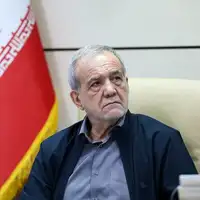
Iran would support any decision by Palestinian leaders in ongoing negotiations with Israel, President Masoud Pezeshkian said on Wednesday during a phone call with Hamas political leader Khalil al-Hayya.
“The Islamic Republic of Iran will support any measure, initiative or decision taken by Palestinian leaders in the course of the negotiations,” Pezeshkian said, according to the Iranian government’s website.
He said Palestine remained central to Iran’s foreign policy despite recent US and Israeli attacks on the country.
“Palestine has never ceased to be a priority of Iran’s foreign policy and remains the foremost issue for the Islamic world,” Pezeshkian said.
Al-Hayya thanked Iran for supporting Palestinians and said Hamas was conducting political negotiations in coordination with other Palestinian factions, according to the Iranian account of the call.
“The Palestinian people, despite the continuing attacks and pressure, will remain committed to their aspirations and to the blood of Palestinian victims,” al-Hayya was cited as saying.




Cyberattacks targeting water and wastewater facilities in at least seven US states appear to have been intended less to cripple infrastructure than to demonstrate Iranian reach, intimidate the public and shape perceptions, cybersecurity experts told Iran International.
"The psychological impact is what these attacks are intended to do,"said Annie Fixler, director of the Center on Cyber and Technology Innovation at the Foundation for Defense of Democracies (FDD).
"Iranian hackers in particular conduct what's called perception hacking," she said.
"They conduct a small-scale operation, they get into a network, they take a couple pictures of what they got, and then they claim to have caused a massive disruption because they're trying to cause a psychological impact even when they can't cause an actual true cyber impact."
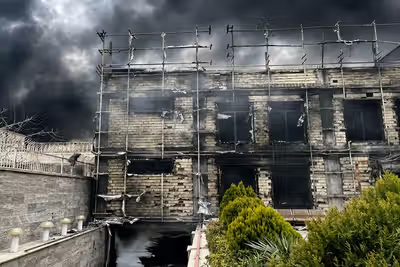
Federal authorities last week warned that "malicious cyber actors" had targeted water and wastewater systems across at least seven states, with Minnesota reporting the largest number of incidents after around 30 water systems were disrupted. Officials urged utilities to disconnect vulnerable internet-connected equipment and switch to manual operations where necessary.
The FBI has opened an investigation but has not publicly attributed responsibility. However, multiple US media outlets, citing government officials familiar with the investigation, reported that Iran is the leading suspect.
President Donald Trump dismissed suggestions that Tehran was responsible, instead blaming Minnesota Governor Tim Walz, while Walz argued the attacks illustrated "what modern warfare looks like."
Why Iran?
Although no official attribution has been made, cybersecurity specialists say several characteristics of the campaign closely resemble previous Iranian operations.
"The particular systems they attacked are programmable logic controllers," Fixler said, referring to industrial control devices widely used in water facilities.
"The US government warned repeatedly earlier this year that Iranian actors were targeting those particular systems."
Earlier this year, the Cybersecurity and Infrastructure Security Agency (CISA) warned that Iranian-affiliated hackers were actively targeting internet-connected operational technology, including programmable logic controllers used in water infrastructure.
The agency later updated its advisory with additional guidance on securing vulnerable equipment.
Unlike financially motivated ransomware attacks, the latest incidents included no ransom demands.
"The first thing I look for is whether there's a ransom request," Fixler said. "We haven't seen that."
That absence points away from criminal hackers and toward a geopolitical operation, she said.
Amin Sabeti, a cybersecurity researcher specializing in Iranian cyber operations, said the campaign also reflects the typical strengths and limits of Iran's cyber capabilities.
"I don't think it was sophisticated, but it was a clever one," Sabeti said.
Rather than deploying cutting-edge exploits, he said the attackers appeared to exploit weak cybersecurity practices such as unchanged default passwords and poorly secured internet-connected equipment.
Compared with Russia and China, "they are a small boy in the town," Sabeti said, arguing Iranian operators excel at social engineering and exploiting simple vulnerabilities more than conducting highly sophisticated cyber campaigns.
A familiar playbook
The suspected campaign would fit a pattern established over recent years.
In late 2023, the IRGC-linked hacking group CyberAv3ngers targeted water facilities in Pennsylvania by compromising Israeli-made Unitronics programmable logic controllers, forcing operators to switch to manual controls.
Iran has also targeted Israeli water infrastructure. In 2020, Iranian hackers attempted to manipulate chlorine levels in Israeli water systems, according to Israeli and Western officials, prompting a reported Israeli cyber retaliation against Iran's Shahid Rajaee Port.
The same industrial control equipment targeted in previous Iranian operations has again become the focus of concern in the United States.
Fighting a war without missiles
Experts say the attacks fit neatly into Iran's broader doctrine of asymmetric warfare.
"They show that, for a big powerful country like America, they can still be reached. Iran can still touch them," security expert Roger Macmillan told Iran International.
"There is a huge psychological warfare piece... They can't attack us physically using missiles, but they can touch us digitally."
Macmillan said the campaign serves several purposes simultaneously: demonstrating that American critical infrastructure is vulnerable, gathering intelligence about similar systems across the country and reminding Washington that Tehran retains options beyond conventional military force.
"There's also an intelligence gathering piece," he said. "They will probe similar types of companies to see where the same weaknesses are and how they will exploit them."
The latest figures released by the Statistical Center of Iran offer the starkest assessment yet of the country's economy, as record inflation intensifies debate over whether the war or government mismanagement is primarily to blame.
Average annual inflation has climbed to a record 62%, while year-on-year inflation has surged to 82%, rapidly eroding household purchasing power.
Food prices remain the principal driver of overall inflation, with annual food inflation staying in triple digits for a sixth consecutive month. In July, food inflation reached 134% nationwide and 140% in rural areas. More than two-thirds of the food items monitored by the statistical agency now exceed what economists describe as crisis-level inflation.
Prices have risen sharply across other sectors as well. Household appliances are estimated to cost 114% more than a year ago, while transportation costs have climbed 103%. Economists warn that a possible gasoline price increase could push food inflation even higher by raising distribution and delivery costs.
War or government policy?
Critics of President Masoud Pezeshkian’s government, many of whom also oppose an agreement with the United States, argue that the inflation surge is rooted entirely in domestic economic policy rather than the recent conflict.
Hojjat Abdolmaleki, labor minister under former president Ebrahim Raisi, dismissed any connection between the war and rising prices.
“The war has had no effect whatsoever on inflation. Inflation has risen steadily throughout the Pezeshkian Administration, and the war’s contribution to these price increases is zero,” he said.
“Virtually all of this inflation is the direct result of misguided policies and government incompetence. Even without the war, the situation would have been the same, perhaps even worse.”
Other economists reject that assessment, arguing that both domestic policy and the conflict have driven prices higher.
Mohammad Sadegh-Alhosseini told the Iranian Students News Agency (ISNA) that domestic policies could account for inflation of between 30% and 50%, but that the increase beyond that range was linked to international tensions and the war.
Mojtaba Yousefi, a member of parliament, also said it was inaccurate to claim that the war had no effect on prices. “But it is equally wrong to attribute all inflation to the war,” he said.
Economists also caution that even an agreement between Tehran and Washington, potentially unlocking frozen assets, easing sanctions, increasing oil revenue and reducing inflation expectations, would be unlikely to bring prices down quickly.
They say chronic budget deficits, entrenched corruption and structural inefficiencies are so deeply embedded that reversing them could take years.
Even if the fighting ends, the cost of rebuilding damaged infrastructure and industry would continue to strain public finances. Conservative politician Mohammad-Reza Bahonar recently estimated reconstruction costs at $200 billion.
Purchasing power continues to collapse
The inflation surge has increasingly affected ordinary Iranians. According to a report by the Iranian Labour News Agency (ILNA), during recent months even basic staples such as chicken, eggs and bread have become unaffordable for many working-class households. Bread prices alone have risen by between 100% and 140% on average.
Official data show that prices of at least eight food items have more than doubled over the past year. Cooking oil has risen 261%, while meat prices have increased 145%.
By comparison, ILNA wrote, the minimum wage has increased by only 60%, while salaries for civil servants, pensioners, nurses and teachers have risen by between 20% and 43%, averaging roughly 30%. As a result, many of these households no longer fit the conventional definition of the middle class, the report argued.
Government food vouchers introduced in January have also lost much of their purchasing power, as authorities have left their value unchanged despite soaring food prices.
Ahmad, a retired civil servant in Tehran, said the vouchers initially allowed him to buy around ten food items. "Now I can only afford three or four."
Social media has also reflected the growing financial strain. Users report increasing numbers of people selling, or even renting out, personal belongings such as electronic devices to cover daily expenses.
Journalist Azadeh Mokhtari wrote: "When advertisements for selling hair, or even renting laptops for online classes, become more common, it means the middle class is being worn away, and the lower-income class is being pushed out of the economy."
Misery index reaches new peak
The deteriorating economic environment is also reflected in Iran's misery index, the combined rate of annual inflation and unemployment.
With annual inflation at 62% and unemployment at 9.1% in the quarter ending in June, the misery index climbed to a record 71.1%, up from 64.2% in the previous quarter. The index stood at 56.6% during the same period in 2021.
The economic burden is not evenly distributed across the country. Several provinces have recorded misery index readings above 100%, with Lorestan registering the highest level at 121.5%.
Economists say the figures reflect not only declining purchasing power and weaker job security but also rising uncertainty that makes long-term financial planning increasingly difficult for households.
Prospects for reopening the Strait of Hormuz remained uncertain Tuesday as Washington said an agreement could come by Wednesday, while Tehran linked normal shipping to transit fees, sanctions relief, security guarantees and an end to the US naval blockade.
At the center of the negotiations is a proposed arrangement under which ships would enter the Persian Gulf through an Iranian-controlled route and leave through a route controlled by Oman.
Whether Iran could collect service or transit fees remains a key point of dispute, with Washington opposing any charges.
Iran is also seeking a role in monitoring vessels leaving the Persian Gulf. A senior Iranian source involved in the negotiations told Reuters that Tehran wanted control over inbound traffic and oversight of outbound ships, including the ability to intervene if necessary. Oman would clear departing vessels after notifying Iran, the source said.
The Wall Street Journal, citing regional mediators, said Iranian diplomats initially welcomed the proposed division of the routes because it preserved some authority for Tehran.
Iran has also demanded the right to collect transit fees, potentially shared with Oman, alongside guarantees against renewed attacks, relief from oil sanctions and an end to the US blockade.
The United States and regional governments rejected the proposed fees and sought assurances that Iran and its proxy groups would not threaten their territories, according to the report. The dispute leaves the sides divided over whether the strait should reopen before Washington offers concessions or only after Tehran’s wider conditions are met.
The latest proposal has yet to receive a formal response from the Revolutionary Guards, the Wall Street Journal reported. Some IRGC officials told mediators they would reject any agreement that did not recognize Iran’s claim to control the strait, while mediators have questioned whether Iranian diplomats have sufficient authority to finalize a deal.
Separately, Tehran indicated that an Iran-Oman shipping arrangement would not by itself restore normal traffic.
The IRGC-affiliated Fars News reported, citing a source close to Iran’s negotiating team, that the waterway would not fully reopen unless the United States halted its attacks and fulfilled Iran’s conditions.
Despite those differences, US Treasury Secretary Scott Bessent said an agreement could be reached as early as Wednesday. Secretary of State Marco Rubio also said discussions with Iran and Oman had made progress but had not yet produced a final deal.
The diplomatic push continued despite a fresh maritime incident Tuesday, when a cargo vessel was hit by an unknown projectile off Oman. The United Kingdom Maritime Trade Operations did not identify those responsible, but the attack underscored the continuing risks to commercial shipping while negotiations remained unresolved.
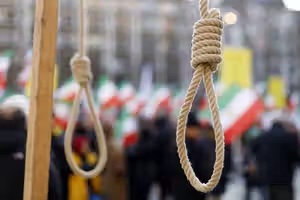
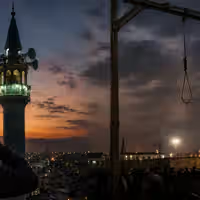
Angered by a wave of early-morning executions of protesters and political prisoners, some Iranian social media users have directed their anger at Islam and the morning call to prayer, prompting an IRGC-linked campaign demanding their prosecution.
As executions have accelerated in recent weeks, some Iranian social media users have increasingly portrayed the pre-dawn adhan as a reminder of hangings rather than the beginning of the day’s religious observances.
The adhan is the Islamic call summoning Muslims to the five daily prayers.
Iranian regulations state that death sentences should ordinarily be carried out at sunrise unless the court specifies another time. Executions are nevertheless widely associated with the early-morning hours, when prisoners’ families and supporters often wait for news as the dawn call to prayer is broadcast.
Social media anger turns toward religious symbols
Posts criticizing Islam and religious symbols circulated across Instagram and X following the latest executions.
An Instagram user wrote that the dawn adhan had become “a symbol and reminder of the execution of this country’s youth,” adding that a call intended to invite people to worship, peace and salvation had instead become associated with taking lives.
Activist Masih Alinejad wrote after clashes outside an execution site that the dawn call to prayer had become “only a symbol of death and execution.”
Another Instagram user wrote before planned executions in Isfahan that the young prisoners were due to be hanged “to the sound of the dawn call to prayer,” adding that it now carried “only the smell of death.”
Other users went further, posting profanity directed at Islam, the Quran, Shi’ite religious figures, the adhan and the Arbaeen pilgrimage. Some wrote that they no longer associated the dawn call with prayer but with executions.
IRGC-linked campaign urges crackdown
The IRGC-affiliated Fars News Agency said more than 700 people had signed a campaign on its platform by Tuesday, calling for the “maximum punishment” of those accused of “insulting Islamic sanctities online.”
Organizers cited Article 513 of Iran’s Islamic Penal Code and urged judicial and security authorities to take what they described as “effective and deterrent” action.
Under Article 513, insulting Islamic sanctities is punishable by between one and five years in prison. Cases classified as sabb al-nabi, or insulting the Prophet, can carry the death penalty.
Fars said campaign supporters called for tougher enforcement against people who “deliberately insult Islamic sanctities” online and urged authorities to prosecute offenders under existing legislation.
Judiciary spokesman Asghar Jahangir has previously said Iran continuously monitors cyberspace through a dedicated unit within the prosecutor general’s office and urged citizens to report alleged online offenses through official channels.
The campaign adds to broader efforts by Iranian authorities to tighten oversight of online speech as criticism over the recent executions continues to spread across social media.

Iran is exploring using two of Pakistan’s ports to keep trade moving amid the US blockade of its own ports, a senior Iranian official said on Tuesday.
Mohammad-Ali Dehghan Dehnavi, head of Iran’s Trade Promotion Organization, said Karachi and Gwadar could serve as hubs for re-exporting Iranian goods to third countries. He said Pakistan could also supply Iran with essential goods and industrial raw materials.
The comments came during a visit to Islamabad alongside Iranian Industry, Mine and Trade Minister Mohammad Atabak for bilateral trade talks.
Pakistan and Iran said they would work toward increasing trade to $10 billion, advancing a free trade agreement and removing barriers involving customs, border logistics and cargo movement.
Pakistan emerged as a key mediator after US-Israeli strikes on Feb. 28 triggered the Iran war and Tehran largely closed the Strait of Hormuz. When Pakistan-hosted US-Iran talks ended without a breakthrough on April 13, President Donald Trump ordered a blockade of maritime traffic entering and leaving Iranian ports.
The blockade ended on June 18 under an interim agreement mediated by Pakistan but was reinstated on July 14 after the deal began to unravel and fighting resumed.
Traffic through the Strait of Hormuz remains severely restricted. Kpler data showed only six vessels — three tankers and three bulk carriers — passed through the waterway on Monday, down from seven on Sunday, with all six using the route through Iranian waters.
On April 22, the US president said the naval blockade was costing Iran $500 million a day, while the War Department estimated that Tehran had lost $4.8 billion in oil revenue by May 1.
A Friday report by The Telegraph said the United States and Israel are weighing a possible land blockade of Iran to deepen its economic isolation, as President Trump reportedly believes the naval blockade in the Strait of Hormuz has achieved all it can.
Trump discussed the proposal with Israeli Prime Minister Benjamin Netanyahu during their meeting in Washington last Tuesday, alongside several other military and non-military options, according to the report.
A senior Israeli official suggested sealing Iran’s land routes to prevent goods from entering or leaving the country, saying such pressure could produce unpredictable consequences.
Iran shares extensive land borders with Iraq, Turkey, Afghanistan, Pakistan, Turkmenistan, Azerbaijan and Armenia.