• العربية
  • فارسی
Brand
  • Iran Insight
  • Politics
  • Economy
  • Analysis
  • Special Report
  • Opinion
  • Podcast
  • Iran Insight
  • Politics
  • Economy
  • Analysis
  • Special Report
  • Opinion
  • Podcast
  • Theme
  • Language
    • العربية
    • فارسی
  • Iran Insight
  • Politics
  • Economy
  • Analysis
  • Special Report
  • Opinion
  • Podcast
All rights reserved for Volant Media UK Limited
volant media logo

Female Iranian colonel charged after allegedly aiding protesters

Aug 3, 2026, 23:15 GMT+1
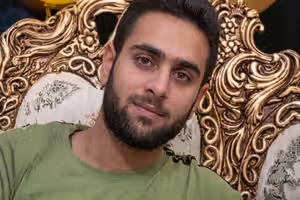
Iranian police colonel Shahrzad Zamiri

A female Iranian police colonel accused of assisting protesters during January's nationwide unrest has been charged with offences including "disclosure of state secrets," according to rights group HRANA, in a rare case involving a serving security official.

Shahrzad Zamiri, 51, remains detained without trial in Mashhad's Vakilabad Prison, HRANA reported on Monday.

Informed sources told Iran International that Zamiri was summoned to report to Iran's police force several days after the protests before being detained. They said the accusations stem from her presence at the protests and alleged assistance to protesters.

Zamiri served as deputy for social affairs at the cyber police, known as FATA, in Khorasan Razavi province.

According to the sources, she spent about two months in solitary confinement after her arrest, during which she was denied telephone calls and family visits.

The sources added that Zamiri has been interrogated but has not been granted access to a lawyer. Her case remains at the investigative stage, with no trial held or verdict issued.

HRANA reported that an investigative hearing was held on Monday at the military prosecutor's office in Mashhad.

The agency said Zamiri faces five charges but identified only two of them: "disclosure of state secrets" and "operational action." Authorities have not disclosed the factual basis for the allegations.

Iran International's sources said authorities have also confiscated Zamiri's property. Her telephone contact and family visits, suspended since late May, have now resumed, according to HRANA, citing a source close to her family.

Cases involving the detention of serving or former members of Iran's police or armed forces rarely become public. Previous reports have, however, pointed to isolated instances of dissent or resistance among security personnel involved in suppressing protesters.

Iranian authorities have not released a comprehensive figure for the number of people detained following the January protests.

In recent months, the judiciary has intensified its crackdown through widespread summonses and arrests, lengthy prison sentences and a sharp rise in executions involving political and protest-related cases.

Most Viewed

Tehran records heaviest damage in latest war, municipal report shows
1

Tehran records heaviest damage in latest war, municipal report shows

2

Khamenei warns Pezeshkian next resignation will be accepted, in-law says

3
EXCLUSIVE

Iran's president met Mojtaba Khamenei in the back seat of a car

4

Iran hangs two more political prisoners as execution wave widens

5

Aramco sidesteps Hormuz as Iran crisis cuts flows to a tenth

Banner
Banner
Banner

Spotlight

  • Anti-Islam posts follow Iran's dawn executions, sparking hardline backlash

    Anti-Islam posts follow Iran's dawn executions, sparking hardline backlash

  • Why Afghans still risk death to reach Iran
    ANALYSIS

    Why Afghans still risk death to reach Iran

  • Iran's president met Mojtaba Khamenei in the back seat of a car
    EXCLUSIVE

    Iran's president met Mojtaba Khamenei in the back seat of a car

  • Trump's U-turn reopens Tehran's political faultline
    INSIGHT

    Trump's U-turn reopens Tehran's political faultline

  • Deny first, negotiate later, Tehran's familiar diplomacy
    INSIGHT

    Deny first, negotiate later, Tehran's familiar diplomacy

  • Iran managing the inflation statistic, not the inflation
    ANALYSIS

    Iran managing the inflation statistic, not the inflation

•
•
•

More Stories

Iran hangs two more political prisoners as execution wave widens

Aug 3, 2026, 08:34 GMT+1
100%

Iran hanged two political prisoners early Monday after convicting them of alleged “spying and intelligence cooperation with Israel,” the judiciary said, extending a surge in executions carried out under broadly framed national-security charges.

Omid Behzad and Pouria Safvat, the judiciary's news outlet said, were executed on Monday, after Iran's Supreme Court upheld their death sentences.

According to Mizan, the two men transmitted “coordinates, images and information about Iranian military and security sites to officers from Israel's Mossad intelligence agency and affiliated communication channels” during the 12-day and 40-day wars in 2025 and 2026.

The pair, the report said, were identified and arrested by the Islamic Revolutionary Guards Corps' intelligence organization but did not specify when, where or how they were detained.

  • Iran executes 20-year-old protester as fears grow for other detainees

    Iran executes 20-year-old protester as fears grow for other detainees

The judiciary outlet also said Behzad maintained direct contact with the administrator of a Telegram channel linked to Israel and supported the US and Israeli military campaign against the Islamic Republic.

Mizan cited Behzad's confessions as evidence, although rights groups have for years documented that Iranian authorities have extracted confessions under coercion, torture or harsh detention conditions.

Iranian authorities use broadly worded charges such as espionage, acting against national security, armed rebellion, enmity against God and corruption on earth to crush dissent and remove political opponents.

Human rights organizations say these labels are routinely applied to protesters, dissidents and political prisoners to portray them as security threats and provide a legal pretext for execution.

Amnesty International, Human Rights Watch and UN experts have documented repeated cases in which such convictions were issued by revolutionary courts after grossly unfair or highly expedited proceedings, with defendants denied meaningful access to lawyers and verdicts based on torture-tainted forced confessions.

Charges against Safvat

Safvat, Mizan said, photographed Iranian air defense systems from rooftops during the 12-day war and sent the images through communication channels linked to Israel.

100%

The outlet said some of the locations he photographed were later bombed. Without providing evidence, it also alleged Safvat had direct contact with Mossad in some instances and sent messages to Iran International.

The court, according to Mizan, sentenced both men to death based on what it described as “explicit confessions, technical evidence, recovered messages and other evidence.” The sentences were upheld by the Supreme Court before being carried out on Monday.

Wider crackdown

Iran has intensified arrests, prosecutions and executions in recent months, with authorities sentencing or executing dozens of people on charges including espionage, involvement in protests and membership of the exiled opposition group Mujahedin-e Khalq (MEK).

  • Iran executes two protesters amid heavy security in Isfahan

    Iran executes two protesters amid heavy security in Isfahan

Human rights groups and activists say the authorities have expanded the crackdown following recent military confrontations, arguing that the campaign is intended to deter renewed public unrest over Iran's deepening economic and political crises.

Iran's latest wave of public hangings of protesters amounts to "killings" and "murders" that form part of a continuing crime against humanity, former United Nations prosecutor Professor Payam Akhavan told Iran International's Eye for Iran.

“What we actually have in Iran are arbitrary executions. These are killings. They are murders,” Akhavan said. "Specifically, the case can be made that this is a crime of extermination, given the large scale of the killings."

More Iranian teenagers at risk of execution, rights groups warn

Aug 3, 2026, 00:44 GMT+1
100%
Shervin Baghera, 18, was sentenced to death following his arrest during the January protests in Isfahan

Rights groups have warned that more teenagers arrested during Iran's January uprising face imminent execution, saying authorities have intensified the use of death sentences against minors as part of a broader execution campaign.

In a joint statement on Saturday, the organizations Defenders of Children's Rights in Iran and the Center for Justice for Children said they were deeply concerned that authorities could soon execute 18-year-old Shervin Bagherian from Isfahan.

The groups said Bagherian's case demonstrated that death sentences against children and teenagers, issued under what they described as flawed criminal procedures, had become a continuing practice in the Islamic Republic.

Their warning came days after authorities executed another defendant in the same case, 20-year-old Arvin Kheirkhah, at dawn on Saturday, raising fears that Bagherian and other co-defendants could also face imminent execution.

The organizations said Iran had already executed two teenagers, Amir Norollahi and Amirhossein Hatami, in recent months after they were arrested during the January uprising.

Citing information gathered by human rights organizations, including the Committee for the Release of Political Prisoners, the groups said at least 184 teenagers detained during the January protests remained in prison as of July 26.

Fourteen had received death sentences, they said, with two already executed and another 12 still at risk.

The warning comes as Iranian authorities increasingly target young protesters who played a prominent role in both the 2022 Woman, Life, Freedom movement and the January uprising, where children and teenagers were among those killed, injured and detained.

Iran has sharply increased executions since the January protests, with rights groups saying authorities have used the death penalty more aggressively against protesters, political opponents and people accused of security-related offenses.

Activists say the escalation accelerated further during and after the recent conflict with Israel, as the government widened its crackdown under the cover of wartime security measures.

The statement accused Iran of violating its obligations under the UN Convention on the Rights of the Child, which prohibits capital punishment for crimes committed by people under the age of 18, regardless of the charges against them.

The groups also criticized authorities' use of national security charges such as moharebeh ("waging war against God") and efsad fel-arz ("corruption on earth") against minors, arguing that coerced confessions, prolonged interrogations and unfair trials had become the basis for death sentences.

They called on governments, international organizations, journalists and rights defenders to press for an immediate halt to executions of anyone accused of crimes committed before the age of 18.

Security forces seized Iran hospital, sent wounded protesters to morgue

Jul 31, 2026, 19:21 GMT+1
•
Farnoosh Faraji
100%

Iranian security forces took control of a hospital in the western city of Khorramabad during January's nationwide crackdown, according to medical staff, transferring dozens of critically wounded protesters to the morgue instead of receiving further treatment.

More than 200 bodies passed through Shohadaye Ashayer Hospital during the crackdown, according to an Iran International investigation based on more than two dozen sources, including medical personnel, eyewitnesses and people close to victims' families, as well as hospital records and videos obtained from inside the facility.

One eyewitness said at least 70 critically wounded protesters who could have been saved were transferred to the morgue instead of receiving further treatment.

Others were removed from treatment wards by security personnel before later reappearing in the morgue with fresh gunshot wounds to the upper body or what staff described as "finishing shots."

Iran International has so far verified the identities of 23 people killed in the city.

Hospital under siege

According to a member of the hospital's medical staff, Shohadaye Ashayer became the only hospital authorized to treat people wounded during the crackdown.

Armed security forces surrounded the hospital while police, intelligence officers and other security personnel operated inside the building. Officers stood over doctors and nurses as they treated patients, confiscated staff mobile phones and prevented them from contacting their families.

Hospital staff were effectively confined inside the facility for three days, the medical worker said. Several employees were arrested, while security forces moved through treatment wards identifying wounded protesters for detention.

Videos obtained by Iran International show dozens of bloodied bodies, many naked or partially unclothed, lying uncovered across the morgue floor and an adjoining room.

Some still had oxygen tubes in their mouths and electrocardiogram pads attached, suggesting they had been receiving treatment before being moved.

Several appeared to have been shot directly in the forehead, while others were covered with pellet wounds. Some had suffered catastrophic head injuries, with parts of their skulls missing. Several bodies also showed severe injuries to the genital area.

Some remained handcuffed despite bearing fatal gunshot wounds.

From operating room to morgue

Eyewitnesses described the hospital as overwhelmed, with blood covering corridors and bodies filling both the courtyard and the morgue. Multiple witnesses estimated that between 200 and 250 bodies passed through the hospital during the crackdown.

A student at Khorramabad University of Medical Sciences who witnessed patients arriving at the hospital described a similar pattern.

According to the student, wounded protesters repeatedly arrived alive on January 8 and 9, only for their deaths to be announced around 20 minutes after they had been taken into operating rooms. The student said the pattern was repeated across numerous patients.

The student also recalled a protester admitted on January 22 with extensive pellet wounds and a severe infection. Before treatment could be completed, security forces removed the patient from the hospital despite objections from the attending physician and took them to an unknown location.

Crackdown beyond the hospital

Witnesses said protests spread across much of Khorramabad on January 8 and 9, drawing tens of thousands of people into the streets.

They described security forces firing military-grade weapons, sniper rifles, shotguns and pellet guns at demonstrators, with several witnesses saying protesters were deliberately shot in the head and chest.

One witness said they personally saw at least five people killed after being struck from behind by bursts of gunfire.

Witnesses said security forces prevented many wounded protesters from reaching medical care, leaving some to bleed to death in the streets. Those who managed to reach Shohadaye Ashayer Hospital remained at risk of arrest, abduction or forced removal.

Witnesses also described an internet shutdown, movement restrictions and the widespread deployment of plainclothes officers, the Basij, the Revolutionary Guards and police units throughout the city.

Families under pressure

Eyewitnesses said bodies accumulated in the courtyard of Shohadaye Ashayer Hospital on January 9 while Basij forces prevented relatives from approaching them.

Some families removed the bodies of loved ones immediately, fearing security forces would seize them.

Among the victims whose identities Iran International has verified was Hossein Yaghmaei, who died after being shot and taken to a nearby home.

Retired municipal employee Hojjat Ahmadian was also among those killed. People familiar with his case said authorities pressured his family to record his death as suicide to avoid losing his pension.


Iranian agents cut protester's royalist tattoos before killing him

Jul 30, 2026, 09:49 GMT+1
•
Farnoosh Faraji
100%
Amirhossein Nobakht Pardasti, 21

Iranian security agents allegedly cut away skin bearing tattoos of Reza Shah and an imperial crown before killing a 21-year-old protester before later shooting him dead, according to sources close to his family.

The sources told Iran International that Amirhossein Nobakht Pardasti was wounded by pellet fire and detained during the January protests at around 10 p.m. on January 8 near 30-Metri Street in Bagher Shahr, south of Tehran.

They said he was taken to hospital, where agents used blades and box cutters to remove skin and flesh bearing the tattoos before shooting him dead in what they described as an execution-style killing.

Nobakht Pardasti had previously been arrested during the 2022 Woman, Life, Freedom uprising, when he was 16.

‘Signs of torture’

His family said they received no information about his whereabouts after his detention.

When they eventually recovered his body from Kahrizak, they found extensive signs of torture, according to the sources, including severe bruising across his face and body and apparent fractures to his jaw, nose and shoulders.

The section of his arm bearing the tattoos of Reza Shah and an imperial crown had been cut away, with skin and flesh removed, the sources said.

They added that Nobakht Pardasti also had the word "Iran" tattooed on his throat and that pressure marks consistent with strangulation or restraint were visible around his neck.

Against nationalist symbols

Nobakht Pardasti's case is not the first in which Iranian authorities have been accused of targeting tattoos carrying nationalist or royalist symbolism.

One of the best-known cases was Majidreza Rahnavard, a protester executed in Mashhad on Dec. 12, 2022.

Rahnavard had a Lion and Sun emblem tattooed on his left forearm. Images published after his arrest showed the tattooed arm badly injured and immobilised in a cast and bandages.

A person close to Rahnavard told Iran International that agents repeatedly struck the arm with batons and stun guns because of the tattoo, eventually breaking it.

While the accounts cannot independently establish an official policy, the similarities between Nobakht Pardasti's case and earlier reports suggest security forces may have deliberately targeted tattoos depicting pre-revolutionary Iranian symbols as a form of punishment, humiliation and torture.

A teenage girl’s last act of defiance against Iran’s regime

Jul 29, 2026, 16:10 GMT+1
•
Farnoosh Faraji
100%

Sixteen-year old Yalda Mohammadkhani was shot dead as she fled with her parents and younger sister from masked security forces on motorcycles during protests in Tehran on January 9, informed sources told Iran International.

Hours earlier, she was at the front of the crowd, chanting “Long live the Shah,” kicking away a tear-gas canister and urging fellow protesters not to be afraid.

It was Yalda's second consecutive day protesting. On January 8, she had joined demonstrations in the Kanal area of Fardis, west of the Iranian capital, with her father and younger sister before returning home after heavy tear gas left her father's eyes burning.

At 4 p.m. the following day, Yalda told her family it was time to go back.

“We have to get ready and return to the streets,” she said. “We have to join the protests.”

This time, all four members of the family went together.

The demonstrations were part of nationwide protests that began in late December, during which state security forces killed tens of thousands of protesters across Iran.

At the protest, Yalda moved towards the front of the crowd.

“Don't be afraid,” she told fellow protesters as tear gas was fired at them. “There aren't many of them.”

Masked security forces then arrived on motorcycles and opened fire. A bullet struck Yalda's leg.

“My leg is burning. I can't walk,” she told her father.

He put an arm around her and tried to help her keep moving.

“Try to go a little further so they don't do anything to you,” he said.

As the security forces continued firing, Yalda's father tried to shield his family with his body. When he looked back, he saw her face covered in blood.

According to her family, eight bullets had struck her from behind, across her back and shoulder.

Her father carried her to hospital, but she died at the scene. Her body was transferred to Behesht-e Sakineh cemetery and mortuary complex near Karaj before being returned to the family five days later.

The family was warned not to hold a memorial ceremony and pressured to say that protesters, rather than security forces, had killed her — an account they rejected.

The phone case

Behind Yalda's phone case was a photograph she had carried since 2022: Nika Shakarami.

Nika, also 16, became one of the defining symbols of Iran's Woman, Life, Freedom movement after she was killed during the 2022 protests sparked by the death in custody of Mahsa Amini following her detention for an alleged violation of Iran's mandatory hijab laws.

As Yalda prepared to return to the streets that January, Nika's story remained on her mind.

When her parents asked how they were supposed to cope if anything happened to her, Yalda pointed to the photograph.

“What did Nika's parents do?” she replied. “You should do the same. I am going to the streets to fight for freedom and a better future.”