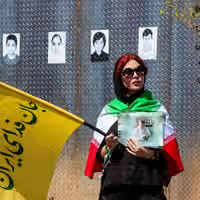
People in Isfahan and cities across Iran described staying awake through the night in the hope that the executions would be halted, mourning the two men after dawn and praising those who gathered despite a heavy security presence around the execution site.
Amirhossein Safari and Abolfazl Sepahi were among 12 young men sentenced to death in what became known as the Alikhani Square case, stemming from clashes during nationwide protests in Isfahan on January 8.
Iranian authorities accuse the defendants of killing four security personnel, as well as arson and vandalism. Rights groups and United Nations experts have questioned the fairness of the proceedings, citing allegations of coerced confessions, closed court hearings and the defendants' young ages.
Iran's judiciary news agency Mizan said Safari and Sepahi were executed early Tuesday, bringing the number of people put to death in the case to four after Golmohammad Mohammadi and Erfan Esfandiari were executed on July 19. Eight other defendants remain under sentence of death.
"They chased people through the alleyways of Isfahan last night," one witness said. "People were running through the streets, and the officers followed them. They did not even spare a thought for those mothers."
Witnesses said security forces maintained a heavy presence around Alikhani Square throughout Monday night after reports that an iron scaffold had been erected there. Social media accounts described confrontations between officers and people who had gathered in the hope of preventing the executions.
Iranians in London also gathered outside the Iranian embassy Monday night to protest the executions, extending demonstrations over the hangings beyond Iran's borders.
'We stayed awake until morning'
Many of the messages focused on the hours before dawn, describing a night spent waiting for news from Isfahan.
"We wished until sunrise that morning would never come to Isfahan," one person wrote.
Another summed up the night in historical terms: "Write in history that people in Iran fought with their bare hands until 5 a.m. to save two of their fellow citizens."
Messages from Bandar Abbas, Pardis, Khomein and other cities suggested many people viewed the gatherings in Isfahan as a sign that opposition to the executions had spread well beyond the city.
"The people of Isfahan showed that when the next call comes, millions across the country will return to the streets," one resident of Bandar Abbas said. "We fight for freedom even with empty hands."
Another resident of Bandar Abbas added: "Thank you to the people of Isfahan for gathering and showing that we are still standing together and still remember everyone who has been executed."
One student said news of the executions overshadowed an examination.
"I did not even know what I was writing during my exam," the student said. "All I could think about were the young men who were executed in Isfahan last night."
Grief turns to defiance
Many reactions expressed sympathy for the families of the two men while arguing the executions would intensify rather than suppress dissent.
"My heart breaks for the families of those two young men who watched them being executed," one message said.
Others said the executions had strengthened their determination.
"We are saddened by these executions, but we are not afraid," one resident of Pardis, near Tehran said. "We have become angrier. We will return to the streets soon."
Another reaction echoed that sentiment: "Did you think executing our brothers and sisters would make us retreat or become afraid? It has only made us more determined."
Several people criticized governments engaged in diplomacy with Tehran for failing to do more to stop the executions.
"Countries that have influence over the authorities, why do they do nothing to stop these executions?" one message asked.
Others addressed US President Donald Trump directly, questioning why preventing executions had not featured more prominently in negotiations with Iran.
International pressure
The public reaction followed an appeal by United Nations experts led by Special Rapporteur Mai Sato, who urged Iranian authorities on Monday to halt the executions of the remaining defendants.
"Sentencing 12 people to death in one hearing, in a closed courtroom and without clarity as to each defendant's individual responsibility violates established fair trial standards," the experts said.
The experts said the convictions relied heavily on confessions broadcast on state television, while Revolutionary Court hearings were held behind closed doors and the judgments were never made public.
They also said several defendants had reportedly been subjected to arbitrary detention, enforced disappearance and, in some cases, ill-treatment.