• العربية
  • فارسی
Brand
  • Iran Insight
  • Politics
  • Economy
  • Analysis
  • Special Report
  • Opinion
  • Podcast
  • Iran Insight
  • Politics
  • Economy
  • Analysis
  • Special Report
  • Opinion
  • Podcast
  • Theme
  • Language
    • العربية
    • فارسی
  • Iran Insight
  • Politics
  • Economy
  • Analysis
  • Special Report
  • Opinion
  • Podcast
All rights reserved for Volant Media UK Limited
volant media logo

Araghchi interview draws fire from Iran hardliners

Jul 21, 2026, 10:43 GMT+1

Criticism of Foreign Minister Abbas Araghchi's recent interview has spread across Iranian conservative media, with critics arguing he disclosed sensitive information about wartime security and internal decision-making following its publication this week.

The backlash followed Araghchi's appearance on the YouTube program Majaray-e Jang (Story of War), in which he discussed the wars with the United States and Israel, internal security planning, succession preparations and negotiations with Washington. He also said security gaps that enabled attacks on senior officials and leadership sites "probably still have not been fully resolved."

"If you wanted publicity or to repair your image, you made it worse," Mostafa Khoshcheshm, a political analyst appearing on Iranian state television, said in response to the interview.

Continue reading

Most Viewed

Rubio signals diplomacy as US-Iran war escalates
1

Rubio signals diplomacy as US-Iran war escalates

2
ANALYSIS

Beyond espionage: Araghchi says spies seek to shape Iran's decisions

3

Araghchi interview draws fire from Iran hardliners

4
INSIGHT

Qatar, Pakistan push Iran-US diplomacy as war escalates

5
EXCLUSIVE

Paris weighs reducing embassy staff in Tehran, source says

Banner
Banner
Banner

Spotlight

  • Why Iran’s Pickaxe Mountain has become Trump’s next target
    ANALYSIS

    Why Iran’s Pickaxe Mountain has become Trump’s next target

  • Araghchi interview draws fire from Iran hardliners

    Araghchi interview draws fire from Iran hardliners

  • Iran economists say war is turning malaise into crisis
    INSIGHT

    Iran economists say war is turning malaise into crisis

  • Beyond espionage: Araghchi says spies seek to shape Iran's decisions
    ANALYSIS

    Beyond espionage: Araghchi says spies seek to shape Iran's decisions

  • Qatar, Pakistan push Iran-US diplomacy as war escalates
    INSIGHT

    Qatar, Pakistan push Iran-US diplomacy as war escalates

  • Family of executed protester says he was tortured into false confession

    Family of executed protester says he was tortured into false confession

•
•
•

More Stories

Ben Gurion passengers told to prepare for flight disruptions - Kan News

Jul 21, 2026, 10:39 GMT+1

Allowing another refueling aircraft into Ben Gurion Airport could force the cancellation of commercial flights, Israel Airports Authority Director General Sharon Kedmi said on Tuesday, according to Kan News.

Kedmi said the authority was coordinating with the Israeli Air Force and doing everything possible to prevent cancellations.

He urged passengers to prepare for possible flight cancellations and delays.

Iran economists say war is turning malaise into crisis

Jul 21, 2026, 10:37 GMT+1
•
Behrouz Turani
100%
A man with a visible disability rests on a park bench in Isfahan during the summer heat, with crutches leaning against the bench, July 17, 2026

Iran's leading economists warned Monday that renewed conflict with the United States risks pushing the country's long-festering economic problems into a more dangerous phase, arguing that inflation is becoming increasingly difficult to contain.

The unusually candid warnings came at a two-day economic conference in Tehran that brought together senior economists, policymakers and business leaders after being postponed three times because of regional instability and wartime conditions.

Speakers said the latest escalation with Washington had transformed discussions from long-term reform into managing an economy under renewed military pressure.

Former presidential adviser Masoud Nili delivered one of the starkest assessments, warning that Iran's economy was moving from a chronic but manageable malaise into an active crisis.

Years of structural mismanagement, he said, were now visibly breaking open, while inflation had entered a "more slippery phase" in which subsidies and social safety nets were no longer sufficient to protect household welfare.

Media coverage reflected the divide between government officials seeking to reassure the public and independent economists warning that structural weaknesses were becoming harder to ignore.

Economic daily Donya-ye-Eghtesad listed chronic inflation, weak and unstable growth, persistent budget deficits, foreign-exchange volatility, dual exchange rates, pension-fund insolvency, foreign-policy pressures and rising geopolitical risks among the country's most urgent challenges.

Economist Mehrdad Sepahvand, one of the conference organizers, said the event had been delayed three times because of the regional crisis.

Investment gap

Former Central Bank Governor Hossein Abdoh Tabrizi argued that banking reform was essential, saying financial institutions must become "efficient allocators of capital rather than money-printing engines."

Although public confidence in the banking system had held up during recent regional conflict, he said, deeper reforms were needed to channel savings into productive investment.

Economist Mohammad-Mehdi Behkish said rebuilding damaged infrastructure, restoring economic growth and modernizing industry would require about $500 billion in investment.

Domestic resources alone were nowhere near sufficient, he argued, making greater foreign engagement and integration into the global economy indispensable.

Alireza Bakhtiari, director of the Donya-ye-Eghtesad Media Group, said policymakers remained trapped between what he described as a "survival paradigm" and a "growth paradigm," arguing that many of Iran's domestic economic constraints could not be resolved without major foreign-policy decisions.

Government response

Government-linked outlets focused instead on Central Bank Governor Abdolnaser Hemmati, who acknowledged the severity of the economic situation while urging against panic.

Hemmati cited Iranian and international data showing a 47 percent decline in real per-capita income, saying the purchasing power of the average Iranian had fallen to levels last seen in the late 1990s.

Calling for "realism without doom-mongering," he argued that neither denial nor exaggeration would improve the economy.

"Price stability alone doesn't create goods," he said. "Only investment and productivity can sustainably restore Iranians' purchasing power."

Inflation pressures

Independent economists painted an even darker picture.

Hossein Tavakolian warned that inflation was entering a more dangerous phase.

Monthly inflation, once around 3 percent and equivalent to roughly 40 percent annually, was now periodically reaching 10 percent, he said, with nearly every major consumer category entering what he described as "red zones."

Academic economist Teymour Rahmani argued that inflation in Iran was fundamentally a political and fiscal problem rather than simply a monetary one.

Although direct government borrowing from the central bank had been curtailed, he said, fiscal pressures had merely shifted onto commercial banks, postponing rather than solving the country's inflation problem.

Araghchi interview draws fire from Iran hardliners

Jul 21, 2026, 10:10 GMT+1
•
Hooman Abedi
100%
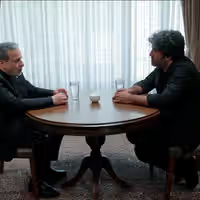
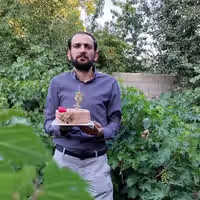
Iranian Foreign Minister Abbas Araghchi speaks during an interview for the YouTube program Majaray-e Jang (Story of War) in an image published on his Telegram channel.

Criticism of Foreign Minister Abbas Araghchi's recent interview has spread across Iranian conservative media, with critics arguing he disclosed sensitive information about wartime security and internal decision-making following its publication this week.

The backlash followed Araghchi's appearance on the YouTube program Majaray-e Jang (Story of War), in which he discussed the wars with the United States and Israel, internal security planning, succession preparations and negotiations with Washington. He also said security gaps that enabled attacks on senior officials and leadership sites "probably still have not been fully resolved."

"If you wanted publicity or to repair your image, you made it worse," Mostafa Khoshcheshm, a political analyst appearing on Iranian state television, said in response to the interview.

Araghchi's remarks, Khoshcheshm said, reflected what he described as "a lack of strategic thinking," adding: "I am genuinely concerned." He called the interview "a disaster in public relations, image-building and image repair."

Araghchi had said attacks on the former Supreme Leader Ali Khamenei's compound were carried out through "security gaps" that continued to affect decision-makers and the public atmosphere.

  • Beyond espionage: Araghchi says spies seek to shape Iran's decisions

    Beyond espionage: Araghchi says spies seek to shape Iran's decisions

He also described wartime contingency plans, including preparations for the possible killing of the country's leader and the government's response to attacks on senior officials.

Conservative newspapers criticize disclosures

Javan, a newspaper affiliated with the Revolutionary Guards, wrote on Tuesday that confirming details surrounding the attacks, discussing the day the former leader was killed or revealing that the foreign minister had no contact with new Supreme Leader Mojtaba Khamenei were not matters that should have been disclosed publicly.

"Please keep the locations of the remaining tunnels and military bases to yourself in future interviews, and exercise restraint when discussing important events," the newspaper wrote.

Safeguarding national security, protecting public trust and defending the country's interests should outweigh the appeal of widely viewed media interviews, Javan added.

Conservative outlet Tabnak also questioned Araghchi's decision to give the interview to documentary filmmaker and online host Javad Mogoei rather than an experienced journalist.

  • Beyond espionage: Araghchi says spies seek to shape Iran's decisions

    Beyond espionage: Araghchi says spies seek to shape Iran's decisions

The outlet wrote that some of the information discussed was likely to be of greater value to Israeli and US intelligence services than to viewers. It also argued that diplomacy and journalism are both specialized professions, asking whether senior officials should grant interviews to content creators without established experience covering political affairs.

The commentary compared Araghchi's media approach with that of former Foreign Minister Mohammad Javad Zarif, arguing that although Zarif also preferred interviews with individuals rather than media organizations, he chose interviewers who better understood political and security sensitivities.

Reaction from Raisi allies

Raja News, a media outlet close to supporters of former president Ebrahim Raisi, also criticized the interview, focusing on remarks by Mogoei identifying locations of underground tunnels and saying military commanders frequently used them.

Araghchi, the outlet said, should not have disclosed such information and argued that the program's producers should have removed those passages during editing. It also questioned why the host publicly identified locations associated with senior commanders, even if foreign intelligence agencies were already aware of them.

The wide-ranging interview touched on issues that Iranian officials have rarely discussed publicly, including internal security failures, wartime contingency plans and high-level decision-making during the conflict.

Bahrain intercepts several Iranian aerial attacks

Jul 21, 2026, 09:44 GMT+1

Bahrain’s air defenses intercepted and destroyed several Iranian aerial attacks on Tuesday, the Bahrain Defense Force said.

The military accused Iran of endangering civilians through attacks involving missiles and drones and urged the public not to approach debris or unidentified objects.

Iran MP says government considering petrol price rise despite war and inflation

Jul 21, 2026, 09:26 GMT+1

Iranian officials are discussing a possible increase in petrol prices, although no proposal has yet been formally presented to parliament, the spokesman for parliament’s Energy Committee said.

Reza Sepahvand told ILNA that discussions were taking place within the government and the Plan and Budget Organization, but said raising fuel prices while Iran faces war and severe inflation would be “in no way advisable.”

Sepahvand said the government has the legal authority to change energy prices and that officials from the Oil Ministry and the National Iranian Oil Products Distribution Company were expected to discuss the issue with lawmakers this week.

“No issue has yet been raised with parliament or the Energy Committee,” he said, adding that lawmakers would seek a clearer answer from ministry officials.

Continue reading