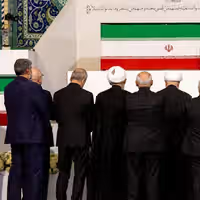
The unusually candid warnings came at a two-day economic conference in Tehran that brought together senior economists, policymakers and business leaders after being postponed three times because of regional instability and wartime conditions.
Speakers said the latest escalation with Washington had transformed discussions from long-term reform into managing an economy under renewed military pressure.
Former presidential adviser Masoud Nili delivered one of the starkest assessments, warning that Iran's economy was moving from a chronic but manageable malaise into an active crisis.
Years of structural mismanagement, he said, were now visibly breaking open, while inflation had entered a "more slippery phase" in which subsidies and social safety nets were no longer sufficient to protect household welfare.
Media coverage reflected the divide between government officials seeking to reassure the public and independent economists warning that structural weaknesses were becoming harder to ignore.
Economic daily Donya-ye-Eghtesad listed chronic inflation, weak and unstable growth, persistent budget deficits, foreign-exchange volatility, dual exchange rates, pension-fund insolvency, foreign-policy pressures and rising geopolitical risks among the country's most urgent challenges.
Economist Mehrdad Sepahvand, one of the conference organizers, said the event had been delayed three times because of the regional crisis.
Investment gap
Former Central Bank Governor Hossein Abdoh Tabrizi argued that banking reform was essential, saying financial institutions must become "efficient allocators of capital rather than money-printing engines."
Although public confidence in the banking system had held up during recent regional conflict, he said, deeper reforms were needed to channel savings into productive investment.
Economist Mohammad-Mehdi Behkish said rebuilding damaged infrastructure, restoring economic growth and modernizing industry would require about $500 billion in investment.
Domestic resources alone were nowhere near sufficient, he argued, making greater foreign engagement and integration into the global economy indispensable.
Alireza Bakhtiari, director of the Donya-ye-Eghtesad Media Group, said policymakers remained trapped between what he described as a "survival paradigm" and a "growth paradigm," arguing that many of Iran's domestic economic constraints could not be resolved without major foreign-policy decisions.
Government response
Government-linked outlets focused instead on Central Bank Governor Abdolnaser Hemmati, who acknowledged the severity of the economic situation while urging against panic.
Hemmati cited Iranian and international data showing a 47 percent decline in real per-capita income, saying the purchasing power of the average Iranian had fallen to levels last seen in the late 1990s.
Calling for "realism without doom-mongering," he argued that neither denial nor exaggeration would improve the economy.
"Price stability alone doesn't create goods," he said. "Only investment and productivity can sustainably restore Iranians' purchasing power."
Inflation pressures
Independent economists painted an even darker picture.
Hossein Tavakolian warned that inflation was entering a more dangerous phase.
Monthly inflation, once around 3 percent and equivalent to roughly 40 percent annually, was now periodically reaching 10 percent, he said, with nearly every major consumer category entering what he described as "red zones."
Academic economist Teymour Rahmani argued that inflation in Iran was fundamentally a political and fiscal problem rather than simply a monetary one.
Although direct government borrowing from the central bank had been curtailed, he said, fiscal pressures had merely shifted onto commercial banks, postponing rather than solving the country's inflation problem.