• العربية
  • فارسی
Brand
  • Iran Insight
  • Politics
  • Economy
  • Analysis
  • Special Report
  • Opinion
  • Podcast
  • Iran Insight
  • Politics
  • Economy
  • Analysis
  • Special Report
  • Opinion
  • Podcast
  • Theme
  • Language
    • العربية
    • فارسی
  • Iran Insight
  • Politics
  • Economy
  • Analysis
  • Special Report
  • Opinion
  • Podcast
All rights reserved for Volant Media UK Limited
volant media logo

Iran MP says government considering petrol price rise despite war and inflation

Jul 21, 2026, 09:26 GMT+1

Iranian officials are discussing a possible increase in petrol prices, although no proposal has yet been formally presented to parliament, the spokesman for parliament’s Energy Committee said.

Reza Sepahvand told ILNA that discussions were taking place within the government and the Plan and Budget Organization, but said raising fuel prices while Iran faces war and severe inflation would be “in no way advisable.”

Sepahvand said the government has the legal authority to change energy prices and that officials from the Oil Ministry and the National Iranian Oil Products Distribution Company were expected to discuss the issue with lawmakers this week.

“No issue has yet been raised with parliament or the Energy Committee,” he said, adding that lawmakers would seek a clearer answer from ministry officials.

Continue reading

Most Viewed

Beyond espionage: Araghchi says spies seek to shape Iran's decisions
1
ANALYSIS

Beyond espionage: Araghchi says spies seek to shape Iran's decisions

2

Araghchi interview draws fire from Iran hardliners

3
EXCLUSIVE

Paris weighs reducing embassy staff in Tehran, source says

4
INSIGHT

Qatar, Pakistan push Iran-US diplomacy as war escalates

5
INSIGHT

Iran economists say war is turning malaise into crisis

Banner
Banner

Spotlight

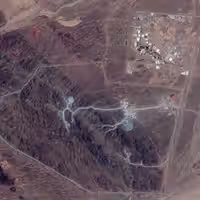
  • Why Iran’s Pickaxe Mountain has become Trump’s next target
    ANALYSIS

    Why Iran’s Pickaxe Mountain has become Trump’s next target

  • Araghchi interview draws fire from Iran hardliners

    Araghchi interview draws fire from Iran hardliners

  • Iran economists say war is turning malaise into crisis
    INSIGHT

    Iran economists say war is turning malaise into crisis

  • Beyond espionage: Araghchi says spies seek to shape Iran's decisions
    ANALYSIS

    Beyond espionage: Araghchi says spies seek to shape Iran's decisions

  • Qatar, Pakistan push Iran-US diplomacy as war escalates
    INSIGHT

    Qatar, Pakistan push Iran-US diplomacy as war escalates

  • Family of executed protester says he was tortured into false confession

    Family of executed protester says he was tortured into false confession

Banner
•
•
•

More Stories

Pakistan, Bangladesh pay years-high prices for LNG amid Iran war - Bloomberg

Jul 21, 2026, 09:23 GMT+1

Pakistan and Bangladesh bought some of their most expensive liquefied natural gas shipments in years as the Iran war disrupted supplies, Bloomberg reported on Tuesday.

State-owned Pakistan LNG bought a shipment for late July at about $21.88 per million British thermal units on Monday, its highest price since 2022, according to traders cited by Bloomberg.

Bangladesh’s state-run buyer purchased at least one shipment for August at an elevated price last week, the traders said.

The rising costs are straining government finances and prompting both countries to reconsider their reliance on LNG, according to the report.

Iran MP says government considering petrol price rise despite war and inflation

Jul 21, 2026, 09:09 GMT+1
100%

Iranian officials are discussing a possible increase in petrol prices, although no proposal has yet been formally presented to parliament, the spokesman for parliament’s Energy Committee said.

Reza Sepahvand told ILNA that discussions were taking place within the government and the Plan and Budget Organization, but said raising fuel prices while Iran faces war and severe inflation would be “in no way advisable.”

Sepahvand said the government has the legal authority to change energy prices and that officials from the Oil Ministry and the National Iranian Oil Products Distribution Company were expected to discuss the issue with lawmakers this week.

“No issue has yet been raised with parliament or the Energy Committee,” he said, adding that lawmakers would seek a clearer answer from ministry officials.

Iran currently sells the first 60 liters of monthly petrol allocated to private cars at 15,000 rials per liter, equivalent to about $0.008 at an open-market exchange rate of about 1.9 million rials to the dollar.

A further 100 liters are available at 30,000 rials per liter, or about $0.016, while additional petrol purchased using station fuel cards costs 50,000 rials per liter, about $0.026.

Sepahvand warned that even from this heavily subsidized base, an increase could push up transport costs and the prices of goods and services.

“Any increase in petrol prices could fuel a new wave of price rises and place additional pressure on people’s livelihoods,” he said.

He urged the government to avoid changing petrol prices while households are already dealing with the economic effects of war and what he described as runaway inflation.

Petrol pricing is one of the most politically dangerous economic issues for the Islamic Republic. Iranian officials have repeatedly approached even limited changes cautiously because higher fuel costs quickly feed into transport, food and other prices, while falling real wages leave households with little capacity to absorb another shock.

The caution is rooted in the nationwide unrest of November 2019. A sudden overnight increase raised the subsidized petrol price by 50% and tripled the price charged above the monthly quota, setting off demonstrations within hours in cities and towns across Iran. The protests quickly broadened from anger over fuel costs into demands directed against the political system.

Authorities responded by cutting Iran off from the global internet for nearly a week and using lethal force against protesters. Amnesty International has documented 321 men, women and children killed by security forces, while Reuters, citing Iranian Interior Ministry officials, reported that about 1,500 people died.

The memory of those protests continues to shape government calculations. A petrol price increase during war and severe inflation would risk being viewed not simply as a fuel-policy change but as another sudden transfer of the state’s economic burden onto households already facing collapsing purchasing power.

Iran calls for IAEA response to US attack on nuclear power plant site

Jul 21, 2026, 09:08 GMT+1

Iran’s nuclear chief urged the International Atomic Energy Agency to take action after a US missile attack on the site of the Karun nuclear plant in Darkhoveyn, Iran’s mission in Vienna said on Tuesday.

The mission said Mohammad Eslami sent a letter to IAEA Director General Rafael Grossi on Sunday, the day of the attack, calling for “effective and appropriate measures.”

It said the United States fired several missiles at the site early Sunday, describing the attack as the 18th wave targeting Iran’s safeguarded nuclear facilities since US-Israeli attacks began in June 2025.

The mission called on the UN Security Council and the IAEA to condemn attacks on peaceful nuclear facilities and take effective action against them.

US strikes disrupt communications with two Iranian islands, minister says

Jul 21, 2026, 08:16 GMT+1
100%

US attacks severed communications between mainland Iran and the islands of Khark and Qeshm several times, Communications Minister Sattar Hashemi said on Tuesday.

Hashemi said fiber-optic infrastructure was targeted in parts of southern Iran, prompting authorities to temporarily use radio and satellite links to maintain communications.

He said the damaged fiber-optic networks needed to be repaired, adding that authorities had worked to restore disrupted connections as quickly as possible.

Qatar condemns Houthi accusations against Saudi Arabia

Jul 21, 2026, 07:31 GMT+1

Qatar condemned on Tuesday remarks by the Houthi military spokesman accusing Saudi Arabia of blockading Yemen and restricting maritime navigation.

The Qatari foreign ministry called on the international community to enforce UN Security Council resolutions on Yemen and freedom of navigation in the Red Sea.

It said freedom of navigation in international waterways was a fundamental principle of international law and expressed Doha’s full support for measures taken by Saudi Arabia to protect its security and sovereignty.