Iran’s Foreign Ministry spokesperson on Monday condemned Saudi Arabia’s attack on Sana’a International Airport, describing it as “a clear violation of international law, the United Nations Charter and Yemen’s sovereignty” and saying it contravened the 2022 ceasefire agreement.
Videos posted on social media showed an Iranian Mahan Air passenger plane, en route from Tehran to Sana'a, landing at Al Hudaydah Airport in western Yemen after airstrikes hit the runway at Sana'a Airport, according to Iranian state-affiliated media and sources close to the Houthis.
Iran's former supreme leader Ali Khamenei (left) and then-president Mahmoud Ahmadinejad
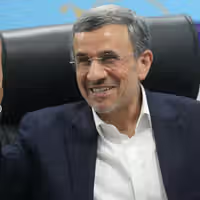
Israel’s Mossad recruited former Iranian President Mahmoud Ahmadinejad and chose him to lead Iran after a planned operation to overthrow the Islamic Republic, Haaretz reported Monday, citing more than 30 political, defense, diplomatic and foreign sources.
The relationship began taking shape in 2022 after the Mossad gathered intelligence indicating shifts in Ahmadinejad’s views, the report said.
Israel focused on his belief that Iran could not continue under sanctions and that its nuclear program had become a burden rather than an asset.
A team of Mossad agents continued a mission involving Ahmadinejad after landing abroad on October 7, 2023, and learning of the Hamas attack on Israel, according to the report.
Then-Mossad chief David Barnea personally oversaw the operation and at one point skipped a security consultation with Prime Minister Benjamin Netanyahu to focus on developments involving Ahmadinejad, the report said.
By early 2026, Ahmadinejad had become one of Israel’s most significant assets and was chosen to take power after “Operation Puss in Boots,” which was intended to overthrow Iran’s government, end its pursuit of nuclear weapons and install a new leadership.
According to the report, the wider plan included influence operations inside Iran, arming and training Kurdish forces in Iraq, mobilizing minorities, recruiting collaborators and creating a land corridor for militia movements. Israel also sought to draw Azerbaijan into the war.
The plan faced opposition from Military Intelligence chief Shlomi Binder, Research Division head Ofir Mizrahi Rosen and then-national security adviser Tzachi Hanegbi, the report said.
Three days before H-hour, the disagreements reached such a boiling point that IDF Chief of Staff Eyal Zamir ordered everything halted. Nevertheless, Prime Minister Benjamin Netanyahu decided to proceed.
The plan collapsed before Kurdish forces fired a single shot, the report said.
Ahmadinejad, a hardline conservative known for fiercely anti-Israel rhetoric, was Iran’s president from 2005 to 2013. During his two terms, he allegedly denied the Holocaust, advocated Israel’s destruction and suggested Tehran could develop nuclear weapons if it decided to do so.
After leaving office, he was repeatedly barred from standing in presidential elections. Over time, Ahmadinejad distanced himself from the political establishment and criticized the system under Ali Khamenei, accusing senior figures of corruption, mismanagement and failing the public.
He also adopted a softer public image, portraying himself as a defender of ordinary Iranians and their economic and social concerns.
Ahmadinejad’s current status is unclear. Last week, he attended a state-run funeral for slain Supreme Leader Ali Khamenei in Tehran, months after an alleged airstrike on his residence which, reportedly set him free from a house arrest.
Iran’s exiled prince Reza Pahlavi welcomed the UK government’s move to designate the IRGC under new state threats powers, describing it as an important step by Prime Minister Keir Starmer.
Pahlavi said on X that the move reflected “the growing threat from the regime in Iran to UK citizens and interests.”
“I hope the UK and other Western governments will go one step further and back the Iranian people’s fight for freedom. There can be no peace as long as this regime survives.”
Iranian President Masoud Pezeshkian told Russia’s energy minister that Tehran was ready to remove obstacles delaying joint projects with Moscow, calling for strategic agreements between the two countries to move rapidly from negotiations to implementation.
Speaking during a meeting with Sergei Tsivilev on Monday, Pezeshkian highlighted cooperation in energy, oil, gas, petrochemicals, industry, trade and transit corridors.
He said the political will expressed by senior officials, including Russian President Vladimir Putin, meant joint projects should not be allowed to proceed slowly.
Pezeshkian also pointed to opportunities for cooperation through BRICS, the Shanghai Cooperation Organization, the Eurasian Economic Union and frameworks involving Caspian Sea states.
The UN’s shipping agency said Monday it was seeking more details after US President Donald Trump announced that Washington would reinstate a naval blockade on Iran and charge the equivalent of 20% of cargo shipped through the Strait of Hormuz.
“We are aware of the post and awaiting more details,” a spokesperson for the International Maritime Organization said.
The IMO rejected the principle of charging vessels for passage through international straits.
“We have always been consistent on our stance on fees – IMO stands firmly against charging fees for passage through straits used for international navigation,” the spokesperson said.
“There is no legal basis through which to introduce mandatory tolls simply to transit through a strait.”
Britain said on Monday it would designate Iran's Islamic Revolutionary Guard Corps and two other groups under new state threats legislation, making it a criminal offense to support or assist them if the measure is approved by parliament later this week.
The IRGC, the Iran-linked Islamic Movement of Companions of the Right and Russia's GRU Volunteer Corps would become the first organizations designated under the National Security (State Threats) Act 2026, which received royal assent last week.
The British government said people who support or assist the groups after they are designated could face up to 14 years in prison, while those carrying out sabotage, including arson, on their behalf could receive life sentences.
The designation is separate from proscription under Britain's terrorism legislation and is aimed at foreign state-backed activity including espionage, interference, sabotage and physical attacks.
The new powers would also allow prosecutors in some cases to bring charges without having to prove a direct connection to a foreign state, making it easier to prosecute people acting for designated organizations, the government said in a statement.
Prime Minister Keir Starmer said on Monday his government “will never let Britain be a playground for states who want to spread fear, division and violence on our streets.”
“We have already taken tough action against the Iranian regime and those linked to it, and against Russian operatives and networks targeting our country,” he said. “These new powers will make it easier to prosecute and lock up anyone carrying out their dirty work here in Britain.”
The government said the Islamic Movement of Companions of the Right had publicly claimed responsibility for seven attacks this year on locations linked to Jewish and Israeli communities and Persian-language media in Britain.
The attacks included an antisemitic arson attack that damaged four Hatzola ambulances in Golders Green, north London, on March 23.
It said members of the IRGC's Quds Force were behind the organization and had “almost certainly” directed the group's attacks across Europe.
Britain's domestic intelligence agency, MI5, identified at least 20 potentially lethal Iranian-backed plots against people in the country over a one-year period, according to the government.
“Iran and Russia are using proxies and thugs to do their dirty work on our shores,” Home Secretary Shabana Mahmood said, adding that those working for the groups would be tracked down and imprisoned.
The government also plans to designate the GRU Volunteer Corps, which it described as a group controlled by Russia's military intelligence agency and used to recruit people online to carry out hostile acts including sabotage, arson and harassment.
Foreign Secretary Yvette Cooper called Iran and Russia’s use of proxy groups to conduct state-backed activity on British soil “reprehensible.”
“Their malign behaviour, and anyone who acts on their behalf, must be held to account,” she said. “We will take all measures necessary to protect the British people, at home and abroad.”