Massachusetts man convicted of illegally exporting electronics to Iran - AP

A Massachusetts man was found guilty of conspiring to unlawfully export electronic components to Iran in violation of US sanctions, the Associated Press reported.
“At its core, this case is straightforward. You cannot send goods, especially the goods at issue in this case, to Iran. Period. Full stop,” Assistant US Attorney Alathea Porter told jurors.
Mahdi Mohammad Sadeghi, a 43-year-old naturalized US citizen and former employee of global electronics company Analog Devices, was convicted on three of five charges.
Prosecutors accused Sadeghi of helping Iranian business associate Mohammad Abedininajafabadi evade US export controls through a front company in Switzerland.
They said Abedini’s Tehran-based company produces navigation systems for the military drone program of Iran’s Revolutionary Guard.





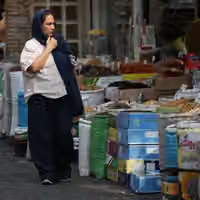





“The use of drugs among women has unfortunately increased over the past seven to 10 years, and this trend often begins with cigarette smoking,” Soleiman Abbasi, Director General of Treatment at Iran’s Drug Control Headquarters, told the ILNA news agency.
“Hashish and cannabis are the most common drugs used by women in society, and there is not a significant tendency among women to use other specific narcotic substances,” he added.
Women, Abbasi said, still account for far fewer drug users than men, although no precise official figures are available. Even so, he warned that addiction among women carries wider social consequences because of their central role in family life.
“When the mother of a family becomes addicted, the family structure quickly falls apart,” Abbasi said, adding that women who do not use drugs often play a key role in maintaining family cohesion.
Iran faces one of the world's most severe drug-use challenges because of its proximity to Afghanistan, historically the world's largest producer of opium, and the long-standing availability of opiates. Official and expert estimates suggest around 2.8 million Iranians are regular drug users, with broader estimates including occasional users exceeding four million.
Cannabis use gaining ground among younger women
Available research indicates cannabis use among Iranian women remains substantially lower than among men but has been rising, particularly among younger women and university students.
A 2021 systematic review covering 90 Iranian studies found that 0.2% of women in the general population reported cannabis use during the previous year, compared with 1.3% of men. However, researchers identified a statistically significant increase in cannabis use among female university students between 2000 and 2020, reflecting growing consumption among younger, urban women.
Researchers have linked the trend to urbanization, changing social attitudes, easier access through informal networks, and greater exposure to global youth culture through the internet, while cautioning that stigma and legal risks likely result in substantial underreporting.
Abbasi also warned about the dangers posed by increasingly contaminated drugs.
Laboratory testing has found many seized narcotics contain harmful chemical impurities, including lead, which can worsen users' health and may contribute to fatal poisonings beyond the effects of the drugs themselves, he said.
He also highlighted overdose as a growing concern.
A study using data from Iran's Forensic Medicine Organization by Britain's Lancaster University recorded 11,944 drug-related deaths between March 2022 and March 2024, with men accounting for the overwhelming majority of fatalities and the average age at death around 37. Earlier official figures put annual drug-related deaths at roughly 3,000, suggesting the toll has increased sharply in recent years.