President Donald Trump declared the ceasefire over after the Islamic Revolutionary Guard Corps fired on three merchant vessels, but said negotiations would continue because Iran “wants to make a deal so badly.”
The contradiction suggests the memorandum may be doing something narrower than ending the conflict. It has failed to prevent renewed violence, but may still provide a structure through which Washington and Tehran can contain escalation, preserve communication and negotiate between military exchanges.
The latest crisis has already damaged one of the memorandum’s main objectives: restoring safe commercial passage through the Strait of Hormuz while the two sides pursued a broader agreement over Iran’s nuclear program and other disputes.
The question is no longer simply whether the ceasefire survived. It is whether the memorandum was ever a peace agreement, or a system for managing an unfinished war.
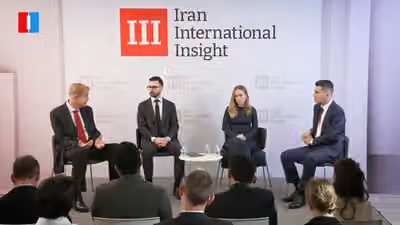
Experts who spoke to Iran International’s Eye for Iran podcast differed over whether the arrangement remains viable, but broadly agreed that both Washington and Tehran still have reasons to prevent the confrontation from returning to full-scale war.
Jonatan Sayeh, a research analyst at the Foundation for Defense of Democracies, said Tehran may have calculated that it could test US limits, absorb a contained response and retain many of the economic benefits it secured under the agreement.
“That to them was a gamble that was kind of worth it,” Sayeh said.
From the IRGC’s perspective, the outcome may still fall short of its worst-case scenario. Iran was struck, but the broader maritime blockade has not been fully restored, Tehran can continue selling oil to China, and the confrontation did not immediately return to all-out war.
Sayeh also questioned claims that Iran’s civilian government had simply lost control of the Guards.
Tehran may instead be using a new version of its longstanding “good cop, bad cop” strategy, he said, with civilian officials seeking concessions while presenting the IRGC as an independent force they cannot fully restrain.
Historian and Atlantic contributing writer Arash Azizi said the attacks had not necessarily destroyed the broader framework.
“I certainly don’t think it was doomed to fail,” Azizi said. “And I don’t, in fact, think it has failed actually yet.”
Neither Washington nor Tehran appears eager to resume full-scale war, he said. That shared interest could preserve negotiations even after the immediate ceasefire collapsed.
Azizi said hardline pressure on President Masoud Pezeshkian and Foreign Minister Abbas Araghchi may also help explain the attacks. Factions opposed to the agreement could fear that 60 days of normal traffic through Hormuz would make it harder for Iran to reassert control of the waterway as a source of leverage.
Fatima Al-Asrar, a senior policy analyst at Ideology Machine, argued that the memorandum’s ambiguity may have benefited the IRGC from the outset.
She called it a “memorandum of undoing,” saying it postponed or weakened earlier US demands concerning Iran’s nuclear program, armed allies and regional conduct.
“The MoU gives you this kind of maybe false sense of progress, and I think it’s performative mostly,” Al-Asrar said. “It’s a truce, and that’s great, but it’s driven by short-term political wins.”
Rather than removing Iran’s capacity to threaten shipping, she said, the arrangement may have allowed Tehran to retain what amounts to a geopolitical switch.
Iran can reduce tensions when it seeks sanctions relief, oil revenue or diplomatic concessions, then disrupt the strait again when it wants greater leverage.
The consequences extend far beyond Washington and Tehran. Disruption in Hormuz raises shipping and energy costs and can affect fertilizer supplies and food prices across Asia and other import-dependent regions.
Itai Reuveni, director of communications at NGO Monitor, described the memorandum as a deliberately flexible answer to the immediate needs of all sides.
Iran wanted to stop US and Israeli strikes before they threatened the survival of the Islamic Republic. Washington wanted to avoid another prolonged Middle Eastern war. Israel had demonstrated its ability to strike Iran but also faced the costs and risks of a sustained campaign.
The agreement reduced the intensity of the war without settling the disputes that caused it.
“It seems to me that the line is always being pushed,” Reuveni said.
The United States, Israel and Iran may now be entering a prolonged cycle in which each side tests how far it can go without triggering another major war.
That may explain why military action and diplomacy are continuing at the same time.
The memorandum did not create a conventional peace process in which violence stopped before negotiations began. It created a framework in which strikes, threats, retaliation and mediation could unfold alongside one another.
The attacks in Hormuz have damaged that framework and increased the danger of miscalculation. Another round of fighting could be broader and more destructive.
But whether the memorandum is dead depends on what it was expected to achieve.
The ceasefire may be over. The managed confrontation it created may only be beginning.
Episode 111 of Eye for Iran is available on YouTube and all major podcast platforms.