We watch as others decide whether there will be war or peace, confrontation or diplomacy, isolation or some grand bargain. We analyse statements, follow rumours and wait for signals from politicians and commanders.
But somewhere along the way, ordinary Iranians seem to have disappeared from the conversation.
Earlier this week, the familiar cycle began again: attacks near the Strait of Hormuz, US retaliation and then President Trump declaring that the agreement meant to end the crisis was dead. The same Iranian leaders he had called reasonable enough to negotiate with were suddenly “crazy” and “dishonourable.”
Watching from Tehran, it is difficult to know what we are supposed to make of it all. We can only wait to find out what happens next.
The city itself has returned to something resembling normal life. It is not the Tehran of the war, when streets emptied and every sound carried a threat. Cafes and restaurants are open again. People go to work, sit in traffic, pick up and put back fruit they can no longer afford—and, of course, curse those they blame for making life so miserable.
But beneath that return of noise is a strange numbness.
Before the war, some politicians at least spoke about listening to society. Few people believed them, but the language existed: reconciliation, reform, understanding people’s anger. Now even the performance has disappeared.
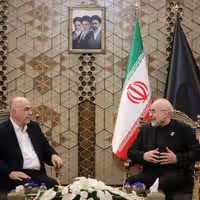
The same state that can negotiate with those it describes as enemies seems unable or unwilling to begin any meaningful conversation with its own society.
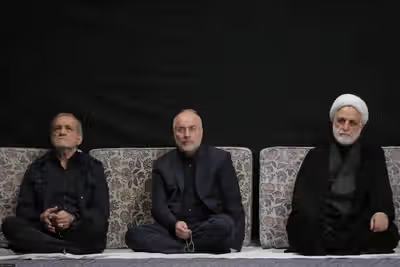
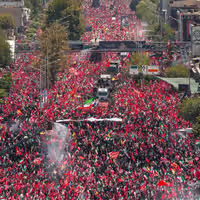
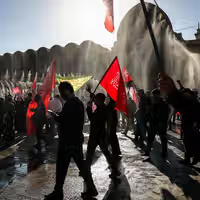
The contrast was visible after Khamenei’s death. The state showed how quickly and effectively it could mobilise when it wanted to: streets filled, ceremonies organised, a national moment of mourning created.
But many families whose children were killed during the January protests were denied something far simpler: the ability to grieve freely, to hold funerals without pressure, to mourn without fear.
It all might have been easier if the outside world offered a different answer. But it rarely does.
President Trump says his goal is denuclearisation. That’s it. Governments obviously pursue interests, not justice. But for those of us living with the consequences, it is another reminder that Iran is often discussed as a problem to solve rather than a society of millions trying to breathe.
So it can feel as if there is no one to trust and no one truly listening. The collective anger has turned into something closer to disbelief and despair. Maybe that is why Tehran looks the way it does now. Not defeated, not dead, not even quiet. Just tired.
People continue because they have no choice. They already protested in 2022. They protested again in January. They risked prison, bullets and death. There is no obvious next step that has not already been tried.
So life goes on, but with very few plans. Nobody knows what tomorrow looks like.
We have not given up on our country. We’re just coping with the realisation that everyone else seems to have a say in its future before we do.