• العربية
  • فارسی
Brand
  • Iran Insight
  • Politics
  • Economy
  • Analysis
  • Special Report
  • Opinion
  • Podcast
  • Iran Insight
  • Politics
  • Economy
  • Analysis
  • Special Report
  • Opinion
  • Podcast
  • Theme
  • Language
    • العربية
    • فارسی
  • Iran Insight
  • Politics
  • Economy
  • Analysis
  • Special Report
  • Opinion
  • Podcast
All rights reserved for Volant Media UK Limited
volant media logo

Tehran airspace shut Monday as Khamenei funeral continues

Jul 5, 2026, 22:02 GMT+1

Iran will fully close Tehran’s airspace on Monday as funeral ceremonies for former Supreme Leader Ali Khamenei continue, the Iranian Students’ News Agency (ISNA) reports.

The Civil Aviation Organization said regular flights at Mehrabad International Airport and Imam Khomeini International Airport will be suspended during public ceremonies in the capital.

Mehrabad airport is expected to resume normal operations on Tuesday, while Imam Khomeini airport will remain closed.

Authorities said airspace over the northeastern city of Mashhad, where the final burial ceremony will take place, will also be shut on July 9, with flights at Shahid Hasheminejad International Airport suspended.

Flights elsewhere in Iran are expected to continue without restrictions on July 7–8.
Most Viewed

Tailored Quran verses at Khamenei funeral spark diplomatic debate
1

Tailored Quran verses at Khamenei funeral spark diplomatic debate

2
PODCAST

After the war, Iran’s rulers face their biggest question

3

Iran's new IRGC Navy chief emerges without formal decree: who is Ali Azmaei?

4
ANALYSIS

Iran buries Khamenei as fight over his power continues

5

Cattle feeding on hospital waste expose risks at Iran landfill

Banner
Banner
Banner

Spotlight

  • Iran’s energy growth slows to a crawl as demand races ahead
    INSIGHT

    Iran’s energy growth slows to a crawl as demand races ahead

  • Iran buries Khamenei as fight over his power continues
    ANALYSIS

    Iran buries Khamenei as fight over his power continues

  • After the war, Iran’s rulers face their biggest question
    PODCAST

    After the war, Iran’s rulers face their biggest question

  • Behind the funeral: Khamenei’s coffin becomes stage for Iran’s wounded power
    ANALYSIS

    Behind the funeral: Khamenei’s coffin becomes stage for Iran’s wounded power

  • Iran hardliners warn Hormuz authority slipping to US-backed Omani route
    INSIGHT

    Iran hardliners warn Hormuz authority slipping to US-backed Omani route

  • Funeral expenses deepen anger over Ali Khamenei's week-long burial
    VOICES FROM IRAN

    Funeral expenses deepen anger over Ali Khamenei's week-long burial

•
•
•

More Stories

Iran buries Khamenei as fight over his power continues

Jul 5, 2026, 21:55 GMT+1
•
Behrouz Turani
Iran buries Khamenei as fight over his power continues
100%
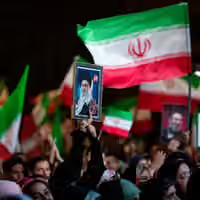
Mourners gather at a state funeral ceremony for slain Supreme Leader Ali Khamenei in Tehran, with large portraits of him displayed across the building facade, July 5, 2026

As Iran holds week-long funeral ceremonies for Ali Khamenei, the political dynamics unfolding behind the scenes point to a striking reality: the succession question that dominated elite politics for more than a decade did not end with his death.

The rapid elevation of his son Mojtaba within ten days was intended to close that chapter. Instead, with the new Supreme Leader still absent from public view, it appears to have opened a new one.

Roughly twenty messages attributed to Mojtaba Khamenei since his succession have failed to convince many Iranians that he is truly exercising power.

Efforts by officials and supporters to prove his presence have often been contradictory, deepening rather than resolving the uncertainty.

A growing number of Iran analysts argue that, regardless of Mojtaba’s invisibility, Ali Khamenei has effectively been replaced by a constellation of elite networks built around family ties, wartime relationships dating back to the Iran–Iraq War, and geographic power bases in provinces such as Tehran, Isfahan, Khuzestan and Khorasan.

These networks, spanning civilian officials, senior IRGC commanders, clerics and younger ideological politicians, existed for decades but were ultimately contained by Ali Khamenei’s authority.

One example was the IRGC high command, which repeatedly shifted between officers from Khuzestan and Isfahan during Khamenei’s 38 years in power, before he appointed Hossein Salami from the Golpayegan region in April 2019 in what many saw as an attempt to contain an increasingly damaging rivalry.

The old reformist–conservative divide has largely faded. Following former President Ebrahim Raisi’s “purification” project, Iran’s political landscape is increasingly shaped by competition between what parliament speaker Mohammad Bagher Ghalibaf has described as “revolutionaries” and “super-revolutionaries.”

The shift has been so dramatic that even Hossein Shariatmadari, the outspoken editor of the hardline daily Kayhan and long seen as a symbol of uncompromising conservatism, is now warning against threats to national cohesion and criticizing hardliners opposing the agreement with the United States.

The struggle in Tehran is no longer over whether engagement with Washington is acceptable. Instead, competing factions are trying to claim ownership of the decision to negotiate.

Even some hardliners who until late June accused pragmatists such as Ghalibaf and Foreign Minister Abbas Araghchi of seeking talks with “the killer of Khamenei” now argue that Iran must secure its financial interests through an understanding with Washington, even if that requires delaying decisions on parts of its nuclear program.

The most uncompromising factions inside and around the IRGC have argued that Iran’s priority should now be preserving its missile program as its remaining strategic asset.

Yet figures including MP Esmail Kowsary and Supreme National Security Council secretary Mohammad Bagher Zolghadr continue to insist Iran must also seek revenge for Khamenei’s killing.

In Mojtaba Khamenei’s continued absence, networks that once operated beneath Ali Khamenei’s centralized and uncompromising decision-making appear to be competing to define the future direction of the Islamic Republic — and to claim ownership of the very diplomatic opening many of them opposed only days earlier.

Iran judiciary chief suggests death penalty for those responsible for Khamenei killing

Jul 5, 2026, 20:44 GMT+1

Iran’s judiciary chief said the Islamic Republic would hold the United States and those responsible for the killing of former Supreme Leader Ali Khamenei to account, invoking charges under Iran’s legal system that can carry the death penalty.

“The ruling on corruption on earth, waging war against God, war criminals, and those who illegally start a war is clear,” Gholamhossein Mohseni Ejei said.

“We will try you according to human and divine standards and international law. A criminal must be tried and punished, and must pay the price for their crimes,” he added.

Ghalibaf tells senior Hezbollah official he is ‘a fighter’ before diplomat

Jul 5, 2026, 19:03 GMT+1
Ghalibaf tells senior Hezbollah official he is ‘a fighter’ before diplomat
100%

Iranian Parliament Speaker Mohammad Bagher Ghalibaf said he was a fighter before being a diplomat and that Tehran must negotiate while maintaining its “combat readiness,” in a meeting with Mohammad Fneish, a senior Hezbollah official and former Lebanese minister.

“Before I am a diplomat, I am a fighter. In the Islamic Republic, alongside diplomacy, we also have our power and combat readiness,” Ghalibaf said. “We must negotiate while preserving the spirit of fighting and readiness for struggle and martyrdom.”

Ghalibaf said there were “clear and principled lines” in the memorandum of understanding between Tehran and Washington, including support for the Islamic Republic’s allies in the “resistance front” and Lebanon.

He said Tehran had insisted before the memorandum was signed that ending the war against its allies in the “resistance front” be included in the text, adding that the Islamic Republic had never abandoned that principle.

“The enemy has realized that establishing peace in the region, Lebanon and the Middle East is not possible except through the Islamic Republic,” Ghalibaf said.

NATO leaders expected to discuss Hormuz security - CNN

Jul 5, 2026, 18:42 GMT+1

Security in the Strait of Hormuz is expected to be among the topics discussed by NATO leaders at a summit in Ankara this week, CNN reported, citing a senior US official.

“I certainly believe that the Strait of Hormuz and the protection of the maritime traffic going through there is going to be a subject that comes up,” the unnamed US official said.

The official said several NATO allies had expressed willingness to contribute to maritime security efforts, but many lacked the ships or assets needed for a meaningful maritime mission.

President Donald Trump is expected to depart Monday night for the summit.

Iran navy chief warns Tehran's adversaries of revenge by ‘Muslim fighters’

Jul 5, 2026, 18:30 GMT+1

The commander of Iran’s navy said the enemy must prepare to confront “Muslim fighters” seeking justice for the blood of their dead, in remarks about the funeral of slain former Supreme Leader Ali Khamenei.

Rear Admiral Shahram Irani told Yemen’s Houthi-run Al-Masirah network that the “children” of Iran’s “great leader and martyred imam” had gathered to renew the pact of brotherhood they learned from him.

Irani said “resistance is no longer limited to a specific geography” and that the enemy was now facing “greater Islam and Islamic resistance.”

“The enemies today must know that they will receive a crushing blow and a firm claw that will smash their faces,” Irani said.