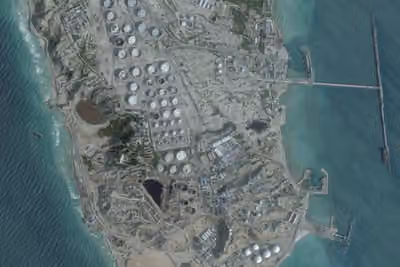
According to the International Energy Agency (IEA), the massive supply shock triggered by disruptions in the Persian Gulf has been partially offset by excess oil production accumulated last year and in early 2026, emergency stock releases by industrialized countries, Saudi Arabia's and the UAE's use of export routes bypassing the Strait of Hormuz, and a sharp decline in global oil demand led by China.
The scale of the disruption remains enormous. Oil production across the Persian Gulf has fallen by more than 10 million barrels per day over recent months, resulting in a cumulative production loss of roughly 1.3 billion barrels.
At the same time, global oil demand contracted by about 5.5 million barrels per day in the second quarter of 2026 as economic activity slowed.
China, the world's largest crude importer, has reduced its oil imports by roughly 40 percent—or about 4.6 million barrels per day—over recent months, making weaker demand one of the biggest reasons prices have retreated.
Even so, the region's oil exports remain about 25 percent below their February levels, and restoring pre-war export capacity is likely to take many months. In some cases—particularly Qatar's damaged liquefied natural gas (LNG) facilities—a full recovery could take years.
Another temporary buffer has come from floating storage. Iran alone holds around 150 million barrels of crude at sea, while Washington's two-month waiver allowing Iranian oil exports has also helped ease market tensions.
Those inventories are helping cushion the supply shock, but they cannot replace the region's lost production capacity.
Meanwhile, production of crude oil and other petroleum liquids across the Persian Gulf region remains roughly 45 percent below February levels. Even Saudi Arabia—which can bypass the Strait of Hormuz through its East-West pipeline to the Red Sea—is producing well below pre-war levels, underscoring the scale of the disruption.
In total, the loss of roughly 1.3 billion barrels of production has only been partially offset by the release of more than 300 million barrels from the strategic reserves of industrialized countries.
Even under the most optimistic scenario, repairing the damage inflicted on global oil markets by the Strait of Hormuz crisis is unlikely before the middle of next year.
Geopolitical risks also remain elevated. Thursday's attack on a commercial vessel near Oman underscored how fragile maritime security remains despite the ceasefire. Shipping costs in waters south of Iran have risen to roughly 5.5 times their pre-war levels, while tanker charter rates have surged to nearly nine times their pre-war levels.
The disruption extends well beyond crude oil. Exports of petrochemicals, metals, fertilizers, helium and other raw materials from the Arab Gulf continue to face severe constraints, with implications for global industry, agriculture, supply chains and international trade.
Oil prices returning to the $72–74 range should therefore not be interpreted as evidence that the crisis has passed. They instead reflect a market being sustained by emergency inventories and demand destruction rather than recovering supply.
Until shipping through the Strait of Hormuz returns to normal and Persian Gulf production fully recovers, the global economy will remain vulnerable to renewed energy shocks and heightened market volatility.