The exchange has exposed signs of growing infighting at the highest levels of the Islamic Republic.
The normally quiet body, responsible for appointing and theoretically overseeing the supreme leader, has become the latest arena for disagreement over negotiations with Washington, the reopening of the Strait of Hormuz and the limits of compromise with the United States.
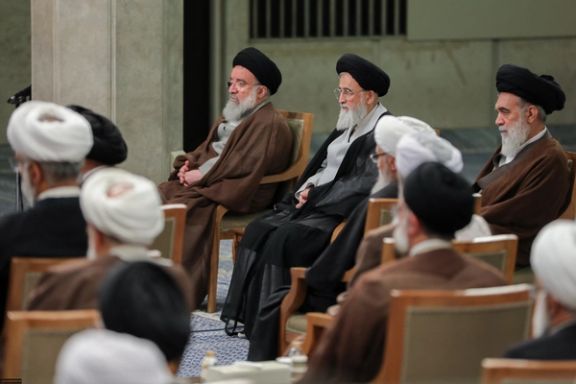
The controversy began after more than 60 of the Assembly's 84 members published a statement on Saturday that ventured far beyond the body's customary role, laying out detailed positions on the memorandum, the Strait of Hormuz, Lebanon, nuclear negotiations and retaliation against the United States and Israel.
The signatories thanked Iranian negotiators but warned them to learn from what they called the failures of previous talks, adding that observing Supreme Leader Mojtaba Khamenei's red lines was a religious obligation and that violating them was "not permissible under any circumstances."
In one of its most inflammatory passages, the statement called for those responsible for Ali Khamenei's killing, including the US president and Israeli prime minister, to be punished, saying anyone with access to them had a religious duty to kill them.
The statement also described reopening the Strait of Hormuz while Israeli operations continued in Lebanon as a "strategic error" and insisted Iran's nuclear rights should be excluded from negotiations.
The intervention was extraordinary because the Assembly almost never comments on day-to-day policy. Better known for infrequent formal sessions and ritual expressions of support for the leadership, it has also come under increased scrutiny following the opaque process that elevated Mojtaba Khamenei after his father's death during the war.
Within hours, however, the Assembly's presidium and secretariat issued a rare public clarification that appeared to rebuke the manner in which the statement had been released.
While reaffirming support for Mojtaba Khamenei and insisting officials must follow his guidance on the memorandum and negotiations, the secretariat said it was unprecedented for a group of members to issue a statement under the Assembly's name outside its established procedures.
It said official positions should be issued through the full Assembly, its chairman, the presidium or the secretariat, and argued that the signatories should have sought broader discussion to preserve the body's unity.
The response immediately drew fire from Raja News, an outlet aligned with ultrahardline factions that oppose negotiations with Washington and are often critical of Parliament Speaker Mohammad Bagher Ghalibaf, who has led the talks.
In an editorial, Raja News argued it was the secretariat—not the signatories—that had undermined the Assembly's unity. It noted that the secretariat itself acknowledged that non-signatories did not necessarily disagree with the statement's substance.
The outlet mocked the suggestion that senior clerics should have sought permission before explaining the supreme leader's red lines to the public and asked why such an overwhelming majority had felt compelled to bypass the body's leadership in the first place.
Rather than criticizing the signatories, Raja News argued, the Assembly's leadership should explain why confidence in its handling of sensitive issues had deteriorated to that point.
In its sharpest criticism, the outlet suggested similar questions had surrounded the Assembly leadership's handling of the selection of Iran's third supreme leader following Ali Khamenei's death—an unusually direct challenge to one of the Islamic Republic's most closely guarded episodes.
President Masoud Pezeshkian, meanwhile, was reported to have traveled to Qom, Iran's center of religious authority, where senior officials often seek the backing of influential clerics during periods of political tension.
The visit suggests the government is also seeking to shore up clerical support as it navigates the increasingly contentious politics surrounding the post-war settlement.
The competing statements—and the storm they triggered within the hardline camp—suggest that arguments over the memorandum with Washington, and over who has the authority to define and defend Mojtaba Khamenei's red lines, have reached institutions that traditionally operate behind closed doors.
For a body long associated with silence and unanimity, the public split offers a rare glimpse into the political strains emerging inside the Islamic Republic's highest clerical establishment.