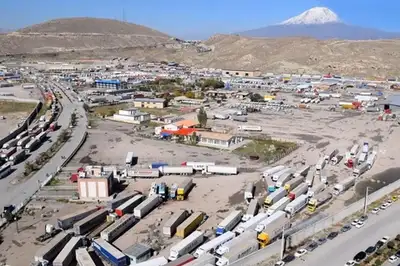
Hardline daily editor says Trump must be handed to Iran for trial


Hossein Shariatmadari, Iranian Supreme Leader’s representative at the Kayhan newspaper, wrote on Sunday that Iran’s first demand in negotiations should be the handover of US President Donald Trump for trial in Iranian courts.
“The first step in fulfilling the Leader’s demands in the negotiations is to insist on handing Trump over to the Islamic Republic for trial in Iran’s judicial authorities,” he wrote.
He also wrote that Iran’s negotiating team should refuse to accept Trump or his representatives in future talks and instead propose a delegation made up of members of the US Congress.
“The effort to avenge Supreme Leader must take place on American soil itself,” he added.



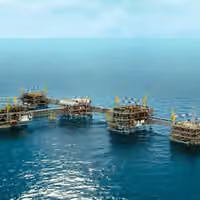
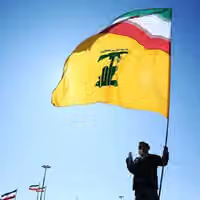
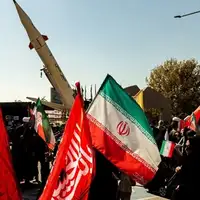
An Iranian lawmaker said on Sunday that concerns over the continued closure of parliament are valid, but the issue should not be handled in a way that creates division or room for abuse.
Parliament budget committee member Mohsen Zangeneh said lawmakers should move forward in a way that avoids division, adding that for various reasons it had been decided to reopen the chamber after the funeral of Iran’s slain Supreme Leader Ali Khamenei.
More than 60 Iranian lawmakers canceled a planned protest outside parliament on Sunday after the parliament's presiding board promised to resume open sessions following funeral ceremonies for senior officials killed in the recent conflict, hardline influencer Davood Modaresian said on Saturday, adding that the lawmakers were wrong to call off the demonstration.
Global oil prices have fallen back to around where they stood before the Iran war. But the decline reflects not a recovery in supply but a combination of emergency measures including strategic reserve releases, alternative export routes and, above all, weakening global demand.
According to the International Energy Agency (IEA), the massive supply shock triggered by disruptions in the Persian Gulf has been partially offset by excess oil production accumulated last year and in early 2026, emergency stock releases by industrialized countries, Saudi Arabia's and the UAE's use of export routes bypassing the Strait of Hormuz, and a sharp decline in global oil demand led by China.
The scale of the disruption remains enormous. Oil production across the Persian Gulf has fallen by more than 10 million barrels per day over recent months, resulting in a cumulative production loss of roughly 1.3 billion barrels.
At the same time, global oil demand contracted by about 5.5 million barrels per day in the second quarter of 2026 as economic activity slowed.
China, the world's largest crude importer, has reduced its oil imports by roughly 40 percent—or about 4.6 million barrels per day—over recent months, making weaker demand one of the biggest reasons prices have retreated.
Even so, the region's oil exports remain about 25 percent below their February levels, and restoring pre-war export capacity is likely to take many months. In some cases—particularly Qatar's damaged liquefied natural gas (LNG) facilities—a full recovery could take years.
Another temporary buffer has come from floating storage. Iran alone holds around 150 million barrels of crude at sea, while Washington's two-month waiver allowing Iranian oil exports has also helped ease market tensions.
Those inventories are helping cushion the supply shock, but they cannot replace the region's lost production capacity.
Meanwhile, production of crude oil and other petroleum liquids across the Persian Gulf region remains roughly 45 percent below February levels. Even Saudi Arabia—which can bypass the Strait of Hormuz through its East-West pipeline to the Red Sea—is producing well below pre-war levels, underscoring the scale of the disruption.
In total, the loss of roughly 1.3 billion barrels of production has only been partially offset by the release of more than 300 million barrels from the strategic reserves of industrialized countries.
Even under the most optimistic scenario, repairing the damage inflicted on global oil markets by the Strait of Hormuz crisis is unlikely before the middle of next year.
Geopolitical risks also remain elevated. Thursday's attack on a commercial vessel near Oman underscored how fragile maritime security remains despite the ceasefire. Shipping costs in waters south of Iran have risen to roughly 5.5 times their pre-war levels, while tanker charter rates have surged to nearly nine times their pre-war levels.
The disruption extends well beyond crude oil. Exports of petrochemicals, metals, fertilizers, helium and other raw materials from the Arab Gulf continue to face severe constraints, with implications for global industry, agriculture, supply chains and international trade.
Oil prices returning to the $72–74 range should therefore not be interpreted as evidence that the crisis has passed. They instead reflect a market being sustained by emergency inventories and demand destruction rather than recovering supply.
Until shipping through the Strait of Hormuz returns to normal and Persian Gulf production fully recovers, the global economy will remain vulnerable to renewed energy shocks and heightened market volatility.
Rare public dispute has erupted inside Iran's Assembly of Experts after a majority of its members issued a statement on the US-Iran memorandum of understanding, prompting an extraordinary public rebuke from the body's own leadership within hours.
The exchange has exposed signs of growing infighting at the highest levels of the Islamic Republic.
The normally quiet body, responsible for appointing and theoretically overseeing the supreme leader, has become the latest arena for disagreement over negotiations with Washington, the reopening of the Strait of Hormuz and the limits of compromise with the United States.
The controversy began after more than 60 of the Assembly's 84 members published a statement on Saturday that ventured far beyond the body's customary role, laying out detailed positions on the memorandum, the Strait of Hormuz, Lebanon, nuclear negotiations and retaliation against the United States and Israel.
Read the full article here.
Traffic through the Strait of Hormuz dropped after the latest escalation between the United States and Iran, according to Al Jazeera’s Open Source Unit.
The unit said it tracked 48 vessels transiting the strait from Friday, June 26, to Sunday, June 28, during two separate timeframes.
Those included 23 oil and gas tankers, seven bulk carriers carrying commodities such as iron, coal, grain, fertilizer and cement, and 19 cargo or container ships.
The figure marked a decline from the 70 transits recorded by Marine Traffic on Wednesday and 54 on Thursday, before the latest exchange of strikes between Washington and Tehran.
Asian stocks wobbled Monday as Iran and the United States agreed to halt recent hostilities that had cast a shadow over their interim peace deal, while oil prices remained supported by uncertainty and the dollar held near a one-year high.
The return to diplomacy follows several days of tit-for-tat strikes after an Iranian projectile hit a cargo vessel in the Strait of Hormuz last week, with both sides accusing the other of violating the interim ceasefire.
S&P 500 and Nasdaq futures gained 0.4% in early trading. South Korea's KOSPI fell nearly 2%, while Japan's Nikkei slipped 1%, leaving MSCI's broadest index of Asia-Pacific shares down 0.4%.